Monday, June 24, 2024

What A Drag It Is Growing Old - Personal Reflections on Ways to Cope with Changing Physical Capabilities as We Age - Juniper Publishers

 Complementary Medicine & Alternative Healthcare - Juniper Publishers


Abstract

In this brief article we discuss successful and authentic aging, emphasizing that rather than seeing aging as a drag we should embrace it. Through anecdotes that embed ideas, the authors present ways that we each are coming to terms with our own constantly changing physical appearance and capabilities and discuss some of the ways that each of has coped with these as we continue to age.

Keywords:Health Maintenance; Successful Aging; Authentic Aging; Happiness; Taoism; Tai Chi; Yoga; Qigong; Age-Appropriate Exercise; Diet; Positive Psychology

What a drag it is getting old [1]

The (Wo)Man in The Mirror

We know from fairy tales that mirrors can be important elements in the past, present and future of the characters who gaze into them. But everywhere I go, whenever I look in a mirror, I am shocked to see an old fat person looking back at me. Who is this strange person invading my mirror and why are they following me?

Is there anything I can do about this intrusion on my self-image? How may I reframe my perceptions to make that image more welcoming? How can I become more content with who I am right now.

In this article, through anecdotes that embed ideas, the authors seek to present the ways that we each are coming to terms with our own constantly changing physical appearance and capabilities and discuss some of the ways that each of has coped with these as we continue to age.

The Changing Nature of Time [2]

“Sometimes you will never know the value of a moment until it becomes a memory.”

Dr Seuss No matter how much the anti-aging industry may try to persuade us differently, ultimately, we cannot outrun aging or death. For unlike Sisyphus, who did so twice [3], we are unlikely to cheat death. And although we mortals may escape pushing boulders up hills for eternity, nevertheless, as Franklin once quipped, nothing is certain except death and taxes. When we are working, we are kept busy dealing with day-to-day necessities. But as we age, especially if we are lucky enough to retire, time is a contradiction. For while each day is a gift, full of opportunities, there is often next to nothing on a retiree’s calendar, and the number of days left in life is diminishing. This, coupled with dealing with the unexpected deaths of old friends, may sometimes sadden and remind us of our own mortality. So, as we age how do we avoid the Marcel Proust trap: constantly seeking solace and meaning in our life by reflecting on experiences and memories from our past ‘glory days’ to avoid our world ending, “not with a bang but with a whimper” [4]. How do we keep each day interesting for ourselves?

Authentic Aging - Being Content with Your Life as It Is.

Authentic Aging [5] reframes ideas about Successful Aging [6] which suggests as we age we aim for optimal physical and cognitive health with an absence of disease/disability and full engagement with social life. These ideas have permeated societal thought about aging and created an atmosphere that puts the onus on all of us as individuals to take care of our own health and treat it as a choice [7]. Authentic aging suggests that everyone has value simply in being, as we are, no matter what our life choices, or even an inability to choose.

This links to Taoist philosophy which sees life as a river that continually flows forward [8]. From a Taoist perspective it is not that we should forget the lessons of the past, nor abdicate planning for the future but ultimately, we must live in this moment and experience it fully. For it is the only moment we can be sure about.
• In accepting this each of us must:
• Acknowledge our journey and its successes and failures; moments of happiness and grief; and even those moments of boredom or depression.
• Accept who we are now - that we are the sum of all the moments that went before and led to THIS moment.
• Live fully in this moment
• As we age, even when living fully in each moment, there are times you may feel a need to look forward, to and plan for:
• Seeing children / grandchildren
• Trips to places or friends
• Weekly events e.g., bingo
• Weddings / reunions

Trying To Stay Healthy - Coping with Changing Circumstances

A friend recently quipped, “I’m supposed to have bad hearing, bad vision, and nothing to say. So, from now on, I’m practicing selective hearing, not paying attention and no filters on talking!”

After giving me a couple of simple exercises for a sore shoulder, the physiotherapist saw I could painfully reach to the level of my head. He said, “You have functional movement. What more do you want?” Instead of warnings to ‘stay vigilant’, these biases can catapult us into decline.

Our mindset, our self-talk, our attitude is often our greatest obstacle to enjoying life to its fullest. There are simple, easy ways to improve our lives despite all variables. How we think about ourselves, or a situation affects everything. When I (GMF) first met my trainer [9] and commented that “at my age, I wanted to avoid ‘overworking”, she agreed, but reminded me that: “your muscles don’t know what age they are! They want to be worked.” This is pivotal information!

I’ve (GMF) found that when angst, panic, dread, worry begin to creep up, one of Bernie’s trademark pieces of advice: just “breath and smile” - becomes the best ‘medicine’. It provides me with momentary relief and starts to become a way of improving the quality of the moment and the day.

Improving Quality of Life

• If you are happy as you are now.
• Accept this and stick to the path you are on.
• IF you feel a need to make changes to your lifestyle to achieve specific goals
• Make an age appropriate and realistic plan.
• Start on that path until you feel the desire to change it.

If you decide you want to make changes here are some suggestions.

Diet/Cooking – Some Notes

To Reduce Ill Health from dietary sources • Identifying your food triggers/cravings e.g.:
• Do you have specific stressors?
• Do you crave sugary or salty foods?
• Do you over fill your plate?
• Do you always go back for second or third helpings?

If you prepare your own meals:
• Plan colourful & balanced meals / weekly menus!
• Even if you’re not vegetarian, add lots of different coloured vegetables/fruits to your meals.
• Rotate starches / proteins.
• Choose healthy snacks.
• Add teas (especially oolong or green) to your diet.
• Drink lots of water
• Reduce alcohol and sodas to a minimum.

Exercise - Some Notes

Setting Realistic and Age-Appropriate Goals
• WHY? Am I doing this e.g., stay healthy / going to a wedding etc.
• Make whatever you choose to do enjoyable.
• ENJOYMENT  Motivation - THE key to sustainable goals

Bert Amies always used to say that motivation is the key to success [10] - however, enjoyment is a key to staying motivated and achieving sustainable goals.

Choose age and ability appropriate enjoyable routines and activities, you can accomplish.
• There are many great exercises and ideas on Instagram/ Internet, however, be aware that:
• Most videos are NOT targeting older adults or addressing specific physical restrictions.
• The number of repetitions / speeds NOT doable for most people and more importantly
• Start at your own pace and only do what you can do.
• IF you wish slowly build up the number of repetitions and speed

Pay attention to any diminished physical capability. If it is due to injury or illness or a particular action… is there something you might do to avoid or reverse the situation? If there isn’t then work within your capabilities, with the one caveat - do not use your restrictions not to try.

A friend in her 90’s complained that she and her retirement home friends were falling. They collectively wondered ‘why we lose our legs first?’ A recent study [11] showed that legs can be strengthened with simple exercises done at home. Likewise, before turning to ‘waddling’, limping, canes, or walkers too soon, realize that aches, pains, niggles can often disappear with a little attention and targeted work.

Coping with Changing Circumstances – Some Suggestions

In a recent article [12], I (BW) documented my struggles with the changes to my health upon my retirement. I also identified that I stubbornly wish to continue to take ownership of my own health and not abdicate this responsibility solely to physicians and big Pharma.

In the seven years since leaving work this struggle has continued but remained manageable. However, our middle daughter’s destination wedding in October 2022, created a tsunami of problems for me precipitating a major health crisis.

The wedding created financial hardship and emotional stress. Like many others during the pandemic lockdown, I had been cooking and eating a lot, and my weight had been slowly creeping up. However, the wedding preparations precipitated stress eating, and the week itself presented excesses of food and drink.

Upon return I attended a regular doctor’s appointment. I discovered that my weight had skyrocketed 20+lbs (10Kilos), I had elevated blood pressure and unhealthy cholesterol numbers. After a good deal of discussion, my physician agreed to let me design a Self-Directed Program to control my BP and Cholesterol and so avoid use of medications. And that we would revisit the numbers in a few months.

My plan was simple but not easy. Identify dietary factors that were affecting my health and change my diet accordingly. To this end I:
• Continued my healthy menu planning and healthy eating [13], but
• Cut out ALL added salt![14]
• Cut out butter!
• Reduced my alcohol consumption by 60% (0-3 standard drinks a day).
• Increased my consumption of milk oolong tea, and water.
• Researched dietary supplements to help reduce my BP/ Cholesterol/Triglyceride levels. To this end I started taking Red Rice Yeast [15]; Organic Beetroot Capsules [16]; and increased my Omega 3 intake [17].
• In addition,
• I worked to reduce my stress by focussing on the positive and on reducing negative thoughts and actions.
• I increased my physical activity.
• Added isometric hand grip training [18]
• Added swimming laps to my routine (10-20 mins at least 4 times a week)
• Continued with:
• My daily martial arts practice (30-45 mins per day) [19].
• Regular floor-based yoga (3-4 times a week) [19].
• Walking for groceries to stores (7-10 miles a week).
• Walking up and down 6 flights of stairs daily.

I am happy to report that over 4 months I lost 22lbs and 2.5 inches from my waist. Most importantly my BP and cholesterol came down within normal parameters for my age. [20] and I am continuing with this program in consultation with my physician, and continue to closely watch my BP, Cholesterol and Triglyceride numbers.

Maintaining / Building Circles of Friends

Sometimes, in an effort to stay on top of health, our medical appointments can become our social lives. But it’s interactions with friends that can have a most profound impact on our health and outlook. What researchers of aging and gerontology have found is that most people are resilient. They find ways to create connections with others, which helps them cope in changing life situations such as: finding that one can rely on same age friends after loss [21]; finding new relationships with others after institutionalization [22]; and seeking new companionship through online dating [23,24].

A few other thoughts on finding useful health information:
• Don’t be afraid to talk to a friendly pharmacist: they are often spot on and have some excellent advice.
• Talk to friends about their experiences.
• If you don’t have a computer, good watch or even iPad, talk to friends who do or go to a library as they usually have computers available.

Looking Forwards – Embracing Aging

While researching for my PhD I (CH) was struck by how many writers have discussed viewing photos of themselves, in their young lives and being taken aback by those images and their lack of wrinkles. A common refrain was, “This is me. But it is not me.” I am still the person in that image but have evolved into being a different person at the same time.

It seems that the struggle is finding balance and congruence between temporal states in our lives, as having a past (but not living exclusively in nostalgia), having a present (an appreciation of each breath without remaining static), and a future with possibilities and growth (without putting off living until tomorrow).

But how do we do this? How do we fight against urges to withdraw, outrun age by staying perpetually busy, or conceal it through altering ourselves to meet unrealistic ideals?

The key may be to get over these impulses and realize that we are doing the best with what we have and overcome our own ego to embrace this time in our lives. Relish the opportunity to fully experience it. We can go beyond social and self-acceptance in aging and move to a place where we embrace this time in life as aspirational.

The secret seems to be in always having something to look forward to. Be it a small thing such as lunch or a television program or going to a weekly social event like attending bingo on a Monday, to larger things like celebrations. Even an afterlife can be part of this future orientation.

We can overcome our own ego and take the photo, eat the cake, recognize change and do it anyway. Be visible and show up for our lives by planning for one small achievable step. Don’t be afraid to be visible and take up the space you need to make connections, be it talking with a cashier at a drugstore, or making a phone call to someone you haven’t spoken to in a while. Realize that moving to self-acceptance and expression in aging is a process of these small steps, not a single result.

To Know more about Journal of Complementary Medicine & Alternative Healthcare

To Know more about our Juniper Publishers

Friday, June 21, 2024

The Clemmensen Reduction - Juniper Publishers

 Organic & Medicinal Chemistry - Juniper Publishers

Abstract

The several uses of zinc amalgam and conc. hydrochloric acid for the reduction of ketone and aldehyde (known as Clemmensen reduction) are described here. The reductions of 1,3-diketones, 1,4-diketones,

α,β-unsaturated ketones etc. afford many unexpected products.

Keywords:Clemmensen Reduction; Zinc Amalgam; Hydrochloric Acid; 1,3-Diketone

*Corresponding author: Ajoy K. Banerjee, Centro de Quimica, IVIC, Venezuela

1. Abstract

Introduction

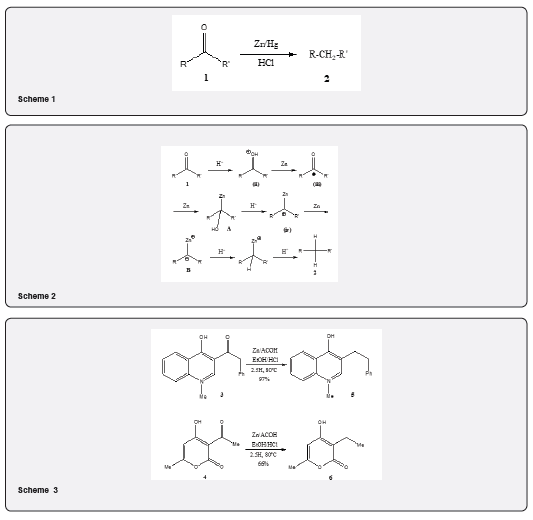
The reduction of aldehyde or ketone 1 to the corresponding methylene compound 2 (Scheme 1) using zinc amalgam and concentrated hydrochloric acid (or gaseous hydrogen chloride) is known as Clemmensen reduction [1,2]. Generally, zinc amalgam and highly concentrated hydrochloric acid under reflux are employed to suppress the formation of by-products such as alcohols, dimerization products including pinacols and related compounds. Alcohol is not considered to be the intermediate since these intermediates are not reduced under Clemmensen reduction [3]. The original procedure is rather harsh and therefore the Clemmensen reduction of the acid-sensitive substrate and polyfunctional ketone seldom affords the desired product. Several modifications have been developed to improve the synthetic utility of the Clemmensen reduction. Generally, zinc amalgam and highly concentrated hydrochloric acid are employed to suppress the formation of by-products such as alcohols , dimerization products including pinacols and related compounds. However, among several modifications of this synthetic procedure, the method using zinc powder in acetic anhydride or ether saturated with hydrogen chloride is recommended [4-6] for its mild condition (0oC) and is valuable for reduction of aldehydes and ketones in molecules carrying such functional groups such as cyano, acetoxy, phenol ether and alkoxy carbonyl groups.

Mechanism

The reaction mechanism of Clemmensen reduction has not been clarified but it is well known that alcohol is not intermediate. As summarized, [1,6] in Scheme 2 the reaction is thought to occur on the zinc metal surface and involves protonation of the carbonyl function and a concomitant electron transfer process to give an organozinc intermediate (A). Furthermore, protonation of (A) followed by the abstraction of water and stepwise electron transfer yield a carbanion (B), which traps a proton and in the final stage the corresponding methylene group is formed by the exchange of zinc with another proton. A radical anion mechanism has been proposed for the Clemmensen reduction although the mechanism suggested in Scheme 2 is mostly accepted. It is recommended to go through the articles [7,8] to obtain more information’s on the mechanism of the Clemmensen reduction. The Clemmensen reduction may be promoted by ultrasound [9,10]. This would appear to be a good method to initiate heterogeneous Clemmensen reduction that takes place on the surface of the zinc metal. In one study the use of nonactivated zinc dust in acetic acid at room temperature with ultrasonic irradiation allowed the reduction of a less hindered ketone from a diketone substrate in good yield.

Applications

Several applications of Clemmensen reduction have been observed during the synthesis of organic compounds and natural products. The principal use of the Clemmensen reduction consists in the reduction of aldehydes and ketones to methylene compounds. The importance of the Clemmensen reduction in organic synthesis can be appreciated from the following examples.

a) Synthesis of Quinolines and Pyran-2-ones: The Clemmensen reduction [11] has been utilized for the preparation of quinolines and pyran-2-ones. Thus 3-acyl-4-hydroxy-2(1H)-quinoline 3 and and 3-acyl-4-hydroxy-6-methylpyran-2-ones 4 have been reduced in good yield to obtain 3-alkyl-4-hydroxy-2(1H)-quinolines 5 and 3-alkyl-4-hydroxy-6-methylpyan-2-ones 6 respectively using zinc powder in acetic acid and hydrochloric acid (Scheme 3).

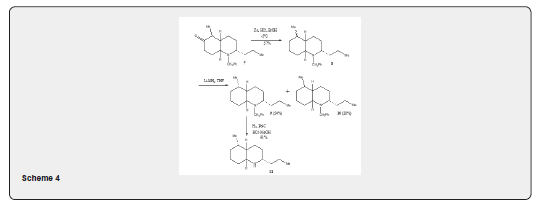
b) Synthesis of (-) of pumiliotoxin C: The clemmensen reduction has been utilized for the synthesis [12] of pumiliotoxin C 11 as depicted in Scheme 4. The cis-fused decahydro- quinoline 7 on being subjected to Clemmensen reduction with zinc, hydrochloric acid, ether at -5oC yields 2:1 epimeric mixture of the compound 8 which on reduction with lithium aluminium hydride followed by chromatographic purification yields 9 (54%) and 10 (28%). The compound 9 undergoes hydrogenolysis over Pd-C in methanolic hydrochloric acid leading hydrochloride salt of 5-epi-pumiliotoxin C 11. Many examples can be cited [13-15] to show that the importance of the Clemmensen reduction for the synthesis of terpenoid and steroidal compounds and also γ-lactones [16] which are important synthetic intermediates found in several natural products methods.

c) Some Newer Aspects of Clemmensen Reduction: It is necessary to mention that the Clemmensen reduction does not always provide the expected product. Some 1,3-diketones do not provide the expected product. In the case of derivatives carrying two carbonyl function stereochemically close to each other, Clemmensen reduction affords an interesting product distribution passing through characteristic intermediates [17].

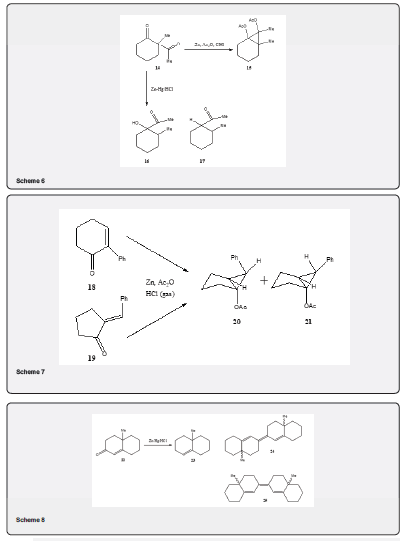
i. The diketone 12 gives 13 as major product under normal Clemmensen reduction condition [18]. The transformation passess through the intermediates 12i and 12ii (Scheme 5).

ii. It has been observed that the diketone 14 on treatment with zinc dust in acetic anhydride and hydrogen chloride yields the cyclopropane diacetate 15 In high yield. Similar result has been observed by repeating the experiment by electrolysis [19] (Scheme 6). The diketone 14 gives a mixture of rearranged products 16 and 17 under normal Clemmensen reduction using hydrochloric acid [20].

iii. With 1,4-diketones the distribution of the reduction products is dependent on the stereochemical situation of the carbonyl group [17]. In conjugated carbonyl system, the usual Clemmensen conditions may give rise to reduction and isomerization of double bond and dimerization. The reaction may include a cyclopropanol intermediate. The ketone 18 and the ketone 19 on treatment with zinc powder in acetic anhydride saturated with hydrogen chloride affords cyclopropanol acetates 20 and 21 in different ratio (Scheme 7) [21].

iv. The deoxygenation of the α,β-unsaturated ketone 22 under the Clemmensen condition leads to the formation of the olefin 23 (60%) along with the formations of the dimers 24 and 25 (30-40%) (Scheme 8) [22]. This paper describes the formations of dimers during the reduction of other unsaturated ketones.

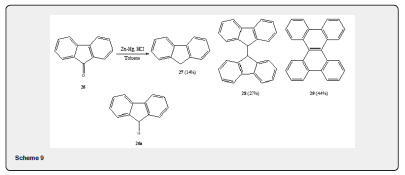
v. Talapatra and co-workers have observed [23] the formations of unexpected products during the deoxygenation of aromatic ketones by Clemmensen procedure. The reduction of 9H-fluoren-9-one 26 by the procedure of Clemmensen affords fluoriene 27 (14%), 9,9’-bifluorenyl 28 (27%) and dibenzo (g, p) chrysene 29 (44%). (Scheme 9). The reaction is probably proceeds via 26a. Similarly, the Clemmensen reduction of benzophenone and 9,10-anthraquinone yields dimerization products.

Conclusion and Comments

The above-mentioned discussion shows the importance of the Clemmensen reduction in the deoxygenation of carbonyl compounds. It is necessary to mention that the Clemmensen reduction does not always afford the expected product. Thus, the deoxygenation of cyclohexenone and cyclopenenone under the Clemmensen reduction with zinc, acetic anhydride in HCl (gas) leads the formation of dieastereomeric cyclopropanol acetates. A typical dimerization reaction in a conjugated system has been observed during the reduction of the octalone with zinc amalgam in concentrated hydrochloric acid under reflux. The reduction of aromatic ketones has produced bifluorenyl, tetraphenylethane and bianthrone [23]. The reduction of 4,4-diphenylcyclohex-2.en-1-one with zinc dust in hydrogen chloride in aprotic solvents affords different reduction products depending on the acid concentration [2]. The Clemmensen reduction has also been achieved by ultrasound [24].

To Know more about Organic & Medicinal Chemistry International Journal
Click here: https://juniperpublishers.com/omcij/index.php

To Know more about our Juniper Publishers
Click here: https://juniperpublishers.com/index.php


Thursday, June 20, 2024

Does the Use of Auto-Transfusion Tourniquet (A-TT) during CPR Drill Influence its Quality Parameters? - Juniper Publishers

 Anesthesia & Intensive Care Medicine - Juniper Publishers


Abstract

Introduction: The Auto-Transfusion Tourniquet (A-TT®) shifts the blood from the legs to the central circulation and blocks its return to the legs. The use of the A-TT has previously been shown to be effective during CPR and was shown in a pig study [1] to increase systolic and diastolic blood pressures, coronary perfusion pressure, cerebral perfusion and end-tidal PCO2. The present study was done to assess if using the A-TT as part of CPR protocol in pre-hospital cardiac arrest patients treated by a team of 4 caregivers interferes with the quality parameters of the CPR.

Methods: Twenty-six cardiac arrest scenarios were performed by teams of 4 paramedics-in-training where half [13] were done in the standard way and in 13 A-TT devices were applied on both legs of the training mannequin. CPR continuity, time to onset of CPR, time to first defibrillation, time to first dose of adrenaline, time to first and subsequent changes of massagers and A-TT application timing and duration were measured.

Results: in all scenarios randomized to A-TT use, it was applied correctly by one person with no difficulty. There were no statistically significant differences between the measured quality parameters of the A-TT vs. No-A-TT scenarios.

Conclusion: Placing A-TT on the legs during cardiac arrest managed by a team of 4 caregivers does not interfere with the quality of the delivered CPR.

Keywords:Cardiac Arrest; Paramedic Training; Cardiopulmonary Resuscitation; CPR Quality

Introduction

The outcome of CPR performed in order to treat patients in out-of-hospital cardiac arrest (CA) continues to be low when the AHA protocol is used (2; 3). While Return of Spontaneous Circulation (ROSC) upon hospital arrival is achievable in over 1/3rd of witnessed CA patients undergoing by-stander CPR and administration of adrenaline by paramedics, the ultimate outcome of hospital discharge in acceptable neurological functionality is very poor (~2%). The neurological outcome when adrenaline is not used is not different (~2%), despite a 70% lesser rate of ROSC upon ED arrival. It is suspected that adrenaline administration during CPR contributes to the poor neurological outcome due to constriction of the cerebral circulation leading to further diminished O2 supply to the brain [3].

In recent studies a novel exsanguination tourniquet device (Auto-Transfusion Tourniquet (A-TT®), “Hema Shock”, Oneg Ha Karmel Ltd. Tirat Carmel, Israel) has been shown to displace over 1000 cc of blood from the legs to the central circulation while blocking the re-entry of the blood into the legs [4]. The A-TT consists of two elastic rings, each wrapped by an elastic sleeve and pull-straps with handles (Figure 1a-b). The A-TT is vacuum-packed in a durable pouch. To apply, the patient’s shoes are removed, but not the pants. The A-TT is then placed on the toes and the ring is rolled up over the foot, the heel and up the leg all the way to the groin area by pulling the handles and straps along the axis of the limb. The A-TT is first placed on one leg and then, in cardiac arrest, immediately on the other. Upon achieving steady ROSC, the A-TT is removed by manually rolling it down the leg in short steps of 20-25 cm at a time. Vital signs should be monitored in each step.

Applying the A-TT caused increase in systolic and diastolic blood pressures in normal volunteers [4], increase in coronary perfusion pressure (CPP), cerebral blood flow (CBF), and end-tidal CO2 (ETCO2) in cardiac arrest pigs undergoing CPR with A-TT on all 4 legs [1]. There were no negative effects on gas exchange or on biochemical markers. In another study in volunteers, it was found that in addition to increased blood pressures, there was also higher cardiac output and stroke volume when A-TT was placed on both legs [5]. In another series [6] A-TT induced ROSC in 7 of 10 terminal cardiac arrest cases arrived at the emergency department after prolonged out-of-hospital CPR by paramedics. 5 of them survived ICU care and one was discharged with fully preserved mental/cognitive functions.

The study reported here was performed in anticipation of a wider clinical use of A-TT as part of CPR protocol by paramedics in pre-hospital cardiac arrest. We tested if field application of A-TT by a team of 4 paramedics-in-training performing CPR has any negative effect on the standard parameters of CPR quality [7]. We tested if A-TT application causes delays in onset of CPR chest compressions, onset of defibrillations in scenarios where the rhythm was shockable, onset of Epi administration or increased number of >10 sec pauses of chest compressions. We also measured the time it took to apply A-TT on both legs. The quality parameters values were compared to the no-A-TT scenarios and to accepted standards of care [8].

Methods

The study was approved by MDA's research committee. Paramedics-in-training who participated in the study first received a lecture on the physiology and clinical use of the A-TT in cardiac arrest and severe shock, signed a participation consent form and practiced applying the A-TT on a mannequin leg under supervision. The participants were then divided into teams of 4 paramedics-in-training of mixed gender. Every team performed 4 CPR scenarios lasting 10 minutes each. Each scenario started with a brief description of the patient’s whereabout and status, a quick evaluation of vital signs followed by immediate initiation of manual chest compressions of the training mannequin paced by a metronome. In each scenario one of the team members acted as a team leader, another one was assigned to apply the A-TT and the other two alternated giving CPR, starting IV and preparing and administering medications.

A-TT was applied in two of the four scenarios performed by each team, selected by the moderator in a random order. (Figure 2a) shows the application of an A-TT on a limb and (Figure 2b) shows a photograph of the A-TT when up on both legs.

During each scenario we monitored and documented the standard parameters of CPR quality [7,8]:

1. Time to onset of CPR chest compressions

2. Time to first and subsequent defibrillations

3. Time to first and subsequent doses of adrenaline

4. Time to onset of A-TT placement (in scenarios where A-TT was indicated)

5. Duration of A-TT placement (from onset of placement on first leg to completion of second leg)

6. Number and duration of chest-compressions interruptions for more than 10 sec. for any reason.

The data were tabulated in excel which was used for descriptive statistics (mean +/- SD). Comparison between yes-A-TT and no-A-TT scenarios was done using Student’s t-test with two tails assumption. P < 0.05 was considered statistically significant.

Results

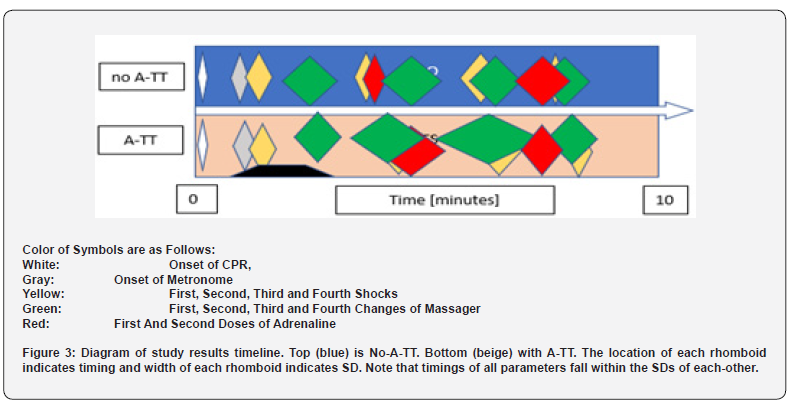
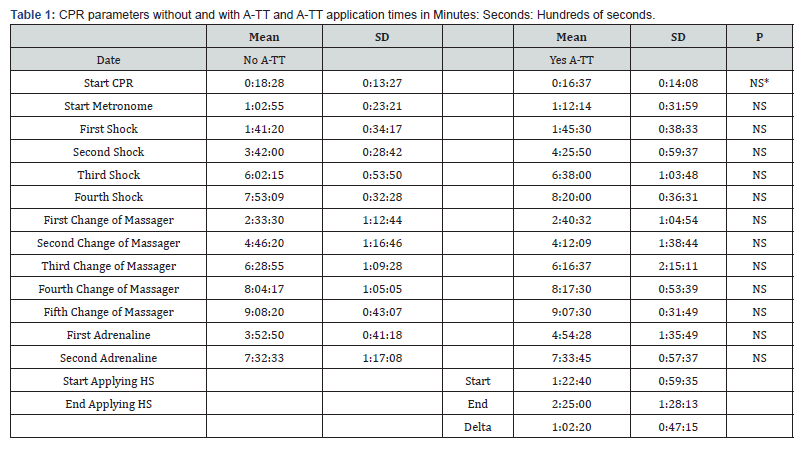
Twenty-six scenarios were performed by the teams, where 13 scenarios were done with A-TT and 13 without. CPR was started within 18.3 +/- 13.3 sec (mean +/- SD) from the onset sign in the no-A-TT scenarios and within 16.4 +/- 14.1 sec in the yes-A-TT scenarios (NS – not a statistically significant difference). (Table 1). In two cases more than 60 sec elapsed from the beginning of the scenario until chest compressions were started: one case with NO-A-TT and one case with A-TT. Time to first cardioversion was 101.2 +/- 34.2 sec in the NO-A-TT scenarios and 105.3 +/- 38.3 sec in the A-TT scenarios (NS). Time interval to first change of massagers was 2:33 +/- 1:12 min in the NO-A-TT scenarios and 2:44 +/- 1:06 min in the A-TT scenarios (NS). Time interval to first IV Epi injection was 3:52 +/- 0:41 min in the NO-A-TT scenarios and 4:44 +/- 1:33 min in the A-TT scenarios (NS). See (Table 1) and (Figure 3) for details.

CPR Quality

There was a total of 6 interruptions of CPR chest compressions that lasted more than 10 sec in 5 of the No-A-TT scenarios (in one scenario there were two interruptions) and 2 CPR interruptions for >10 sec in the A-TT scenarios, both occurring in a single scenario (NS).

A-TT Placement

A-TT was successfully placed by a single paramedic-in-training in all the scenarios that were randomized to A-TT placement. The A-TT placement started 82.4 +/- 59.4 sec after the onset of the scenario and application to both legs was completed 145.0 +/- 68.1 sec after scene arrival. The mean placement duration was 62.2 +/- 47.2 sec (range 30-180 sec) with all but two placements taking less than 60 sec. A-TT placement occurred before first massager replacement in 9 scenarios, before the second replacement in 3 scenarios and before third massager replacement in 1 scenario. All the participants rated the A-TT placement as “Easy”.

Discussion

The purpose of this study is to address a concern that the use of the Auto-Transfusion Tourniquet (A-TT) during performance of CPR in out-of-hospital cardiac arrest may interfere with the quality of CPR. The current AHA directive for high quality CPR requires early onset of uninterrupted and effective chest compressions, early defibrillation if rhythm is shockable, repeated in intervals if ROSC was not achieved, and quick administration of epinephrine with repeated doses in intervals [7,8]. It is now standard to monitor administration of CPR during training and in practice to assess the quality of the care and correct it when needed. As such, this study addresses the question: Does the use of A-TT during CPR interfere with its quality? To do so, we conducted CPR drills with and without application of the A-TT, while measuring the quality parameters. This prospective, non-blind controlled study was performed by trainees in MDA’s paramedics course and their trainers during Q1 2023. The paramedics-in-training were half-way of their course and have all performed CPR drills beforehand.

The physiological rationale for using A-TT during CPR consists of the following factors:

1. Rolling the A-TT on each leg pushes >500 cc of the patient’s own fresh blood to the core and >1000 cc from both legs [4]. In fact, it is postulated that during cardiac arrest the blood volume in the legs vessels is even higher due to the paralysis of the sympathetic nervous system during cardiac arrest, thereby significantly increasing the squeezable blood quantity relative the amount in normal adults. This shift of blood to the central circulation increases the end-diastolic volume of the heart chambers thereby amplifying the effectiveness of chest-compressions and the resulting stroke-volume [5].

2. The positioning of the A-TT ring in the upper thigh blocks the flow of blood into the legs. [The legs blood supply in a normal adult is approximately 24% of the total cardiac output [9]. As a result, the entire CPR-induced cardiac output is distributed to the essential organs (brain, heart, liver, gut, and kidneys) and is not “wasted” to perfuse the legs which can withstand 2 hours of ischemia with no risk of damage [10-12]. If simple arithmetic is used, this increases the share of the CPR cardiac output to the core from 75% to 100% or by approximately 25/75=0.33.

3. The blocking of blood-flow into the legs substantially increases the total vascular peripheral resistance. Therefore, the blood pressure during diastole, which is very low during CPR, increases substantially causing a major rise in coronary perfusion pressure (CPP). It was shown in a porcine study [1] that CPP nearly doubled when A-TTs were applied to the 4 legs of the experimental animals during induced cardiac arrest. Given the fact that most coronary perfusions are diastolic, having a sufficient level of CPP is critical for cardiac O2 supply and the likelihood of successful cardioversion.

4. The application of A-TT is quick, can be done by a single person with minimal training and does not interfere with other treatments given to the patient around his/her upper body (e.g. CPR, insertion of lines, intubation etc.). When ECMO is used as part of CPR [13], A-TT may facilitate cannula placement by increasing large vessels volume and diameter and increase the ECMO rate of suctioning the blood into the oxygenator for the same reason and by prevention of blood vessels flutter. Care must be taken to leave enough space for the sterile insertion of the cannulas.

5. The A-TT completely constricts the blood vessels of the legs. As such, it is an ultimate mechanical vasoconstrictor matching or surpassing the effect of adrenaline on the periphery without any detrimental effect on brain blood supply [14]. It is hypothesized that the use of A-TT in CPR may be able to eliminate the need for adrenaline with similar outcome on ROSC and better cognitive outcome when it is used instead of adrenaline. This hypothesis needs to be tested in prospective clinical studies.

Discussion of the Results of this Study

In all the categories of the CPR quality parameters, no statistically significant differences were observed when A-TT was used compared to when A-TT was not used. Onset of CPR, timing of massager replacement, time of first and subsequent shocks, first and subsequent Epi and the number of CPR interruptions were not statistically different between the scenarios with and without applying A-TT. In the A-TT scenarios the rings were applied approximately 82 seconds after arrival and the application took 62 sec, where all but two applications took less than 60 sec with the shortest application done in 30 seconds and the longest 3 min (Table 1). There were no difficulties in applying the A-TT in any of the scenarios and the paramedics-in-training did so without a problem after a brief practical training on a mannequin leg. The paramedics-in-training consisted of both males and females in equal numbers and there was no advantage to physical strength or body mass in achieving successful applications.

Study limitations

This study was done in teams of 4 paramedics-in-training and its results are only applicable to the situations where 4 or more providers are available on the scene. The number of scenarios with and without A-TT was 13 in each. This number is relatively small but there were no trends in the measured valued that could have become significant had the groups been bigger except, perhaps, the timing of first epi that was 52 sec longer at 4:44 min vs. 3:52 min (p = 0.078) when A-TT was used. Clearly, additional evaluations can and should be done in real-life cases of cardio-pulmonary resuscitations.

Applicability to Clinical use and Conclusions

We conclude that applying A-TT during CPR administered by a team of 4 trained persons does not impose a detrimental interference on the quality of CPR. Other safety and effectiveness aspects of A-TT use in CPR should be studied in real-life cases.


To Know more about Journal of Anesthesia & Intensive Care Medicine
Click here: https://juniperpublishers.com/jaicm/index.php

To Know more about our Juniper Publishers
Click here: https://juniperpublishers.com/index.php

Wednesday, June 19, 2024

The Impact of Covid-19 Pandemic on Children’s Mental Illness Presentations to A Pediatric Emergency Department - Juniper Publishers

 Pediatrics & Neonatology - Juniper Publishers


Abstract

Introduction: The number of children presenting with symptoms of mental illness (MI) to emergency departments (ED) increased during the COVID-19 pandemic.

Objective: The objective of this study was to identify changes in ED visits for new onset MI in children compared to children with a pre-existing MI during the COVID-19 pandemic in a paediatric ED.

Methods: A retrospective chart review of children treated for MI in the ED was conducted from March 1,2019 to September 29,2022.

Results: There were 6431visits for mental illness by 5092 patients during the study period. Of them 4084(63.5%) were biological females. During the first two years of the pandemic the percentage of all children presenting with mental illnesses increased significantly compared to the pre pandemic year from 2.04% to 3.34% and 3.5% of all total ED visits and reduced slightly to 2.92% in the third year. New onset MI visits increased from 1.08% in the pre pandemic year to 1.63%, 1.65 % and1.65% in the first second and third year of the pandemic whereas visits for children with known MI increased from 0.96% in the pre-pandemic year to 1.71% and 1.85% and 1.27 the first and second and third year of the pandemic. Overall, eating disorder presentations increased significantly through all three years of the pandemic compared to the pre pandemic year and admission rates were similar during the pandemic years.

Conclusion: The percentage of MI related visits to the paediatric ED increased significantly during the pandemic, for both new onset and known mental illnesses.

Keywords: Mental Illness; Mental Health; Children, Pandemic; Emergency Department; Covid 19

Introduction

The COVID-19 pandemic had a profound impact on the world and has resulted in widespread suffering and loss of life [1]. Of note, the paediatric population has been less severely affected by medical complications of COVID-19 compared to adults [2,3], and containment methods implemented to battle the covid pandemic have led to an overall decrease in emergency department (ED) visits during the initial stages of the pandemic [4-6]. Nonetheless, the pandemic has had deleterious effects on children’s mental health, with several studies showing an increase in anxiety, depression, and other mental illness (MI) related complaints [7,8]. While the absolute number of MI related ED visits was variable at the onset of the pandemic in 2020, with some reporting a decrease in MI related visits [9-11], almost all studies have shown an increase in the proportion of MI related ED presentations , especially in the second half of the 1st year of pandemic [5,6,12-17]. Although it seems that the pandemic has led to an increase in many MI related symptoms in the community, some have suggested that ED visits for MI related complaints are mainly reserved for the more severe cases of MI, such as those involving risk of self-harm [6,12,13], similar to presentations prior to onset of the pandemic [18]. In addition, literature shows that children with some MI seem to be more vulnerable to the effects of the pandemic [16].

The pandemic and measures employed to manage it have brought rapid changes to the lives of all, with loss of structure and daily routines, decreased opportunities of socialization and social isolation, loss of support mechanisms including those provided by schools [10,11]. These changes had a toll on everyone, and especially on adolescents and young children who usually lack the emotional and mental resilience to deal with emotional hardship compared to adults [8,9,19]. These effects are theorized to be even more pronounced in children already dealing with mental health disorders [10,11].

While several studies have focused on the effect of the pandemic on paediatric mental health, studies examining the differential effect it had on those previously dealing with mental health disorders have been scarce, with at least one showing an increase in MI visits by those with prior MI diagnosis [13]. Studies had contradicting findings regarding the admission rate of MI during the covid pandemic, from an increase [3, 13], to no change or a decrease in rate of admission [13,16]. This study aims to examine the impact of the COVID-19 pandemic on ED visits for mental illness in the paediatric population, focusing specifically on the differential impact of the pandemic on children with new onset and known MI.

Objectives

The objective of this study was to identify changes in presentations of children with new onset mental illness and those with a pre-existing mental illness diagnosis during the Covid-19 pandemic in a paediatric emergency department.

Materials and Methods

A retrospective chart review of patients under 18 years of age who were treated for mental illness at the paediatric emergency department from March 1, 2019, to September 29, 2022, at a tertiary care children’s hospital in Canada was conducted after obtaining institutional ethics approval. The study collected data on patients’ demographic information, pre-existing conditions, presentation, and disposition information between those who sought treatment during the pre-pandemic year and those who presented during the first, second, and third years of the COVID-19 pandemic.

Additionally, the patients’ previous MI were classified into comparable groups, resulting in the identification of the following patient groups:

i. New onset MI visits.

ii. Those with a history of known mental illness presenting with.

a. Exacerbation of known MI.

b. New presentation leading to another MI diagnosis in those with known MI.

The patients’ ED visit discharge diagnoses were classified into several mental health diagnosis groups based on ICD 10 codes. Of note ICD 10 identifies suicides and intentional selfharm by poisoning or overdose of substances as a primary diagnostic category and they were grouped as such [20]. Data regarding previous mental health disorders, chronic conditions and previous diagnoses were extracted automatically from the electronic medical records (Epic) and 10% of them were manually checked for accuracy. The primary diagnosis of a prior visit was for mental illness in the institution only was used to identify prior mental illness. The institution is a tertiary care paediatric hospital with a psychiatry ward and provides psychiatry assessments both in the emergency department and outpatient urgent care clinics.

Although co-existence of more than one mental illness diagnosis is possible and different symptoms can present at different times we subdivided the children with known mental illness, if a mental illness diagnosis was made at the ED visit that was different from previously diagnosed mental illness or illnesses. In instances where the discharge diagnosis did not necessarily suggest a mental health condition (e.g., decreased intake, irritability, altered mental status), the nursing triage notes were reviewed to ensure that the discharge diagnosis was indeed secondary to a mental health-related condition. In cases where uncertainty arose, a full chart review was conducted. SPSS 16.0 statistical software was used for the analysis and chi-square tests, or Fischer exact tests were used to compare subgroups as appropriate.

Results

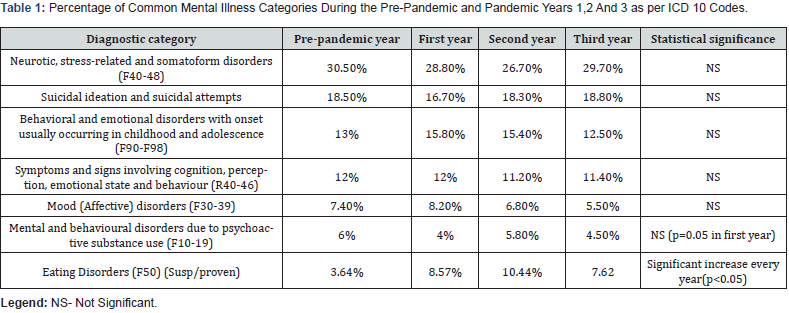
A total of 6431 ED visits related to mental health disorders were identified, which involved 5092 individuals. Most patients were biologic females (4084; 63.5%) with 97 (2.4%) identifying as non-binary or transgender. Among the 2347 (36.5%) children who were biologically males, 28 (1.2%) identified as non-binary or transgender. Mean age was 12.7 (SD ± 3.57) years. A total of 3173 (49.3%) had a known MI and 2333 (36.3%) were taking psychotropic medications. Compared to the pre pandemic year (2.04%), here was a significant increase in the proportion of MI related visits in the first (3.34%) second (3.5%) and third (2.92%) and third years of the pandemic (p < 0.001). Some of the common mental illness diagnosis in the pre-pandemic period and the first three years of the pandemic are listed in Table 1.

Period

New Onset MI

The proportion of new onset MI visits increased from 1.08% (852/78378) in the pre pandemic year to 1.63% (735/45158), 1.65 % (1054/63858) and 1.65% (617/37363) in the first second and third year of the pandemic respectively. Of all mental illness presenting to ED, new onset MI presentations were 53.3% in the pre pandemic year, which reduced to 49% and 47% in the two subsequent years of the pandemic and returned to 57% in the third year Table 2. New MI diagnosis increase was seen in the eating disorder category where it was 3.64% of all new MI diagnosis which went to 8.57%, 10.44%, 7.62% respectively in the first, second and third years of the pandemic (P< 0.001).

Patients With Known MI

The proportion of visits for known MI increased significantly from 0.96%(746/78378) in the pre-pandemic year to 1.71% (772/45158)and 1.85%(1180/63858) and 1.27%(475/37363) the first and second and third year of the pandemic. The percentage of patients with known MI presenting with exacerbations or new symptoms which was at 43.5% of all mental illness presentations increased significantly in the first (51.2%) and second (52.8%) years of the pandemic (p=0.01 and < o. ooo1 respectively). However, there was no statistically significant change compared to the pre-pandemic year in the third year of the pandemic (46.7%).

The common previous MI identified in children presenting with MI exacerbations and new symptoms were suicidal ideation and attempts (SI) (20.95%), neurotic, stress-related, and somatoform disorders (F40-48) (20.93%), mood disorders (F30-39) (13.28%) and eating disorders (F50) (11.48%). The percentage of patients with a history of SI/SA who presented with MI-related complaints significantly increased from 15.4% to 22.7% in the first year (p<0.0001,) and remained significantly increased at 23.4% in the second year (p<0.0001), and at 21.7% in the third (p<0.0001) of the pandemic. The percentage of patients with previously diagnosed history of mood disorders did not change significantly during the study period. The percentage of patients with neurotic, stress-related, and somatoform disorders (F40-48) also did not change significantly from pre-pandemic compared to the first 2 years of the pandemic. However, it was significantly reduced in the third year of pandemic from 21.2% to 16.7% (p=0.004)

The percentage of patients with a history of eating disorders significantly increased from 8.4% in the pre pandemic year to 15.9% in the first year of the pandemic (p<0.0001) and remained significantly increased at 11.9% in the second year (p=0.001). However, there was no significant change compared to prepandemic levels in the third year (9.1% vs 8.4%). There were no significant changes in other categories except for patients previously diagnosed with substance abuse where emergency visits significantly increased from 4.6% in the pre pandemic year to 7.1% in the first pandemic year (p=0.003) and remained significantly increased at 6.4% in the second year (p=0.013). In the third pandemic year, the difference was not statistically different (6.0% vs 4.6%; p=0.11).

Length of Stay (LOS) in the Emergency Department

Children with new onset mental illness had significant decrease in LOS (p<0.001) from pre-pandemic (292 ± 160) to first year (249 ± 149), followed by an increase in LOS in the next two years (326 ± 185) and (388 ± 187). A trend of decreased LOS in the first year of the pandemic, followed by an increase over the next two years, was observed in the patients with known mental illness but it was not statistically significant.

Hospital Admissions

Admission rates for all children with mental illness was at 21% in the pre pandemic year and increased significantly to 29% (p 0.001) in the first year and reduced to 25% and 22 % in the second and third years of the pandemic. In the pre pandemic year 30.6% of patients presenting with suicidal ideations or attempts were admitted which increased significantly to 41.3% in the first year(p=0.05) but was not statistically significant in the second (29.7%) and third years (32.3%) of the pandemic. Children with eating disorders had the highest admission rates in the pre pandemic year (63.6%) which was similar in the first (63.8%), second (57.8%) and third (62.2% years of the pandemic.

New MI presentations had no statistically significant change in admission rates compared to the pre pandemic rate of 2.1% during the first year (3.4%), but admission rates increased significantly to 5.5% in the second year (p<0.0001) and remained significantly increased at 5.2% in the third year of the pandemic (p=0.001). Patients diagnosed with MI presenting with exacerbation, had significant increase in the admission rate from the 49.3% in the pre pandemic year to 60.8% in the first year of the pandemic (p=0.0002). During the second and third pandemic year the rates were not significantly different from pre-pandemic year (50.7% and 54.1% respectively). For patients with MI presenting with new symptoms the pre pandemic admission rate of 30.41% did not change significantly in the three years of the pandemic (34.52%, 24.53% and 21.9% vs 30.41% respectively. Admission rates for patients with known MI on psychiatric medications were not statistically different from those who were not on psychiatric medications.

Discussion

Our findings support previous studies that have reported an increase in MI during the COVID-19 pandemic, as well as an increase in the proportion of MI-related visits to ED [6,7,13]. However, the distinction of new onset mental illness and exacerbation in children during pandemics has not been previously described well in the literature. Interestingly, during the first 2 years of the pandemic, a greater proportion of ED visits for MI were for exacerbation of symptoms rather than new onset mental illness compared to the pre-pandemic period. This suggests that the pandemic tends to exacerbate existing MI symptoms to a greater degree compared to causing new symptoms. However, this increase was not statistically significant in the third year of the pandemic, suggesting a shift back to the baseline of the prepandemic period.

It is worth noting that whilst some previous studies have also discussed the more severe effect of the pandemic on patients already suffering from MI disorders [10,11,13,20], others have indicated that children with high levels of mental health problems before and during the pandemic were less likely [20], or at least as likely [21] as their healthy peers to display an increase in mental health problems in response to the onset of the pandemic.

In our study we observed an increase in the proportion of patients presenting for MI complaints who had a history of suicidal ideations or attempts and those with eating disorders. This increase was more pronounced during the first two years of the pandemic, again suggesting a gradual return to baseline levels in the third year of pandemic. These findings are consistent with previous studies that have shown that individuals with these disorders are at higher risk of being affected by the COVID-19 pandemic [22].

Our study also found no significant increase in the proportion of patients presenting with mood disorders, which is consistent with previous reports suggesting that ED visits are increasingly reserved for more severe cases involving a risk of self-harm [7,16]. Therefore, the true rate of mood disorders in the community may not be accurately reflected by ED visits alone.

In our study, we observed that the highest admission rates were for those presenting with an exacerbation of a known MI. This finding was not surprising, as children who present to the ED with an already known condition may represent a situation where they have failed outpatient management or are unable to receive the help they need in the community setting, while those who present with new onset symptoms may simply require reassurance, education, and referral for appropriate services. While some previous studies have reported an increase in admission rates during the pandemic [6,12,13], not all studies have found this to be the case [16].

During the first year of the pandemic, the rate of admission increased in our institution and the reasons for this are challenging to discern. One possible explanation is that there were fewer community resources available, another explanation might be related to more severe presentations during the pandemic. The fact that children with a first-time presentation of MI symptoms were more likely to be admitted during the second and third years, but not during the first, is not well understood.

When children experience mental distress without access to evidenced-based interventions, their risk of relapse is seven times higher than those who receive treatment services [23], and as psychiatric hospitalization is a major contributor to high health care costs among children suffering from MI, providing a suitable work frame to address acute presentation of MI in a timely fashion and limiting hospitalization can help reduce costs [24].

Limitations

The study is a retrospective chart review in a single institution that relies heavily on the completeness of documentation in the charts and is limited by what is available on the charts. Data regarding previous mental health disorders, chronic medications, and previous diagnoses were extracted from the electronic medical records available at our site, and missing entries or visits to other hospitals may have affected our study results. However, we have no reason to suspect that the completeness of data has significantly changed between groups or over the study period. Therefore, we have assumed that any omission in the data entry would be random and equal over the various groups. As such, we do not anticipate any major errors in data collection.

Furthermore, our study is based on data from a single tertiary care paediatric hospital, and the findings may not be generalizable to other locations with different patient populations or healthcare systems. In addition, our study period was limited to the first three years of the pandemic, and future studies are needed to examine the long-term impact of COVID-19 on paediatric mental health. It should be noted that it was not possible to distinguish between the effects of the pandemic itself and the effects of the public health measures taken in response to the pandemic, such as school closures and social distancing. These measures may have had an impact on children’s mental health, but we were unable to quantify their effects.

Finally, our study was not designed to establish causal relationships between COVID-19 and mental health outcomes. While we observed associations between the pandemic and certain mental health conditions, further research is needed to determine the underlying mechanisms of these associations.

Conclusion

MI related visits to the Paediatric ED increased significantly during the pandemic, for both new onset MI presentations and exacerbation of previously diagnosed MI with increases being more pronounced in children presenting with exacerbations. The study results will hopefully aid in identifying populations that are at-risk for worsening MI and help us better target preventative strategies and guide resource utilization for the management and treatment of vulnerable individuals.


To Know more about Academic Journal of Pediatrics & Neonatology

To Know more about our Juniper Publishers
Friday, June 14, 2024

Role of Early Inpatient Physiotherapy in Improving Functional Independence after Craniotomy-A Case Study - Juniper Publishers

 Case Studies - Juniper Publishers


Abstract

Background: Craniotomy is a type of surgical procedure to open the cranium to access the brain for surgical repair, and any damage to brain parts or alteration in brain function. The brain surgery is generally the first step of treatment for brain injuries and conditions. The aim of the study was early inpatient physiotherapy to improve the functional outcomes in post craniotomy patient. Functional independence measure (FIM) was the outcome scale that was used to see the progress level of the patient. The patient’s score varies from 18 points (the patient is completely dependent) to 126 points (the patient is completely independent). Derivatives of the FIM score include, FIM gain where it is the difference between discharge and admission FIM and measures absolute functional gain. FIM efficiency is the FIM gain divided by the length of stay in rehabilitation and measures the rate of functional improvement.

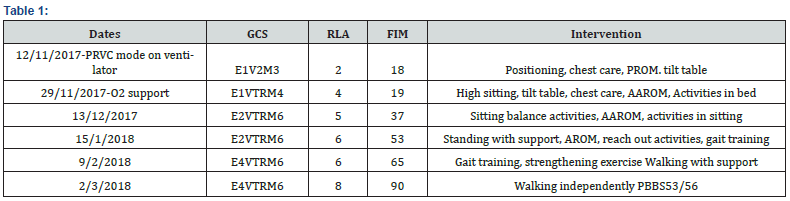
Case Description: A 9-year-old child admitted after a traumatic brain injury with subdural hematoma on 9th November 2017, he underwent craniotomy on 11/11/2017. His GCS level was E2V2M3 and RLA was 2 on 12/11/2017. The child had left hemopneumothorax as associated complication. Intervention done was positioning, chest care, tilt table, activities in bed, balancing, standing and walking. FIM on admission and discharge was taken. Patient was discharged on 2/3/18.

Result: The Absolute FIM gain was calculated where Discharge – Admission; 90-18= 72 and FIM efficiency was calculated where FIM gain /by length of stay i.e., 72/90 *100=80% rate of functional improvement.

Keywords: Craniotomy; FIM; Exercise protocol; Physiotherapy intervention

Background

Craniotomy is a type of surgical procedure to open the cranium to access the brain for surgical repair, and any damage to brain parts or alteration in brain function. The brain surgery is generally the first step of treatment for brain injuries and conditions. The common indications of craniotomy are Brain tumours, Cranial abscess, Cerebral oedema, Haemorrhage, Traumatic brain injury like Stroke, Aneurysm, skull fractures [1].

The postoperative period is the first part of the journey of care but, as reported by SASM, this is perceived to be an area where the need for guidance is a supreme priority to prevent complications like pain, Deep vein thrombosis, Respiratory problems due to surgery, Pressure sore, Decrease range of motion, Muscle contractures, Hypotension [2]. There may well be a “Platinum 24 Hours” (maximum 48 hours) after surgery when patients are subjected to complications and decision making is very important with the help of clinical data that is presented and treatment options that are available [3]. Inpatient physiotherapy refers to early, all stages of recovery and it begins when the patient’s emergence from anaesthesia and continues through the time required for the acute effect of anaesthetic and treatment procedures to subside. The main aim of inpatient physiotherapy is to prevent complication due to immobilization and to make the patient to achieve basic level of energy so that the functional skills are improved and retained [4]. It helps to promote return to functional levels, prevent respiratory complication, increase muscle strength and endurance, and encourage early mobility to prevent DVT, prevent bed sores, and prevent contractures. Functional independence measure (FIM) was the outcome scale that was used to see the prognosis level of the patient. Admission and discharge functional status were measured in the areas of self-care, mobility, locomotion, sphincter control, communication, and social cognition to know the level of disability [5]. As there is increase in incidence in patient undergoing brain surgery (craniotomy) early prevention of post-surgical complications and improving functional status can reduce the morbidity further reduces the length of hospital stay by giving early Inpatient physiotherapy.

Aim

Role of early inpatient physiotherapy to improve the functional outcomes in post craniotomy patient.

Case Description

A 9-year-old child admitted after a traumatic brain injury with subdural hematoma on 9th November 2017, he underwent craniotomy on 11/11/2017. His GCS level was E2V2M3 and RLA was 2 on 12/11/2017. FIM on admission and discharge was taken. The child had right hemopneumothorax as associated complication. Patient was discharged on 2/3/18. The patient’s score varies from 18 points (the patient is completely dependent) to 126 points (the patient is completely independent). Derivatives of the FIM score include, FIM gain where it is the difference between discharge and admission FIM and measures absolute functional gain. FIM efficiency is the FIM gain divided by the length of stay in rehabilitation and measures the rate of functional improvement.

Intervention

Overall treatment duration was 30mins with total frequency was 2 sessions in a day for 2weeks which was for 1 hour per Session from the post operative day to discharge day. FIM is administered on admission and discharge patient from ward (from post operative day to discharged day). The materials used are tilt table, knee brace, Incentive spirometer, crape bandage, wheel chair, walker and pillows.

a) Positioning Advice: Optimal positioning with pillows to minimize the pressure on body surface to avoid pressure sores. Positions was done with Elevation of bed up to 30 degrees to decrease ICP for (head ace), Limb elevation up to 75 degrees for 20mins with compression stockings improve circulation.

b) Tilt table: Tilt table treatment included upper limb exercises, and breathing exercises. It is a padded table with a footplate and three large Velcro straps, the patient lies on top of the table on his back. To secure the patient safety strap are strapped, and then slowly the table is elevated to 30 degrees for 10mins followed by constant monitoring and later to 70 degree for 5mins and once the vitals are stable the patient is elevated into a standing position for 20mins with constant monitoring of blood pressure and heart rate throughout the treatment.

c) Respiratory therapy: Postural drainage technique was used for 15mins depending on the lobe that was affected to prevent secretion accumulation. Incentive spirometer was used once the patient is weaned from ventilator as feedback and to gain confidence for 10 counts with rest period for every 3 counts. Thoracic expansion exercise, Diaphragmatic breathing, breathing re-education was demonstrated and practiced about 10 cycles with rest period and was instructed to do 2 hourly. This will help patient to maintain saturation level and decrease breathlessness.

d) Activities in the bed: Passive movements of upper limb and lower limb in various planes of motion for 15mins 10 repetition with 5min rest period twice a day was given to patient. Segmental rolling, Bridging (unilateral and bilateral), Pelvic rotation (hip, knee flexion) was taught and practised for 10 counts with rest period of 2mins for every 3 counts. Active movements were started once the manual muscle testing of muscle reach grade 3 which includes exercise like Scapular movement, Extension /abduction movement of arm and fingers and touching the opposite shoulder.

e) Activities out of the bed: Patient was made from Supine to sitting progressed to weight bearing activities, shoulder shrugs, hitching and hiking, knee extension, overhead activities static and dynamic strengthening exercise. Once the Sitting balance was achieved the patient was made to Stand with maximal support and progressed to independent standing by the time of discharge.

f) Ambulation: Wheelchair was used initially to get oriented to environment and surroundings, progressed to support standing and later to support waking.

g) Balance training: Static balancing exercise like shifting weight to both lower limbs, step stance training, Perturbation, trunk movements was done for 10mins with rest period with gait belt as assistive device. Dynamic balancing exercise like reaching activities, one leg standing, throwing activities was practiced. Patient was trained from sitting without support till standing independently.

h) Handgrip exercises: Exercise like reach, grasp, releasing objects were taught with different shapes object like glass, spoon, plate so that eating component is trained and patient can become independent functionally.

Overall Intensity: The program consists of 1 hour, for 2-week, therapist-assisted sessions (Figure 1-4).

Results

a) Absolute FIM gain: Discharge – Admission=90-18= 72.

b) FIM efficiency =FIM gain /by length of stay 72/90 *100=80% rate of functional improvement.

Discussion

Through physical stimulation, the residual neurons provide the foundation for creating new function-restoring neuronal networks. It is an “if-you-don’t-use-it-you-lose-it” system, in which paralysis-associated disuse of muscles over time results in viscous-circle. Inpatient physiotherapy is given to patient based on functional gain. (self-care, dressing, feeding, bathing, mobility, sphincter, communication). Home programme is planned to maintain the functions that are gained and improve the in patient’s social life. Do and Don’ts after craniotomy like lifting heavy weights, strenuous aerobic exercise, treadmill, cycling are explained to the patients. The program is distinguished by its intensity, continuity, and personalization [6]. Body weight supported ambulation is given for some patients depending on GCS with help of assistive device. The program believes weight bearing is essential to recovery for function because that is what the human body was designed for. The FIM is a sensitive functional status instrument that assesses the degree of dependence of rehabilitation patients. It is a good indicator to know level of burden of care and to evaluate changes during inpatients rehabilitation. Two important components are assessed; FIM gain which is the difference between discharge and admission FIM. FIM efficiency which is based on FIM gain divided by the length of stay in rehabilitation [7]. A tilt table serves as an integral part of physical therapy by providing early mobilization for patients who are too weak to stand on their own. Tilt tables are used to reintroduce patients to the vertical position. The most common reasons for inclusion of tilt table treatment are to facilitate weight bearing, prevent muscle contractures, to prevent blood clots, to prevent pulmonary embolism, improve lower limb strength and increase arousal and prevent other bed rest complication for the hospitalized patient [8,9]. Optimal positioning after surgery is first step to minimize the potential risk of abnormal amounts of pressure on relatively small parts of the body surface like occipital and heel. Positioning helps to preserve joint integrity and protect skin from breakdown due to prolonged pressure [10]. The brain controls breathing and since surgery carries with it some risk of respiratory complications it is important as a physical therapist to prevent further complication by chest manipulations [11]. Activities in the bed and passive movements in various planes of motion is integral part of therapy to reactivate and reorganize the nervous system. Brain surgery has the potential to affect a patient’s static and dynamic balance where physical therapy focused on the patent’s balancing exercise for ambulation and better functional outcomes [12]. Based on Functional Independence Scale handgrip exercises is a key element for FIM gain which decrease the dependency [13]. Thus, very few case studies were attempted on ‘Role of inpatient physiotherapy on functional outcomes in patients with post craniotomy’ to check FIM gain and FIM efficiency.

Conclusion

Early physiotherapy rehabilitation is one of the most important aspects of rehabilitation in craniotomy patients. This case report proves that functional independence is the main outcome for the patients as well as for medical and paramedical team to know the level of progress. Here by inpatient rehabilitation after 24 hrs of post craniotomy is ideal for making the patient functionally independent. This study further recommends doing RCT on patient with post craniotomy.

To Know More About Juniper Online Journal of Case Studies Please click on:

For more Open Access Journals in Juniper Publishers please click on: 

Thursday, June 13, 2024

Role of Instant Messaging Forensic Investigations on Detection of Corporate Fraud among Commercial Banks in Kenya - Juniper Publishers

 Forensic Sciences & Criminal Investigation - Juniper Publishers

Abstract

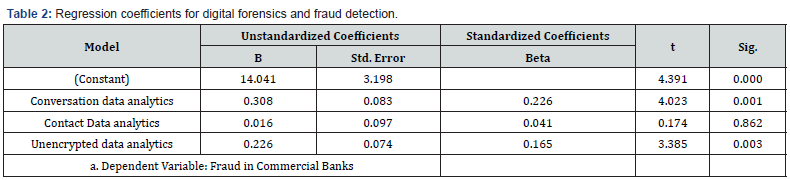
Despite ongoing efforts to curb corporate fraud in both the public and private sectors, the prevalence of such fraudulent activity persists. Notably, digital forensics remains a primary focus of research, given its potential for facilitating fraud detection. In light of this, the study investigates the role of instant messaging forensics, specifically conversation data analytics, contact data analytics and unencrypted data analytics, in detecting corporate fraud within the Kenyan banking industry, guided by Locard’s Exchange Principal Theory. The research adopted a descriptive study design, which incorporated responses from a target population of 380 individuals, primarily from 43 banks and the banking fraud investigation department of the central bank. Our sample size encompassed 114 participants, out of which 100 provided responses through questionnaires and semi-structured instruments. The results indicate that that conversation data analytics (β= 0.308, p =0.001) and unencrypted data analytics (β= 0.226, p =0.003) have a significant positive impact on fraud detection in banks while contact data analytics (β= 0.016, p= 0.862) was found to have a non-significant effect on fraud detection. We recommend the that banks prioritize the adoption of conversation data analytics and unencrypted data analytics as a way to increase fraud detection in their systems.

Keywords: Digital forensics; Conversation data analytics; Contact Data analytics; Unencrypted data analytics; Fraud detection.

Introduction

The accelerating pace of technological and commercial advancements has coincided with a troubling surge in corporate fraud, posing significant challenges to the global financial sector and, specifically, the banking industry. High-profile surveys by leading consultancies and institutions such as the Association of Certified Fraud Examiners (ACFE), PricewaterhouseCoopers, Deloitte, KPMG, and Ernst & Young have underlined this escalating trend, capturing the attention and concern of businesses worldwide. The adverse implications of these fraudulent activities extend beyond destabilizing the banking sector; they also erode profitability, a concern that is especially pronounced in developing economies.

Across both developed and emerging markets, banks grapple with a spectrum of fraudulent activities that range from asset misappropriation to cybercrime, corruption, procurement fraud, and accounting inconsistencies [1]. These activities have been estimated to siphon off between 2% and 7% of banks’ annual revenue, translating to losses in the trillions of dollars on a global scale. This alarming trend necessitates deeper exploration, especially in the context of developing countries where existing research remains scant, Kassem (2014).

In an effort to fortify their defenses against this scourge of corporate fraud, banks globally have escalated their investments in strengthening internal controls and enhancing digital forensics investigation capabilities. The domain of Digital Forensic Investigation (DFI) has emerged as a linchpin in tackling digital crimes, encompassing a gamut of activities from the identification and preservation to the analysis, documentation, and presentation of digital evidence. As digital media increasingly becomes the de facto medium for storing and transmitting information, the significance of specialized forensic techniques in the fight against fraud amplifies, especially in developing countries where fraudulent activities are burgeoning [2]. This study pivots around the Kenyan banking sector, seeking to appraise the impact of instant messaging forensics investigations in detecting fraud. By scrutinizing various branches of instant messaging digital forensics, ranging from conversation data forensics, contact data analytics and unencrypted data forensics, this research aspires to elucidate the role these techniques play in mitigating corporate fraud within banks. The insights gleaned from this study will contribute to the formulation of more efficacious fraud detection and prevention strategies, thereby enhancing financial stability and preserving the profitability of banks.

Literature Review

Theoretical framework

The Locard Exchange Principle (LEP), established by Edmond Locard (1877–1966), the founder of the Lyons Police Technical Laboratory in France, serves as the foundational theory for this study. LEP asserts that every interaction or contact between two entities results in an exchange of trace evidence [3]. This principle has been extended to digital crime investigations, where digital evidence, such as logs or malware, may be present even in the absence of physical contact between the perpetrator and the crime scene [4]. LEP provides a robust theoretical basis for the study’s objectives, as it suggests that traces of digital evidence can be found and analyzed in various forms of digital forensic investigations. LEP posits that digital evidence, such as messages exchanged between fraudsters, can be uncovered through instant messaging forensic investigations, leading to the identification of perpetrators and their criminal activities [5]. The theory also implies that traces of digital evidence may be present on social media platforms used by fraudsters, allowing for the identification and analysis of criminal activities through social media forensic investigations [6]. LEP supports the idea that computer systems and networks can contain digital evidence, such as malware or logs, which can be analyzed through computer forensic investigations to detect and deter corporate fraud [4]. In addition, the theory suggests that mobile devices, which have become indispensable tools for fraudsters, may contain retrievable digital evidence that can be analyzed through mobile forensic investigations to identify and counter corporate fraud [5]. Locard Exchange Principle serves as a valuable theoretical underpinning for this study, emphasizing the significance of digital evidence in combating corporate fraud. By applying LEP to the context of digital forensic investigations in the Kenyan banking industry, this study aimed to contribute to a deeper understanding of the roles played by various forensic methods in detecting and preventing corporate fraud.

Literature review

Instant messaging forensics and fraud detection in banks: Instant messaging, a form of real-time communication enabling private conversations via the internet, has gained significant popularity since its inception in 1996 with the launch of the ‘I Seek You’ service. The evolution of instant messaging has extended beyond text-based conversations to include the exchange of various media formats, location sharing, and voice and video calls. This widespread adoption has led to the incorporation of instant messaging in businesses, organizations, and government agencies worldwide, exemplified by services such as WhatsApp Business Chat and Twitter accounts of government officials. Given the ubiquity of instant messaging, it is crucial for forensic investigators to analyze conversation artifacts during device examinations. Décary-Hétu and Aldridge [4] highlighted the importance of instant messaging forensics in digital crime investigations, but their study did not specifically address its role in various industries such as banking. Previous research on instant messaging forensics has primarily focused on popular applications for Android and iOS mobile operating systems. Studies by Gao and Zhang (2013) and Ovens and Morison (2016) have explored artifacts left by applications such as WeChat and Kik on iOS devices. However, these studies largely centered on the first generation of instant messaging apps, neglecting the latest generation of platforms like WhatsApp and Telegram. While Sgaras et al. (2015) conducted a forensic acquisition and analysis of WhatsApp, Viber, Skype, and Tango on both Android and iOS, their focus was on evidence acquisition in digital forensic investigations rather than evidence assessment and examination processes. Stirparo (2016) examined general iOS forensics information and investigated the security features of Telegram, Signal, and WhatsApp, corroborating Sgaras et al.’s (2015) findings on WhatsApp’s unencrypted Chat Storage SQLite database on iOS. Rathi et al. (2018) analyzed forensic artifacts left by WeChat, Telegram, Viber, and WhatsApp on Android smartphones, revealing methods for retrieving encrypted databases and decrypting them. However, these studies do not explicitly explore the role of instant messaging forensics in detecting corporate fraud [7-10]. One of the most promising areas in instant messaging forensics is conversation data analytics, which involves the algorithmic analysis of textual and non-textual elements within chat conversations. Kim and Lee (2016) were among the pioneers to integrate natural language processing (NLP) tools into fraud detection, highlighting the potential of keyword frequency as a predictor of fraudulent intent. Johnson and Gupta (2018) took this a step further by employing machine learning algorithms to categorize patterns of conversation that correlate with fraudulent activities. Their study, however, raised questions about the use of conversation data analytics in various sectors outside policing sector, a concern later echoed by Davis and Williams (2019).

But while these studies showed promising outcomes, they also revealed significant gaps in the field. For instance, Smith et al. (2017) pointed out the absence of standardized protocols for analyzing conversation data. They noted that the forensic community has yet to agree on the metrics and tools to be used, creating inconsistencies in the quality and reliability of the findings. Moreover, the issue of false positives and negatives was raised by Thompson and Smith (2020), who found that current algorithms could erroneously flag innocuous conversations as suspicious. Another critical aspect of instant messaging forensics is the analysis of unencrypted data. Because they are not protected by cryptographic algorithms, unencrypted messages and files are easier to intercept and scrutinize. Williams (2016) provided empirical evidence suggesting that unencrypted data often yield quicker results in fraud investigations due to the reduced need for decryption. Davis et al. (2017) supported this view by empirically showing that the absence of encryption not only facilitates faster analysis but also increases the accuracy of the results. However, the ethical implications of this approach have been a significant concern. Brown and George (2018) delved into the ethical dimensions of scrutinizing unencrypted data, especially where third parties are involved. They argued that the ease of access to such data raises questions about privacy and consent, issues that the forensic community has yet to fully resolve. Furthermore, Yang and Zhang (2019) noted that with the growing adoption of end-to-end encryption in corporate communications, the future relevance of unencrypted data analytics is becoming increasingly uncertain [11-16].

The final component under review is contact data analytics, which focuses on analyzing an individual’s network of contacts within the instant messaging environment. Zhang et al. (2015) were among the first to illustrate the effectiveness of this approach in identifying fraudulent networks within organizations. Their empirical study used basic statistical methods to map out contact frequencies and durations, thereby identifying potential key players in fraudulent activities. This methodology was later refined by Thompson and Smith (2020), who integrated machine learning algorithms to reduce false positives and negatives. However, despite these advancements, the field of contact data analytics still has significant gaps. For example, Yang et al. (2021) pointed out that existing methodologies are prone to generating false positives, which can have severe legal consequences. Additionally, the ethical aspects of contact data analytics remain underexplored. Questions about data ownership, consent, and the potential for misuse are yet to be adequately addressed, as noted by Wilson and Davis (2020). The empirical literature on the role of instant messaging forensic investigations in the detection of corporate fraud reveals several critical gaps that warrant further study, particularly within the context of commercial banks in Kenya. First, there is a pressing need for testing the applicability of instant messaging forensics in various contexts using the developed standardized protocols and methodologies. Existing research highlights the inconsistency in the tools and metrics employed, leading to variable quality and reliability in outcomes. Second, ethical concerns, especially concerning unencrypted and contact data analytics, remain largely unaddressed. These ethical dilemmas become more pressing in a banking environment where confidentiality and privacy are paramount. Third, the legal admissibility of evidence generated from instant messaging forensics is still a grey area, a critical concern in the prosecution of fraud cases. Fourth, the rapid adoption of encryption technologies raises questions about the future utility of certain types of data analytics, particularly unencrypted data analytics. Lastly, there is a notable lack of comprehensive methodologies capable of minimizing false positives and negatives, an issue that could result in wrongful accusations or overlooked fraudulent activities. Given that commercial banks are integral to Kenya’s economy and are susceptible to sophisticated fraudulent schemes, addressing these gaps becomes vital for enhancing the effectiveness and reliability of fraud detection mechanisms within this sector [17-25].

Materials and Methods

Study design

This research employed a descriptive design to investigate the role of instant messaging forensics in detecting corporate fraud within the Kenyan banking sector. The study encompassed 43 Kenyan banks and also included the Banking Fraud Investigation Department (BFID) at the Central Bank of Kenya (CBK). The target population consisted of 390 individuals, specifically digital forensics managers and officers working within these banks and the BFID, all of whom are directly involved in handling cases of corporate fraud requiring digital forensic investigation.

Sampling methodology

A total sample size of 114 digital forensic officers, representing both the banks and the Central Bank of Kenya, was selected for this study. Stratified proportionate sampling techniques were used to divide respondents into two categories: officers and managers from both the banks and BFID. In addition, purposive sampling was used to select participants with specific expertise in digital forensics within these institutions. To address the study’s sensitive nature and encourage participation, a snowballing technique was employed, leveraging existing relationships and referrals to gain the trust and cooperation of prospective respondents [26-34].

Data collection instruments and procedure

Data collection relied exclusively on a Likert-type questionnaire, composed of 5-point scale questions, aimed at gathering insights on various facets of instant messaging forensics, including conversation data analytics, contact data analytics, unencrypted analytics, as well as fraud detection in banks. Questionnaires were distributed and administered through a combination of drop-and-pick methods and face-to-face interviews. The latter were also employed for conducting semistructured interviews. To ensure the instrument’s reliability and validity, a pilot study was conducted involving 11 respondents from the Criminal Investigation Department’s fraud investigation unit. Content validity was ascertained by incorporating questions directly related to the constructs being measured, while face validity was enhanced through consultations with subject matter experts and academic supervisors. The internal consistency of the questionnaire was evaluated using Cronbach’s alpha test.

Data analysis

Completed questionnaires were coded and entered into SPSS software (version 24) for analysis. Given the use of close-ended questions, data entry was streamlined and efficient. Data was first cleaned and coded, followed by descriptive statistical analysis using frequencies and percentages to summarize respondent profiles. Multiple regression techniques were employed to assess the relationship between digital forensics methods and fraud detection, thereby testing the study’s objectives [35-40].

Results

Respondent profiles in terms of work experience

Table 1 results shows that about half of the respondents (50.5%) have between 9 to 12 years forensic investigation experience followed by those who had more than 12 years of experience (29.7%). 13.2% of the respondents had between 5- 8 years of experience while 6.6% had less than 5 experience. These results imply that significant portion of the respondents had experience on forensic investigation.

Regression results

The results in table 2 shows the relationship between digital forensics technologies and fraud detection in banks. The dependent variable is fraud detection in banks, while the independent variables are conversation data analytics, contact data analytics and unencrypted data analytics. The results indicate that conversation data analytics (p =0.001) and unencrypted data analytics (p =0.003) have a significant positive impact on fraud detection in banks. On the same note, conversation data analytics has the highest contribution (β= 0.308) to fraud detection followed by unencrypted data analytics (β= 0.226) and contact data analytics (β= 0.016) [41-45].

Discussion of Findings

The study found that conversation data analytics has a significantly positive impact on fraud detection in banks, as indicated by a p-value of 0.001 and a beta coefficient of 0.308. This result aligns with previous scholarly work, such as the study by Johnson and Gupta (2018), which found that machine learning algorithms could effectively categorize patterns of fraudulent conversations. The strong beta coefficient of 0.308 suggests that among the variables studied, conversation data analytics is the most potent predictor of successful fraud detection. The study also revealed that unencrypted data analytics has a significant positive impact on fraud detection, with a p-value of 0.003 and β=0.226. This supports Davis et al. (2017), who noted that unencrypted data often yield quicker and more accurate results in fraud investigations. The result also underscores the importance of unencrypted data analytics in the banking sector, suggesting that it is a valuable but slightly less influential tool compared to conversation data analytics for combating fraud. Contrary to expectations, contact data analytics showed a very minimal impact on fraud detection in banks, with a β value of 0.016. This is surprising given prior research, such as the study by Zhang et al. (2015), which found contact data analytics useful in identifying fraudulent networks within organizations. The unexpected result in our study raises the question of whether the role of contact data analytics in fraud detection is context-dependent or influenced by other variables not considered in this study.

Conclusion

The current study provides an understanding of the role of instant messaging forensics investigation on fraud detection within commercial banks, particularly focusing on the Kenyan context. Our empirical findings indicate a significant positive relationship between conversation data analytics and fraud detection. Similarly, unencrypted data analytics also emerged as a significant predictor of successful fraud detection, albeit to a lesser extent. Surprisingly, contact data analytics demonstrated a minimal impact. These findings offer both academic and practical implications. From an academic standpoint, the study validates the significance of conversation and unencrypted data analytics in fraud detection, while raising questions about the role of contact data analytics that warrant further investigation. Practically, the results suggest that commercial banks in Kenya would benefit from investing more heavily in conversation and unencrypted data analytics technologies for more effective fraud detection. Given the increasing sophistication of fraud schemes, adopting such advanced forensic methods appears to be not just beneficial but essential for ensuring the financial integrity of banks.


To Know more about Journal of Forensic Sciences & Criminal Investigation
Click here: https://juniperpublishers.com/jfsci/index.php

To Know more about our Juniper Publishers
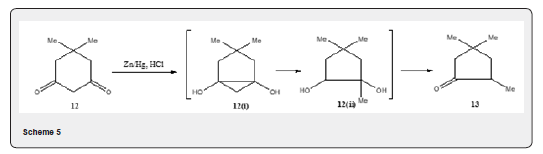
Click here: https://juniperpublishers.com/index.php


Effective converting ratio when switching between Ona-botulinumtoxin-A and Abo-botulinumtoxin-A in cervical dystonia. A patient assessment cross over study- Juniper Publishers

  Neurology & Neurosurgery- Juniper Publishers Introduction In the 1950s it was hypothesized that Botulinum Neurotoxins (BoNT-A’s) could...