Juniper publishers have been established with the aim of spreading quality scientific information to the research community throughout the universe. We, as Open Access publishers, strive to offer the best in class online science publications. Open Access process eliminates the barriers associated with the older publication models, thus matching up with the rapidity of the twenty-first century. Our main areas of interest lie in the fields of science, engineering and other related areas.
Showing posts with label Juniper Publishers Contact Info. Show all posts
Showing posts with label Juniper Publishers Contact Info. Show all posts
Juniper
Publishers Submission Guide 2025: How to Prepare a Manuscript That Gets
Accepted
Preparing a
manuscript for academic publication requires more than strong research
findings. Authors must also meet journal expectations related to ethics,
structure, formatting, and transparency. In 2025, Juniper Publishers
continues to emphasize originality, ethical compliance, and clear presentation
across its multidisciplinary journal portfolio.
This guide
outlines the key submission requirements and best practices authors
should follow to improve the likelihood of smooth editorial handling and
successful peer review.
Core
Ethics and Submission Conditions
Ethical
compliance is a foundational requirement for manuscript consideration.
Authors
must ensure that:
The manuscript is original work
and has not been published elsewhere
The same manuscript is not
under simultaneous review at another journal (in any language)
All sources, data, and ideas
from prior work are properly cited and credited
Any conflicts of interest are
fully disclosed
Studies involving human
participants include ethics committee approval and informed consent where
applicable
Meeting
these conditions helps protect research integrity and author credibility.
Manuscript
Types Accepted in 2025
Juniper
Publishers journals accept a variety of manuscript formats. Selecting the
correct type before writing helps ensure proper structure and review alignment.
Common
manuscript categories include:
Research Articles
Review Articles
Case Reports
Short Communications or
Mini-Reviews
Opinions or Commentaries
Letters to the Editor
Editorials or journal-specific
formats
Authors
should choose the manuscript type that best matches the scope and intent of
their work before submission. Submission instructions are available through the
official portal: 👉https://juniperpublishers.com/submit-manuscript.php
What
Your Submission Package Should Include
A complete
and well-prepared submission package helps minimize delays during initial
screening.
Required
components typically include:
Main manuscript file (properly formatted and
complete)
Cover letter, including:
Full author and co-author
details
Corresponding author contact
information
Disclosure statements
(conflicts of interest, ethics approval if applicable)
Copyright transfer form, submitted after acceptance
Providing
complete documentation signals professionalism and readiness for review.
How to
Structure and Format Your Manuscript
While
Juniper Publishers does not mandate a single universal template for all
journals, clarity and consistency are essential.
Recommended
formatting best practices:
Use clear, concise academic
English
Follow a structure appropriate
to your manuscript type
For
original research articles, a common structure includes: Title Page → Abstract & Keywords → Introduction → Materials &
Methods → Results → Discussion → Conclusion → Acknowledgments → References →
Tables/Figures
Additional
formatting guidance:
Label all tables and figures
clearly
Include ethics and consent
statements where required
Ensure references are complete
and accurately formatted
Avoid plagiarism and ensure
originality throughout
Consistency
and readability are prioritized even when formatting rules vary by journal.
Submission
Process Overview
The
submission workflow is designed to be straightforward and efficient.
Typical
steps include:
Manuscript submission via the
online portal (or journal-specific email, where applicable)
Initial editorial screening for
scope and compliance
Peer review if the manuscript
passes screening
Copyright transfer request
after acceptance
Authors are
kept informed throughout the process.
Practical
Pre-Submission Checklist
Step
What
to Verify
Originality
Manuscript
is unpublished and not under review elsewhere
Manuscript
File
Prepared
in Word (DOC/DOCX) with all required sections
Cover
Letter
Includes
author details, rationale, disclosures
Ethical
Compliance
IRB/ethics
approval and consent statements if applicable
Citations
& Permissions
All
sources cited; permissions obtained where needed
Declarations
Ready to
submit copyright transfer post-acceptance
Format
& Clarity
Clear
language, accurate references, labeled tables/figures
Completing
this checklist before submission can significantly reduce editorial delays.
Conclusion
Successfully
publishing with Juniper Publishers in 2025 requires careful preparation,
ethical rigor, and close attention to submission requirements. Authors who
submit original, well-structured manuscripts supported by accurate
citations and transparent ethical disclosures are more likely to progress
smoothly through editorial screening and peer review.
By ensuring
that manuscripts, cover letters, figures, tables, and permissions are complete
at submission, researchers demonstrate professionalism and readiness for
publication. Following the practices outlined in this guide helps authors
present their work effectively and improves the likelihood of acceptance across
Juniper’s scientific journals.
Juniper Publishers
Peer Review Timeline: What Authors Can Expect in 2025
The peer review workflow
at Juniper Publishers has been refined in 2025 to support timely
publication, clear communication, and strong scientific standards. Authors
submitting manuscripts can expect a structured, transparent, and
well-regulated review process from submission through final publication.
This guide explains each
stage of the Juniper Publishers peer review timeline and what authors should
prepare for in 2025.
Initial Manuscript
Assessment
Once a manuscript is
submitted, it undergoes a preliminary editorial evaluation to ensure it meets
basic journal requirements.
Key checks include:
Scope and relevance: Alignment with the journal’s
aims and subject focus
Formatting and structure: Compliance with submission
guidelines (abstract, keywords, references, sections)
Originality screening: Plagiarism checks to confirm
the work is original
This step ensures that
only suitable manuscripts proceed to full peer review.
Handling Editor
Assignment
Manuscripts that pass
initial screening are assigned to a handling editor with subject-area
expertise.
The handling editor:
Oversees the review process
Selects appropriate reviewers
Ensures evaluations remain constructive
and objective
This role helps maintain
consistency and academic rigor throughout the review cycle.
Reviewer Selection
and Invitation
Qualified reviewers are
invited based on several criteria to ensure a fair and knowledgeable
evaluation.
Reviewer selection
typically considers:
Relevant research and academic experience
Publication history in the subject area
Prior reviewing reliability
Absence of conflicts of interest
Review begins only after
reviewers confirm their availability.
Peer Review
Evaluation Process
Reviewers conduct a
detailed assessment of the manuscript’s scientific quality and contribution.
Evaluation focus
areas include:
Originality and contribution: Novelty and significance of
findings
Methodological rigor: Study design, data quality,
and analysis
Results and interpretation: Accuracy, clarity, and logical
consistency
Presentation quality: Organization, readability, and
clarity
Ethical compliance: Human/animal protections and
data integrity
References: Accuracy and contextual relevance
Double-blind review
Author and reviewer
identities remain anonymous to support impartial and unbiased feedback.
Editorial Decision
Outcomes
Based on reviewer
reports, the handling editor makes one of the following decisions:
Acceptance
Minor revisions
Major revisions
Revise and resubmit
Rejection
Decisions are guided by
reviewer feedback and journal standards to ensure fairness and transparency.
Author Revisions and
Response
When revisions are
requested, authors submit a revised manuscript along with a detailed response.
Author
responsibilities include:
Addressing all reviewer and editor
comments
Explaining any suggestions that cannot be
implemented
Improving clarity, accuracy, and scholarly
value
This collaborative stage
often strengthens the overall quality of the manuscript.
Final Editorial
Assessment
After revision, the
handling editor reviews the updated manuscript to confirm all issues have been
resolved. If necessary, further clarification may be requested before final
approval.
Galley Proofs and
Author Approval
Once accepted, the
manuscript enters production.
This stage includes:
Typesetting and formatting
Copyediting and proofreading
Author review of galley proofs
Authors approve the
final version before publication to ensure accuracy.
Online Publication
and Indexing
The final article is
published online and made globally accessible.
Publication outcomes
include:
Online availability on the journal website
DOI assignment for citation and
referencing
Enhanced discoverability and citation
potential
This ensures research
reaches the global academic community efficiently.
What Authors Can
Expect in 2025
Authors publishing with
Juniper Publishers in 2025 can generally expect:
A transparent and efficient peer review
workflow
Expert handling editor oversight
Double-blind reviewer evaluation
Constructive feedback with clear revision
guidance
Final publication with DOI and global
accessibility
The Juniper Publishers
peer review process in 2025 is designed to balance efficiency, transparency,
and scientific rigor. From initial screening to final publication, each
stage supports ethical standards and constructive scholarly evaluation.
By clearly defining
expectations and maintaining structured editorial oversight, Juniper Publishers
provides authors with a reliable pathway to producing high-quality, impactful
research for the global academic community.
Significant among the 21st century's global health challenges is the growing prevalence of obesity and insulin resistance, particularly type 2 diabetes mellitus (T2DM) [1-3]. Type 2 diabetes mellitus is characterized by obesity and insulin resistance and is associated with cardiovascular disease, renal disease, neuropathy, nonalcoholic fatty liver disease, blindness and malignancy, making it a significant global cause of morbidity and mortality [2,3] Research increasingly indicates that obesity, metabolic derangement and T2DM could be interrelated through the gut Microbiome, as studies have found that obese individuals possess a Microbiome that diverges significantly from that found in lean individuals [1].
The gut Microbiome refers to the ecosystem of >1014 bacteria that reside in the human gastrointestinal tract in a symbiotic relationship with the human host [2,3]. It is well documented that the gut Microbiome plays a role in host health by synthesizing vitamins and altering bile acid solubility. The Microbiome also contributes to daily caloric intake via the breakdown of insoluble dietary components into the short chain fatty acids (SCFA) acetate, propionate and butyrate. Without the gut Microbiome, these dietary elements would be indigestible by the human enterocyte [2]. Additionally, the Microbiome influences disease states -deviations from normal gut flora impact numerous inflammatory and metabolic conditions such as inflammatory bowel disease, irritable bowel syndrome, nonalcoholic fatty liver disease, T2DM and obesity [1-4].
Current hypotheses regarding mechanisms of Microbiome impact on obesity and insulin resistance include enhanced absorption of nutrients, enhanced SCFA production and lipogenesis, decreased activity of fasting-induced adipose factor, increased inflammation and intestinal permeability and altered bile acid circulation [2]. The focus of much research in recent years has been the SCFA butyrate and its relationship to obesity and T2DM. A preliminary search of PubMed reveals that the number of papers published on "butyrate and obesity" or "butyrate and diabetes" has almost doubled in the last decade. Specific research that focuses on the role of SCFAs in obesity and T2DM indicates that butyrate may promote insulin sensitivity in peripheral tissues, contribute to glucose homeostasis and may even prevent and treat diet-induced insulin resistance in obesity [1,5]. However, the majority of studies have been performed in rodents and there is still a great deal of knowledge to be elucidated on the subject of human gut Microbiome interactions with obesity and T2DM, as well as the impact of specific SFCAs and microbial products on insulin resistance and glucose tolerance [2].
The obese Microbiome exhibits decreased bacterial species diversity and altered species -to-species ratios, both of which are associated with increased insulin resistance. Specifically, in T2DM, the populations of the phyla Firmicutes is increased, while Bacteroides is decreased [3]. Studies indicate, albeit with varying levels of certainty, that these derangements in bacterial ratios correlate with decreased numbers of butyrate-producing bacteria and increased numbers of Lactobacillus, a Firmicute. Butyrate then appears significant in the relationship between insulin resistance and the Microbiome. In fact, insulin-resistant individuals treated with vancomycin were noted to have a decrease in the number of butyrate-producing gut microbiota and an associated increase in insulin resistance. Additionally, fecal transfer of lean individuals into obese recipients results in increased insulin sensitivity and increased numbers of butyrate- producing bacteria in the Microbiome of obese recipients[4].
Studies in mice have attempted to characterize the impact of butyrate on insulin resistance and obesity, however such studies are lacking in humans. A study of mice that underwent Roux-en-Y gastric bypass (RYGB) indicates that the microbiome of post-RYGB mice is modified compared to that found in the native gut. Indeed, diabetic mice that received a fecal transplant from the gut of post-RYGB mice were noted to have weight loss, improved glucose and lipid metabolism, and an increase in butyrate-producing organisms in their gut microbiota [3]. This data, in conjunction with a study by [5] continues to lend significance to butyrate's role in modulating insulin sensitivity. In this study, obese mice received dietary supplementation with butyrate and were noted to have increased insulin sensitivity and decreased body fat content. In addition, mice receiving a high fat diet supplemented with butyrate did not develop insulin resistance and obesity. In comparison with mice not receiving butyrate supplementation, these mice had decreased adiposity, increased energy expenditure, and increased fatty acid oxidation [5] This indicates that dietary supplementation with butyrate can prevent insulin resistance in susceptible animals and halt further development of obesity in already obese mice [5].
Although some promising research has been conducted to untangle the mechanistic relationships between obesity, insulin resistance, and the function of the gut Microbiome in mice, there is a dearth of information on these subjects in humans. In order to more fully investigate etiology and treatments for T2DM, obesity and insulin resistance, research on the Microbiome and its role in these conditions needs to shift its focus into human subjects. Future studies could investigate the effect of dietary supplementation with butyrate in humans, as well as attempt to characterize the mechanism of action of SCFAs in inducing insulin-sensitivity, should that be a benefit of human butyrate supplementation. Moreover, studies could investigate the impact of diet upon the gut microbiome and attempt to characterize the relationship between changes in diet and changes in microbial populations. Mechanistic studies could characterize the most representative places in the gastrointestinal tract from which to sample the Microbiome, and still other studies could investigate the role of individual species as opposed to the "cocktail" of the entire Microbiome in inducing insulin sensitivity.
We look forward to developments in translational research in the relationship between the gut Microbiome and obesity and T2DM.
Background: Biliary Atresia (BA) is the most common cause of chronic cholestasis in infants It is a destructive inflammatory obliterative cholangiopathy that affects varying lengths of both intrahepatic and extrahepatic bile ducts. Even after a successful surgery, scARGHing of the liver can continue, resulting in cirrhosis and its complications.
Aim: The aim of this study is to evaluate different serological markers derived from routine investigations in the prediction of liver fibrosis in infants with BA.
Methods: This retrospective study included a total of 147 infants with proved diagnosis of BA. We employed six noninvasive scores (FIB-4, FibroQ, King’s score, APRI, GUCI and AAR). Liver fibrosis was classified into 5 grades. For further descriptive purpose, we arbitrarily divided fibrosis grades into early (F1, F2 and F3) and advanced (F4 and F5) fibrosis.
Results: FIB-4, FibroQ and King’s score correlated significantly with fibrosis grade (P values were 0.007 and 0.015 respectively) while there was no significant correlation with other studied scores (P value >0.05). FIB-4, FibroQ and King’s score were significantly higher in patients with advanced fibrosis compared to early fibrosis and at cutoff values of 0.0098, 0.0085 and 0.115 respectively they were able to discriminate those with advanced fibrosis with acceptable sensitivity (61.9%-64.3%) and specificity (60.0%-62.9%).
Conclusion: Conclusion: FIB-4, FibroQ and King’s score, but not APRI, GUCI and AAR, correlated significantly with fibrosis and could predict those with advanced fibrosis with relatively acceptable performance. These markers may be of help in predicting advanced fibrosis and in long term follow up of infants with BA and reduce the need for repeated liver biopsy.
Biliary Atresia (BA) is the most common cause of chronic cholestasis in infants and the most frequent cause for surgery in cholestatic jaundice in this age group. It is a destructive inflammatory obliterative cholangiopathy that affects varying lengths of both intrahepatic and extrahepatic bile ducts [1]. If not treated, BA leads to biliary cirrhosis, hepatic failure and death within the first two years of life [2,3].
The etiology of BA has been a subject of intense investigation. However, the precise etiology remains largely unknown [4]. The initial event may be a viral infection, which targets the biliary epithelium [5]. This is followed by activation of immune cells and release of proinflammatory cytokines that perpetuates the injury and causes biliary destruction, which is followed by collagen deposition to produce the atresia phenotype [6]. Some studies suggested the involvement of biliary morphogenesis genes [7,8] or very recently discovered biliary toxin; biliatrisone [9,10].
The principal treatment of BA is based on surgical reconstruction of bile flow by Kasai portoenterostomy. However, such interventions can be insufficient to prevent further hepatic injury. Even after a successful surgery, scARGHing of the liver can continue, resulting in cirrhosis over the years. This is probably due to the ongoing inflammatory process [11].
Complications of progressive fibrosis and cirrhosis such as esophageal varices may endanger the patient’s life and necessitates urgent intervention [11]. Furthermore, the success of Kasai portoenterostomy is largely dependent on the absence of advanced fibrosis or cirrhosis [12]. For that, noninvasive prediction of liver fibrosis in such patients, avoiding the risks of repeated liver biopsy [13,14] and its limitations including sampling error, and inter- and intra-observer variability in interpretation [15], would be of value during monitoring and follow up of this devastating disease [16]. The aim of the current study was to evaluate different serological markers derived from routine laboratory investigations in the prediction of liver fibrosis in infants with BA.
This retrospective study included 147 infants with surgically proved BA attending the Department of Pediatric Hepatology, Gastroenterology and Nutrition in the period between year 2010 and 2015. Preoperative demographic (age and sex), laboratory data including total and direct bilirubin, transaminases (alanine transaminase; ALT and aspartate transaminase; AST), biliary enzymes (gammaglutamyl transpeptidase; GGT and alkaline phosphatase; ALP), total proteins, serum albumin, international normalized ratio (INR) and platelets count were collected. Hepatic histopathological features in the form of portal fibrosis, were also revised. Due to the retrospective nature of the study, an informed consent was not needed. The study was approved by the Research Ethics Committee of the National Liver Institute, Menofiya University, Egypt.
Fifteen milliliters venous blood samples were taken by sterile venipuncture, without frothing and after minimal venous stasis using disposable syringes. The blood samples were distributed as follows: 5 ml of venous blood were delivered in a vacutainer plain test tube. Blood was left for a sufficient time to clot; serum was then separated after centrifugation at 3000 rpm/min for 10 min for liver function tests. Five milliliters of venous blood were delivered in a vacutainer plastic tube containing EDTA for complete blood count (CBC). Five milliliters of venous blood were delivered in a vacutainer plastic tube containing Sodium Citrate for INR. CBC was performed on Sysmex KX-21 (Wakinohamakaigandori, Kobe, Hyogo, Japan). Liver function tests [ALT, AST,albumin, total protein, total bilirubin, direct bilirubin, ALP and GGT] were conducted using Integra 400 autoanalyzer (Roche- Diagnostics, Mannheim, Germany). Prothrombin time and INR were conducted using Sysmex CA 1500 coagulometer
infection received peg-interferon and ribavirin treatment for 48 weeks, out of nine patients showed Resistance to the treatment. Blood sampling were made on at start and end of the treatment. Based on the therapeutic response to antiviral treatment, those 18 patients could divide into two groups: Treated (Responder, R) 9 patients, and Resistant (Non-responder, NR) 9 patients.
Ultrasonography-guided liver biopsy was done for all patients using a tru-cut needle. Biopsy specimens were fixed in formalin and embedded in paraffin. Five-micron thick sections were cut and stained with Hematoxylin-Eosin, Mason-Trichrome, Orcein and Perls’ stains for routine histopathological evaluation. Portal fibrosis was assessed using a semi-quantitative histopathological score as described by Russo et al. [17].
The employed scores was calculated as follows; AST-toplatelet ratio index (APRI) was calculated according to the formula; APRI = AST / upper limit of normal x 100 / platelet count (109/L) [18]; Fibrosis-4 (FIB-4) = Age (years) x AST / platelet count (109/L) x (ALT)1/2 [19]; Fibro-quotient (FibroQ) index using this formula 10 × (age in years × AST × INR)/(ALT × platelet count) [20]; King’s score using this formula Age (years) x AST (IU/L) x INR/platelet count (109/L) [21]; AST/ALT ratio (AAR) [22]; Göteborg University Cirrhosis Index (GUCI) using the formula (Normalized ASTxINRx100)/platelet count (109/L) [23].
This retrospective study included 147 infants with surgically proved BA attending the Department of Pediatric Hepatology, Gastroenterology and Nutrition in the period between year 2010 and 2015. Preoperative demographic (age and sex), laboratory data including total and direct bilirubin, transaminases (alanine transaminase; ALT and aspartate transaminase; AST), biliary enzymes (gammaglutamyl transpeptidase; GGT and alkaline phosphatase; ALP), total proteins, serum albumin, international normalized ratio (INR) and platelets count were collected. Hepatic histopathological features in the form of portal fibrosis, were also revised. Due to the retrospective nature of the study, an informed consent was not needed. The study was approved by the Research Ethics Committee of the National Liver Institute, Menofiya University, Egypt.
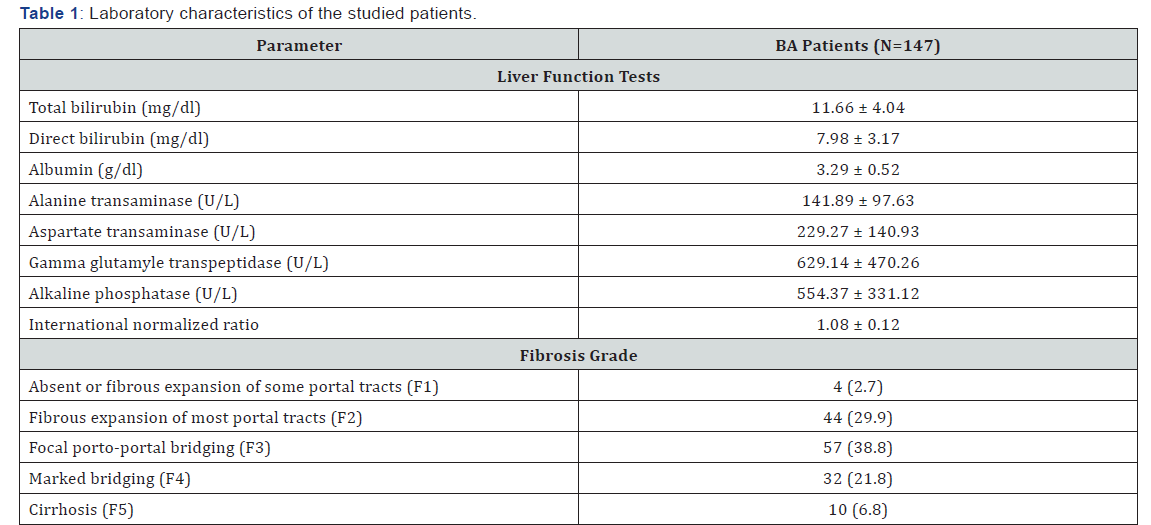
The current study included 147 infants with BA. Their mean age was 76 ± 41 days and 55% were females. Other baseline laboratory parameters and histopathological fibrosis grades were as presented in Table 1.
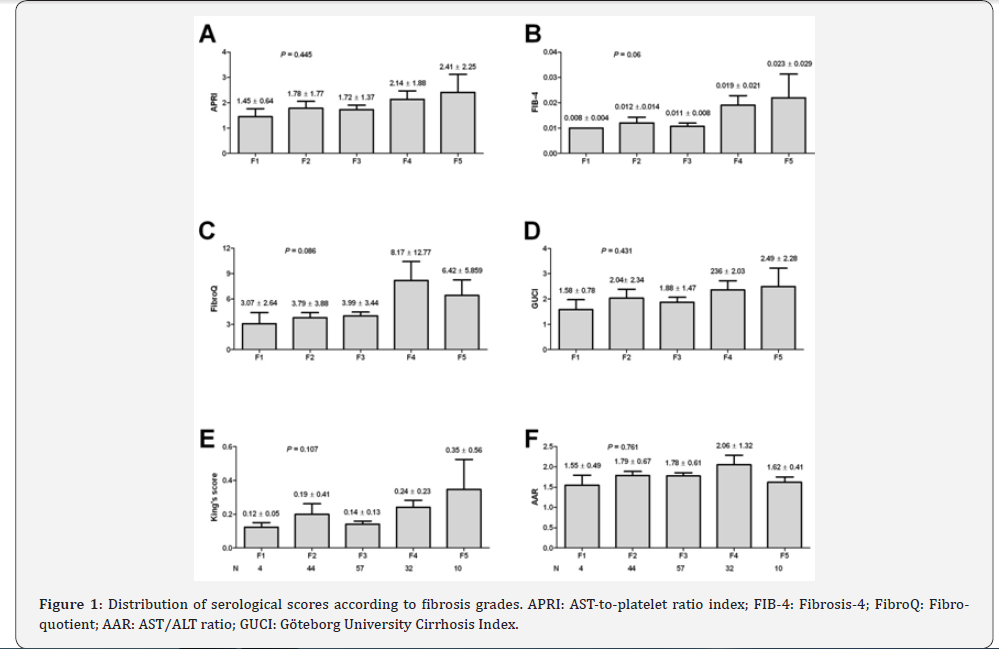
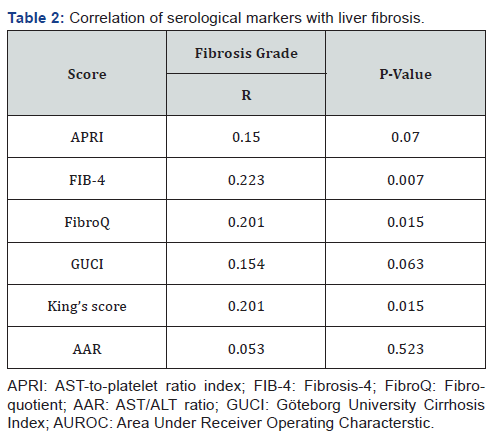
The selected scores were compared according the individual fibrosis grades. In all the six scores, the values were at its lowest in F1 and was highest in F5 except for FibroQ and AAR, the values were lower than that of F4, yet, there was no significant statistical difference among the different grades of fibrosis (Figure 1). On the other hand, correlation analysis revealed a significant positive correlation of FIB-4, FibroQ and King’s scores with fibrosis grades (P values were 0.007 and 0.015 respectively) while there was no significant correlation with the other studied scores (P value >0.05) as shown in Table 2.
APRI: AST-to-platelet ratio index; FIB-4: Fibrosis-4; FibroQ: Fibro-quotient; AAR: AST/ALT ratio; GUCI: Göteborg University Cirrhosis Index.
For descriptive purpose, we arbitrarily divided fibrosis grades into early (F1, F2 and F3) and advanced (F4 and F5) fibrosis. Again, FIB-4, FibroQ and King’s scores showed a significantly higher values in those with advanced fibrosis (P values were 0.007, 0.017 and 0.009 respectively) while there was no significant difference using the other studied scores (P value >0.05) as shown in Table 3.
The three scores (a cutoff value of 0.0098 for FIB-4; 0.0085 for FibroQ and 0.115 for King’s score) showed nearly a comparable performance in discriminating advanced fibrosis (Table 4).
The prognosis of chronic cholestatic diseases depends, in part, on the extent of liver fibrosis [24,25], while it markedly influences the outcome of Kasai protoenterostomy in infants with BA [12]. In addition, it identifies those in need of liver transplantation whether in those who performed a previous Kasai operation or not [26,27] For that follow up of fibrosis progression is of utmost importance. Liver biopsy, being the gold standard in assessment of liver fibrosis, is not largely accepted when repeated, especially in the pediatric population. For that , the use of noninvasive predictor of liver fibrosis is needed [28,29].
Several noninvasive markers and scores have been applied satisfactorily in hepatitis C virus [18] and non-alcoholic fatty liver diseases [30], while studies on its use in BA are very limited. APRI score has been used in predicting liver fibrosis in BA. Yet, the results are contradictory. Kim et al. [31] reported that APRI significantly discriminated F3 and F4 Metavir score in infants with BA. AUROC for F≥3 and F=4 were 0.92 and 0.91, respectively. Distinct optimal cutoff values of APRI for F≥3 and F=4 were obtained (1.01 and 1.41, respectively). In addition, Grieve et al. [16] using a cutoff value of 1.22 [AUC 0.83] showed a sensitivity of 75% and a specificity of 84% for macroscopic cirrhosis. Native liver survival was significantly different but improved only for those with the lowest APRI quartile (P=0.009). Similar results were also reported by Yang et al. [32].
On the other hand, Lind et al. [33] found that APRI did not significantly differ in various fibrosis Metavir scores (P = 0.89) and was not correlated with transplant-free survival (r=0.08; P=0.67) in infants with BA. Our results are in agreement with that of Lind et al where APRI value neither differ significantly with different Russo fibrosis grades (P = 0.445) nor correlated with fibrosis (r=0.15; P = 0.07). Nonetheless, APRI values increased successively as fibrosis increases with its lowest in F1 and highest in F5.
Other scores have been used in predicting fibrosis in HCV, all of which are dependent on the routine laboratory tests regularly performed in these patients. Leung et al. [34] found that APRI performed better than FIB-4 in predicting fibrosis studied in children with cystic fibrosis liver disease. In the current study, contrary to APRI, FIB-4 was significantly correlated with fibrosis in BA (P = 0.007) and was significantly higher in those with advanced fibrosis (Russo F4 and F5; P=0.007). With AUROC of 0.644, FIB-4 could predict advanced fibrosis with 61.9% sensitivity and 61.9% specificity. On the other hand, Chen et al. [35] reported that FIB-4 failed to correlate with fibrosis stage. This may be due to the small number of patients in Chen’s study (n = 24) compared to our study (n = 147).
GUCI and AAR were able to predict fibrosis in HCV and hepatocellular carcinoma in addition to predicting response to antiviral therapy [36-38]. In our study, both scores were not correlated with liver fibrosis (P = 0.063 and 0.523 for GUCI and AAR respectively) and could not discriminate advanced from early fibrosis. Unfortunately, there are no reported studies for their use in BA.
On the other hand, FibroQ and King’s score showed a significant positive correlation with fibrosis grade (P = 0.015 for both) and at a cutoff value of 0.085 and 0.115 respectively, both could discriminate advanced fibrosis from early fibrosis with comparable sensitivity (64.3% for both) and specificity (60.0% and 62.9% respectively). King’s score has been used in assessing fibrosis in chronic hepatitis B [39] and hepatitis C [21] but no reports about its use in predicting fibrosis in BA. Combining the three scores (FIB-4, FibroQ and King’s score) did not improve the performance compared to the performance of each score individually. Although statistically significant, the performance of these scores was found to be better in adult studies with chronic hepatitis C. This may be due to the fibrogenic nature of BA and the relatively high platelet counts even in cases with advanced fibrosis [40] which may influence the performance of platelet count-based scores.
In conclusion, FIB-4, FibroQ and King’s, but not APRI, GUCI or AAR, correlated significantly with fibrosis grade in infants with BA. These noninvasive serological markers, which are derived from simple routine laboratory tests, may be of help in predicting advanced fibrosis and in long term follow up of infants with BA, and minimize the need for repeated follow up liver biopsies.
Telomeres are structures at the ends of eukaryotic chromosomes and consist of tandemly repeated DNA sequences. Telomeres shorten with each cell division, and it is well known that telomere length in peripheral blood mononuclear cells (PBMCs) decreases with age. High oxidative stress can lead to accelerated telomere shortening, which causes premature cell senescence. In summary, this review shows the short Telomere Length has been identified in a limited number of population studies as a risk factor for development of T2DM. Also, it is importantly to notice the antioxidant properties of Curcumin which may play a key role in the prevention and treatment of premature aging while preserving the length of the telomeres.
Diabetes Mellitus 2 (T2DM) is a multifactorial complex disorder which is emerging as a major cause of morbidity and mortality [1]. Telomeres are structures located at the extreme ends of chromosomes and are considered as indicators of biological age [2]. Increased telomere shortening has been demonstrated in several diseases, including diabetes type [3-6]. Telomere shortening increases with the diabetes duration, in our study, we established the potential importance of telomere dynamics in T2DM. We associated the time of disease duration closely in parallel to the progressive increased of inflammation and/or oxidative stress and both played a direct role in telomere shortening [7]. However, a study based on Chinese population found no relationship between Telomere Length and either the onset time or the Diabetes Mellitus 2 duration [8]. Genetic regulation of telomere could potentially explain telomere shortening and also an increased risk for Diabetes Mellitus 2. Zee et al. [9], analyzed 11 telomere pathway genes and their relationship to the development of Diabetes Mellitus 2. A total of eleven tSNPs within TERF1, TNKS, TEP1, ACD and TERF2 were associated with Diabetes Mellitus 2 risk [9]. These findings suggest that genetic variation within the telomere pathway gene loci examined may be a useful predictor for Diabetes Mellitus 2 risk assessment [10,11]. Paik JK, et al. [12], did not observe an association between the selected TL-related SNPs and the presence of Hypertension and Coronary Heart Disease in [12]. These findings tell us the great importance of telomere dynamics in T2DM and the need for translational research.
Endogenous factors that cause telomere shortening are aging inflammation and oxidative stress. Telomere attrition (expressed in WBCs) can serve as a biomarker of the cumulative oxidative stress and inflammation [13,14]. The association of UCP2 gene involved in the production of reactive oxygen species and functional promoter variant in mitochondria with the telomere length implies a link between mitochondrial production of reactive oxygen species and shorter telomere length in Diabetes Mellitus 2 [15]. Oxidative stress exerts a major influence on telomere dynamics by two principal mechanisms; firstly, the GGG triples on the telomere sequence are highly sensitive to the hydroxyl radical. Masi et al. [16] demonstrated that antioxidant defenses are important to maintain telomere integrity, potentially reducing the progression of vascular ageing in patients with T2DM. Secondly in contrast to genomic DNA, telomeric DNA was reported to be deficient in the repair of single-strand breaks. Consequently telomeres appear to be especially vulnerable to the accumulation of ROS-induced DNA- strand breaks [17,18].
Recent studies propose that telomere shortening and abnormal telomerase activity occur in patients with diabetes mellitus 2 and targeting the telomere-telomerase system has become a prospective treatment for diabetes mellitus [19]. Dietary supplementation of antioxidants has been proposed as alternative treatment to reduce oxidative stress caused by obesity and diabetes. Different studies have shown that curcumin has antioxidant and antihyperglycemic properties in diabetes and obese animal models [20-24]. Hyperglycemia modifies oxygen consumption rate, NO synthesis and increases TBARS levels in mitochondria from the liver and kidneys of diabetic mice, whereas curcumin may has a protective role against these alteration [25-27]. Antioxidant properties of curcumin could play a key role in the prevention and treatment of chronic inflammation diseases [28]. Zhou et al. [29] demonstrated that diet ingredients significantly have an impact on inflammation and oxidative stress markers, which probably also have an effect on Telomere Length. Diabetes patients with normal plasma glucose levels had longer Telomere Length [29].
Telomere Length has been identified in a limited number of population studies as a risk factor for development of T2DM, antioxidant defences are important to maintain telomere integrity, Curcumin which may play a key role in the prevention and treatment of premature aging while preserving the length of the telomeres.