Showing posts with label Graves’ Disease. Show all posts

Monday, February 19, 2024

Alternating Graves’ Hyperthyroidism and Hashimoto’s Hypothyroidism for more than 20 Years: A Case Report - Juniper Publishers

 Endocrinology and Thyroid Research - Juniper Publishers


Abstract

Background: Graves’ disease (GD) and Hashimoto thyroiditis (HT) are autoimmune thyroid diseases. Around 20% of patients with GD develop spontaneously Hashimoto hypothyroid, contrarily, with less frequency occurred that a patient with HT became hyperthyroid during its clinical course. In the present case, a patient shows spontaneous oscillations of her thyroid function over a period of 21 years.

Case report: A 78-year-old woman presented GD, her medical history was notable for had been diagnosed with GD at 58-year-old, she was treated for 18 months with antithyroid drug (ATD). After withdrawal of ATD, she remained in remission for 9 years. Later, she developed HT with frank hypothyroidism, and was treated with levothyroxine for 12 years. At the end of this period, she had Graves’ hyperthyroidism again and was treated with Metimazole for 14 months before returning to hypothyroidism.

Conclusion: there are very rare cases that have an oscillating course, alternating GD, and HT for decades, whose pathogenesis is pending clarification. This case supports the view that GD and HT are two ends of the same spectrum.

Keywords: Graves’ disease 1; Hashimoto thyroiditis 2; autoimmune thyroid disease 3.

Abbreviations: AITD: Autoimmune thyroid diseases; HT: Hashimoto’s thyroiditis; GD: Graves’ disease

Introduction

Autoimmune thyroid diseases (AITD) are organ-specific autoimmune diseases. AITD are the most prevalent alterations that affect the thyroid gland. AITD comprises interrelates conditions: Hashimoto’s thyroiditis (HT), Graves’ disease (GD), atrophic autoimmune hypothyroidism, postpartum thyroiditis, the first two being the most prevalent. The common pathological feature of AITD is the presence of lymphocytic, mainly T cells infiltrate the thyroid gland that may progressively replace the thyroid tissue. Variable thyroid follicular cell atrophy and fibrosis are characteristic of HT, while in GD thyroid follicles are hypertrophied. Anti-tiroperoxidase antibodies (TPOAb) are a sensitive marker of ATID both in HT and GD. Thyroid stimulating hormone receptor antibodies (TSHR-Ab) are characteristic of GD and responsible for hyperthyroidism [1]. One form of AITD may change to another as the course of the immune process progresses [1]. Around 12 % - 20% of patients with GD spontaneously develop Hashimoto hypothyroid after antithyroid drug (ATD) discontinuation [2-4]. Contrarily, with less frequency occurred that a patient with HT became hyperthyroid during its clinical course [5]. In the present case, a patient shows spontaneous oscillations of her thyroid function over a period of 21 years.

Case Presentation

A 78-year-old woman, with anxiety begins to be noticed from about 6 months. Three months later, she added to her symptomatology palpitations, dyspnea and edema in the lower extremities that increase in intensity slowly. Then she requests medical attention in an endocrinology consultation. She was diagnosed with hypothyroidism 12 years ago and treated with 75 mcg/day of levothyroxine. She had not done control thyroid tests for 2 years due to the covid-19 pandemic. A month before the Endocrine consultation, she was attended in a primary care center, for worsening of dyspnea, palpitations, and increased edema in the lower extremities and tachyarrhythmia. Thyroid function tests were done, showed elevation of free T4 and decrease in TSH levels, doctor recommended reducing the dose of levothyroxine to 25 mcg /day, added diuretic (Furosamide) and beta-adrenergic blocker (Bisoprolol) drug to her treatment. Two weeks later due to worsening of her symptoms, she came to our Endocrine office.

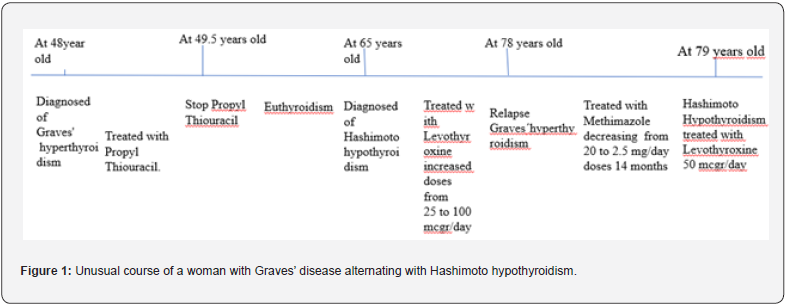
Personal medical history was notable for having been diagnosed with Graves’ hyperthyroidism at 58-years-old when living in Houston (USA), she was treated for 18 months with ATD (Propyl-thiouracil). After withdrawal of ATD, she remained in remission for 9 years. Later, she developed Hashimoto’ thyroiditis with frank hypothyroidism, treated with increasing doses of levothyroxine for 12 years. Physical examination revealed a female patient 1.60 meters tall, and 59 kg weight. Blood pressure 150/100, the patient had frank dyspnea, with a fibrillar tremor in both hands, pulse 100/min, with frequent extrasystoles. She also had edema in both ankles. She was diagnosed with relapse of Graves’ hyperthyroidism, and prescribed as treatment: rest, suppress levothyroxine, and administration of Methylmazole (MMI) of 5 mg, 4 tablets per day, and Bisoprolol 2.5 mg every 12 hours. It is also recommended to quit smoking.

Six weeks later, the patients felt better, presented light dyspnea, rhythmic pulse at 76 beats per minute, no edema. The thyroid function test showed Free T4, Free T3, and TSH within the reference values (Table 1). MMI doses were reduced to 2 tablets per day. Two months later she was asymptomatic with thyroid function test within reference values. MMI dose was reduced to 1 tablet per day. Eight weeks later, in view of the results of the thyroid function tests, MMI were reduced to 1 tablet 5 days and a half tablet 2 days. Two weeks after she became to fill anxiety and palpitations, a new function test performed 4 weeks later, revealed a slight increase of Free T4 and Free T3, Table 1, and then MMI dose was increased to 1 tablet per day. The symptoms disappear 10 days later. MMI was maintained until the levels of anti-TSH receptor antibodies were negative. Fourteen months after the diagnosis of GD recurrence, and two months after MMI withdrawal she again presented hypothyroidism demanding treatment with levothyroxine (Figure 1).
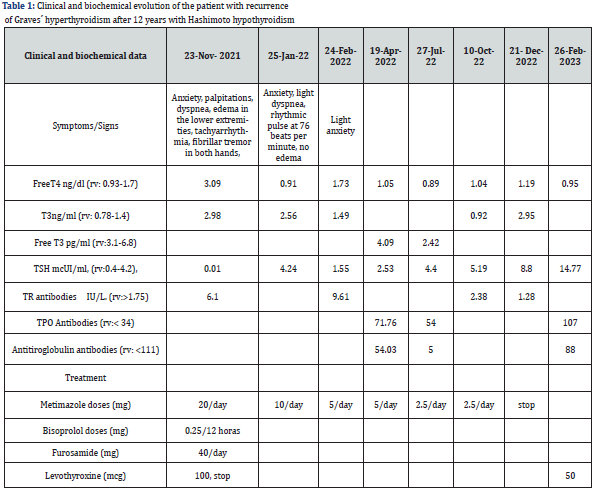
The hormone tests performed included determinations of serum Free T4 (FT4) (reference values: 0.93-1.71 ng/dl), Free T3 (FT3) (reference values: 2.55-4.33 pg/ml), Thyrotropin hormone (TSH) (reference values: 0.30-4.50 mUI/L), all of which were analyzed by an immunochemiluminescent assay, IMMULITE (Diagnostic Products Corp. Los Angeles, CA, USA). The levels of both Thyroid peroxidase antibodies (TPOAb) and thyroglobulin antibodies (TgAb) were measured by a chemiluminiscent assay (Immulite 2000, Diagnostic product Corp, Los Angeles, CA, USA, with reference values of 0-30 and 0-40 mIU/ml respectively. The concentration of Thyroid receptor antibodies (TRAb) (reference values 0-10 IU/L) was measured using a radioreceptor assay (TRAK-assay; Henning, Berlin, Germany). The intra-assay and inter-assay CVs were 5% and 7.5% respectively. South Galicia is an area with sufficient iodine intake [6]. Long-term remission was defined as the absence of clinical manifestations of hyperthyroidism, together with biochemical euthyroidism and negative TRAb values, at least 12 months following the withdrawal of ATDs [7].

Discussion

Autoimmune thyroid disease results from dysregulation of the immune system leading to an immune attack of the thyroid gland. The AITD comprise two main clinical presentations: HT and GD. The clinical hallmark of these conditions is hypothyroidism and hyperthyroidism, respectively. One form of clinical presentation can change to another as the immunological process progresses. There have been cases of patients switching from Graves’ hyperthyroidism to Hashimoto hypothyroidism, being less frequent patients switching from hypothyroidism to hyperthyroidism [8], due to the critical loss of thyroid mass that can respond with TSHR Ab [9], although it is described some patient who developed frank hyperthyroidism and required treatment with ATD [10]. The shift from Graves’ disease to Hashimoto’s disease and vice versa in the same patient suggests that both would be the same disease that can be expressed in two ways. However, genetic studies indicate that GD and HT are modestly related diseases [11].

In the present case report, a woman initially diagnosed with Graves’ hyperthyroidism treated with ATD for two years. After withdrawal of ATD she remained in remission for 9 years. After which she developed Hashimoto’s thyroiditis, being treated with increasing doses of levothyroxine. Twelve years later, frank Graves’ hyperthyroidism requires treatment with ATD. She was treated with MMI for 14 months. Finally, after two months of withdrawal ATD she developed Hashimoto’s hypothyroidism needing small doses of levothyroxine. Cases of alternating hyperthyroidism and hypothyroidism are very rare [12]. The unusual course of this case supports the view that it is the same disease that can be expressed from both hyper- and hypothyroidism.

Some authors postulated that the pathogenesis of patients alternating hyperthyroidism and hypothyroidism is due to the balance between the levels of stimulating TSHR-Ab with thyroid Blocking hormone receptor antibodies (TBHR-Ab) [13]. However, in patients with long-term course, when presented HT, follicular cells are destroyed to a variable extent, depending on the chronicity of the HT related hypothyroidism [14], and for the development of frank hyperthyroidism requires a restoration, at least partially, of the mass of follicular cells of the thyroid. Thus, the pathogenesis of such a phenomenon is pending clarification.

This case also draws attention to the fact that we must bear in mind that patients with long-standing autoimmune hypothyroidism can be transformed into frank hyperthyroid ism, which requires diagnosis and treatment without delay. Some authors believe that given the unpredictability of the diseases in these patients who alternate hyperthyroidism and hypothyroidism, ablative treatment would be advised [10]. In my opinion, educating patients and their families about the nature of the disease, its clinical characteristics, and an annual follow-up, can be sufficient to manage these cases properly, avoiding postablative hypothyroidism that is not easy to handle, in addition, if we avoid ablative treatment, we can know the natural history of Graves’ disease in more patients, without any added risk [15].

Conclusion

Although very rare, there are cases of patients who spontaneously alternate long-term periods of Graves’ hyperthyroidism with Hashimoto related hypothyroidism for decades, whose pathogenesis is pending of clarification. The present case supports the view that GD and HT are two ends of the same spectrum. Clinicians must also keep in mind that although rare, these cases exist and require diagnosis and treatment without delay.


To Know more about our Juniper Publishers

Wednesday, May 11, 2022

Particularities of Graves’ Disease in Diabetes Mellitus - Juniper Publishers

Endocrinology and Thyroid Research - Juniper Publishers

Abstract

Graves’ disease and diabetes mellitus (DM) are frequently associated pathologies. The excess of thyroid hormones influences the carbohydrate homeostasis through their action on several organs, leading to alteration of glycemic control and acute hyperglycemic complications in patients with diabetes mellitus. On the other hand, a severe pre-existing metabolic imbalance can mask a life-threatening thyroid crisis, by lowering the thyroid hormones levels, especially triiodothyronine (T3). The prevalence of Graves’ disease is higher in patients with type 1 diabetes mellitus (T1DM). Besides the impact on the glycemic control, Graves’ disease has a high cardiovascular risk, in addition to DM. This is why the thyroid dysfunction screening is so important in patients with DM. These two endocrinopathies may be clinically similar, according to the overlapping signs and symptoms at the start which may cause differential diagnosis problems. Graves’ ophthalmopathy is one of the most specific clinical manifestation of Grave’s disease, being frequently associated with type 2 diabetes mellitus (T2DM). Its severity seems to be closely related to obesity, duration of diabetes, micro and macrovascular complications of diabetes and some types of oral hypoglycemic agents. Oral hypoglycemic agents also influence the thyroid function. Biguanides belong to the most studied therapeutic class. It is very important monitoring the blood glucose until the thyroid function gets normal by antithyroid agents, as well as the thyroid hormones in case of severe glycemic imbalance. Special attention must be paid to the type of treatment we use and its impact on metabolic and hormonal balance.

Keywords: Graves’ disease; Diabetes mellitus; Graves’ ophthalmopathy

Introduction

Thyroid dysfunctions are frequently associated with DM, hence the definition of glucocrinology, which underlines the important effect of thyroid hormones on carbohydrate metabolism [1]. Graves’ disease is the most frequent cause of hyperthyroidism and is characterized by high serum titer of TSH receptor autoantibodies (TRAb) with stimulatory effect. Diffuse goiter, Graves’ ophthalmopathy and dermopathy are the typical clinical manifestations of Graves’ disease. Their simultaneous presence is not mandatory, and they evolve independently from one another [2]. Because of its autoimmune pathogenesis, Graves’ disease is more commonly encountered with T1DM in polyglandular autoimmune syndromes type II and III. Glycemic imbalance appears either as excess thyroid hormones consequence or independent of thyroid function, regarding the association with T2DM [3]. DM is an important risk factor for Graves’ ophthalmopathy evolution, patients with T2DM often presenting impairment of ocular motility, diplopia and marked exophthalmia [4]. The aim of this study is to reveal the features of the association between Graves’ disease and DM from a metabolic, clinical-paraclinical and therapeutic point of view.

Epidemiology

Over time, there have been realized multiple surveys that have analysed the prevalence of thyroid dysfunction associated with DM and all of them have shown a strong correlation between these two pathologies. The largest study published until 2014 conducted on a group of 7079 children and adolescents with thyroid dysfunction and T1DM reported impaired thyroid function in 9,5% of them [5]. Moreover, about 0,5% of adolescents with T1DM also have Graves’ disease [6]. According to American Diabetes Association (ADA) guidelines 2020, 17% to 30% of T1DM patients associate autoimmune thyroid disease [7]. “The Colorado Thyroid Disease Prevalence Study” illustrated low TSH value in 2,2% of subjects [8]. National Health and Nutrition Examination Survey (NHANES III study) reported the prevalence of hyperthyroidism and subclinical hyperthyroidism as 1,3% and 2% respectively [8,9].

A study by a Romanian researcher was published in 2014 in European Scientific Journal showing that Graves’ disease is frequently associated with DM, without any significant gender differences. On the other hand, Graves’ disease prevalence was higher in T2DM subgroup patients (20,68%) than in T1DM (10%). It also had been shown that thyroid disease is 2-3 times more common in DM patients than non-diabetics [3]. A European meta-analysis reported the prevalence of thyroid dysfunction between 9,9% and 48% in T2DM patients and only 3,82% in the general population [10]. The prevalence of thyroid disorder is 33% in patients with T1DM [7].

According to estimates, 10,8% of those with thyroid dysfunction also have DM and about 12% of patients with hyperthyroidism suffers from DM at the same time [11]. Among children with T1DM about a quarter of them present anti-thyroid autoantibodies [7]. Also, children with Graves’ disease have greater tendency to associate or develop T1DM later [11]. Graves’ disease and T1DM are part of polyglandular autoimmune syndromes type II and III [12]. A recently published adult study has shown that 13.7% of newly diagnosed Graves’ disease patients also have anti-islet cell autoantibodies. Although the association of any type of diabetes was more likely to them, it has been shown that there is no significant correlation between anti-islet cell autoantibodies and the development of diabetes over time [13,14].

Screening of Thyroid Dysfunction in Diabetes Mellitus Patients

The clinical features of poor controlled Graves’ disease and T1DM or insulin requiring T2DM can overlap, being characterized by alterations in weigh and appetite. On the other hand, the existence of hyperthyroidism may cause insufficient glycemic control and ketoacidosis eventually. Both hyperthyroidism and DM have a high cardiovascular risk. The combination of the two endocrinopathies can lead to increased cardiovascular mortality which is an additional argument for the necessity of screening [5,10]. Most guidelines recommend thyroid dysfunction screening for T1DM without mention of T2DM.

The latest ADA 2020 guidelines recommend autoimmune thyroid disorder screening right after T1DM diagnosis and then regularly. For children and adolescents, anti-TPO and anti-thyroglobulin antibodies will be titrated shortly after T1DM diagnosis. TSH serum level dosing is performed with T1DM diagnosis when the patient is clinically stable. Otherwise, TSH concentration measurement is recommended when efficient glycemic control. Later, patients with normal TSH serum level and T1DM will be re-evaluated at 1-2 years or even often if: they develop suggestive signs and symptoms for thyroid dysfunction, anti-thyroid autoantibodies are positive, thyromegaly, abnormal growth rate or unexplained glycemic variability appear [7].

Thyroid dysfunction screening in T2DM is not usually recommended. However, it may be indicated in several selected cases presenting markers of dyslipidemia or autoantibodies. The serum level of thyroid hormones can also be dosed, mentioning that freeT3 (FT3) and freeT4 (FT4) are preferred in patients with acute conditions. It requires special attention for DM patients with severe hyperglicemia when talking about the laboratory tests results. The thyroid hormones serum level is low in this case, especially T3, situation that leads to masked life threatening “thyroid storm” [5,15].

Moreover, if Graves’ disease is suspected, it may be used additional tests like TRAb serum level, thyroid ultrasound, or scintigraphy [16].

A simplified thyroid dysfunction screening strategy based on TSH serum level looks like this:

· All euthyroid T1DM patients are monitored annually.

· Euthyroid T2DM patients are monitored annually if TSH serum level is greater than 2mU/l or anti-TPO antibodies are positive.

· The other patients are evaluated at 3-5 years [10].

Hyperthyroidism Effects on Glycemic Metabolism

The hyperthyroidism can interfere with carbohydrate metabolism through different mechanisms and about half of Graves’ disease patients present low glucose tolerance [10]. Thyroid hormones are active on several organs affecting carbohydrate homeostasis. In the liver they increase phosphoenolpyruvate carboxykinase activity, an enzyme involved in gluconeogenesis stimulation and exacerbates GLUT2 expression in hepatocyte membrane with the release of a large amount of glucose in the blood. They also lower the glycogen level by glycogenolysis stimulations and glycogenesis inhibition secondary to Akt enzyme inactivation involved in glucose storage as glycogen [17,18]. Hepatic gluconeogenesis also takes place via an indirect thyroid hormones effect by catecholamine stimulation, leading to active lipolysis and increased level of free fatty acids. In presence of hyperthyroidism, it is noted a marked muscular glycolysis with secondary hyperlactatemia, lactic acid being another precursor of gluconeogenesis [19].

Marked hepatic glucose release represents the key factor in the occurrence of insulin resistance (IR), hyperinsulinemia and low glucose tolerance. These phenomena cause improper glycemic control in both DM patients and prediabetes, and they are also responsible for the increased risk of hyperglycemic complications like diabetic ketoacidosis [8]. Regarding thyroid hormones effects on beta pancreatic cells, studies show quite heterogeneous results, hyperthyroidism being associated with low, normal or increased insulin secretion. A recent study has shown that thyroid hormones excess leads to altered insulin secretion by decreasing beta pancreatic cell mass and inducing some abnormalities in ATP-dependent potassium channels and calcium L channels [20].

These findings appear to be in contrast with the results of other studies which showed that serum insulin level is high in hyperthyroid patients. Thereby, several authors suggested that thyroid hormones lead to hyperinsulinemia through β adrenergic stimulation [21].To conclude, it is difficult to assess the real quantity of insulin, primarily because in thyroid storm the rise in insulin secretion could be masked by the increased catabolism of insulin or by its accelerated clearance [10]. On gastrointestinal tract, thyroid hormones increase gastrointestinal motility and consequently the glucose absorption, causing postprandial hyperglycemia such as oxyhyperglycemia (rapid increase of serum glucose level after the ingestion of glucose) [17].

Thyroid storm is also linked to a high level of oxygen free radicals. Kocic et al. revealed in one of his studies the possible link between oxidative stress induced by hyperthyroidism and diabetes mellitus, showing a high level of serum reactive oxygen species (ROS) in a hyperthyroid patient which further developed DM. Based on the hypothesis that ROS are involved in decreasing insulin sensitivity, some authors suggested that oxidative stress present in hyperthyroid state can lead to DM [18,22].

High BMI, insulin resistance and hyperinsulinemia contribute to the pathogenesis of Graves’ ophthalmopathy in type 2 DM, explaining the severity of orbitopathy among patients with Graves’ disease and type 2 DM. Hyperinsulinemia reduces IGF1 binding proteins and consequently increases IGF1 bioavailability. Like TRAb, IGF1 receptors are overexpressed on preadipocites and orbital fibroblasts and their excessive stimulation promotes an increase in orbital volume both through accentuated adipogenesis and extracellular matrix expansion [4].

Clinical and Biochemical Implications of the Association of Graves Disease and Diabetes Mellitus

Under the phenotypic aspects, characteristics of uncontrolled DM and Graves’ Disease are similar. Patients with type 1 or type 2 poorly controlled DM might have similar clinical characteristics with hyperthyroid patients such as weight loss with increased appetite, unexplained fatigue, alterations in the general condition. Clinical similarities of both endocrinopathies can sometimes create confusions among doctors regarding the right diagnosis. For example, Graves’ dermopathy can be misdiagnosed as diabetic dermopathy [1]. It is well known that DM is an aggravating factor of Graves’ disease symptoms, being a risk factor for Graves’ ophthalmopathy even more important than smoking and moreover, the unique predictive factor for development of diplopia.

The precise mechanisms of how DM influence Graves’ ophthalmopathy’s severity remains unclear. Common autoimmune pathogeny of type 1 DM and Graves’ disease can be one of these mechanisms, but paradoxically some studies showed an increased prevalence of Graves’ ophthalmopathy among patients with type 2 DM in the absence of autoimmunity. Regarding the severity of ophthalmopathy, in patients with type 2 DM, this is frequently asymmetrical with marked proptosis and involvement of soft tissues, more important impairment of ocular motility and more frequent diplopia. In both Graves’ ophthalmopathy and type 2 DM there are changes in adipogenesis and increased inflammation level. Studies suggest that severity of Graves’ ophthalmopathy in patients with type 2 DM is associated with obesity, duration of DM and with the presence of diabetic angiopathy, and no significant correlation was found between its severity and metabolic control [4].

Co-existence of DM and thyroid dysfunction not only affects clinical characteristics, but also the biochemical parameters [5]. DM decreases serum TSH levels and impairs peripheral conversion of thyroid hormones. In addition, long duration of hyperglycemia can further alter thyroid function. Acute diabetes - related complications such as ketoacidosis decrease thyroid hormones level, mainly T3, but maintain TSH in normal ranges [10].

Regarding the biochemical parameters, hyperthyroidism is typically associated with worsening glycemic control until euthyroid state is achieved with antithyroid drugs administration [1]. Hyperthyroidism in patients with insulin-dependent DM not only induce postprandial hyperglycemia, but also increased fasting blood glucose as a result of dawn phenomenon. This effect can be alleviated with improvement in thyroid function [19]. Moreover, levels of glycated hemoglobin and glycated albumin can be altered in patients with hyperthyroidism. HbA1c is not a reliable marker of glycemic control in hyperthyroid patients because of the decline of life-span of erythrocytes caused by the increased cellular turnover. On the other hand, excess of thyroid hormones enhances albumin catabolism that can lead to false positive results of glycemic control when measuring the level of glycate albumin [1,10].

Therapeutic Particularities

Therapeutic goal of Graves’ disease in patients with DM is bidirectional: on one hand to achieve a euthyroid state in context of the metabolic imbalance and on the other hand to ensure optimal glycemic control in the presence of hormonal dysfunction [5]. This therapeutic approach was termed as thyrovigilance in diabetes and glucovigilance in thyroidology, respectively [1]. It is important to monitor glucose level until the normalization of thyroid function under antithyroid drug treatment and also thyroid hormones level in case of a severe glycemic imbalance. In patients with insulin-dependent DM it is often necessary to increase insulin doses when Graves’ disease is diagnosed and step-down titration of insulin after the antithyroid drug treatment is initiated [19]. All therapeutic strategies in Graves’ disease can impair glucose homeostasis.

· Methimazole, first-line therapy in Graves’ disease, can infrequently induce insulin autoimmune syndrome and consequently hypoglycemia [17].

· Corticotherapy used in treatment of thyroid storm and Graves ophthalmopathy leads to hyperglycemia and therefore can unmask latent diabetes. In this case, it is recommended to initiate insulin therapy and to increase insulin doses when severe hyperglycemia occurs [23].

· Betablockers, utilized in the management of tachycardia in hyperthyroid patients, can alter some of the symptoms of hypoglycemia by masking alarm adrenergic signs such as palpitations, tremors and sweats. Moreover, by acting on muscular and hepatic level, β2 selective betablockers inhibit glycogenolysis, preventing thereby the correction of hypoglycemia [24]. Treatment with antithyroid drugs in Graves’ disease is maintained up to 12-18 months and then is stopped to verify the possibility of remission. In case of Graves’ disease recurrence, surgery is recommended (total/partial thyroidectomy) or radioiodine therapy, followed by substitution therapy with levothyroxine (LT4) [16].

· Radioactive Iodine it is accumulated not only in the thyroid tissue but also in others organs including the pancreas. Immunohistochemical studies have shown an increased expression of Sodium/Iodine cotransporter in Langerhans cells leading to local injury of the β pancreatic cells under the influence of radioactive iodine-derived ROS. These ROS, mainly H2O2, activate uncoupling protein-2, decrease mitochondrial ATP production and this way inhibits glucose-induced insulin secretion [25]. However, Kiani et al. showed that radioiodine therapy (5-13 mCi) does not affect IR nor glucose tolerance in patients with Graves’ disease [26]. It seems that the presence of thyroid tissue limits the accumulation of radioactive iodine in the pancreas, thus the alteration in glucose tolerance and even the development of type 2 DM appears particularly in patients who prior suffered a thyroidectomy [27].

· Thyroidectomy – it is well known that surgical removal of thyroid gland in patients with DM and hyperthyroidism has positive effects on restoring the glucose tolerance [8].

· Levothyroxine, according to one study which involved patients with DM and subclinical hypothyroidism, decreases fasting blood glucose level, postprandial glucose level and HbA1C with nearly 0.8% [28]. Oral antidiabetic drugs can influence on their own thyroid hormones’ function and clinical manifestations of Graves’ disease, mostly Graves’ ophthalmopathy.

· Metformin reduces thyroid volume and increases glucagon-like peptide-1 (GLP-1) levels, promoting proliferation of orbital adipocytes [4,10]. A special attention must be paid in patients with levothyroxine substitution, in which metformin decreases TSH levels without affecting FT3 and FT4 levels [29]. These effects can be beneficial in patients with diabetes mellitus and treatment-refractory hypothyroidism (high TSH levels despite the therapy with LT4). The simultaneous administration of metformin and levothyroxine should be avoided because of its effect on reducing LT4 absorption [5]. Studies have indicated that metformin inhibits iodine uptake by thyroid cells and thus may limit the effectiveness of radioiodine treatment [30]. Concerning the influence of biguanides on Graves’ ophthalmopathy evolution, a recent in vitro study has revealed a potential therapeutic effect of metformin by inhibiting adipogenesis, synthesis of hyaluronic acid and production of proinflammatory molecules in orbital fibroblasts [31].

· Old sulfonylureas can cause enlargement of thyroid gland and inhibit thyroid hormone synthesis [1].

· Thiazolidinediones promote adipogenesis, increase retroocular adipose tissue and enhance the expression of TSH receptor in orbital preadipocytes and fibroblasts [32]. Pioglitazone reduces FT4 concentration with secondary increase in TSH level and can lead to orbital edema by increasing IGF-1 [33].

Conclusion

Graves’ disease is frequently associated with DM, its prevalence being higher in T1DM patients. On the other hand, Graves’ ophtalmopathy is more common and more severe in T2DM patients. Thyroid dysfunction screening is important in DM patients in order to prevent the possible diabetic complications caused by inadequate hormonal activity, but also to decrease the cumulative cardiovascular risk. The hyperthyroidism interferes with carbohydrate metabolism through thyroid hormones action on several levels, leading to insulin resistance and glucose intolerance in the end. The management of Graves’ disease in DM patients is bidirectional and it is based on thyrovigilance and glucovigilance. Patients with diabetes may need high doses of insulin until their thyroid function returns to normal, in Graves’ disease context. On the other hand, therapeutic strategies addressed in Graves’ disease can influence carbohydrate homeostasis. Methimazole, the treatment of choice for Graves’ disease rarely induces hypoglycemia, while betablockers can lead to masked hypoglycemia. Additionally, oral antidiabetic drugs used to achieve good glycemic control can influence thyroid hormones and clinical signs of Graves’ disease, especially the ophtalmopathy. Therefore, the management of patients with Graves’ disease associated with DM is complex, including aspects related to diagnosis, clinical manifestations, laboratory test results and finally choosing the best therapeutic approach with bidirectional positive effects.

Planned Abortion Post COVID-19 - Juniper Publishers

  Public Health - Juniper Publishers Abstract Reproductive health policies, focused on the decriminalization of abortion, have effects on th...