Showing posts with label disease dynamics. Show all posts

Tuesday, January 28, 2020

Heavy Metal Bioaccumulation by Cestode Parasites of Mustelus Schmitti (Chondrichthyes: Carcharhiniformes), from the Bahía Blanca Estuary, Argentina-Juniper Publishers

Journal of Dairy & Veterinary Sciences


The environment of the Bahía Blanca estuary is considered a hot spot in terms of pollution. Bioindicators should have the ability to react relatively fast to certain pollutants and environmental disturbances. Therefore, an exploratory study was carried out determining and quantifying the concentrations of cadmium (Cd), chromium (Cr), copper (Cu), lead (Pb) and zinc (Zn) in the muscle and liver of Mustelus schmitti narrownose smooth-hound and were compared with the values obtained from their respective helminth assemblies. In most of the fishes analyzed, the concentration of heavy metals was higher in the infra communities of cestodes compared to the host. Our results position the cestodes as efficient sentinel species of pollution by bioaccumulating higher concentrations of heavy metals than the host tissues, thus behaving in excellent early warnings of environmental pollution, more real than quantifications in sediments, in water and fish
Keywords: Heavy metals; Bioaccumulation; Sentinels parasites

Introduction

The estuary of Bahía Blanca (39° 03′44 ″ S 62° 04′00 ″ W) is an adequate environment to develop pollution studies, considering that it is an area that includes urban centers, several industrial parks and deep-water ports. All the effluents are discharged with different degrees of pretreatment, so they generate different impacts on the ecosystem. In environmental monitoring to detect heavy metals, organisms are often used as bioindicators, which have the ability to react relatively fast to certain toxic products and environmental disturbances. Some of these organisms, such as parasites, may be highly sensitive to brief exposures, poorly detected in water, sediment or fish [1-5]. Our previous studies in the estuary have focused on evaluating the parasitism of fish in the time scale to be able to compare and analyze them as effect indicators altering some parasites population parameter such as prevalence and abundance or causing symptoms in their hosts in response to environmental disturbances [6-10]. The narrownose smooth-hound Mustelus schmitti Springer, 1939 is a resident fish of the estuary of Bahía Blanca and third in importance as a fishing resource. Based on the fact that some parasites, such as cestodes, have the ability to absorb and accumulate more chemicals than their host tissues [11].
The objective of the present study was to analyze whether a higher concentration of metals in the parasites respect to their host was applicable in the cestodes- narrownose smooth-hound model and to evaluate if these helminths possess ecotoxicological value and could be used in the study area as early bioindicators of anthropic impact. Therefore, an exploratory study was carried out in order to determine and quantify the cadmium (Cd), chromium (Cr), copper (Cu), lead (Pb) and zinc (Zn) concentrations in the muscle and liver of the narrownose smooth-hound and compared with the values obtained from their respective cestode assemblages (Dollfusiella sp., Orygmatobothrium schmittii, Calliobothrium australis and Symcallio sp.) The samples were analyzed by Inductive Coupling Plasma Atomic Emission Spectrometer (ICP-AES, LANAQUI-CERZOS-CONICET-UNS). The values were compared with the limit values allowed by the European Union for fish meat.

Results and Discussion

In most of the fishes analyzed, the concentration of heavy metals was higher in the infra communities of cestodes compared to each host. The parasites concentrated 270 times more Cadmium than the fish muscle. For this metal, the standards established in the liver and those of the parasites were exceeding the limits established by the European Union for muscle or liver. Chromium was bioconcentrated in the cestodes two times more than the muscle and six times more than the liver. Copper was accumulated with values 65 times more than muscle and up to four times more than in the liver. Lead had values 48 times more in helminths than both muscle and liver of fishes. For this metal in most dosages, the concentration measured in parasites exceeded the limit value established by the European Union. Zinc bioaccumulated in parasites seven times more than muscle and four times more than liver. Only in one case the Zinc concentration was three times higher in the liver than in parasites.
The environment of the Bahía Blanca estuary is considered a hot spot in terms of pollution and is included among the most eutrophic coastal ecosystems known [12]. Also, since many years it have been reported high concentrations of heavy metals and pesticides in water and sediments [13,14]. The combined effect of these pollutants, plus the sewage discharge, the industrial effluents of petrochemical origins, and the overheated water from a thermoelectric power station (620MW) all of them represent a growing threat to the environment. These increase in anthropogenic activity around estuaries, coupled with the persistence of heavy metals, their high toxicity, strong tendency to bioaccumulate, and non-degradability [15], usually affect water. As negative effects it could change the trofic web in the aquatic fauna, eliminate the spawning and larval recruitment sites and a potential decrease in diversity, affecting all the ecosystem [16,17]. That is why the need to choose of efficient bioindicators in the evaluation of the quality of the environment [18].

Conclusion

The estuary of Bahía Blanca is one of the most important in Argentina, having the main deep-water port system in the country. Although fish species can be used as efficient and useful bioindicators, our results position cestodes parasites as sentinel species of contamination for the fact that reported higher concentrations of heavy metals than their hosts. This would avoid possible underestimations in pollution levels by being quantified only in sediments, in water and in fish. 

To Know More About Journal of Dairy & Veterinary sciences  Please click on: juniperpublishers.com/jdvs/index.php 

To Know More About Open Access Journals Please click on: ttps://juniperpublishers.com/index.php

Tuesday, January 14, 2020

Biological Efficient Dairy Cows in Grazing Systems-Juniper Publishers

Journal of Dairy & Veterinary sciences

The availability of indicators that would help to avoid the overvaluation of one of the characteristics involved in the assessment of a good dairy cow over others that are important as well would also allow identifying the most adapted biotypes to the different environments existing at the place of the evaluation This article aims to discuss the need to use several productive and reproductive indicators when measuring the biological efficiency of a dairy cow in grazing systems. It was used retrospective data corresponding to the lactations of 300 primiparous and multiparous cows of the Holstein breed - American-Canadian biotype, along with records of their entire productive life, from their incorporation into the system until their sale or death. The animals were divided into two categories: pure cows (PC, n = 120) and cows in the breeding record (CBR, n = 180). It is observed that there are two different strategies in some variables that achieve the same biological efficiency, where the CBRs live longer, produce less and have smaller first delivery intervals. There are no significant differences in the milk index but in the fat index. It is concluded that the greater individual production does not guarantee a greater production at the end of the productive life of the cow, nor a greater productive efficiency when considering the time involved to produce a certain amount of liters. In grazing systems, the contribution of other variables included in the milk index - longevity, rearing efficiency and reproductive behavior - should be considered while searching for an aggregate indicator that tends to achieve greater productive efficiency.
Keywords: Dairy cows; Indicators; Efficiency; Grazing Systems

Introduction

The notable increase in the productive performance and size of these modern high-production cows has been made possible by the repeated and asymmetric use of a selection based exclusively on milk production. Although this process has been accompanied by changes in the nutritional area, these have not been sufficient to prevent vital function deterioration such as reproduction and survival. It becomes increasingly difficult to provide a non-limiting environment, being almost impossible during the initial phase of lactation [1]. The efficiency of a productive system is one of the most important factors from an economic and social point of view. And the most used modality to evaluate it is assessing indicators of biological and economic productivity. However, when producing in conditions where resources are scarce and expensive (grazing systems), not only products or outputs but also inputs should be considered when evaluating efficiency. In the particular case of high production dairy cows, the traits associated with biological efficiency or fitness (reproduction and longevity) have deteriorated despite their importance for the viability of the company [2,3].
Suggest that the sustainability of dairy systems depends, to a large extent, on the availability of a biotype adapted to the handling conditions and that it is capable of efficiently transforming food into good quality milk. This biotype must have a good reproductive performance, being the main goal of the system to maximize an efficient productive response per unit area [4]. The search for the maximization of the value of a single productive variable disregarding the remaining variables can alter the equilibrium and deteriorate the overall efficiency of productive systems [5]. Every open system processes the inputs received and generates outputs. In productive systems, the concept of efficiency refers to the most appropriate way to use resources with existing technology and products.
As a result of this positioning, it is considered that a production process is efficient if the maximum output is obtained with the lowest possible inputs [6]. In dairy production, the expression “maximize outputs” may have different connotations: maximize individual production during lactation or maximize production considering the entire life of the cow, reproductive success should be considered in the analysis. The amount of milk produced by a cow can be considered the most important indicator in intensive systems, even though, this indicator alone is not the most appropriate to make operational a complex variable like productive efficiency, when the goal is to make the most out of grazing systems. In these cases, it should be complemented, or even replaced, by other more aggregated indicators that constitute alternatives as a more comprehensive measure to assess the behavior of production in those systems in which pasture is the basic component of the diet.
The availability of indicators of this nature would help to avoid the overvaluation of one of the characteristics involved in the assessment of a good dairy cow over others that are important as well. It would also allow identifying the most adapted biotypes to the different environments existing at the place of the evaluation [7]. This article aims to discuss the need to use several productive and reproductive indicators when measuring the biological efficiency of a dairy cow in grazing systems.

What Is Efficiency

Efficiency is the relationship between an income and an expense, between an input and an output or between a resource and a product [8]. When measuring efficiency, it is necessary to specify exactly which elements are used to evaluate the result through a relation of its values. And to define the units used to measure the values of these elements. The concept of efficiency refers to a relationship between elements and that the circumstances in which the relationship is established have a high specificity. As a consequence, the term itself is very relative, and any value that can be considered as good or low is even more so [8].

How to Measure Efficiency

The advantages of grazing systems are sought within the framework of this approach, in which the cow is provided directly with the necessary input to meet its food requirements, without the need for transportation, processing or distribution of rations [9]. Although it is the most widespread modality, the amount of milk produced by a cow does not represent the most appropriate indicator to make operational a complex variable as productive efficiency. As such, it should be complemented or replaced by other more aggregated indicators creating alternatives for a more comprehensive production measurement to assess their performance in grazing systems. The availability of indicators of this nature would help to avoid the overvaluation of one of the characteristics involved in the assessment of a good dairy cow over others that are important as well. It would also allow identifying the most adapted biotypes to the different environments existing at the place of the evaluation [10].
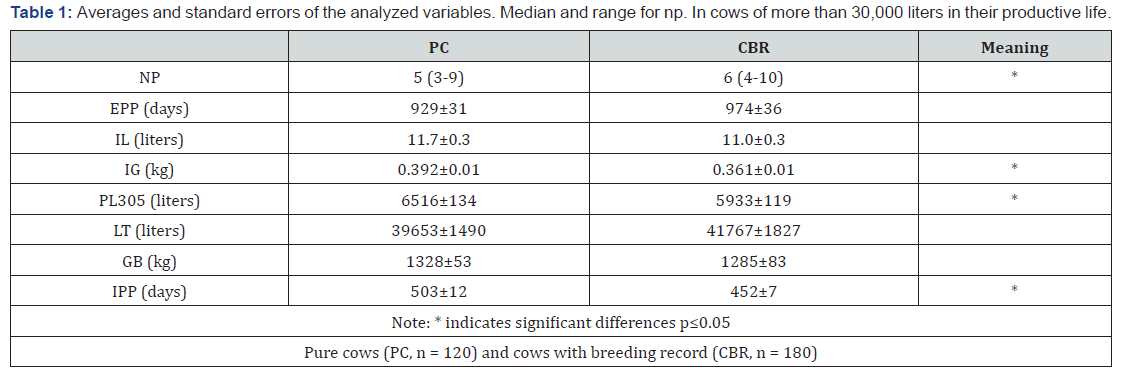
It was used retrospective data corresponding to the lactations of 300 primiparous and multiparous cows of the Holstein breed - American-Canadian biotype, along with records of their entire productive life, from their incorporation into the system until their sale or death. The animals were divided into two categories: pure cows (PC, n = 120) and cows in the breeding record (CBR, n = 180). The existence of significant differences in the assessed time between groups was studied by applying variance analysis to a classification criterion. JMP 5.0 for Windows (JMP®, SAS Institute, 2003) was used for statistical analysis Table 1.
The following variables were analyzed: a. Number of births b. Milk production (PL by its initials in Spanish): liters produced per cow adjusted to 305 days c. Age at first birth (PPE by its initials in Spanish) in days d. Total Butyrose Fat production in kg: GB, ΣGBi where “i” are the kilograms produced in the j-th lactation e. Total milk production (liters) = pl, Σpli, where “i” are the liters produced in the j-th lactation f. Milk index (milk production per day of life) in liters = IL, by its initials in Spanish, (il: LT / e e: age in days at the end of the last lactation): il = pl / age [11] g. Fat Index (production of Butyrose fat per day of life) in kg = IG by its initials in Spanish, (ig: Total GB / e e: age in days at the end of the last lactation): ig = kg GB / age [10] h. First delivery interval - delivery in days (IPP by its initials in Spanish): Σipp, where “i” are the days between deliveries / number of deliveries [12].
Pure cows are pregnant at an age closer to optimal, showing a difference of 60 days with cows in the breeding record. They produce in their five lactations 6516 liters on average against the 5933 liters in six lactations of cows in the breeding record, achieving a total of 41767 liters in its life against the 39653 liters of pure cows. Additionally, the pure cow takes for each new delivery 51 days (total 306 days (6 deliveries * 51 days)) more than the cow in the breeding record. In conclusion, the advantage in days they have because of its first birth during its life is lost in a single IPP, as well as producing almost for a year in the less efficient part of the lactation curve.
It is observed that there are two different strategies in some variables that achieve the same biological efficiency, where the CBRs live longer, produce less and have smaller IPP. There are no significant differences in the milk index but in the fat index. Although considering each variable separately is relevant, when reference values are available and allow these cows to be positioned in particular in the framework for milk production of the Holstein breed, the characterization of the efficiency of a productive system requires a joint analysis of all of them instead of individual consideration [5].

Conclusion

It is concluded that the greater individual production does not guarantee a greater production at the end of the productive life of the cow (LT) nor a greater productive efficiency when considering the time involved to produce a certain amount of liters (il). In grazing systems, the contribution of other variables included in the milk index - longevity, rearing efficiency and reproductive behavior - should be considered while searching for an aggregate indicator that tends to achieve greater productive efficiency.

 
To Know More About Open Access Journals Please click on: ttps://juniperpublishers.com/index.php


Wednesday, December 4, 2019

Heavy Metal Bioaccumulation by Cestode Parasites of Mustelus Schmitti (Chondrichthyes: Carcharhiniformes), from the Bahía Blanca Estuary, Argentina-Juniper Publishers

Journal of Dairy & Veterinary sciences

The environment of the Bahía Blanca estuary is considered a hot spot in terms of pollution. Bioindicators should have the ability to react relatively fast to certain pollutants and environmental disturbances. Therefore, an exploratory study was carried out determining and quantifying the concentrations of cadmium (Cd), chromium (Cr), copper (Cu), lead (Pb) and zinc (Zn) in the muscle and liver of Mustelus schmitti narrownose smooth-hound and were compared with the values obtained from their respective helminth assemblies. In most of the fishes analyzed, the concentration of heavy metals was higher in the infra communities of cestodes compared to the host. Our results position the cestodes as efficient sentinel species of pollution by bioaccumulating higher concentrations of heavy metals than the host tissues, thus behaving in excellent early warnings of environmental pollution, more real than quantifications in sediments, in water and fish
Keywords: Heavy metals; Bioaccumulation; Sentinels parasites

Introduction

The estuary of Bahía Blanca (39° 03′44 ″ S 62° 04′00 ″ W) is an adequate environment to develop pollution studies, considering that it is an area that includes urban centers, several industrial parks and deep-water ports. All the effluents are discharged with different degrees of pretreatment, so they generate different impacts on the ecosystem. In environmental monitoring to detect heavy metals, organisms are often used as bioindicators, which have the ability to react relatively fast to certain toxic products and environmental disturbances. Some of these organisms, such as parasites, may be highly sensitive to brief exposures, poorly detected in water, sediment or fish [1-5]. Our previous studies in the estuary have focused on evaluating the parasitism of fish in the time scale to be able to compare and analyze them as effect indicators altering some parasites population parameter such as prevalence and abundance or causing symptoms in their hosts in response to environmental disturbances [6-10]. The narrownose smooth-hound Mustelus schmitti Springer, 1939 is a resident fish of the estuary of Bahía Blanca and third in importance as a fishing resource. Based on the fact that some parasites, such as cestodes, have the ability to absorb and accumulate more chemicals than their host tissues [11].
The objective of the present study was to analyze whether a higher concentration of metals in the parasites respect to their host was applicable in the cestodes- narrownose smooth-hound model and to evaluate if these helminths possess ecotoxicological value and could be used in the study area as early bioindicators of anthropic impact. Therefore, an exploratory study was carried out in order to determine and quantify the cadmium (Cd), chromium (Cr), copper (Cu), lead (Pb) and zinc (Zn) concentrations in the muscle and liver of the narrownose smooth-hound and compared with the values obtained from their respective cestode assemblages (Dollfusiella sp., Orygmatobothrium schmittii, Calliobothrium australis and Symcallio sp.) The samples were analyzed by Inductive Coupling Plasma Atomic Emission Spectrometer (ICP-AES, LANAQUI-CERZOS-CONICET-UNS). The values were compared with the limit values allowed by the European Union for fish meat.

Results and Discussion

In most of the fishes analyzed, the concentration of heavy metals was higher in the infra communities of cestodes compared to each host. The parasites concentrated 270 times more Cadmium than the fish muscle. For this metal, the standards established in the liver and those of the parasites were exceeding the limits established by the European Union for muscle or liver. Chromium was bioconcentrated in the cestodes two times more than the muscle and six times more than the liver. Copper was accumulated with values 65 times more than muscle and up to four times more than in the liver. Lead had values 48 times more in helminths than both muscle and liver of fishes. For this metal in most dosages, the concentration measured in parasites exceeded the limit value established by the European Union. Zinc bioaccumulated in parasites seven times more than muscle and four times more than liver. Only in one case the Zinc concentration was three times higher in the liver than in parasites.
The environment of the Bahía Blanca estuary is considered a hot spot in terms of pollution and is included among the most eutrophic coastal ecosystems known [12]. Also, since many years it have been reported high concentrations of heavy metals and pesticides in water and sediments [13,14]. The combined effect of these pollutants, plus the sewage discharge, the industrial effluents of petrochemical origins, and the overheated water from a thermoelectric power station (620MW) all of them represent a growing threat to the environment. These increase in anthropogenic activity around estuaries, coupled with the persistence of heavy metals, their high toxicity, strong tendency to bioaccumulate, and non-degradability [15], usually affect water. As negative effects it could change the trofic web in the aquatic fauna, eliminate the spawning and larval recruitment sites and a potential decrease in diversity, affecting all the ecosystem [16,17]. That is why the need to choose of efficient bioindicators in the evaluation of the quality of the environment [18].

Conclusion

The estuary of Bahía Blanca is one of the most important in Argentina, having the main deep-water port system in the country. Although fish species can be used as efficient and useful bioindicators, our results position cestodes parasites as sentinel species of contamination for the fact that reported higher concentrations of heavy metals than their hosts. This would avoid possible underestimations in pollution levels by being quantified only in sediments, in water and in fish. 

To Know More About Journal of Dairy & Veterinary sciences Please click on: https://juniperpublishers.com/jdvs/
 
To Know More About Open Access Journals Please click on: ttps://juniperpublishers.com/index.php
 

Is Juniper Publishers Legit in 2025? A Transparent Review for Researchers

  Is Juniper Publishers Legit in 2025? A Transparent Review for Researchers   In 2025, the academic publishing landscape continues to evol...