Showing posts with label Climate Change. Show all posts

Thursday, August 1, 2024

“Strategic Communication” for the Sustainable Climate Action- Juniper Publishers


Social Sciences & Management Studies - Juniper Publishers


Abstract

In the 6th IPCC report, the climate crisis has now been proven as a scientific fact. As such, many international and social conflicts are also appearing. Carbon neutrality can be contributed by science and technology. But what leads to people’s climate action is another area of discussion. This paper is a discussion from the perspective of communication studies for a sustainable climate action. The sustainable climate action requires well-designed deliberation sphere and procedures for bringing people to the public and how to keep them engaged.

Keywords: Climate Change; Strategic Communication; Climate Action; Carbon neutrality

Abbreviations: SDGs: Sustainable Development Goals; UN: United Nations; MDGs: Millennium Development Goals

Introduction

A book entitled “How to Avoid a Climate Disaster” has recently emerged as a bestseller. In it, the author Bill Gates offers breakthrough solutions for climate change. He also stresses that climate change is no longer a danger but a disaster [1]. However, there was someone who already foresaw the climate disaster from a scientific view three decades ago. That person is the renowned Atmospheric scientist, Richard Anthes. He argued that overpopulation, unsustainable economic growth, hunger and poverty, and environmental destruction are the four disasters that the global society is facing [2].

Overpopulation started in the 1900s, when the global population grew exponentially. Subsequently, a noticeable increase of energy usage and depletion of resources was inevitable. The first report by the Rome Club, “The Limits to Growth” [3], forecasted early on that economic growth is not sustainable. Approximately 1.1 billion people are currently living in extreme poverty, suffering from hunger and destitution. That means that one out of six people are dying of starvation and poverty. Environmental destruction is a result of human activities. Alongside climate change, unprecedented natural disasters such as typhoons and tsunamis are on the rise. Biodiversity is in serious decline due to the extinction of species.

Many scientists are publishing research results about the seriousness of climate change as much as overpopulation. It is now agreed that climate change will have negative consequences for the survival of all mankind [4]. International communities such as UN agencies, EU, World Bank are also responding immediately to the problem. The United Nations (UN) has announced the Sustainable Development Goals (SDGs) as a follow-up to the Millennium Development Goals (MDGs). In the SDGs, ‘Climate Action’ was set as the 13th goal. And the Paris Climate Agreement adopted in 2015 has emphasized the importance of education, training, public awareness, public participation, public access to information, and cooperation at all levels on the climate change topics addressed in the Agreement [5].

As such, in order to solve the problem of climate change, various stakeholders are required to make joint efforts. European and international NGOs have been dealing with this issue in fierce debate. They are also demonstrating and campaigning to urge governments and industries to take urgent action to combat climate change and its impacts [6,7].

Climate crisis, risk society, and reflective practice in science

The modern knowledge society is exposed to a world where time and space have become dramatically shortened and compressed (Figure 1). Science and technology are developing at an equally rapid speed. Such developments have without doubt benefited our lives. Every day we face a flood of civilization full of new scientific theories and innovations. The development of science and technology overwhelm us with new knowledge and information. We need not count the number of scientists and technicians, which has increased tens of times in the past century, to recognize this. Our society and our lives are now that much more complicated.
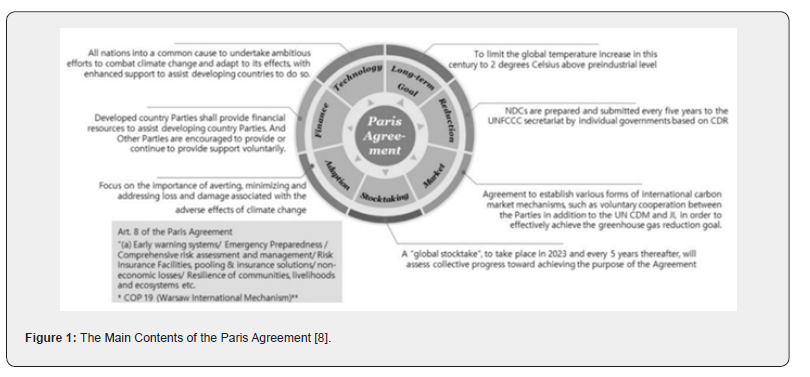
We are defenselessly exposed to the results of climate change (whether it be negative or positive). Innovative climate solutions to prevent danger are continuously offered, like those by Bill Gates or scientists. But a question follows this statement. Are science and the progress of technology not at all responsible for this dire situation? What about the desire of human beings and the development that followed? We must examine the dangers of climate change from this context. Problems like climate change require a fundamental reflection by the entire global society [8]. We are, in the words of German Sociologist Ulrich Beck, a “Risk Society.” It is now high time that we contemplate on modern science and discuss reflective practice in science.

Centuries ago, people at least understood how the wagon they made or used worked. They probably tried various things with the wagon to make it easier to maneuver - perhaps trying to tie it to a horse. Another question comes up, then. How many people in contemporary society actually understand how their smartphones, their inseparable devices, work? In this world where time and place seem to have become irrelevant, how much knowledge, outside the circles of experts, have we then accumulated compared to the past? Excess always seems to be the problem. The explosion of communication and networks make us focus on social arguments rather than the essence of a problem. Perhaps that is why we believe that this society is full of danger. Thus, a contemplative attitude and communication are more important than ever. Communicating through a reflective practice of science allows us to get closer to an ecological approach. We cannot think and act from an ecological approach without being exposed to the problem. And therefore, the most basic step towards climate action is becoming aware of the problem. Only after we are exposed to the problem can we focus our attention, and only then can we enter the cognitive process of solving the problem.

Carbon neutrality and effective communication for breakthroughs
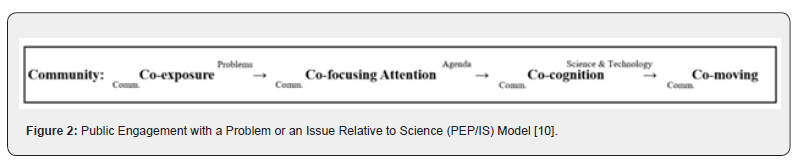
Carbon neutrality and ESG (Environmental, Social, and Governance) have become hot potatoes throughout our society lately. They are at the same time matters of governmental policy and business management. The two keywords not only greatly increased global communication and numerous networks, but they also became political and economic issues. As such, even Bill Gates is striving to solve the problem (Figure 2).

Leading citizens to climate action through a “strategic communication” is just as important as political slogans or stressing economic profit [9]. The environmental pollution, especially air problem, is a global challenge that not only threatens public health, but also takes away lives. Strategic communication, in other words, public relations, is an essential way of tackling air pollution and managing the risks involved.

As discussed, addressing the challenge of climate change requires international collaboration based on full implementation of policy on global agenda, openness, mutual solidarity, and cooperation. And engaging global citizens into the public sphere requires the building of a sense of collectivity and duty on achieving climate mitigation. Strategies and policies on an international scale that are based on the theoretical framework (Behavior Procedure Model) and focus on leading citizens into the mature and unified collectivity during the observance of the UN International Days related the Climate and Environment as the Environment, Water, Clean Air, etc. are crucial.

It we are to urge people to act on climate change, we need to expose them to accurate and true information. This stage is necessary to move on to the next step when the targeted public start to pay attention to the problem before moving on to solve the problem. By appropriately going through each stage of the communication process, finding solutions to the problem of climate change is possible. Song et al. argue for the public engagement for the carbon neutrality [11]. “Now is the time when we need the wisdom to identify problems together and collaborate instead of focusing on competition and conflicts for the long-lasting journey toward the carbon neutrality.”

Conclusion

Notably, many high-growth developing countries have inevitably found itself at the crossroad between economic growth and environmental protection, and has even been observed to be pursuing a passive response to the environmental pollutions. The key communication strategies are supported by the three goals, which include: expanding existing communities and building a new collectivity, supporting international solidarity and individual member state activities, and implementing systems and structures.

In conclusion, effective communication must be precedented to bring out climate action for carbon neutrality [12]. Now it needs to separate problems from agenda and issues. Then the appropriate management becomes possible. It is important that we find the right target public and communication goals that must be met. Let us focus not on speed but on “correctness,” deploying a strategic communication that could solve the civil communities’ problems. If so, we will be able to promote the breakthrough climate solutions that Bill Gates proposed.


To Know more about our Juniper Publishers


Monday, June 6, 2022

Impact of Climate Change on Biodiversity - Juniper Publishers

 Wildlife & Biodiversity - Juniper Publishers 

Abstract

Anthropogenic activities are exacerbating climate change and significant alterations to biodiversity are envisioned to transpire if the situation is to continue unabated. Habitat loss, migrations and disruptions in ecosystem food webs are amongst the adverse ramifications of climate change. The paper attempted to highlight the importance of biodiversity and the negative impacts of climate change on soils, plants and animals.

Keywords: Biodiversity; Climate change; Ecosystems; Habitat loss

Introduction

Biodiversity is the cornerstone of ecosystem functioning and also plays a fundamental role in human life. Anthropogenic activities are exacerbating climate change and have led to loss of biodiversity in numerous parts of the globe. The wrath of climate change has been evident on landscapes, freshwaters, rainforests and coastal ecosystems. The decline of global biodiversity has been rapid over the past century due to the loss of favorable conditions for growth and survival of certain species. The distribution of species in ecosystems is determined by climatic factors and thus changes in the climate affect their distribution and diversity [1].

Changes in Biodiversity

Soil

The interaction of living and non-living components of the soil is crucial for the thriving of forests and native species. Climate change culminates in alterations in soil properties such as soil temperature and moisture which in turn influences biodiversity of soil dwelling biota [2]. Warmer temperatures have the potential to increase the rate evapotranspiration and consequently, yield dryer cracked soil surfaces. Subsequently, poor soil health will ultimately affect the growth of many plant species and will restrict their diversity.

Plants

Trees and plants are predominantly responsive to climate changes since they have restricted adaptive methods to deal with environmental disruptions. It has been predicted that climate change will disrupt the profusion of plants and trees in forests. Moreover, climate change alters the metabolism of plants by inducing late or early flowering and sometimes may lengthen vegetative growth [3]. The frequent outbreak of plant pathogens and diseases is also a phenomenon associated with climate change that will impact plant biodiversity. According to [4], plants will shift to elevated latitudes as a consequence of climate change. The occurrence of alien invasive species is predicted to escalate as a consequence of climate [5]. This would result in competition for resources and ultimately extinction of species.

Animals

The morphology and behavior of certain species has undergone rapid alterations as a result of climatic changes [6]. The impact of climate change on species has been documented in many parts of the globe. The arctic regions have been negatively impacted by climatic changes as warmer temperatures have caused snow cover to subside dramatically. Consequently, this has impacted animals like the polar bear through habitat destruction and limited food resources. Climate change not only influences animal behavior but changes reproductive cycles of some species. Warmer temperatures have been observed to cause accelerated sexual maturity in turtles [7]. In addition, male frogs have been observed to call mates frequently during periods of warmer temperatures [8]. Climate change has also been said to cause migration of certain species to places with favorable conditions [9].

To Know more about Wildlife & Biodiversity  

Click herehttps://juniperpublishers.com/jojwb/index.php


To Know more about our Juniper Publishers

Click here: https://juniperpublishers.com/index.php 

Friday, October 22, 2021

One Hundred Years Later and in a Warmer Climate – A Case of Ecotonal Treeline Change in the Swedish Scandes - Juniper Publishers

 Ecology & Conservation Science: Open Access - Juniper Publishers  

Abstract

This paper accounts for a case of substantial transformation of the treeline ecotone (Picea abies (L.) Karst.) in the Swedish Scandes. During the past 100 years, coinciding with summer warming by 1.6 °C, the ecotonal landscape changed from predominance of stunted krummholz individuals to a mosaic of tree groves and intervening alpine tundra.

Keywords: Treeline ecotone; Picea abies; Climate change; Swedish Scandes

Introduction

Natural treelines in high-mountain regions are considered as excellent and broad-scale indicators of biological responses to climate change and variability [1-10]. Since the early 20th century, treelines of different species have advanced by maximum 200-245 altitudinal meters in the Swedish Scandes, while the forest limit has changed substantially less in elevation [3,11].

Treeline is here taken in a broad sense, as the transition zone (ecotone) between the closed forest and the treeline proper, i.e. the highest trees of a specific species, with a minimum height of 2 m. Up to the present most studies have focused on the treeline with this narrow definition, since spatially-precise early 20th century measurements exist from a large area in the Swedish Scandes. Studies of the entire treeline ecotone are constrained by lack of stringent and repeatable old records and the strongly shifting structure and configuration of this entity, which has precluded accurate inter-site comparisons over space and time [8,11-13].

Results and Discussion

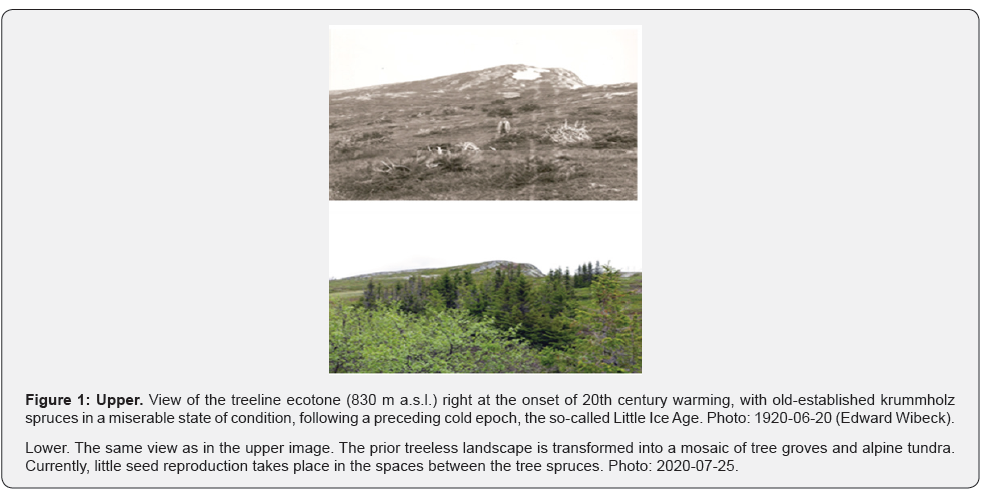
Below, a compelling case, based on repeat photography, describing transformation of the treeline ecotone, from a belt of stunted and climatically constrained old-established krummholz spruces (Picea abies (L.) Karst.) into a partly treed landscape. This change is coinciding with summer (June-August) warming by 1.6 °C since the early 20th century [11].

The study site is on the south-facing slope of Mt. Mullfjället (peak 1031 m a.s.l.) in the southern Swedish Scandes (63° 24´N; 12° 25´E). Norway spruce (Picea abies (L.) Karst.) is the dominating tree species in the lower slopes and in the treeline ecotone. This is a deviation from the general situation in the Scandes, where mountain birch (Betula pubescens ssp. czerepanovii) generically forms the forest-alpine tundra transition above the coniferous belt. In this, region Picea abies has a particularly long history and appeared on isolated nunataks quite early following the deglaciation, about 13 000 cal. yr. BP [14]. The current treeline position (narrow definition) is at 880 m a.s.l., which is 80 m higher than by the early 20th century and 50 m above the view here specifically concerned.

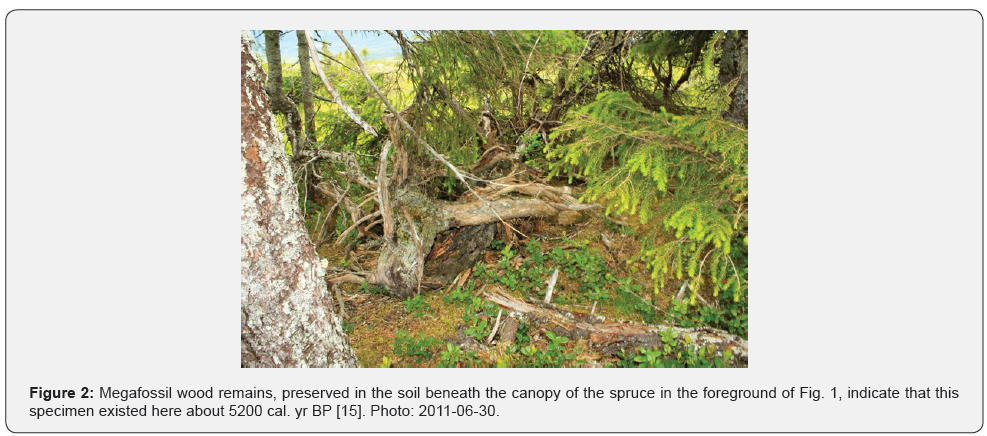
A matched pair of now-and-then photographs (830 m a.s.l.) depict fundamental structural transformation of the spruce treeline ecotone over the past one hundred years (Figure 1), when summer temperatures (June-August) increased by 1.6 °C [11]. Megafossil remains (Figure 2) indicate that one of the concerned spruces existed 5200 cal. yr BP [15].

These results add further support to general observations of ongoing climate-driven structural change in the treeline ecotone of the Swedish Scandes [11]. This is one of few cases, with Picea responding progressively at the broad landscape scale to secular climate change. Possibly, this anomaly ultimately relates to the local maritime climate [16] and the long-term (Holocene) dominant presence in the region. Predominantly, spruce progression is accomplished by phenotypic transformation of oldage and stunted and layering maritime climate, rather than spread and establishment of new individuals. This appears to be the general mode of subalpine spruce response to climate warming in the Scandes [17].

Prior to the onset of present-day climate warming, a pool of krummholz specimens existed above the treeline. Possibly, they originated from early-Holocene pulses of immigration and spread. It is a well-established fact that still living clonal spruces in the treeline ecotone may date more than 9000 years of age. That is close to the deglaciation of mountain valleys [18] and, as mentioned above, mountain peaks had harboured spruce 4000 years earlier. As this pool becomes increasingly depleted when these spruces transform into tree-size, little further spruce treeline advance is likely to occur.

Click here: https://juniperpublishers.com/index.php   

Friday, July 2, 2021

One Hundred Years Later and in a Warmer Climate – A Case of Ecotonal Treeline Change in the Swedish Scandes - Juniper Publishers

 Ecology & Conservation Science - Juniper Publishers

Abstract

This paper accounts for a case of substantial transformation of the treeline ecotone (Picea abies (L.) Karst.) in the Swedish Scandes. During the past 100 years, coinciding with summer warming by 1.6 °C, the ecotonal landscape changed from predominance of stunted krummholz individuals to a mosaic of tree groves and intervening alpine tundra.

Keywords: Treeline ecotone; Picea abies; Climate change; Swedish Scandes

Introduction

Natural treelines in high-mountain regions are considered as excellent and broad-scale indicators of biological responses to climate change and variability [1-10]. Since the early 20th century, treelines of different species have advanced by maximum 200-245 altitudinal meters in the Swedish Scandes, while the forest limit has changed substantially less in elevation [3,11].

Treeline is here taken in a broad sense, as the transition zone (ecotone) between the closed forest and the treeline proper, i.e. the highest trees of a specific species, with a minimum height of 2 m. Up to the present most studies have focused on the treeline with this narrow definition, since spatially-precise early 20th century measurements exist from a large area in the Swedish Scandes. Studies of the entire treeline ecotone are constrained by lack of stringent and repeatable old records and the strongly shifting structure and configuration of this entity, which has precluded accurate inter-site comparisons over space and time [8,11-13].

Results and Discussion

Below, a compelling case, based on repeat photography, describing transformation of the treeline ecotone, from a belt of stunted and climatically constrained old-established krummholz spruces (Picea abies (L.) Karst.) into a partly treed landscape. This change is coinciding with summer (June-August) warming by 1.6 °C since the early 20th century [11].

The study site is on the south-facing slope of Mt. Mullfjället (peak 1031 m a.s.l.) in the southern Swedish Scandes (63° 24´N; 12° 25´E). Norway spruce (Picea abies (L.) Karst.) is the dominating tree species in the lower slopes and in the treeline ecotone. This is a deviation from the general situation in the Scandes, where mountain birch (Betula pubescens ssp. czerepanovii) generically forms the forest-alpine tundra transition above the coniferous belt. In this, region Picea abies has a particularly long history and appeared on isolated nunataks quite early following the deglaciation, about 13 000 cal. yr. BP [14]. The current treeline position (narrow definition) is at 880 m a.s.l., which is 80 m higher than by the early 20th century and 50 m above the view here specifically concerned.

A matched pair of now-and-then photographs (830 m a.s.l.) depict fundamental structural transformation of the spruce treeline ecotone over the past one hundred years (Figure 1), when summer temperatures (June-August) increased by 1.6 °C [11]. Megafossil remains (Figure 2) indicate that one of the concerned spruces existed 5200 cal. yr BP [15].

These results add further support to general observations of ongoing climate-driven structural change in the treeline ecotone of the Swedish Scandes [11]. This is one of few cases, with Picea responding progressively at the broad landscape scale to secular climate change. Possibly, this anomaly ultimately relates to the local maritime climate [16] and the long-term (Holocene) dominant presence in the region. Predominantly, spruce progression is accomplished by phenotypic transformation of oldage and stunted and layering maritime climate, rather than spread and establishment of new individuals. This appears to be the general mode of subalpine spruce response to climate warming in the Scandes [17].

Prior to the onset of present-day climate warming, a pool of krummholz specimens existed above the treeline. Possibly, they originated from early-Holocene pulses of immigration and spread. It is a well-established fact that still living clonal spruces in the treeline ecotone may date more than 9000 years of age. That is close to the deglaciation of mountain valleys [18] and, as mentioned above, mountain peaks had harboured spruce 4000 years earlier. As this pool becomes increasingly depleted when these spruces transform into tree-size, little further spruce treeline advance is likely to occur.

To Know more about Ecology & Conservation Science


To Know more about our Juniper Publishers

Click here: https://juniperpublishers.com/index.php  


Friday, February 5, 2021

One Hundred Years Later and in a Warmer Climate – A Case of Ecotonal Treeline Change in the Swedish Scandes - Juniper Publishers

Ecology & Conservation Science - Juniper Publishers


Abstract

This paper accounts for a case of substantial transformation of the treeline ecotone (Picea abies (L.) Karst.) in the Swedish Scandes. During the past 100 years, coinciding with summer warming by 1.6 °C, the ecotonal landscape changed from predominance of stunted krummholz individuals to a mosaic of tree groves and intervening alpine tundra.

Keywords: Treeline ecotone; Picea abies; Climate change; Swedish Scandes

Introduction

Natural treelines in high-mountain regions are considered as excellent and broad-scale indicators of biological responses to climate change and variability [1-10]. Since the early 20th century, treelines of different species have advanced by maximum 200-245 altitudinal meters in the Swedish Scandes, while the forest limit has changed substantially less in elevation [3,11].

Treeline is here taken in a broad sense, as the transition zone (ecotone) between the closed forest and the treeline proper, i.e. the highest trees of a specific species, with a minimum height of 2 m. Up to the present most studies have focused on the treeline with this narrow definition, since spatially-precise early 20th century measurements exist from a large area in the Swedish Scandes. Studies of the entire treeline ecotone are constrained by lack of stringent and repeatable old records and the strongly shifting structure and configuration of this entity, which has precluded accurate inter-site comparisons over space and time [8,11-13].

Results and Discussion

Below, a compelling case, based on repeat photography, describing transformation of the treeline ecotone, from a belt of stunted and climatically constrained old-established krummholz spruces (Picea abies (L.) Karst.) into a partly treed landscape. This change is coinciding with summer (June-August) warming by 1.6 °C since the early 20th century [11].

The study site is on the south-facing slope of Mt. Mullfjället (peak 1031 m a.s.l.) in the southern Swedish Scandes (63° 24´N; 12° 25´E). Norway spruce (Picea abies (L.) Karst.) is the dominating tree species in the lower slopes and in the treeline ecotone. This is a deviation from the general situation in the Scandes, where mountain birch (Betula pubescens ssp. czerepanovii) generically forms the forest-alpine tundra transition above the coniferous belt. In this, region Picea abies has a particularly long history and appeared on isolated nunataks quite early following the deglaciation, about 13 000 cal. yr. BP [14]. The current treeline position (narrow definition) is at 880 m a.s.l., which is 80 m higher than by the early 20th century and 50 m above the view here specifically concerned.

A matched pair of now-and-then photographs (830 m a.s.l.) depict fundamental structural transformation of the spruce treeline ecotone over the past one hundred years (Figure 1), when summer temperatures (June-August) increased by 1.6 °C [11]. Megafossil remains (Figure 2) indicate that one of the concerned spruces existed 5200 cal. yr BP [15].

These results add further support to general observations of ongoing climate-driven structural change in the treeline ecotone of the Swedish Scandes [11]. This is one of few cases, with Picea responding progressively at the broad landscape scale to secular climate change. Possibly, this anomaly ultimately relates to the local maritime climate [16] and the long-term (Holocene) dominant presence in the region. Predominantly, spruce progression is accomplished by phenotypic transformation of oldage and stunted and layering maritime climate, rather than spread and establishment of new individuals. This appears to be the general mode of subalpine spruce response to climate warming in the Scandes [17].

Prior to the onset of present-day climate warming, a pool of krummholz specimens existed above the treeline. Possibly, they originated from early-Holocene pulses of immigration and spread. It is a well-established fact that still living clonal spruces in the treeline ecotone may date more than 9000 years of age. That is close to the deglaciation of mountain valleys [18] and, as mentioned above, mountain peaks had harboured spruce 4000 years earlier. As this pool becomes increasingly depleted when these spruces transform into tree-size, little further spruce treeline advance is likely to occur.

Wednesday, July 22, 2020

About Climate Change - Juniper Publishers

Engineering Technology Open Access Journal -  Juniper Publishers 


Opinion

Humanity annually takes away more and more lands from nature: plowing it under crops, flooding it with hydroelectric power stations, concreting and asphalt cities and roads. The total area of such lands was 67% of the total land area of the planet by 2015. All water evaporated from such territories, at best, does not change its structure. As they came with precipitation, they returned back to the atmosphere. At worst, they are impregnated and combined with chemical elements, which then, it happens that, with a strong concentration, they fall acid rain. Evaporations from artificial areas are substantially complemented by evaporation from technological processes of industrial and municipal production. At their core, these fumes are alien to nature. Before the advent of man, such fumes did not exist. You can call them artificial fumes. Nature did not expect such a massive evaporation from washing and drying clothes, dishes, asphalt - everything that was created by man.

Historically, the interaction of the plant and animal worlds with water created atmospheric phenomena and a circuit in the nature of water itself and other substances. For millions of years, the volumes and frequency of precipitation, their places of precipitation have stabilized. The consequence of this was the formation of various zones: steppes, deserts, forests, tropics - the whole palette of geographical zones, including the comfortable climate in the inhabited man, areas. Of particular importance is the accumulation of water in the polar and mountain glaciers. It is possible that the reduction of glaciers at the poles of the Earth and in the mountains is not a result of warming, but changes in atmospheric phenomena. And the warming itself is a consequence of the decrease in the action of the “global refrigerator” - glaciers.

As industrialization develops, artificial evaporation increases in volumes and speeds. The quality of evaporation is a little-studied direction of science, but, in all likelihood, it also has some effect on the «heavenly kitchen.» Evaporations from drying asphalt and from the plant or from our breathing cannot be the same. The official hypothesis, based on carbon dioxide emissions, distracts the world community from the true cause of climate change and leads the world to a global catastrophe. If during the year 4 billion tons of carbon dioxide is released into the atmosphere, then the water of artificial evaporation alone is 2,200 billion tons. Since the beginning of the 20th century, according to UN experts, the increase in CO2 emissions has ranged from 0.5 to 5% per year. As a result, over the past hundred years, 400 billion tons of carbon dioxide has just entered the atmosphere due to the burning of fuel. ” Or 4 billion tons per year. According to http://jkg-portal.com.ua/ru/publication/one/globalna-posuha-abo-problemi-vodospozhivannja-32688. Up to 20 thousand km of cubic groundwater is extracted annually. Plus to this: http://www.kursach.com/geografiya-ekonomicheskaya-geografiya/816-referat-gidrosfera-v-sostave-biosferi/view-details.html. Plus, every year people irrevocably take approximately 2,000 cubic meters from rivers and lakes. km fresh water. Annually. All this water through sewers and evaporation goes into the atmosphere without organic changes.

They are joined by natural evaporation - in volume, perhaps even greater. Against the background of such fumes, the fight against carbon dioxide is a flea war.»Heavenly kitchen» has broken, due to changes in its components. Distribution mechanisms, schedules, dosing of precipitation by zones of the earth’s surface have disappeared. In some places, devastating floods, in others - drought and fires. These facts are known to us from reports and chronicles from the scene. Today floods in Spain, yesterday - hurricane Florence.

It is assumed that the mechanism of long-term accumulation of water in glaciers also broke down. The growth of glaciers stopped. Without reaching the poles and mountain zones of the water, snow falls not in historically given places, but in the rain in the oceans and foothill zones. The level of the oceans is growing, and the glaciers are decreasing. According to the chain of positive feedback, this growth increases in some progression. This is indicated by increasing natural disasters, their destructiveness and the prospects for flooding the continents. The future of the planet is quite alarming.

Is there salvation? Do we want to continue the human race and in general life on the planet? It is necessary to return all taken away to nature: land and water. It is urgent to prove the assumptions made here and develop a new concept of saving life on the planet. It should be based on total saving of water in production and everyday life by every enterprise, every state, every person. It is not easy to make rules about forgotten tap and the reduction of water consumption. It is necessary to radically reconsider all actions related to water. Water must make a qualitative transition from the functions of the working fluid body, the reagent to the food product - drinking and only to personal consumption - by living organisms. Everything else must be reduced. 


On the Positive Effects of Overconfident Self-Perception in Teams - Juniper Publishers

  Social Sciences & Management Studies - Juniper Publishers Abstract In this paper, we study the individual payoff effects of over confi...