Journal of Archaeology & Anthropology-Juniper Publishers

Abstract
Copper-based weapons including battleaxes, daggers, and spearheads from the Middle Bronze Age II (c. 1900-1600 B.C.E.) have been unearthed mainly in burials found in the southern Levant. Archaeological and metallurgical analyses of these metal weapons done recently, make it clear that in the beginning of the period, in the decorated weapons were made of tin bronze with and without arsenic while during the second part of this period we can see a decrease in the number of weapons found in graves as well as changes in the metallurgical composition into the usage of tin bronze, arsenic copper and copper with tin and arsenic. To explain these results, there is a need to look further on the possible social economical context of the “Warrior’ burials” phenomenon using metal weapons made of copper, arsenic, and tin, which are unavailable metals in the southern Levant at this period.
Keywords: Metal Weapons; Warrior Burials; Middle Bronze Age; Tin Bronze, Arsenic copper; Southern Levant; Kit; Tin; Archaeological; Funerary contexts; Society; Copper sources
Case Report and Results
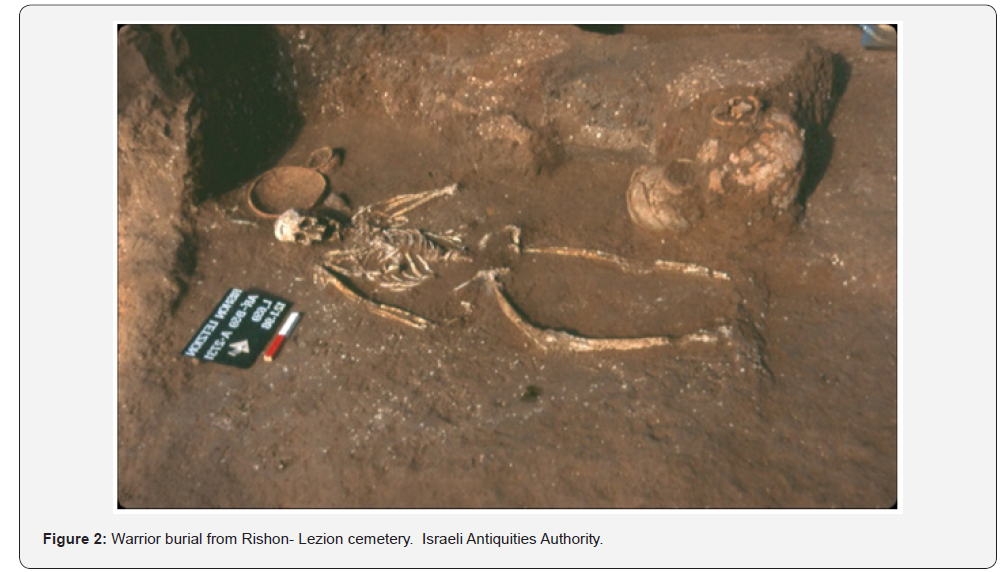
More than 1000 copper-based weapons associated with the Middle Bronze Age II (MB II; ca. 1950–1550 BCE) culture have been recovered, primarily in burials, throughout the Levant (Figure 1); [1-7]. These, funerary contexts have generally been referred to as “warrior burials”, and contained individuals buried with a presumed “kit”, comprising weapons, such as daggers, axes and spearheads found on the deceased’s waist and/or next to their head (Figure 2). The “warrior burials” are dated mainly to the first half of the MBII period (MB IIA; 1950–1750 BCE) and decline in occurrence in the Middle Bronze IIB (MB IIB; 1750–1550 BCE) [6-8].

Recently, it has been shown [6,7] that less than 25% of all the MB IIA burials can be defined as “warrior burials”, and they should rather be considered to reflect high-ranking members of the contemporary society, i.e., an elite social class . The weapons in the MB IIA “warrior’ burials” were well-made, elaborate and composed of copper alloyed with up to 14% tin, both with and without low arsenic concentration [5-7].
The use of tin bronzes is considered the most important technological innovation of the Middle Bronze Age II (MBII). Tin Bronze objects are known from earlier periods, but in small quantities while the use of arsenic copper was more common [5,9]. During the Middle Bronze Age II, tin bronze was widely used to create metal objects in general and weapons [5,6,7,10]. While for production of arsenic copper one metal source containing copper with arsenic was needed, the production of tin bronze required two metal sources, one of tin and one of copper, which were in far distance from the southern Levant [11,12]. Nevertheless, no tin sources were found in the Levant and there is no evidence that local copper sources were exploited at this time, in contrast to the former periods [13-15]. In addition, almost no ingots and complete workshops from this period were found in the Levant [1,2,14-16]. This raise a series of significant questions concerning the factors that led to the widespread use of tin bronzes at this period, the sources of copper and tin, and the trading systems that brought the raw materials and the finished products to the Levant.
In addition, to date, the transition from the use of arsenical copper to tin bronze was perceived as a linear development; It was assumed that at the beginning of the Middle Bronze Age (MBIIA), most weapons, in continuation of the former period, were made of arsenical copper, while in the later part of the period (MBIIB), most of the weapons were made of tin bronze [5]. Through a detailed analysis of the available metallurgical data we have shown that the situation was in fact quite the opposite. It was demonstrated that the transition was highly complex; Tin bronze appeared quite abruptly in the MBIIA, with only few antecedents, and decreased during the MBIIB [6,7].
To know more about Journal of Archaeology and Anthropology
Click here: https://juniperpublishers.com/gjaa/index.php
To know more about Juniper Publishers
Click here: https://juniperpublishers.com/index.php


