Showing posts with label Hybrid. Show all posts

Thursday, June 3, 2021

Higher ratios of face to face blended learning is positively related to student satisfaction - Juniper Publishers

 Annals of Social Sciences & Management Studies - Juniper Publishers


Abstract

This study investigated the satisfaction of 303 undergraduate students who enrolled in traditional 200-level criminology/ criminal justice courses. University students were offered the opportunity to self–select into one of four blended online ratios ranging from 10%, 30% 70% to 90% of the course operating within an online environment. OLS linear regression analysis suggests that students who selected lower intervals of online blended instruction (or high intervals of F2F instruction) were statistically more likely to report higher levels of overall satisfaction in the course. Alternatively, the findings suggest that higher ratios of student selected online instruction may lead to higher levels of student dissatisfaction. OLS data findings reported that younger university students who require more flexibility and convenience of scheduling, are enrolled in higher course loads and/or majoring or minoring in the subject matter produced statistically higher levels of student satisfaction.

Keywords: Online; Blended; Hybrid; Face to Face; F2F; Student Satisfaction; Learner-Content; Learner-Instructor; Learner-Learner; Learner-Technology; Interaction; Student Satisfaction Survey

Introduction

In the current COVID19 pandemic environment [1], post-secondary academic institutions and instructors are scrambling for a best practices model to continue to teach their students. Additionally, the university student (or consumer) searches for the instructional delivery that suits their needs and priorities. With the increasing cost of living, expectation of employment, travel, tuition and textbooks, students are consciously re-assessing the value for their dollar to determine which institution is right for them. We know when universities offer the availability of online and blended courses [2] as well as flexibility in scheduling [3,4] students prefer and are likely more satisfied with their courses [4]. Blended learning offers a solution to traditional face to face lecture contact, combining technology with interval levels of face to face instruction.

It certainly appears that undergraduate students as consumers of educational attainment want more choice and selection of course instruction, not less. As consumers of learning, student satisfaction needs to be accounted for. As Brooks [5] suggests, a significant majority (83%) of students preferred some form of blended instruction rather than a traditional face to face (10%) or traditional online (7%) course. The Center for Applied Research also reports that prefer digital mediums, that device ownership (tablets, smartphones, tablets) is greater among students than the public marketplace and students view their technology as important to their education and success (2016:5). The use of technology within an online environment appears to breed a form of success and/or satisfaction not found within traditional face to face courses. This study explores the use of interval/ ratio levels of student self-selection of course delivery to determine if/ and at what ratios of blended course delivery impacts overall reported student satisfaction.

Literature review

Student satisfaction can be conceptualized using a variety of indices from objective performance measurements assessing grade attainment to subjective measures of student attitudes on process- based learning and its efficacy [6]. Student satisfaction surveys have been numerous and rely on similar questions [7]. As a result, many satisfaction surveys probe the interactions learners have with one another, their instructor, course content, online technology and the method by which it is delivered [8]. There is ample research to suggest that blended learning instruction can impact student satisfaction. Blended learning generally offers differing environments that connect traditional lectures with some form of online learning [10]. A meta-analysis by Moskal et al. [10] examined the adoption of blended learning to its implementation and outcomes. The study reported higher levels of satisfaction among students who enrolled in blended courses versus fully online or lecture-based modes of instruction [10]. Research suggests that even if there may be no difference within instructional delivery, students still prefer blended learning. 

Owston et al. [11] found similar levels of satisfaction when students were asked to compare their blended course instructional delivery to other traditional courses they previously had taken; almost 70% of students reported they would take a blended course again. This was also confirmed by Madriz and Nocente (2016) who surveyed nearly 600 undergraduate students finding overall levels of satisfaction were higher among blended learning and student’s willingness to take another blended course. Vernadakis et al. [12] compared blended and face to face (F2F) sections and found that students enrolled in blended sections reported significantly higher satisfaction (conceptualized from a twelve-question survey). Forte and Root (2011) reported similar findings in which students who enrolled in a blended format had higher levels of satisfaction versus traditional courses with some levels of web-enhancement. Melton et al. [13] compared the satisfaction of students enrolled in four general health courses finding that satisfaction scores were statistically higher for those students enrolled in three blended learning courses than one traditional F2F course. Therefore, there appears to be significant advantages for students when employing a blended learning method to their course load. A study conducted by Dziuban et al. [14, 15] reported higher levels of student satisfaction in a variety of blended courses with 85% of students agreeing that they were satisfied and 67% reporting they would like to take another blended course. 

Utilizing both blended and F2F instructional delivery within a nursing student population, Kumrow (2007) found that blended students were more satisfied than unsatisfied. These studies have all implied that there is an importance of learning independently outside of the classroom which has positive impacts on satisfaction, grades and future expectations for blended courses [16]. The question may not be why an instructor may implement blended learning, but rather why wouldn’t an instructor consider this blending learning opportunity. Student satisfaction includes inherent factors which are often difficult to operationalize such as the motivation to taking a course to a student’s level of pleasure throughout the course to the effectiveness of the educational experience (Wang, 2003). Wu et al. (2008) suggest that higher levels of student satisfaction within a blended learning approach is due to a student’s perceived ease of use, value of the content and the climate or environment itself (for involvement and social interaction). 

Further research by Wu and Liu (2013) confirmed that perceived ease of use is positively correlated with student satisfaction. Sahin and Shelley [17] suggest, it is not just ease of use but also the value and usefulness of the content (similar to any traditional F2F or fully online course). Therefore, each instructor’s inherent design, organization, choice and ease of software implementation and adoption (or lack thereof) of content and value within performance measures can impact student satisfaction. As such, the value of learning interactions and outcomes can often be associated not just with student satisfaction but also the choices instructors make when selecting software and organizing a course. This best reflects what we know in blended learning. While blended learning appears to offer significant value and benefits to students, choices instructors make should ensure that there is an ease and proficiency of use of software within course delivery is paramount to ensuring student success and/or satisfaction. Should students not be proficient in the software and/or frustrated with the layout of the course design, satisfaction may wane. Therefore, student success and satisfaction can closely be tied to the design of the blended course.

The design and implementation of blended instruction requires a thoughtful approach to content, the technology being utilized and performance measurements [18,19]. Some studies offer quality assurance checklists to assist instructors (Chauhan et al., 2016) however, there is no uniform one size fits all strategy. Therefore, instructors need to ensure that new online learning environments are designed appropriately for their targeted audience while also meeting the needs and expectations of students [17]. Due to the holistic and individualized approach to the adoption, development and implementation of courses (not just blended), it creates a level of difficulty and uncertainty in ascertaining what blending works, with which student populations and whether these courses can even be compared to traditional F2F or fully online courses. As meta-analyses of studies have identified, there is a lack of matched or equivocal groups of students to make often generalizable comparisons between blended, traditional face to face and online courses [6,16,20]. 

As such, there are limitations to simply suggesting that blended learning, as a one size fits all strategy will be effective. Satisfaction is often measured conceptually or operationally differently across studies which can lead to mixed results. Other studies have proposed that success be measured in terms of mean/average disparities of grades between groups of students but perhaps the performance measurements in the courses were different. Some studies lack more rigorous testing to examine correlations and/or relationships. As such, there are limitations in asserting that blended learning is simply better than traditional face to face or online learning instruction. This is not simply the fault of poor research methodologies but rather the lack of being able to randomly select students (for ethical reasons) and how university and college courses are offered/ distributed to instructors on an annual basis (leading to logistical issues). The lack of random sampling and selection, experimental designs and rigorous testing means that instructors and students should have a healthy level of skepticism of blended learning. 

Meta-analyses indicate promise in the adoption of blended learning but due to the lack of rigorous methodological approaches, there is no one perfect strategy on how to employ it [6,16,20]. An instructor’s selection of design and construction of blended learning within a course can and should be individualized to fit every instructor and student’s needs and priorities [22]. Therefore, there is not likely one specific percentage or interval that can be used to assert where blended learning is more successful than unsuccessful [23]. There does not appear to be a one size fits all ratio of blended instruction that will universally be effective [11]. Several studies and meta-analyses have reported similar findings where students prefer and/or rank blended course instruction over traditional face to face instructional delivery [20, 23] despite a lack of consensus of the appropriate ratios of blending. It should be noted that comparisons are often made between blended learning and traditional and/or online courses as if blended ratios were at a fixed ratio [10]. 

Despite these limitations, the evidence still supports the use of blended and online learning environments in that they can offer higher levels of student satisfaction than traditional face to face (F2F) instruction [16, 24]. This would suggest that there may be tipping points (for every instructor) when comparing success and satisfaction in and out of the classroom. As Shea et al. (2006) point out, having examined thirty-two colleges, an instructor’s teaching presence is positively related to a student’s sense of learning community and direct instructional facilitation. Therefore, while students may appreciate the convenience of hybrid/blended/independent time, that friendly face in the course is also likely a necessity when constructing a course that will ensure student satisfaction. A 2009 study by Morris and Lim examined the influence of instructional delivery and student learning interactions. Their findings suggest that in addition to age and prior experiences with distance learning opportunities impact students’ satisfaction; a student’s preference in delivery format and average study times are increasingly relevant factors in student satisfaction. This study suggests we need to consider other circumstantial and/or situational factors that are relevant to whether student satisfaction is attained - flexibility and convenience within a student’s life.

A 2016 government report reports that college and university students are working harder than ever before, where students are often taking full course loads (considered full time) while also employed either part or full time. Nearly half of students taking a full course load (41%) were currently employed either part or full time (Kena et al., 2016: 221). Of all students reporting, two in ten (18%) were employed 20-34 hours a week and one in ten students (7%) were working over 35 hours a week (Kena et al., 2016: 221). Therefore, flexibility is a significant need for a majority of students [10,11]. Owston et al. [11] found that students typically benefit from increased time and spatial flexibility during the delivery of their courses providing them more resources and autonomy to regulate their own learning. As Packham et al. [25] suggest, the causes of student failure in online courses are often attributed to issues of family, employment and management support. Therefore, providing more flexibility in time management has a significant impact on satisfaction [3, 26]. Therefore, generating an instructional delivery that facilitates choice and selection of blended learning may allow for higher levels of student success and/or satisfaction.

There is evidence to suggest that student selection of instructional format (when students are offered the opportunity to choose) may have an impact on student satisfaction. A study by Yatrakis and Simon [27] found that students who chose to enroll in courses within an online format achieve higher rates of satisfaction and a perceived retention of information than do students who enroll in online courses where no choice is provided. This concurs with the research of Debrourgh (1999) in that selfselection and satisfaction can be linked to a student’s retention of information. The findings of Yatrakis and Simon [27] suggest that students feel a greater degree of satisfaction when allowed to selfselect for online courses and that choice may carry over into their perception of retained information. These results can be used to support choice and self-selection as satisfying the preferences of the student consumer. This study explores the interval levels of student chosen instructional delivery on overall reported student satisfaction. While the majority of research points to selection being an advantageous option for students, other research [28] suggest a level of mixed results in whether instructional delivery has an impact on student satisfaction. Some studies have found no significant differences between the ratios of blended instructional delivery and satisfaction [29,30]. As such, this exploratory study seeks to add to the limited amount of research on student choice of blended instructional delivery and how other factors (explored above) impact on student satisfaction.

Methodology

This exploratory study examined students enrolled in seven undergraduate courses offered over a sixteen-week semester cycle. This was a convenient sample of students where no random selection existed. This is obviously a limitation but one that allowed student choice and selection of course instruction. Initially, there were 334 participants registered for the seven 200-level criminology/ criminal justice courses. Twenty-two students were removed from the study having dropped or withdrawn from the course throughout the semester. An additional nine students were removed from the study for not having completed survey instruments. Therefore, the sample size for the purpose of analysis was 303 participants. This study conceptualized and operationalized four blended delivery systems that students could select as developed by Twigg [31] and the Sloan Consortium [9]: (1) replacement (90% F2F:10% online); (2) supplemental (70% F2F:30% online) and two emporium options (3) 30% F2F:70% online and (4) 10% F2F:90% online. The most traditional offering was replacement delivery where 90% of the course would be face to face (F2F) and 10% within an online environment. As students considered transitioning away from face to face traditional mlectures, they could connect with one another and the instructor through the use of discussion boards and additional digital-based lectures (rather than F2F). 

Once a student had selected their desired blended instructional delivery, they could opt to revise this offering after the first exam (one month; 8 classes into the course). This offered each student more flexibility, an operational component of Twigg’s [31] buffet style approach Students were asked to complete several pre-test and post-test surveys which included Elaine Strachota’s Student Satisfaction Survey (2006) to ascertain satisfaction within each interval of student’s chosen blended learning which will be explored below. Each of the courses utilized a hard copy and/or digital textbook to ensure ease of access. Instructor developed Microsoft power point modules were used to supplement the textbook and offer additional resources and examples to ensure the retention of key concepts. Supplemental technical reports, peer reviewed articles and online open sourced audio-visual clips were also used to stimulate critical thinking and problem solving skills while ensuring overlap of important concepts and themes in the course. The course was rigorous in a sense that students would be asked to engage in significant reading and watching/viewing videos with a rigid structure/ schedule to ensure timelines were maintained and no additional time was offered for any groups of students being studied. The course was designed to ensure consistency across time, content and performance measurements [32]. Performance measures included three in-class examinations (75%) and three assignments (25%) with deadlines within the semester.

Findings

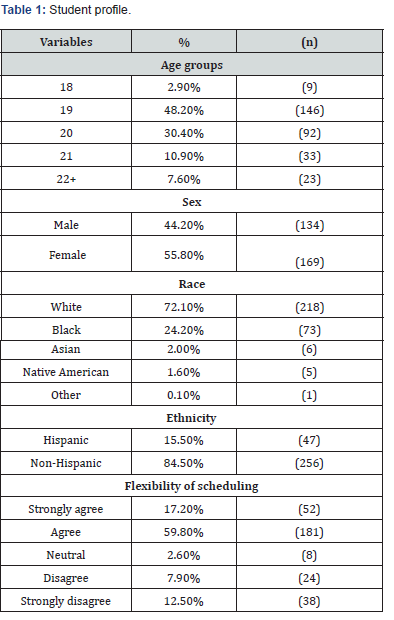
As explained previously, the study sample began with 334 eligible students enrolled in seven 200-level criminology/ criminal justice courses within a liberal arts university in the midwestern United States. Thirty-one students were removed from the study for (i) having dropped or withdrawing from the course or (ii) not completing their self-administered surveys. Therefore, 303 students were used for the analysis of this study. Students were asked to complete a short open-ended self-administered questionnaire at the beginning of the course. Responses were relevant to establishing a baseline of data points to understand the profile of the sample (Table 1 below). Table 1 provides a general demographic profile of the 303 students enrolled in the study. In terms of age distribution, a substantial majority (92%) of undergraduate students were aged 21 21 or under which would suggest that it would be typical of a traditional university 200-level course. Women represented a larger percentage (55%) of the students enrolled in the criminology/ criminal justice courses which mirrored the University’s student body demographics. 

The majority of students enrolled in courses self-identified as White (72%) and a large concentration of students self-identified as Black and/or African American (24%). Asian (2%) and Native American (1.6%) students were also well represented in the course, which closely resembled the student body population of the institution. The University campus in which these courses were facilitated in have a diverse population across it from large concentrations of Black and African American residents (16%) as well as Hispanic/ Latino residents (14%) which mirrored the student body populations of 21% and 15% respectively. Within this study, approximately 16% of the students self- identified as Hispanic and/or Latino. These demographic numbers on race and ethnicity would suggest that visible minorities were slightly oversampled in terms of their population in the area and within the student body population. While this may have an impact on results of the study, this profile of students was somewhat representative of the Institution’s student body. 

In an effort to test for student motivation and needs, the pre-test questions probed for students to reflect on whether flexibility and convenience (in time, travel to campus) was a factor for selecting a particular form of course instruction. A significant percentage of students enrolled in these courses agreed (60%) or strongly agreed (17%) that flexibility and convenience of scheduling impacted their decision on which ratio of blended learning instruction they would select. Approximately 3% of students reported a neutral response however, over 20% of students reported it would not affect their decision. This might suggest a number of factors that were not studied from whether a student was already on campus and felt more online instruction may not be useful, that a student’s schedule did or did not allow for revisions and whether this course should have been introduced to students with more advance warning could have impacted a student’s decision.

These findings would substantiate the importance of flexibility and convenience that student’s require and perhaps why students may consider blended or online learning. However, as noted above, this was not an issue for nearly one in five students. Student profile data attained from pre-test surveys was also corroborated with a more rigorous and valid reporting measurements attained from the University Registrar. Table 2 examines the validation measurements that were used to also generate variables of interest for further predictive analysis.
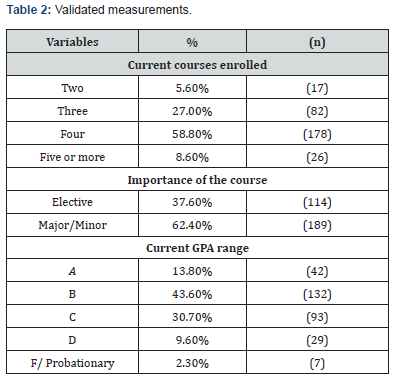
Within Table 2, undergraduate students enrolled in the seven criminology/ criminal justice courses were asked to provide their student number so that further variables (their current course load, their designated field of study and current grade point average) could be utilized as a more valid representation of their student history at the Institution. A significant percentage of students (94%) were currently enrolled in three or more classes, which is considered a full-time course load. Additionally, there were more students (8%) were taking the most courses allowed (without permission at five courses) than those students who were only taking two courses in the semester they were taking this course (7%). This finding would suggest that there were no students taking this course as their sole component of their university workload. This would suggest (not accounting for students who may be registered students at another university and the University where this study was conducted) that the findings identified in this study may be significantly different than those studies who may be unaware or not have controlled for course load. This is why the methodological approach within this (exploratory) study will likely generate unique findings that could be more consistent with traditional university students taking larger course loads than those students who are enrolled as part time or single course consumers.

The relative importance of the course was another variable of interest that is often not considered particularly pertinent or tested within the literature. Within this study, there was an expectation that undergraduate university students who are more likely to engage in a designated career path (in this case criminology/ criminal justice) may feel that face to face course work might be more ideal or are more motivated to take face to face courses versus students who enroll in the course to fill an elective within their liberal arts degree. This 200-level course was a pre-requisite for additional courses within the degree program and as such, a majority of the students (62%) had enrolled in these seven courses to fill that pre-requisite for their major/minor of study in criminology/ criminal justice. A smaller but still relatively large component of the students participating in this study (38%) had enrolled in the course either in fulfillment of their liberal arts degree requirement, as an elective and/or not having declared a major or minor in criminology/ criminal justice (which would have likely occurred prior to this course). This finding would suggest that there is still significant variance within the variable that the author felt could be a concern for further analysis. A final variable of interest that was validated through University records was a student’s cumulative grade point average (GPA), A student’s GPA would be compiled from their course work within the University and any other courses they may have transferred into from previous universities or colleges. 

This study purposely chose to use validated University records rather than selfreported scores from students as they would be more reliable and accurate considering that GPA is generally from a score of zero to a 4.0/4.5. Once a student’s GPA was coded, it was then categorized into University pre-determined values of an A, B, C, D and F and/or probationary status. Most students may characterize themselves as excellent however, a validated assessment of student GPA found that only 14% had attained a cumulative A average. The predominant number of students had attained a B (44%) and C (31%) cumulative GPA. Approximately one in ten students (12%) were considered at more high risk of poor or failing cumulative work. Obviously, the finding here is that a large majority of students had completed coursework in a good to fair job prior to enrolling in the course. As such, they may be inherently more likely to be satisfied with their previous work while also be very concerned with their grade in this course. Throughout the survey process, students were asked to select their mode of instructional delivery (viewed below).

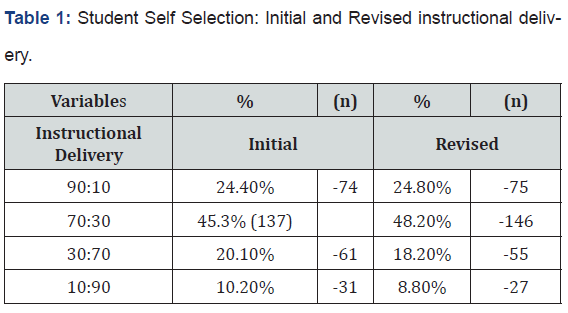
Table 3 highlights the student self-selection and/or reselection of online instructional delivery within the seven criminology/ criminal justice courses. As viewed above, 45% of students preferred the 70:30 blended option of course instruction; where 70% of the course would be taught face to face (F2F) and 30% within an online environment. Approximately 2$% enrolled in a 10% online learning environment, similarly to 20% of students who selected a 70% online environment. Only 10% (31) of the 303 students selected an almost entirely 90% online environment. It should be noted that at no point in time, across all seven classes did any one student ever ask or want to select an option of 100% face to face. While this was not an option that students were offered, no one student even chose to ask. This in and of itself, was an interesting finding as there would be an expectation that if 20% of students who reported that convenience and flexibility was not an issue, that one of those students or perhaps other students who had performed well in traditional face to face courses may not want to change (and/ or choose to register/ enroll in this study). As explained within the methodology, to offer students additional flexibility and/or a choice, students were offered the opportunity to revise their initial blended course delivery. When provided this opportunity, 10 students revised their initial choice. This accounts for only 3% of all students. 

This would suggest that 97% of students were satisfied with their initial choice. Therefore, this study can infer that students appear to be confident in determining which level/ ratio/ interval of online instruction they favor. This might suggest that offering this option to traditionally based F2F courses may not require instructors to be overly concerned about student’s ease of access or uncertainty over their initial decision. Of the 10 students who revised their initial instructional delivery, each of these 10 students initially chose less face to face engagement (90:10 or 30:70). When asked to re-select their desired blended course instruction, 10 of 10 students re-selected options with more face to face interactions. Similar to the initial student selection process, no students wanted or preferred a re-imagined 100% face to face course. Operationalizing Twigg’s [31] classification of blended learning, a majority of undergraduate university students selected a replacement (25%) or supplemental approach (48%) rather than an emporium approach (26%). This finding suggests that students in this study preferred higher intervals of face to face instruction than higher ratios of online instruction. Reiterating what was mentioned previously, no one student sought out an entirely face to face traditional course which they originally enrolled in. These findings would infer that students did appreciate the opportunity to select their own instructional delivery. However, Might this appreciation have an impact on satisfaction?

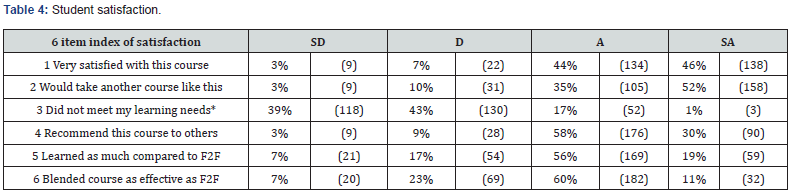
To assess student satisfaction, participating undergraduate students were asked to complete a follow-uo post-test survey once the course was complete and grades assigned. The six-item index of satisfaction was developed by Strachota [33] and further redesigned into what she coined as the Student Satisfaction Survey (2006). Table 4 highlights the findings of the general satisfaction of students within the sample. To pilot her survey instrument, Strachota [8] found this general satisfaction dimension had a reported.90 Chronbach alpha (ranging from zero to one) which is exceptional. The findings from Table 4 indicate that students enrolled in seven 200-level criminology/ criminal justice courses were very satisfied with the course utilizing Stachota’s general satisfaction survey (2006). Nine of ten students agreed or strongly agreed with the statement that they were very satisfied with the course while only 3% (9) of the 303 students reported being very dissatisfied with the course. Nearly the same percentage of students (87%) reported that they would take another selfselected blended instructional course again if it was offered. Further extrapolating the data, one in ten (12%) students reported that they would not recommend this course to others. When considering learning needs, there was significantly more variation in student responses. Approximately eight in ten students (82%) agreed or strongly agreed that the course met their learning needs with 18% reporting the course did not meet their learning needs. Three-quarters (75%) of respondents agreed or strongly agreed with the statement that they learned as much in this course (as compared to other face to face courses they had taken previously) [34-40].

Interestingly, 30% of students reported that they generally believed that blended courses would not be as effective as face to face courses. Therefore, the student responses to satisfaction in the course report some unusual and contradictory findings where students appear to have been very satisfied with the course, there were issues whether they would take another self-selected course (despite previous frequency distributions which inferred some level of appreciation) and/or whether the learning and instruction met their needs. It could be concluded that perhaps the instructor’s learning and/or instructional materials may not have matched the expectations of students. More research is certainly need to justify this potential inference. To assess and predict student satisfaction, an ordinary least squares (OLS) linear regression was utilized for further analysis. As such, survey item/ statement three required a change in coding to ensure that each of the six item likert scales could be aggregated from strongly disagree (0) to strongly agree (3); within the appropriate direction. This allowed for the generation of a larger index of scores from 0-18. As seen in the frequency distributions above, there was enough variability in each of the variable to make conclusions about the potential relationship of that variable (age, sex, race, flexibility, course load, fulfillment of course credit, GPA and student choice of course instruction) and general satisfaction. Student self-selection was coded appropriately from low online instructional delivery to high) [41-50]. The OLS regression data is below.
The linear regression model, located in Table 5, was found to be statistically significant (.001 with a confidence level of 95% with the p < .05 being significantly different than zero). Student self-selection and seven variables of interest were found to explain 48% of student satisfaction based on the Nagelkerke R Square (.482). The regression reported a Chi-square of 209.46 and a model -2 Log likelihood of 111.29 (with 8 degrees of freedom). Four cases were removed from the analysis when the variance inflation factor (VIF >4) and tolerance (TOL) levels of 2.0 or above were controlled for. Student self – selection of instructional delivery was found to be the second most important variable to predict student satisfaction. This finding would suggest that the lower the ratio of online blended learning, the higher the likelihood of student satisfaction. Put another way, the higher the percentage of independent or online learning within courses, the more likely students in this sample would be dissatisfied. This finding suggests that as interval levels of blended learning increase, it can have a detrimental effect on student satisfaction. This might suggest that not all blended learning is the same and that there may be tipping points where satisfaction may become dissatisfaction. However, it should be noted that student choice of instructional delivery was not the only statistically significant variable within the model (based on the Beta values) [51-59].
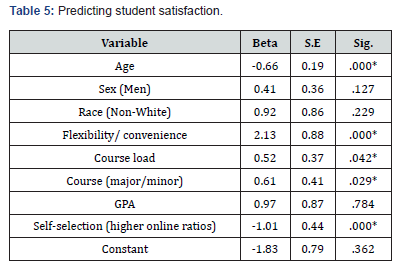
The most significant predictor of the course satisfaction regression model was the flexibility and convenience of the course offerings. This is consistent with previous research in the field in that blended learning courses can predict student satisfaction. This suggests that not only is flexibility important in scheduling but additionally, that those students who enroll in more courses within a semester are more likely to be satisfied than students who enroll in lower numbers of courses simultaneously. The evidence, supported by the data, suggests that age was also a predictor of satisfaction. It appears that older students who participated in the study were more likely than younger adults to be dissatisfied with the course. This is somewhat surprising as it could be hypothesized that older students may be more likely to require more flexibility and convenience (due to employment, child care, etc.). However, this could be a case where ease of use (as explored in the literature) may have been an impact variable rather than age. Other demographic variables including sex and race were found to not have any statistical significance within the model. This is consistent with some of the research findings [16]. Students with higher course loads appeared to be more satisfied with the course. This could be due to the opportunity to have a more balanced and/or flexible schedule however, it is more likely that attaining more course independent time to complete work and assignments had an impact. However, more research is needed before this can be verified but it is certainly an interesting finding. A finding not often examined in the research is whether student interest or motivation, as denoted by a student’s major or minor level of study, has an impact on their reported satisfaction. The data suggests that students who had declared a major or minor in the study of criminology/ criminal justice were more likely to be satisfied with the 200-level criminology/ criminal justice course they enrolled in. Therefore, students who utilized this course as an elective for their liberal arts degree were less likely to be satisfied with the course. This might suggest that how the instructor constructed this course may have inherently benefitted students who declared a major or minor in the field of interest versus those who may have had less interest in the course content. Obviously more research is necessary to understand how student motivation impacts satisfaction.

Implications

As an exploratory case study, the findings of this research would suggest that more examination of blended learning and intervals/ratios of blended learning need to be examined. Simply offering blended learning does not have an impact on course satisfaction (as all forms of instructional delivery in this study had some form of online delivery). This would suggest that there is a tipping point where students find satisfaction with the blended offering but too much blended learning (using the instructional delivery explained within the methods section) has an inverse relationship to student satisfaction. This study finds that student selected ratios or intervals of blended learning that offer more face to face interaction rather than less result in higher levels of student satisfaction. This finding would certainly suggest that while students appreciate the convenience and flexibility of hybrid and blended instruction, they still want (in this instructor’s course) face to face interactions. Therefore, when constructing courses, instructors should be diligent to ensure that they are present and that students receive that face to face time (that even digital recordings are unable to capture). That rapport and relationship building appears to be important to student satisfaction in this study (however more in-depth research is needed). However, as expressed in the literature review, there is no perfect one size fits all strategy to implement blended learning as each instructor will construct their own course, based on their needs and the needs of their students.

As referenced in the literature, convenience and flexibility remains a significant factor when understanding the circumstances students face and satisfaction within their courses. This also may hold true for instructors as well. With a relatively good variance explained within the model, there appears to be hope on the horizon that the use of this a consistent construction and design of a course could reap benefits with instructors and students alike (without significant revision each year). While more research is needed to identify more conclusive findings, blended learning is an increasingly attractive alternative to traditional face to face or online learning and has a significant impact on a student’s or consumer’s satisfaction particularly post-COVID-19. As students continue to search their desired instructional delivery it would be wise that instructors consider offering more choice and selection to ensure each student can attain their desired learning interactions within the same class based on their motivations. Allowing student self-selection also might alleviate the finding that with more online instruction, Allowing student discretion to make their instructional delivery selection places more emphasis on their decision making rather than potentially blaming one form of instructional delivery over another. Despite these findings, it is clear that more research is needed on intervals of blended learning, stronger comparison groups and how student selection impacts not simply student satisfaction but also grade attainment and/or other measures of student success.

To Know more about Annals of Social Sciences & Management Studies

To Know more about our Juniper Publishers

Click here: https://juniperpublishers.com/index.php 

Thursday, July 2, 2020

Student Motivations that Predict the Self-Selection and Choice of Blended Instructional Delivery - Juniper Publishers

Social Sciences & Management studies - Juniper Publishers

Abstract

This case study examined 303 undergraduate students enrolled in seven traditional face to face courses who were offered the opportunity to self-select into one of four blended modes of instruction. Students could select face to face (F2F) intervals of 90% (almost exclusively in the classroom) to 70%, 30% and 10% (almost exclusively online with the exception of final exams). Findings suggest that students preferred a blended 70:30 face to face instructional delivery. Motivating factors including but not limited to the age of the learner, employment, flexibility and convenience, the number of courses a student is enrolled in, whether a course was an elective for their degree completion and commuting distance were all found to be significant factors in predicting a student’s self-selection of instructional delivery.

Keywords: Online; Blended; Hybrid; Instructional delivery; Face to face; F2F; Self-selection; Grade attainment

Introduction

The COVID19 coronavirus led the World Health Organization (WHO) to identify a global pandemic in 2020 which forced the closure of thousands of schools, colleges and universities across the United States and abroad [1]. As the WHO reports, this is the first time in recorded history where “technology and social media are being used on a massive scale to keep people safe, productive and connected while being physically apart” [1]. This has led colleges and universities across the world to scramble to attempt to complete courses online without face to face community spread in the classroom. This global pandemic [1] has forced instructors to adopt radical approaches to complete their courses online potentially neglecting their own unique outcomes but rethinking how their courses can be implemented in the future. This article offers a glimpse into how self-selection of instructional delivery could assist in delivering courses in the future.

Academic learning within post-secondary institutions has traditionally been face to face (F2F) teaching instruction. The scholarship of teaching and learning has always encouraged and promoted the use of best practices determining what works, what doesn’t and what is promising [2-6]. However, there is no one size fits all, universal method of instruction simply because each instructor is unique in their own delivery [7-9]. Every instructor has their own unique outcomes for their coursework (Singh, 2006) and this certainly varies based on class size [10], lecture versus seminar courses [11-13], basic versus applied courses [11,14] and by discipline [15]. As such, governments, post-secondary institutions and students/ consumers have begun pondering whether online programming is more effective than blended or face to face engagement in the classroom. As such, the timing of this study may not be more appropriate. How do universities and faculty react to a changing online environment and how might students wish to proceed in an online/hybrid environment? What are student motivations for taking blended coursework and furthermore, what might be the most appropriate level of engagement that ensures strong performance outcomes? This case study focuses on approximately three hundred students within seven undergraduate courses at a medium sized liberal arts midwest American university.

Literature Review

Research indicates that online and blended courses are reliable and valid methods of course delivery [3,5,16,17]. Similar to face to face course instruction, the evidence of the efficacy of online courses is mixed. For each study that suggests online instruction is similar or as effective as traditional classroom instruction [2], there are also studies to the contrary [18]. The reasoning is simplistic. There is a plethora of course deliveries available for instructors from the extremities of traditional F2F instruction to no F2F interaction at all. A meta-analysis by Zhao & Breslow [19] reported that evidence is mixed in terms of the efficacy of blended versus traditional and online learning deliverables. The lack of comparison groups, low sample sizes and the differentiation of modes of delivery [19-21] impacted the efficacy of the 45 studies examined. The meta-analysis concludes that students who enroll in hybrid learning “performed modestly better” than those enrolled in F2F interactions [21]. However, there is very little research to suggest how student self-selection can impact their chosen instructional delivery. Often instructional delivery is forced on students and they do not have the opportunity to select what might be in their best interests. The purpose of this study is to build on what we know, what we don’t know and what is promising highlighting selfselection within differing/varying intervals of F2F interactions.

The Sloan Consortium has adopted a scaled form of online learning delivery based on the percentage of content delivered online [2]. The lowest level of content delivered to students is denoted as web supported delivery; where online instruction is less than 30% online and focuses specifically on online content and internet sourced works. This could range from using selected readings that are available online or within a digital library consortium to the adoption of online readings developed by book publishers. Alternatively, the higher extremes of 80% and above are categorized as online. This categorization could be the implementation of entire textbooks and performance measurement outcomes. Hybrid or blended learning is determined to be within the mid-range of 30%-70%. This is where there is an inclusion of more digital content with an emphasis on some F2F lecture or seminar time (without it being diminished almost entirely).

The motivations for students selecting online and/or blended programs are based primarily on three priorities: convenience, flexibility in programming and managing their educational attainment with their employment [22]. Jaggers [23] reported that 80% of participants who selected online courses in Virginia did so due to time conflicts with employment (50% being full time employment). While many studies point to the need of flexibility of employment [23-25] when selecting courses, very few include volunteerism and/or internships. Often students will be supplementing their educational attainment with volunteer experience and/or internships that also affect their time management and flexibility, yet it is not studied with much rigor. However, there is also the possibility that other demographic variables and motivators may be able to predict why students select online or blended learning environments.

With a sample of nearly 650 undergraduate students, Harris & Martin (2012) reported that students who were older were more likely to enroll in a fully or mostly online course, while those within the 18-22 range are more likely to remain traditional classrooms, likely due to being on-campus already (being part or full time). Older students have been found to be more likely to engage with online materials [26,27], enroll in online courses [28] while also exploring and identifying new content [29]. Chyung [27] found that non-traditional and older students were more active on discussion boards than their younger counterparts, while also boasting more content-based narratives. Studies have also suggested that the older the student, the more likely they consciously examine material leading to better performance [27,30]. There is also a likely correlation that those students who are older are more likely to be employed, have a significant other, dependents and/or employed and less likely to be on campus [22,31,32]. Jaggers [23] reported that 30% of participants who selected online courses in Virginia did so due to child care time conflicts. Therefore, we should not assume that age is the strongest predictor, but rather a significant predictor of determining whether a student considers a traditional, blended or solely online course.

Boysen et al. [33] have reported that nearly half of students can feel victimized by instructor bias, either implicit or explicit. As such, instructor bias can be reduced if course delivery is managed in an online environment rather than face to face. Those who self-identify as visible minorities (whether through sex, gender, race, ethnicity) or who may have language barriers may feel more comfortable taking courses outside the classroom, where there is less likelihood of bias. Ruling out ignorance, prejudice or racism certainly should not be underestimated (via either implicit or explicit bias). The availability of an online course or more blended coursework mitigates this potential bias [34,35]. Conaway and Bethune have reported that White instructors had shown an implicit bias towards African American names more so than instructors of other ethnicities. Therefore, those students who may self-identify of a different sex, gender, race, ethnicity and/or even speak a less prevalent language than English could be more vulnerable to bias. However, as Jagger [23] suggests, those speaking foreign languages may not be as proficient in online environments that are generally in English. Perhaps, a universal design offering easy language translation could reduce these issues (which are already available online). However, it is often difficult to ascertain how prevalent demographic variables are in determining self-selection because it is likely due to unobservable factors which are likely situational and can change based on individual student circumstances. As Xu & Jaggers [36] suggest it would be useful to compare representative online courses to traditional face to face courses. Xu & Jaggers [37] examined 24,000 students across 23 community colleges in Virginia concluding that students performed “significantly worse in online courses in terms of both course persistence and end of-course grades” (2011:375). This is further corroborated after they examined 34 colleges in Washington State, Xu & Jaggers [36] report that an online format had a significant negative impact on a student’s course persistence and grade attainment (2013: 54). This study hopes to build on their work to control for those motivating factors including influences on a students’ course selection of instructional delivery, employment, volunteerism and educational motivation like one’s field of study and grade expectations/ attainment. Furthermore, this study further accentuates the need to account for “unobservable underlying student self-selection [which] may underestimate any negative [… or positive] impacts of the online format on student course performance” [36].

Methodology

The participants of this study were chosen from seven traditional undergraduate courses offered within a midwestern American liberal arts university. Three hundred and twenty-two undergraduate students, initially unaware of any instructional self-selection study. enrolled in a typical sixty student maximum face to face 200-level required course in criminology/ criminal justice. The study sample began with 334 eligible students enrolled in seven criminology courses during both fall and spring semesters. Twenty-two students were removed from the study having dropped or withdrawing from the course throughout the semester. An additional nine students were removed from the study for not having completed the pre-test (n=5) and/or post-test (n=4) survey. Therefore, the sample size for the purpose of analysis was 303 participants. Each of the seven undergraduate criminology courses were offered over a sixteen-week semester cycle encompassing 34 one-hour blocks of class time. The course was designed with the specific purpose of exploring the nature of crime and theories associated with offending. The course was predicated on utilizing a text that could be offered in both print and online versions. Microsoft power point modules were also used to ensure that additional resources were included in the course to ensure the retention of key concepts, inter-connectivity with the text and any outside resources. Students would be expected to read the required text for the course in addition to supplemental technical reports, peer reviewed articles and online audio-visual clips.

Each course was designed to ensure consistency across performance measurements. Performance measures included three examinations (75% of a final grade) and three assignments worth 10%, 5% and 10% respectfully. The three examinations were proctored in class and were similar in questions and rigor. Examinations were designed for reading comprehension, retention and application of information. Three assignments could easily be related to course materials presented in class and a student’s ability to identify other valid online sources (technical reports and peer reviewed studies) to ensure connectivity and engagement to the text and course content. Assignments were designed with more emphasis on critical thinking and problem solving (associated within experiential and student-centered pedagogical approaches). Rubrics were clearly conceptualized and operationalized within an online environment with drop-box delivery systems. Ensuring systematic and consistent performance measures were integral to ensure transparency, fairness and equity in grading for all students in these courses. Transparency in grading rubrics and performance measurement objectives would also assist students in their initial choice of selecting instructional delivery; further ensuring that blended or online delivery would be no more or less difficult.

Maintaining systematic and consistent measurements across all seven classes ensured that there would be fewer disparities in how the classes were taught. The study also attempted to alleviate concerns that online courses would require more time to grade engagement measurements. Therefore, no additional instructional time was allocated to an online delivery system that would not be present in a traditional course delivery. While significant time and energy was devoted into developing these instructional methods of delivery, no one group was asked to do more rigorous work than another group. This simplistic approach was adopted to demonstrate that instructors may not need to compromise outcomes when developing new types of instructional delivery that students could select. However, due to the simplicity of the study, there were some obvious limitations. Attendance and participation/ engagement would not be a measurable outcome. Therefore, whether in face to face classes or online, some common engagement techniques were not utilized. Students were offered discussion boards, discussion threads and online video conferencing as levels of peer engagement similar to that of a traditional classroom setting. However. these modes of engagement would not be used as performance measurements. This conflicts with other studies such as Garrison & Anderson [39] that argue engagement is important within online settings. How to cite this article: Michael S.Student Motivations that Predict the Self-Selection and Choice of Blended Instructional DeliveryAnn Soc Sci Manage 0034 Stud. 2020; 5(2): 555659. DOI: 10.19080/ASM.2020.05.555659 Annals of Social Sciences & Management studies Despite the lack of graded engagement, the use of office hours and/ or email for instructor feedback or assistance was still available. This study assumed that offering more immediate instructor feedback (Acton et al. 2005; Hill et al. 2013) was more important than grading engagement as a performance measure.

On the first day of classes, students were asked to choose or self-select into one of four types of instructional delivery methods. This study conceptualized and operationalized four instructional delivery systems as developed by Twigg [40] and the Sloan Consortium [2] into different categories of hybrid/blended instructional delivery: replacement (90:% F2F : 10% Online), supplemental (70% F2F : 30% Online) and two emporium options - 30% F2F : 70% Online and 10% Online : 90% F2F.
In selecting an instructional delivery mode, students were offered four options. Utilizing a replacement model approach, Twigg [40] articulates that some in class time can be replaced rather than supplemented with online or interactive learning activities. Using this model, 90% of the course would be delivered face to face and 10% online. Within this 90:10 option, 10% of course materials and assignment functions would be online with students able to interact with one another in class or through discussion boards. Over a sixteen-week semester with 34 instructional hours, 28 hours would be devoted to face to face lectures, 3 hours devoted to 3 examinations and 3 hours devoted to online learning. These three online classes would be used to replace time in class devoted to written assignments so that students could utilize reliable and valid sources of information to supplement their written work. These classes were designed around both experiential and student-centered learning strategies while also ensuring compliance in reading comprehension and retention of key concepts and themes (Chen et al. 2010; Stelzer et al. 2010).

The second option, designated as a 70:30 blended option, offered students 70% of the course within the classroom and 30% within an online environment. Within this 70:30 supplemental approach (inclusive of 34 instructional hours), 21 hours would be devoted for face to face lectures, 10 hours initially designated as face to face lectures would be substituted by 8 video-based lectures and 2 hours of independent online readings. Three hours were devoted to in class examinations. The 10 digital lecture recordings would be made available through Camtasia software within an online environment. Digital recordings of all instructor criminology/ criminal justice lectures allowed for its simple reintroduction at different intervals without revising content and/ or translation. Therefore, class-based discussions could still be utilized and implemented within an online environment. Students could select a third option, denoted 30:70, where 30% of the course would be delivered face to face and a larger majority (70%) would be offered within an online delivery environment. The emporium approach [40] offers students a replacement of face to face discussions with more online deliverables including more Camtasia lectures and collaborative peer discussions, if students want to remain engaged. This approach offered students more independence and flexibility outside the classroom. In terms of instructional delivery, 3 hours were devoted to in class examinations, 10 hours were allocated to instructional face to face lectures with 21 hours of original lecture time replaced with 19 hours of digital Camtasia lectures and 2 hours of independent readings.

To offer students even more selection, students were offered the choice of a 10:90 instructional delivery. Similar to a very traditional online delivery, 10% of the course would be delivered face to face and 90% of the course would be instructed within an online environment. This emporium model approach offered students the most discretion and flexibility in their schedule where 3 instructional hours were devoted to examinations, 3 hours for face to face discussions that were pertinent more to assignments and examinations whereas 28 hours of instruction was delivered online. Digital Camtasia lectures and tutorials were utilized to replace all face to face lectures while discussion boards and threads were also utilized as forms of engagement (but were not graded). Symbolic of Twigg’s [40] modelling, there inherent design of the course was to ensure that students were able to self-select and choose their instructional delivery. As such, the study wanted to ensure that students were generally satisfied with their selection. Therefore, after the completion of the first exam (one month; 8 classes into the course), students could re-select an option that they initially had not chosen. This offered each student more flexibility if they felt the instructional mode they first selected was incorrect. This buffet style approach [40] offered students the ultimate level of discretion of their own learning environment without revising any performance measures. This was also a component of the study to ascertain whether students would revise their original desired instructional method to something more useful for that individual student.

In addition to selecting an instructional delivery model, students were asked to complete a pre-test survey to attain baseline data. A pre-test self-administered questionnaire was explained in class and students were expected to complete the questionnaire and their self-selection of class instruction within two days. The questionnaire included demographic variables associated with age, sex, self-identified race and ethnicity, language preference and motivating factors which were explained previously in the literature review. This pre-test questionnaire was supplemented with validated measurements (attaining additional consent for use of a student number) to ascertain each student’s educational status (based on number of credits attained), a validated grade point average, number of courses the student was enrolled in at the beginning of the semester and their home address to determine their proximity to the University campus.

Findings

As explained previously, the study sample began with 334 eligible students enrolled in seven 200-level criminology/ criminal justice courses within a liberal arts University in the Midwest United States. Thirty-one students were removed from the study for (i) having dropped or withdrawing from the course or not completing their self-administered surveys. Therefore, 303 students were used for the analysis of this study. Table 1 below illustrates the self-selection of instructional delivery that each student has chosen. As explained previously, students initially chose their preferred instructional mode within the first few days of the beginning of the course. However, each student was also able to revise this choice at any time between the beginning of the course and the first examination (one month later).

When given the opportunity, a large majority of students initially selected an emporium approach (as explained by Twigg [40]). Nearly half of the seven classes of students (45%) preferred the 70:30 blended option; giving them more flexibility than the 90:10 traditional course (24%) or the more online 30:70 blended (20%) option. One in every ten students selected the almost entirely constructed course where 90% would be instructed online. However, the decisions of students became clear after one month of the course had been completed. Of those 31 students who initially chose the 90:10 option, four students re-selected to the 70:30 option. Of those selecting the 30:70 instructional delivery (61 students), six students revised their decision with one student returning to the most traditional instructional method and five moving to a 70:30 mode of delivery. It was clear that students did appreciate more of an emporium approach (64%) to traditional (25%) or almost solely online (9%) instructional delivery. The ten students who re-selected and/or revised their initial decision all had said in some form that they wanted more opportunities to interact with other students and/or attain more detail in understanding key concepts and themes. It should be noted that the revised selection options were used for further analysis. In addition to choosing their desired instructional delivery medium, students were asked to complete a short open-ended self-administered questionnaire at the beginning of the course. Responses were relevant to establishing a baseline of data points to understand the profile of the sample. Responses of the variables of interest were coded to generate the appropriate values; as seen below in Table 2.

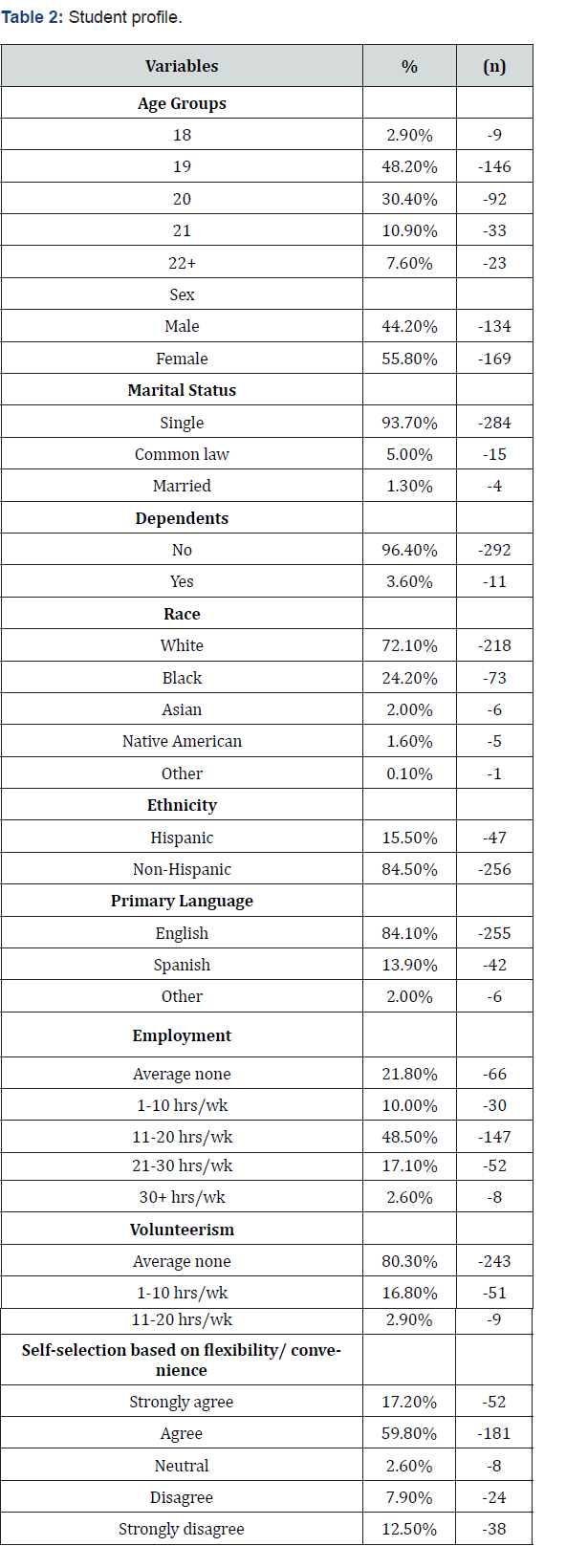
The profile of the students studied would suggest this is a typical, traditional 200-level undergraduate course where a majority of students are young and progressing to determine their career trajectory. In terms of age, a significant majority (92%) of students who participated in the study were generally 21 or under, Similar to the University demographics, women represented a larger percentage (55%) of the students enrolled in the courses. Students represented in the sample are young, single (94%) and are without children or dependents (96%). Similar to the University’s student body demographics, the majority of students self-identified as White (72%), a large concentration of students self-identified as Black and/or African American (24%). Furthermore, those who identified as Hispanic were approximately 16% of the sample and typical of the student body at the University where this study was conducted. English was the primary language spoken and was not a limitation to this study as all students had a proficiency in English despite 16% of respondents suggesting English was their second language.

The open ended pre-test also encouraged students to explain some of their current and/or situational factors that may be impacting their self-selection of instructional delivery. As denoted within the scholarship of teaching and learning research, students are often employed and/or volunteering outside of the classroom to supplement their career aspirations. Almost eight in ten students in courses reported being employed at the time of being enrolled in the course. A large majority of students (58%) reported working part time while as many as 19% of the students reported working over 20 hours a week in addition to their coursework. A large percentage of students (80%) were not involved with volunteerism and/or internships at the beginning of the course. This is likely due to their workload in and out of the classroom. A further question asked students to report whether time flexibility and/or convenience would impact their decision to self-select into a specific instructional method. Three-quarters of students reported that they agreed (60%) or strongly agreed (17%) that flexibility and convenience would have an impact on their decision. These findings would substantiate the literature as to why students may consider blended or online learning. In addition to the self–reporting of the students, it was also important to attain other validated measurements. Student consent to the study allowed for the use of their University student number to access other variables of interest (Table 3).

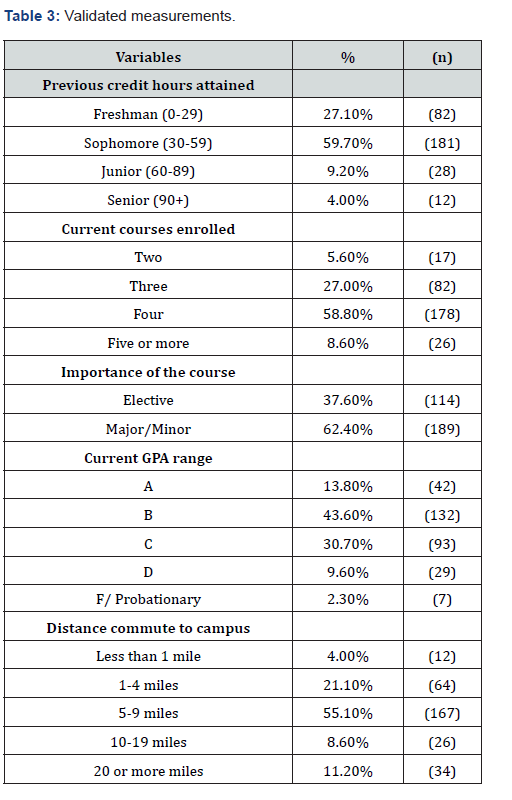
Validated measurements of students were able to supplement the knowledge attained by students while also ensuring more validated measurements focusing on accuracy. As such, it appears that these measurements validated the data that was self-reported by undergraduate students in the study. Consistent with the previous table, the ages of students and credits attained matched to substantiate that students enrolled in the 200-level criminology/ criminal justice courses were typically freshmen (27%) and/or sophomores (60%), thereby not having significant progress towards their degree. This would explain why a low percentage of students may not be as active in volunteerism and/ or internships (as they are still deciding on their career path).

Furthermore, a large majority of students were taking larger numbers of classes simultaneously. Less than 6% of the students were taking courses on a part time basis while a remarkable 94% of students were taking three or more classes (considered full time employment). This is particularly troubling as nearly 8% of the sample were taking the most courses allowed (without permission) at five courses within the same semester. If we consider that nearly 60% of students are also employed part time and another 20% of students are working over 20 hours a week, this could be considerable strain on many students within the sample. The relative importance of the course was another variable of interest that is often not considered particularly pertinent in the literature. Perhaps students who are more likely to engage in a their designated career path (in this case criminology/ criminal justice) feel that face to face course work might be more ideal versus students who perceive the class as simply an elective (and/ or perhaps a class they simply have to complete their liberal arts degree). A majority (62%) of the students enrolled in the seven courses were utilizing the class as a chosen major or minor of their study while 38% of students were taking the class as an elective and/or general course (not having declared a major or minor in criminology/ criminal justice).

Two variables of interest that are often self-reported and not necessarily validated in the literature were two of the final variables of interest. Preferring precision and accuracy, University Registrar records report that a large percentage of students (74%) were in the grade point average (GPA) range of a B to C. A lesser number of students had an A average (14%) while one in ten students (11%) were considered more high risk (having attained a D, F and/or probationary score). The second variable of interest was meant to assess and test the effect of commuting distance to determine if a longer commute to campus had an impact on self-selection. The University is considered more a of a commuter campus and as such, the student data was supportive of this analogy. Three of four students lived further than 5 miles from campus making the commute particularly more time consuming. This study did not address parking or public transportation. However, it appears that a substantial percentage of students would require time to commute as nearly one in five students commute over 10 miles each way, as per their schedule (which is predominantly two to three times a week) which could be five days a week. It would be expected that the longer the commute, the more likely students may select a more online based course. However, as illustrated above, a majority of students are taking a full-time course load so they may likely need to commute to campus for other courses. This should be considered when considering self-selection. The following section examines how self-reported and further validated motivating factors predicted a student’s self-selection of blended or hybrid instructional delivery. Due to a lack of variation in responses, several variables were unable to be included in the multivariate analysis. This includes one of the dependent variables (the 90% face to face to 10% online instructional delivery). For this reason, these variables were excluded to ensure a reduced level of error and multicollinearity. With a sample size of 303 students, the data analyses attempted to control error and multicollinearity with a tolerance level of 2 and a variance inflation factor of 4.0 to ensure that data outliers would be removed from the analysis.

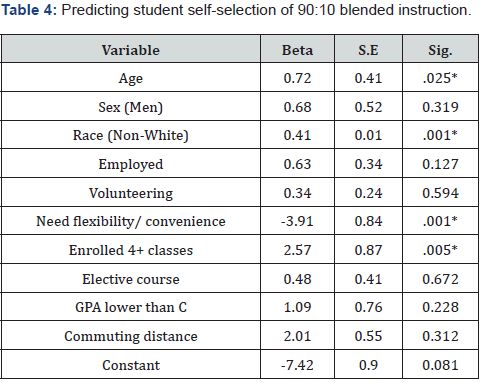
Table 4 below examines the predictive power of motivating factors that influence students’ self-selection of rhe most traditional form of instructional delivery where 90% of the course is face to face with 10% of the course within an online environment. This model was found to be statistically significant (.001 with a confidence level of 95% with the p < .05 being significantly different than zero). The motivating factors within the model explained 36% of students selecting a 90:10 more traditional instructional delivery (versus other delivery methods) based on a Nagelkerke R Square. The regression reported a Chisquare of 184.32 and a model -2 Log likelihood of 243.49 (with 10 degrees of freedom).

Findings suggest that while the model was good at predicting a 90:10 delivery of course instruction, only four variables were statistically significant at the .05 level. Those who were older were more likely to take a traditional face to face instructional method than a more blended or online approach. This is an interesting finding as you would expect that the older a student is, the more responsibilities they may have outside of taking courses at the university. However, the limitation of the study is that the range of the students who took this course was from 18 to 37. As such, it may not be representative of students in their mid to late 20s as a large percentage of students were below the median of 20. Students who self-reported as non-White were more likely to take a 90:10 delivery method than students who were White. While race has been considered a variable of interest, it may be difficult to determine why this could be the case in this model. The two most significant variables in the analysis (based on the Beta values) were those who did not require flexibility/ convenience and students who were enrolled in four or more classes within the same semester. It appears that students who did not require additional flexibility in their schedules were more likely to take a 90:10 deliverable course. This is consistent with some of the research that has been conducted. Furthermore, students who were enrolled in four or more courses within that particular semester (equating to 12 credit hours or more) were more likely to consider a more face to face instructional delivery. While this appears to contradict the idea of flexibility and convenience, this finding could be a result of students having to attend other classes on campus and therefore, simply chose to attend class because they were on campus already. This finding would require further research to substantiate.

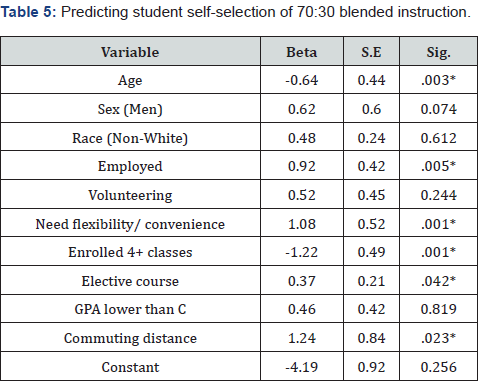
The Table below examines the strength of ten motivating factors influencing students’ self-selection of the most prevalent 70:30 instructional delivery. In this mode of instructional delivery, 70% of the course is face to face and 30% of the course is available within an online environment. This model was also found to be statistically significant (.001 with a confidence level of 95% with the p < .05 being significantly different than zero). The motivating factors within the model explained 51% of students selecting a 70:30 instructional delivery based on a Nagelkerke R Square. The regression reported a Chi-square of 244.81 and a model -2 Log likelihood of 314.26 (with 10 degrees of freedom). It should also be noted that three cases/outliers were removed from the analysis to ensure there was no multicollinearity.

The model explained in Table 5 finds that half of the variables of interest are significant when understanding a blended form of instructional delivery (versus other modes of delivery). Findings suggest that there is considerable differentiation as to why students in this sample chose blended learning versus a traditional form of instructional delivery (Table 4). Age remained a significant demographic variable of significance. It appears that the younger the student, the more likely they would enroll in a 70:30 blended instructional delivery of a criminology class. This could be due to a number of other corresponding factors such as comfortability of online environments or different priorities (versus older students). More study would be needed.


Employment, or the more a student works per week was found to be significant in determining if a student selected a 70:30 blended instruction. It also appears that other factors or a complex set of factors is having the most impact on a student’s selection of 70:30 delivery. The Beta values above would suggest that the three most significant motivating factors was the commuting distance of students, enrollment of fewer than four courses per semester and the need for flexibility/ convenience in their scheduling. These variables of interest have all been found to be significant in other research studies. In this particular study, it would appear that the longer the commute a student has to the University (from their primary listed address), the more likely they would consider enrolling in a 70:30 blended instruction. This would also correspond to the relevance of taking fewer classes and perhaps not being on campus as often, providing them more flexibility and convenience. As we know, most students will select courses on particular days (Monday, Wednesday, Friday or Tuesday, Thursday) rather than five days a week. It also becomes apparent that students who take the course as an elective were more likely to consider the 70:30 blended instruction than those students who enrolled in the course to fulfill their major or minor liberal arts degree requirements. Therefore, with a commuting distance, higher levels of employment per week and convenience, it would not be self-serving if students selected a traditional method especially considering that they are taking fewer classes.

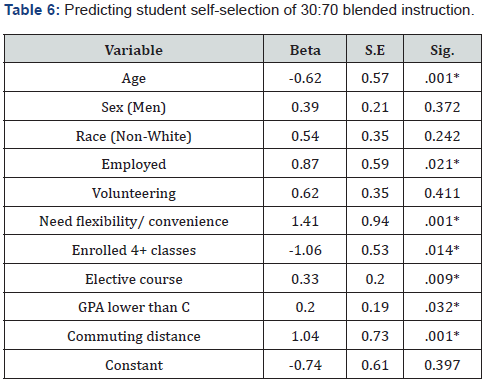
Table 6 illustrates the predictive power of ten motivating factors that influence a student’s selection of a 30:70 blended instructional offering (versus other instructional deliveries). The model was found to be statistically significant at a .001 with a confidence level of 95% (with the probability < .05 being significantly different than zero). The variables of interest within the model explained 52% of students selecting a 30:70 instructional delivery based on a Nagelkerke R Square. The regression reported a Chi-square of 219.65 and a model -2 Log likelihood of 307.24 (with 10 degrees of freedom). It should also be noted that the same three cases/outliers were removed from the analysis to ensure there was no multicollinearity.


The model represented above substantiates the previous model of why students may consider enrolling in a more blended learning environment. Of the 10 variables of interest, seven variables were found to be significant in predicting enrollment in a 30:70 instructional delivery mode (versus other modes). Age remains a constant within the three tables. It appears that the younger the student, the more likely they may consider a blended option. Sex, race and volunteering do not seem to have any impact on student selection of course instruction. Students who reported higher levels of hourly employment (per week) were more likely to consider a 30:70 online instructional deliverable who may obviously require more flexibility and convenience.

It also appears that the number of classes and which classes students are enrolled in becomes a more significant variable as blended instruction applies. Students who were enrolled in three or fewer courses, considered the criminology course as an elective course and also having a lower GPA (corresponding to a C or lower) were more likely to choose the 30:70 option. Might this be due to students simply prioritizing other classes over this particular criminology course? Perhaps students registered for fewer courses equates to a lessening engagement of traditional materials if given the option. Unfortunately, it appears that these findings while being interesting does not explain the complexity surrounding the inter-connectivity of these variables. It also appears that a longer a student commutes to the university (from their primary residence) is also having an impact on their selection of instructional delivery. This variable in combination with taking fewer courses may be driving a student’s selection or preference to stay at home more or working more hours (where university courses are less of a priority).

The findings of these three tables offer some insight in how a student may be motivated to select a particular course instructional delivery. Linear and logistic regressions are often performed with sample sizes over 400 to ensure reduced multicollinearity. While three cases were removed from two analyses, results should be taken cautiously. Several variables were also not included from the sample profile due to a lack of variation in responses. A final anticipated discussion on a student’s motivations to take an almost completely online 90:10 course was also not analyzed due to a low sample size. These findings are conclusive however, it should be noted that due to a low size of this population, results should be taken as exploratory [41-50].

Implications

As other researchers have maintained, there is certainly a complexity surrounding how students select traditional, blended/ hybrid or online classes. While many of these motivations are often situational and/or circumstantial, this study offers an exploratory view on why students may self- select into one particular instructional delivery over another, if given the opportunity, It appears that age and race are demographic groups which were considered significant and require more research. We know that age could be directly correlated with confidence in computer literacy and/or more traditional face to face methods. However, more study is needed with perhaps more attention explored within what we know about distance learning. This study sought to learn more about commuting and distance education and it appears that a student’s commute to campus (the longer the commute) has an impact on their decision to choose a more blended offering of course instruction. The higher number of hours a student was employed through any given week in a semester was also a significant factor in blended learning instruction versus a lack of it. Flexibility and convenience was found to be a significant predictor of blended learning while also found to impact a more traditional face to face delivery (in a negative correlation). This might suggest that convenience may have more of an impact with blended learning rather than traditional face to face courses which is consistent with the literature. A student’s motivation to take more blended learning could be derived from the necessity of the class itself. It appears that students who enrolled in the class as an elective were more likely to consider more blended (70:30 or 30:70) options. This finding may have more to do with a student’s perception of how important the course is and the priority it is within a student’s liberal arts education within the institution studied. These findings offer a glimpse into self-selecting into an online learning environment. There are few studies that have offered such an insight into selecting one instructional method versus another and as such, more study is needed. 


To Know more about our Juniper Publishers

Frequency of Visiting a Doctor: A right Truncated Count Regression Model with Excess Zeros- Juniper Publishers

  Biostatistics and Biometrics - Juniper Publishers Abstract Count response variables are frequently encountered in medical data, which call...