Showing posts with label Medicinal Chemistry. Show all posts

Thursday, May 28, 2020

Challenges to Solve Our Plastic Waste Problems - Juniper Publishers

Organic & Medicinal Chemistry - Juniper Publishers


Abstract

This year the campaign to stop plastics pollution has increase. On Social Media it is used the theme: #Beat Plastic Pollution. Such actions are crucial in the implementation of the 2030 Agenda for Sustainable Development and its SDGs, and the Paris Agreement on Climate Change, including through engaging in political advocacy, providing expertise and insights on potential policy choices, as well as being directly responsible for the implementation of many of these decisions [1]. At the moment, humanity makes about 300 million tons of plastic every year. And half of it is used only once (like bags and wrapping). Approximately 10% of it is recycled and the rest goes to garbage dumps/landfills and rivers. According to a recent study, 10 rivers (2 in Africa and 8 in Asia) transport 90% of all the plastic that ends up in oceans. The scale of pollution is awful and many of us don’t even realize how bad this situation is [2]. Countries in the world are mobilizing to ensure they become nations free of plastic bags and straws and polystyrenes takeaway boxes, among other undesirable plastics by the end of present year 2018. The ban on these plastics is an opportunity for us to help protect our planet and to strengthen our sustainable cultural practices [3]. 

Keywords: Plastics Pollution; Water Pollution; Land Pollution; Air Pollution; Sustainable Development; Climate Change

Discussion
Over the time, our oceans have increasingly become dumping grounds for different types of waste, including sewage, industrial waste, chemicals, plastics and litter. An estimated 80% of marine pollution originates from land-based sources including wastewater and nutrients loadings. Worldwide, pollution in coastal waters has increased exponentially during the last decades due to population growth and the increasing number of anthropogenic activities. Coral reefs are particularly vulnerable to wastewater and nutrient pollution, which consequently threatens the health and well‐being of hundreds of millions of people who depend on coral reef ecosystem services for nutrition, livelihoods and a safe living environment. With the influences of ocean warming and coral bleaching impacts, land-based pollution constitutes a significant additional threat that must be addressed with urgency.

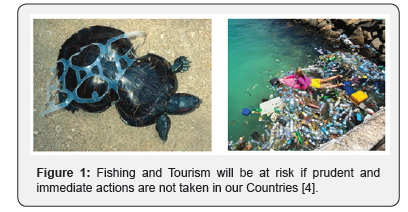
you choose. There is the hawksbill turtle struggling to free itself from a plastic bag. The sea of polystyrene trash floating over a Caribbean nature reserve. Or the sperm whale washed ashore, its stomach filled with plastic waste. Pieces of plastic are sharp, brittle, toxic, and routinely found in the stomachs of dead fish, turtles, and marine mammals. Plastics can come with a range of hazardous additives and can act as a chemical sponge, soaking up and concentrating other pollutants. Marine species, including fish, seabirds and even marine mammals, can end up eating pieces of plastic, and at the same time get an additional dose of toxic chemicals.

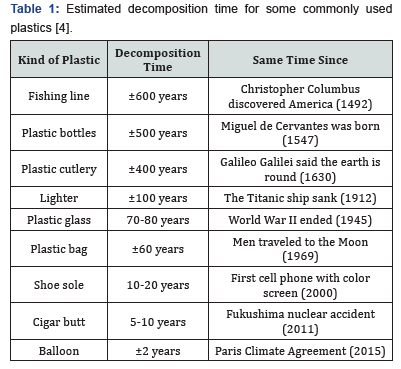
Since the introduction of mass-produced plastics in the early 20th century, humanity has produced an estimated 8,300 million tons of the stuff. Around three-quarters has been thrown away, and 80% of that has drifted into the environment or gone into a landfill. Approximately, eight million tons a year end up in the ocean, it makes more than 5 trillion pieces and counting. It is an environmental catastrophe and a human one, too, as some people in parts of the developing world live ankle-deep in filthy, non-biodegrading plastic trash (Table 1). The long-term health implications for all of us remain uncertain, as ingested plastic works its way up to the food chain. Everyone agrees something must be done. From banning plastic straws to rebooting recycling systems to harnessing plastic-munching bacteria, there is no shortage of touted solutions. It is less clear what would work best. But fixing the plastic waste crisis is going to take some seriously joined-up thinking. If we make the wrong decisions now, we risk making the problem worse. If plastics didn’t exist, we would have to invent them. Generally made of oil-derived polymers, they can be hung with different chemical groups and spiced up with additives to give them wildly differing properties such as hardness, strength, density and heat-resistance. This makes them just the thing for everything from colorful, durable kids’ toys Figure 1.

We need to tackle the problem of marine debris head on. It’s not just an issue for environmentally conscious, it is an issue that ultimately affects human health. Man is a top predator that feeds on a variety of ocean fish, shellfish and other marine species. We face the same risks as the killer whale and polar bear. While any plastic or polystyrene pellets that may have been clogging the gut of the fish that is nicely presented on our dinner plate have been long removed, the toxic contaminants originating from that debris remain stored in the flesh we are about to eat. Food for thought indeed. Some scientists are suggesting that burning plastic could be the most environmentally-friendly way to get rid of it. They base it on the fact that plastics are composed of a mixture of hydrocarbons with varying chain length, mainly long chain hydrocarbons. They support the theory that there is not big difference with other fuels apart from some halogens and Sulphur that can be removed from any emissions using appropriate filters and sequesters [1-4].


Conclusion

When we deal with plastics pollution, we should be sober in adopting solutions. Climate Change and the Loss of Biodiversity remain our top environmental concerns, and we cannot afford to adopt plastic alternatives that increase, not decrease, our impact on the planet. A cotton tote bag or steel water bottle may generate higher carbon emissions over its lifetime. A rush to bioderived plastics may, as with bio-fuels, increase land cleared for crops. Plastics that degrade faster risk increasing the scourge of microplastic in the environment if not partnered with better waste management.

Some solutions to reduce plastic pollution are specific actions policy makers can take to improve waste management, promote eco-friendly alternatives, educate consumers, enable voluntary reduction strategies and successfully implement bans or levies on the use and sale of single-use plastics, etc. World Environment Day 2018 issued a call to action to individuals, governments, the public and the private sector to examine joint solutions to reduce the heavy burden of plastic pollution on our natural places, our wildlife and our own health. Now more than ever Zac Goldsmith quote is a proven statement: “Of all the waste we generate, plastics are perhaps the greatest symbol of our throwaway society. They are used, then forgotten, and they leave a terrible legacy”.

To Know more about Organic & Medicinal Chemistry

Click here: https://juniperpublishers.com/omcij/index.php


To Know more about our Juniper Publishers

Click here: https://juniperpublishers.com/index.php

Wednesday, March 11, 2020

Simultaneous Estimation of Aliskiren and Amlodipine in Combined Tablet Formulation by Simultaneous Equation and First Derivative Spectroscopic Methods-JuniperPublishers

Journal of Organic & Medicinal Chemistry-Juniper Publishers

Abstract

Simple, sensitive and accurate UV-spectroscopic methods were developed and validated for simultaneous estimation of aliskiren and amlodipine in tablet formulation using simultaneous equation and first derivative spectroscopic methods. Developed methods include direct estimation of amlodipine at 365nm without any interference, since aliskiren has zero absorbance at this wavelength. Estimation of aliskiren through simultaneous equation was performed at 279 nm, while 236.8 nm were selected as zero crossing point for estimation of aliskiren by first order derivative spectroscopic method. Linearity was found to be satisfactory over the concentration range of 25-300μg/ml and 5-100μg/ml for aliskiren and amlodipine respectively. The mean percentage label claim of aliskiren and amlodipine using simultaneous equation was 99.84 and 99.85 % respectively, while for first derivative spectroscopic method it was found to be 100.36 and 99.85% respectively. The developed methods are economical and reproducible for routine analysis of aliskiren and amlodipine in tablet formulation.
Keywords: Aliskiren; Amlodipine; First order derivative method; Simultaneous equation Method; Validation

Introduction

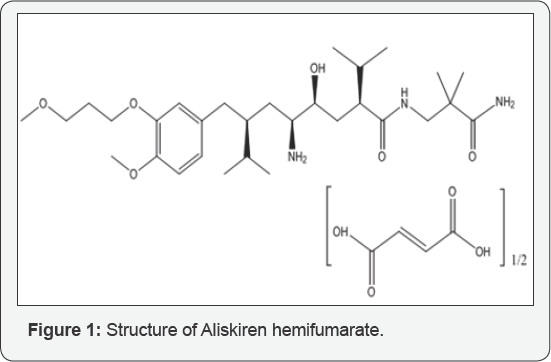
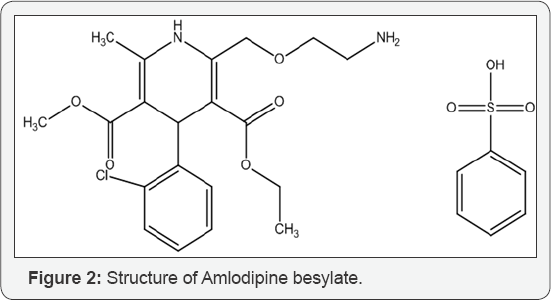
Chemically aliskiren (ALS) is (2S, 4S, 5S, 7S)-5-Amino-N-(3- amino-2, 2-dimethyl-3-oxopropyl)-4-hydroxy-7-[[4-methoxy- 3-(3-methoxypropoxy)phenyl]methyl]-8-methyl-2-propan-2- ylnonanamide [1]. It is a is a white to slightly yellowish crystalline powder. Aliskiren is the first in a class of drugs called direct renin inhibitors. It is used for essential (primary) hypertension [2]. It is highly soluble in water, ethanol and DMSO [3,4]. Amlodipine (AML) is chemically 3-Ethyl-5-methyl (±)-2-[(2-aminoethoxy) methyl]-4-(2- chlorophenyl)-1, 4-dihydro-6-methyl-3,5- pyridinedicarboxylate. Amlodipine besylate is white to off white powder, crystalline and has long-acting 1, 4-dihydropyridine calcium channel blocker [5,6]. It acts primarily on vascular smooth muscle cells by stabilizing voltage-gated L-type calcium channels in their inactive conformation. By inhibiting the influx of calcium in smooth muscle cells, amlodipine prevents calcium-dependent myocyte contraction and vasoconstriction. Amlodipine is used to treat hypertension and chronic stable angina [7,8]. Several analytical methods have been reported for estimation of ALS and its combination with other drugs which includes spectrophotometry and HPLC [9-13]. Similarly, various spectrophotometric and HPLC methods have been reported for estimation of AML and its combination with other drugs [14-18]. In the present work, a successful attempt has been made to estimate both these drugs simultaneously using dual wavelength UV spectrophotometric method. Structures of both the drugs ALS and AML are given in (Figures 1 & 2).

Materials and Methods

Instrumentation

A double beam UV spectrophotometer (UV-1800, Shimadzu, Japan) with UV probe software version (2.31) and 10mm quartz cells was used. All weights

Reagents and Chemicals

Pure drug, Aliskiren hemifumarate and amlodipine besylate was procured from Swapnroop Drugs and Pharmaceuticals, Aurangabad, Maharashtra, India. Marketed formulation was procured from local Pharmacy. All the chemicals and reagents used were of A.R. grade.

Method Development

Preparation of Standard Stock Solution: The standard stock solutions of Aliskiren and Amlodipine were prepared by dissolving 110.5mg of aliskiren hemifumarate (110.5mg of aliskiren hemifumarate is equivalent to 100mg of aliskiren) and by dissolving pure drug of amlodipine besylate equivalent to 100mg of amlodipine in separate 100 mL volumetric flask containing sufficient quantity of distilled water, the solutions were sonicated for 5 min then volume was made up to the mark with distilled water to get a concentration of 1000μg/mL of each solution. The standard stock solutions were further diluted to obtain desired concentrations.
Preparation of Sample Solution: Twenty tablets were weighed and powdered. The quantity of the powder equivalent to 150mg of ALS was transferred to 100 ml volumetric flask. The content was mixed with sufficient quantity of distilled water and sonicated for 20min to dissolve the drug. The solution was then filtered through a Whatman filter paper no. 41 and made up to the mark with distilled water An aliquot of solution (1.0ml) was transferred to a 10 ml volumetric flask and the volume was adjusted up to the mark with distilled water to obtain required concentration of ALS (150μg/ml) and AML (10μg/ml).

Simultaneous Equation Method

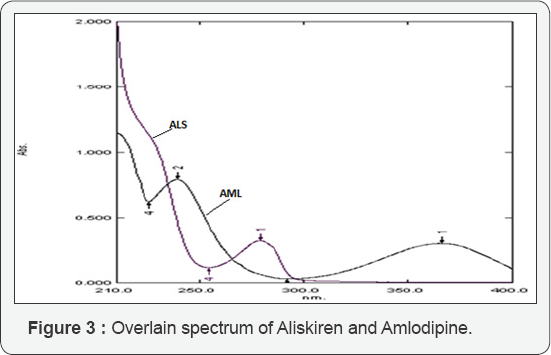
For simultaneous estimation of ALS and AML using simultaneous equation method (SE method) the solutions of ALS (50μg/ml) and AML (20μg/ml) were prepared from the standard stock solutions of ALS and AML and scanned over the range of 200 nm to 400 nm. An overlain spectrum was studied for development of suitable method for analysis. The overlain spectrum of ALS and AML is shown in (Figure 3). From the overlay spectra, 279 nm wave length was selected for the estimation of ALS using simultaneous equation method. Estimation of AML was done as a single component at 365nm. The absorptivity values were calculated and were applied in framed simultaneous equation 1, which is presented as,]
Where, A is absorbance of sample solution at 279 nm, CX and CY are concentrations of ALS and AML, respectively in μg/ml.

First Order Derivative Method

Estimation of AML was performed similarly as in simultaneous equation method. For estimation of ALS first order derivative method (DR method) was applied. The zero order spectrum was then derivatised to obtain first order derivative spectrum (Figure 4). From this spectrum of ALS and AML zero crossing point of 236.8 nm was selected using 2 nm as wavelength interval (Δλ = 2) and scaling factor taken as 1 for estimation of ALS.

Analysis of ALS & AML in Tablet Formulation

The absorbance of final sample solution was measured against distilled water as blank at 279 nm for SE method and at 236.8nm for DR method while the estimation of AML was done directly at 365nm. The analysis procedure was repeated five times for marketed formulation.

Method Validation

Linearity and Range: Aliquots of standard solution of ALS (0.25, 0.5, 0.75, 1.0, 1.25, 1.5, 2.0 and 3.0 ml) and AML (0.05, 0.1, 0.2, 0.3, 0.4, 0.5, 0.6 and 1.0 mL) were transferred in a series of 10 ml volumetric flasks. The volume was adjusted up to the mark with distilled water and mixed. Absorbance values were recorded at 279 nm for SE method and at 236.8 nm for DR method against distilled water as blank for determination of ALS. Absorbance values of AML were recorded at 365 nm for all dilutions. The calibration curves were plotted between the concentration of component and absorbance values of ALS for SE method and between concentration and dA/dX for DR method. Calibration curve for AML was plotted between the concentration of component and absorbance value of AML.
Standardization of the Method by Analysis of Mixed Standard Solutions: To check the validity of the selected methods, mixed standard solutions of ALS and AML were prepared. The solutions were subjected to determine absorbance values at respective wavelengths and concentration of the components were calculated.
Accuracy: The accuracy of the method was determined for both the methods by calculating recoveries of ALS and AML by the standard addition method. Known amount of standard solution of ALS and AML were added at 80%, 100% and 120% levels to pre-quantified tablet sample solutions of ALS and AML. The results are reported in terms of % Recovery

Results and Discussion

Method Development and Validation

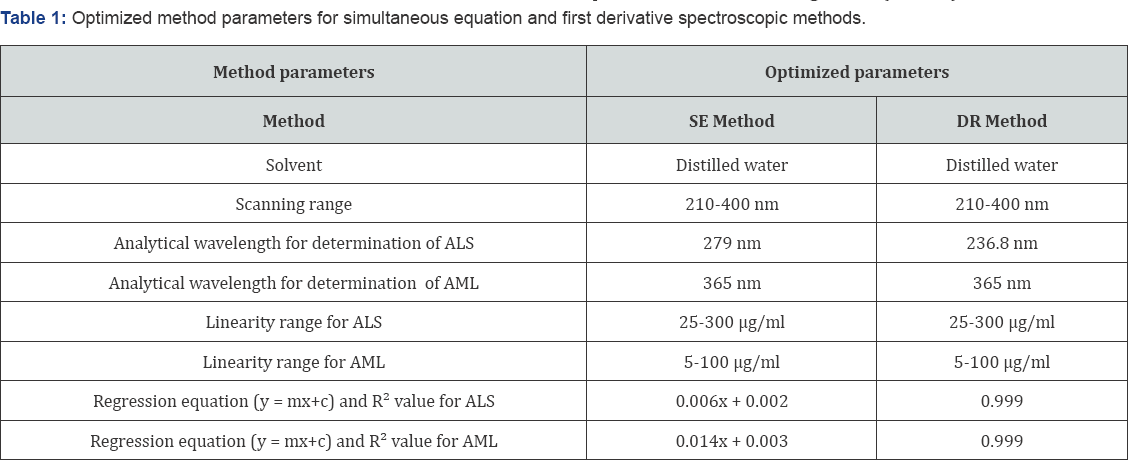
Two simple, sensitive and accurate UV-spectroscopic methods were developed and validated for simultaneous estimation of aliskiren and amlodipine in tablet formulation using SE and DR spectroscopic methods. From the overlain spectra of the drugs it was observed that SE and DR spectroscopic methods were suitable methods for simultaneous determination of ALS and AML. Distilled water was taken as solvent system, as both the drugs were soluble in this solvent and reduce the cost of the method. In SE method and DR method, wavelengths 279 nm and 236.8 nm respectively were selected for determination of ALS, whereas AML was estimated directly at 365 nm as ALS has zero absorbance at this wavelength. Optimized method parameters for simultaneous equation and first order derivative spectroscopic methods are shown in Table 1.

Linearity

The calibration curves of ALS and AML were linear in the range of 25-300μg/ml and 5-100μg/ml respectively. Regression equation and R2 values are given in (Table 1).

Standardization of the method by analysis of mixed standard solutions

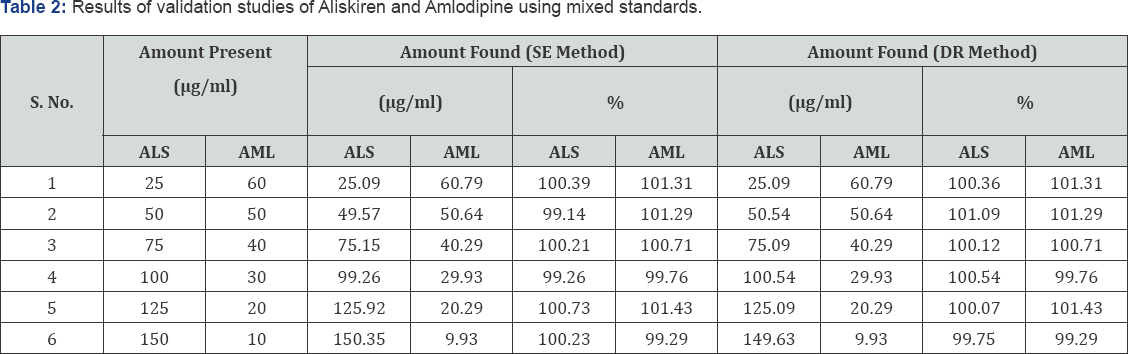
The concentration of ALS and AML recovered from mixed standard solutions for both methods was within range and are given in Table 2.

Accuracy

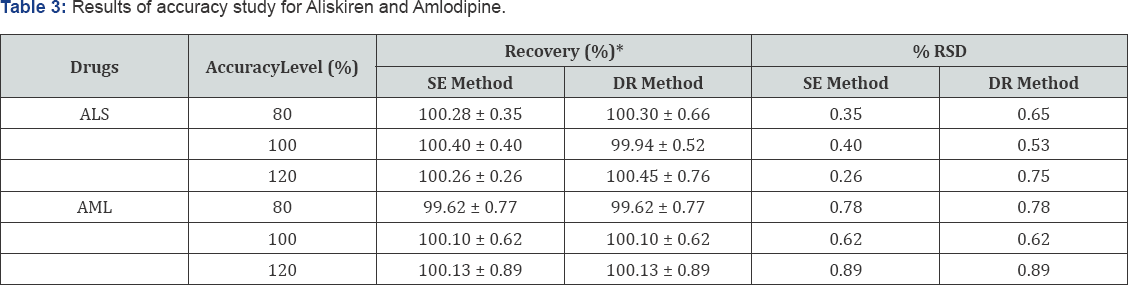
The percentage recoveries of drugs from sample were determined by standard addition of pure drugs at three known concentrations and recoveries were obtained at each level.The percent recoveries for ALS were found to be in the range of 100.26- 100.40% for SE method and 99.94-100.45 % for DR method. Percent recoveries for AML were found to be in the range of 99.62-100.13% for both methods. The results of accuracy studies are shown in Table 3.

Application of the Method in Assay of Tablets

The proposed UV method was applied for the determination of ALS and AML in their combined pharmaceutical formulation and the results are shown in Table 4.

*Mean ± SD (n=3), SD (Standard deviation), %RSD (Percent relative standard deviation).


*Mean ± SD (n=5), SD (Standard deviation), %RSD (Percent relative standard deviation).

Conclusion

The proposed simultaneous equation method and first order derivative gives accurate and precise results for determination of aliskiren and amlodipine in marketed formulation (tablet) without prior separation and is easily applied for routine analysis. Method validation has been demonstrated by variety of tests like linearity, accuracy and validation through mixed standard. The proposed method can be successfully applied for determination of these drugs in commercial tablet formulation.

Acknowledgement

The authors express their sincere gratitude to Swapnroop Drugs and Pharmaceuticals, Aurangabad, Maharashtra, India for providing the pure drug samples of Aliskiren Hemifumarate and Amlodipine Besylate and are also thankful to colleagues and authorities of Department of Pharmacy, SRMSCET, Bareilly, U.P. who helped us in this work.

To know more about Juniper Publishers

Cytotoxicity, Antimicrobial and Antioxidant Activities of Apocarotenoid Rich Leaf Essential Oil of Maesobotrya Barteri Var. Barteri (Baill.) Hutch - Juniper Publishers

  Technical & Scientific Research - Juniper Publishers Abstract Background: Maesobotrya barteri var. barteri (Phyllanthaceae) has anal...