Background/Aim: COVID-19 can rapidly develop
into acute lung injury, and even acute respiratory distress syndrome
(ARDS), which has a high risk of death. Patients with ARDS often require
intubation. However, the timing of intubation and its effect on
clinical outcomes in COVID-19 ARDS (CARDS) patients remains unclear.
Thus, the authors explored the impact of intubation time on clinical
outcomes in COVID-19 patients with ARDS through a systematic review and
meta-analysis.
Materials and Methods: Research articles from
PUBMED, CINAHL, MEDLINE, ProQuest Covid database, and Web of Science
were searched through December 2021. All patients in the research met
the Berlin criteria for ARDS. For the purposes of this review, “Early”
intubation was defined as intubation within 24 hours of an ARDS
diagnosis, while “Late” was defined as 24 or more hours after diagnosis.
The primary outcome was ICU mortality, and secondary measures included
length of ICU stay and duration of mechanical ventilation. The
meta-analysis was performed using a random-effects model. The quality of
cohort studies was assessed using the Newcastle-Ottawa Scale. The
methodological quality of the overall evidence in this review was
evaluated using the GRADE approach.
Results: After an extensive search, six cohort
studies were ultimately included in the systematic review, altogether
encompassing 2,739 patients with CARDS. A meta-analysis revealed
statistically significant differences in mortality [risk ratio
(RR)=0.78; 95% confidence interval (CI),0.69-0.88; Z=3.91, P <
0.0001)]. The mortality rate was 36.2% (817 deaths) in the early group
and 48.2% (229 deaths) in the late group, respectively. Results of the
narrative analysis showed that early intubation resulted in shorter ICU
stays, which was statistically significant. However, no statistical
difference was found in the duration of mechanical ventilation.
Conclusions: Early intubation can reduce
mortality and length of ICU stay in adult COVID-19 patients with ARDS.
However, the timing of intubation did not affect the duration of
continuous mechanical ventilation.
Keywords: COVID-19; ARDS; Timing of Intubation; Invasive Mechanical Ventilator; Systematic Review; Mortality
In December 2019, COVID-19 was identified as a new
clinical syndrome caused by a novel coronavirus. The virus is
transmittable through the respiratory tract and is highly contagious.
Despite significant efforts to control the spread of COVID-19, it
triggered a global pandemic [1-4], an epidemic of scale across
international borders [5]. COVID-19 pneumonia may develop rapidly into
acute respiratory distress syndrome (ARDS) with a high risk of death
[6]. ARDS is an acute respiratory failure caused by increased pulmonary
capillary permeability secondary to inflammatory oedema. It leads to
alveolar flooding and subsequent deep hypoxemia, in which intrapulmonary
shunt is the most important underlying mechanism [7]. However, ARDS
caused by COVID-19 is different from ARDS with any other underlying
cause. According to Huang et al. (2020) [8], the onset of ARDS
associated with COVID-19 is between 8-12 days. There are two distinct
phenotypes of COVID-19-associated ARDS (CARDS), L-type and H-type. Type L
presents as pneumonia and is limited to mild inflammation of the
subpleural interstation.
It is characterized by low elasticity, atelectasis, normal
compliance, and low lung weight. On the other hand, patients
with Type H meet typical ARDS criteria, including decreased lung
compliance, hypoxemia, bilateral lung infiltration, and increased
lung weight [9]. Li and Ma [10] have been reporting on respiratory
support strategies for patients with CARDS during the past two
years, but how exactly the timing of tracheal intubation and use
of invasive mechanical ventilation impacts clinical outcomes
is still unclear in patients with CARDS. Delayed intubation can
cause autologous lung injury (SILI) due to high respiratory drive
pressure [11]. However, intubating patients too early can also
be associated with some complications, including ventilatorassociated
pneumonia, airway injury, ventilator-induced lung
injury, and hemodynamic disorders due to positive pressure
ventilation [12]. Six primary studies [13-18] have indicated
different results regarding the timing of intubation for patients
with CARDS, and currently there is no systematic review relevant
to this topic. Therefore, a systematic review is necessary to further
explore how the timing of intubation impacts outcomes for these
patients.
The PRISMA statement, which contains a 27-item checklist
and four-phase flow chart [19], is used to help authors report
systematic reviews and meta-analyses.
Eligibility Criteria
The population included in this systematic review was defined
as adult patients (≥18 years old) with PCR-confirmed COVID-19
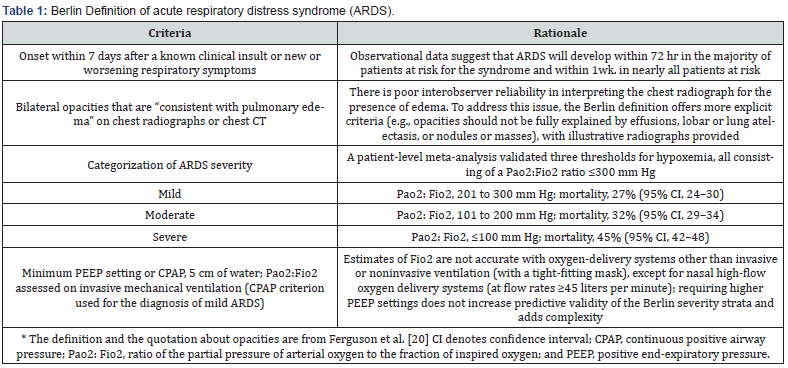
diagnoses who also had ARDS. ARDS was defined by the Berlin
Criteria or American-European Consensus Conference (Table 1)
[20]. Early intubation was defined as being intubated within 24
hours of being diagnosed with ARDS; Late intubation was defined
as being intubated 24 or more hours after an ARDS diagnosis.
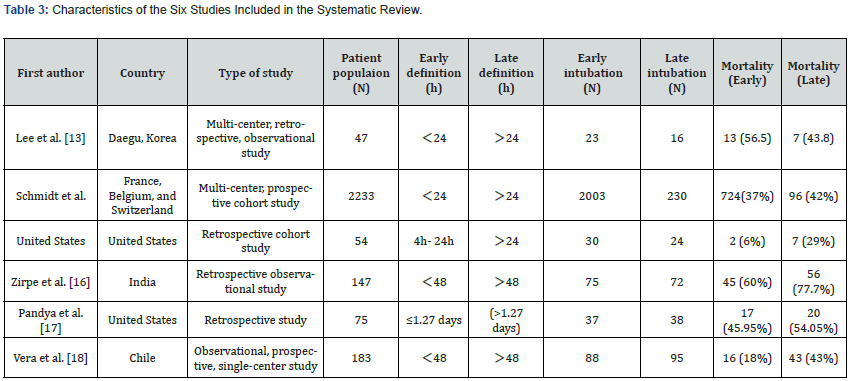
The timing of intubation was also defined by authors of four
original studies [21]. Systematic reviews and meta-analyses are
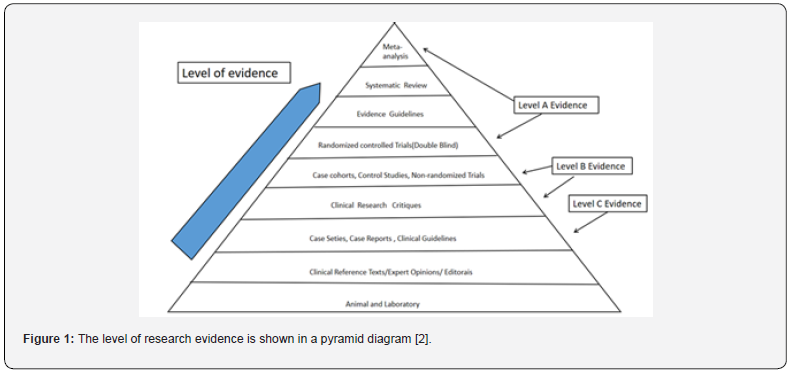
in the upper echelon of the evidence-based medicine hierarchy
of evidence, followed by randomized, controlled, double-blind
studies, followed by cohort studies, case-control studies, case
series, and case reports [2] (Figure 1). Randomized trial studies
were not permitted due to potential ethical issues regarding the
timing of intubation of COVID-19 ARDS patients [22]. Therefore,
existing cohort studies and case-control studies were sought out
to provide high-quality research evidence for this systematic
review [23], (Figure 1).
Search Strategy
The authors only searched relevant scientific databases, which
included PUBMED, CINAHL, MEDLINE, ProQuest Covid Databases,
and Web of Science. Articles were retrieved from December
2019 to December 2021, and the language was restricted to
English. In this systematic review, the search strategy developed
by the authors consisted of a combination of keywords, medical
subject headings (MeSH), free-text words, wildcards, acronyms,
synonyms, and transatlantic terms. Boolean operators (“AND”
“OR” and “NOT”) were used to combine the terms entered in
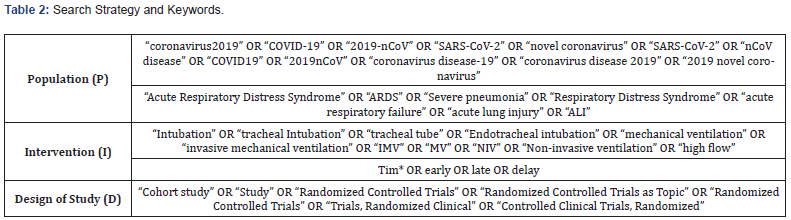
each search field. Search strategy and keywords are described as
follows (Table 2).
Study Selection
Two authors independently searched for relevant
literature
by executing the above search strategy and browsing abstracts or
full texts to find potential articles. Detailed inclusion and exclusion
criteria were used to screen the articles, and six primary research
articles were finally selected as suitable for review.
Data Extraction and Risk of Bias Assessment
Two reviewers independently extracted and examined
data from each included study. Extracted data included article
title, author name(s), the date of publication, language, country,
characteristics of participants, type of study, and data pertaining
to the study’s outcome. Outcomes included mortality, length of
ICU stay, and duration of ventilator use. The Newcastle-Ottawa
Scale (NOS), developed by the University of Newcastle in Australia
and the University of Ottawa in Canada, is a quality assessment
tool for the systematic evaluation of non-randomized studies,
especially for cohort and case-control studies [24]. The NOS
cohort study version consists of eight multiple-choice questions
involving topic selection and comparability, as well as outcome
assessment or exposure. A star rating system is used to indicate
the quality of the study, up to a maximum rating of nine stars. One
star is awarded for each criterion if the reporting methodology is
appropriate. Separate scales have been developed for cohort and
case-control studies, which can help authors identify low-quality
studies and inform sensitivity analyses or meta-regression [25].
NOS developers have examined NOS face and standard validity,
reliability among evaluators, and evaluator burden. Surface validity
has been assessed as strong by comparing each assessment item
with its stem problem [26]. Therefore, NOS can be a helpful tool
in assessing the quality of studies included in systematic reviews.
Data Synthesis
Stroup et al. published criteria for conducting and
reporting
meta-analyses of observational studies to improve the quality of
reporting. Dichotomous data and risk ratio (RR) were chosen for
data synthesis. The most common, a 95% confidence interval, is
used to analysed mortality and favourable outcomes. Narrow
confidence intervals are used to indicate that treatment estimates
are relatively accurate [27]. In the second stage, the pooled
(combined) intervention effect estimates are calculated as a
weighted average of the estimated intervention effects in a single
study. There are four methods for binary results meta-analysis,
including three fixed-effect methods (Mantel-Haenszel, Peto, and
inverse variance) and one random-effects method (Der Simonian
and Laird inverse variance) [28]. For this systematic review,
Rev Man software from the Cochrane Review was used for data
analysis. The results were presented using forest maps.
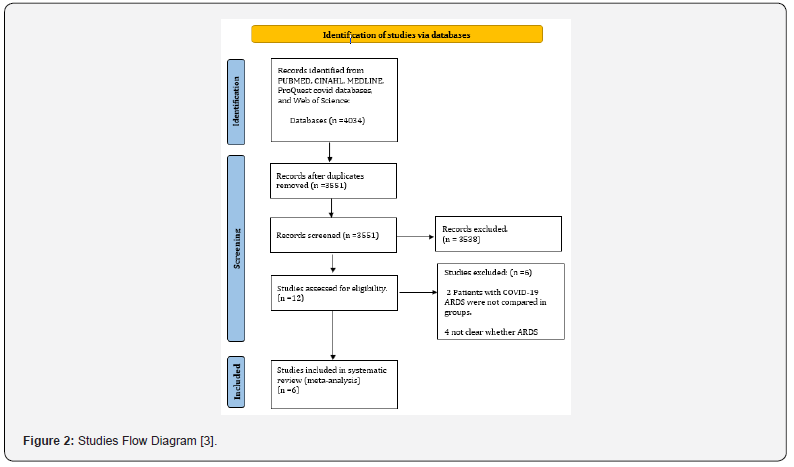
Study Selection.
Assessment Quality
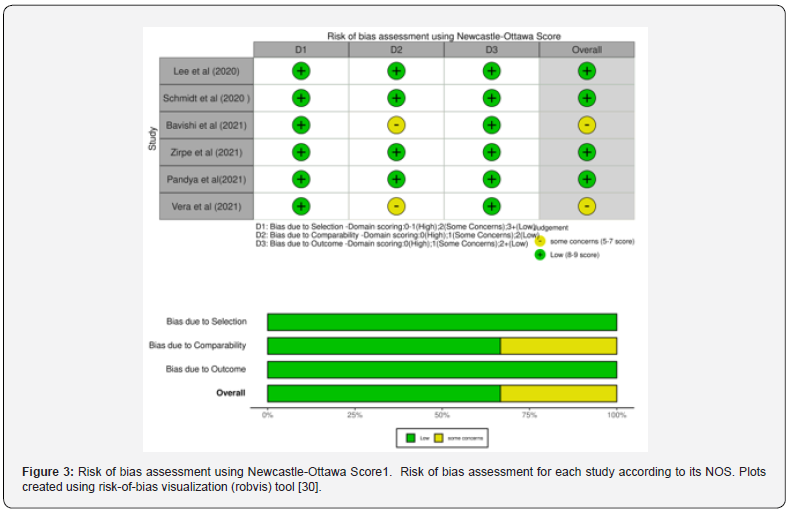
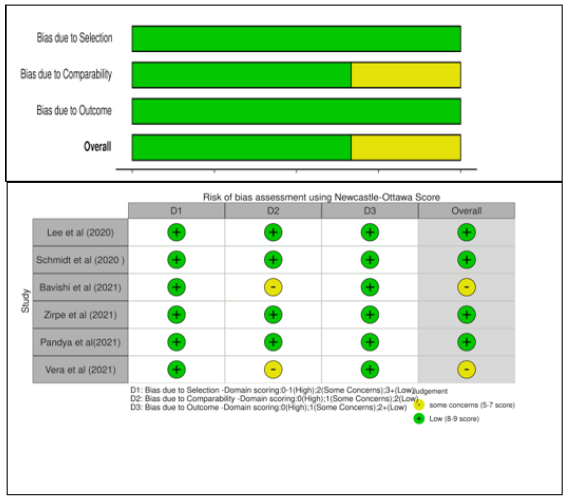
The Newcastle-Ottawa Scale was used to evaluate the quality
of the six studies [32] (see Appendix 3). There are detailed
evaluation records for each study, as well as summary tables for
each of the six studies. The traffic-light plots and summary bar
plots were created using the robvis tool (Figure 3), which is a web
application for visualizing deviation risk assessment as part of
a system assessment [33]. Selection criteria, comparability, and
outcome (cohort) or exposure (case-control) were scored on a
scale up to 9 (Figure 3).
Main Outcome
The forest plot showed that 2,731 participants across six
studies were included in the meta-analysis with a combined RR =
0.78 (95% CI 0.69 to 0.88, Z=3.91, P < 0.0001) (Figure 4). Overall,
the results showed that the mortality of the early intubation group
was lower than the late intubation group, and the difference was
statistically significant. Significant heterogeneity was observed
(I2=63%), which indicated a large degree of variation between
effect sizes in the included studies (Figure 4).
Length of ICU Stay
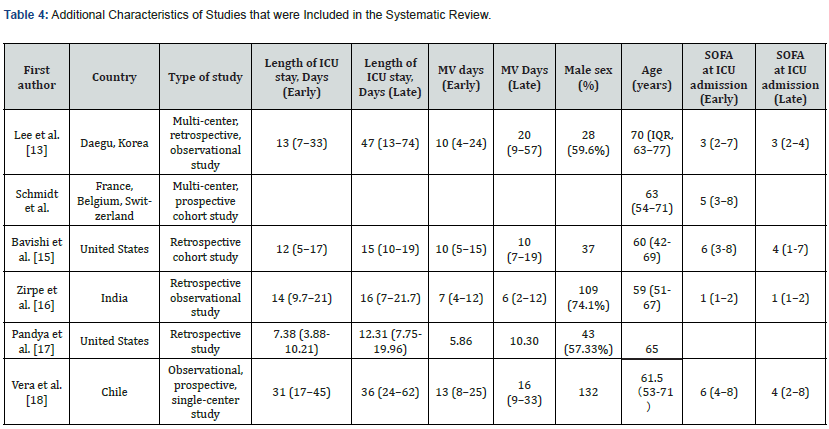
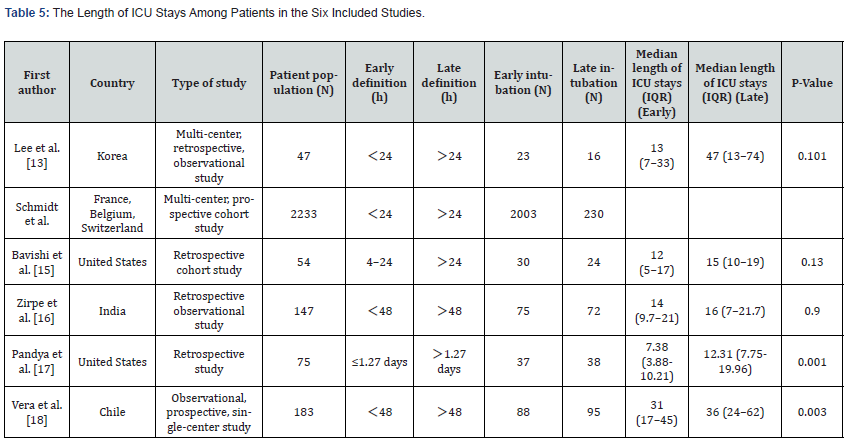
Schmidt et al. failed to extract the length of ICU stay of
participants. No statistically significant differences were found
between groups regarding the number of days spent in the ICU in
three of the other studies (P > 0.05) [34,35]. Two studies indicated
that there were significant differences between the groups (P<
0.05). Overall, since analysis found that early intubation results in
shorter ICU stays, this was seen as statistically significant (Table
5).
Duration of Ventilation
Ventilation time was not extracted for the participants in one
study Schmidt et al. The other five studies reported no significant
difference in the duration of mechanical ventilation between the
early intubation group and the late intubation group (P>0.05).
Overall, the timing of intubation does not appear to impact the
duration of mechanical ventilation of CARDS patients in the ICU
(Table 5).
Complications
Patient complications were not reported separately in one
study. Lee et al. observed that among patients treated with MV, the
incidence of ventilator-associated pneumonia (VAP) in the early
intubation group was often higher than that in the late intubation
group, but no statistical significance was found (30.4%; N = 7 vs
6.2%; N = 1; P = 0.109). In research by the secondary infection rate
was 13.3% in the early intubation group, while it was 22.2% in the
late intubation group (P = 0.6). Additionally, AKI/RENAL failure
was 21.3% in the early group and 18% in the late group (P = 0.1).
A total of 16% of patients underwent tracheostomy in the early
group, while the percentage rose to 25% in the late group (P =
0.1). Therefore, no statistically significant differences were found
regarding secondary infection, Acute kidney injury (AKI), and
interventional tracheotomy between intubation within 48 hours
(early group) and intubation 48 hours after ICU admission (late
group). Two studies did not describe patient complications.
The purpose of this systematic review was to explore
the
effects of intubation time on clinical outcomes in COVID-19
patients with ARDS. Questions to investigate included whether
late intubation increases ICU mortality, length of ICU stay, and
duration of ventilator use. Results indicated that early intubation
could reduce mortality and length of ICU stay in patients with
CARDS. However, intubation time did not affect the duration
of continuous mechanical ventilation in patients. There were
obvious differences between the definitions of early intubation and late
intubation in the six included studies. In three studies early
intubation was defined as intubation within 24 hours after
diagnosis of ARDS. Two studies defined early intubation as within
48 hours of diagnosis, while defined it as within 1.27 days. Most
studies defined the early intubation time as within 24 hours after
admission to an ICU [36,37]. However, according to the systematic
review reported by the definition of early/late intubation time had
no statistical difference in all-cause mortality between the two
groups and did not influence the clinical outcomes of COVID-19
patients. Therefore, for the sake of homogeneity, early intubation
group and late intubation group data was extracted for analysis
according to the respective definitions included in the current
study. However, the definition of early/late intubation time directly
affected the number of participants between the two groups.
The Effects of Early and Late Intubation
The high mortality associated with late intubation may
be related to lung injuries (P-SILI) unintentionally caused by
the patients themselves. When COVID-19 patients’ respiratory
support was insufficient, their lung function deteriorated in
the first week [38]. ARDS is characterized by non-cardiogenic
pulmonary oedema, decreased exchange volume of hypoxic blood,
and normal gas related to V/Q imbalance, which leads to low
respiratory compliance. Hypoxemia may cause patients to inhale
spontaneously and violently, leading to lung injury caused by
high trans-pulmonary pressure. Early intubation with pulmonary
protective ventilation can prevent P-SILI [39]. In a study including
457 ARDS patients, the 60-day mortality rate of the late intubation
subgroup (56%) was significantly higher than that of the early
intubation group (36%) [40]. The mortality rate of the late
intubation group continued to rise during the 2-year follow-up
period, which was consistent with the results of the current study.
Chinese critical care experts also suggested that tracheal
intubation should be done when critically ill patients are
asymptomatic (persistent respiratory distress and/or hypoxemia)
after standard oxygen therapy, which was also referred to in the
COVID-19 guidelines for patient treatment [41]. Given the high
risk of non-invasive respiratory support failure and the risk of
virus particle atomization [42], Brown et al. also recommended
that early tracheal intubation be performed for patients with
respiratory failure who need ventilation support. Other factors
influencing death included BMI, age, Sequential Organ Failure
Assessment (SOFA) Score, and (Acute Physiology, Age, and Chronic
Health Evaluation Ⅱ(APACHEⅡ)); however, no statistical difference
was found between the two groups in the early/late stage. In a
study by Pandya et al. The included population was characterized
by a nasopharyngeal swab-confirmed COVID-19 patient with a
mean age of 65 years. A median BMI of 31 was observed in the
study, and all patients were more than 50% of the standard BMI
and could be categorized as ‘obese’.
These were risk factors associated with mortality. In
this
study, the mortality rate of patients with mechanical ventilation
was as high as 49%. The median age of non-survivors was higher
than that of survivors (70 VS 59, p = 0.0006). The median ages of
patients in the six included studies were 70, 63, 60, 59, 65, and 61.5,
all of which were higher than 59. Therefore, elderly COVID ADRS
patients were found to have a higher mortality rate. Compared with
the United States, whose patients had a mortality rate of 16.6%,
India’s mortality rate was much higher at 68.7%, which may be
related to the level of economic development and medical care
[43]. Overall, this systematic review found that patients with early
intubation were prone to more severe illness, organ dysfunction,
and higher SOFA and APACHE scores when diagnosed with ARDS
compared to those with late intubation. These results may have
great significance in clinical practice, by providing strong evidence
for researchers and clinicians to consider when choosing when to
intubate COVID-19 ARDS patients. This can assist in rationalizing
the allocation of medical resources and reduce the mortality of
patients.
Agreements and Disagreements with Other Studies and
Reviews
No similar systematic reviews were found pertaining to the
topic of this article. Navas-Blanco and Dudaryk (2020) agreed that
early intubation can prevent adverse consequences due to delayed
intubation in patients with CARDS. Two studies recommend early
intubation for COVID-19 ARDS patients. However, a recent review
by Papoutsi et al. found no statistically detectable difference in allcause
mortality between patients undergoing either early or late
intubation (3981 deaths; 45.4% versus 39.1%; RR 1.07,95% CI
0.99-1.15 p = 0.08). The same was true of MV duration (1892; MD-
0.58 days, 95% CI -3.06 to 1.89 days, p = 0.65). Intubation time
may have had no effect on the mortality and morbidity of critically
ill COVID-19 patients, which was inconsistent with the results
summarized in this systematic review. In a study by Papoutsi et
al. (2021), participants were critically ill patients with COVID-19.
However, the population in this systematic review included ARDS
patients with COVID-19.
There are a few notable limitations to this study. For one, the
reviewers only searched English-language articles, which can
potentially lead to language bias. There may perhaps be articles
related to this topic in other languages, but if so, these would have
been excluded from the current review. In terms of secondary
outcome data extraction, we contacted the authors of the six
included studies by email, but failed to obtain specific data on
length of ICU stays and MV duration. Therefore, the reliability of
secondary measurement results may be reduced.
The findings of this systematic review conclude that early
intubation for mechanical ventilation is beneficial to patients
with COVID-19 ARDS. However, it appears that early intubation
cannot reduce the overall duration of mechanical ventilation. The
authors recommend immediate tracheal intubation for patients
with moderate to severe COVID-19 ARDS. The treatment and
management strategies of ARDS patients have been the continuing
focus of researchers. In the face of COVID-19 pandemic, decreasing
COVID-19 ARDS patients’ mortality remains an unsolved problem
that needs further investigation. Further work is needed to improve
research design and solve the problem of high heterogeneity and
provide higher quality evidence.
To Know more about Academic Journal of Pediatrics & Neonatology
Click here: https://juniperpublishers.com/ajpn/index.php
To Know more about our Juniper Publishers
Click here: https://juniperpublishers.com/index.php