Showing posts with label Advances in Cancer Research. Show all posts

Tuesday, February 11, 2020

Three Different Cases of Breast Fibro adenomas-JuniperPublishers

Journal of Cancer Therapy & Oncology-Juniper Publishers

Abstract

Fibro adenoma is a common benign breast lesion and results from excess proliferation of connective tissue. Fibro adenomas characteristically contain both stromal and epithelial cells. They usually occur in women between the ages of 10 and 40 years. It is the most common breast mass in the adolescent and young adult population [1]. Their peak incidence is between 25 and 40 years. Incidence decreases after 40 years. When found in an adolescent girl, the term juvenile fibro adenoma is more appropriate.
Keywords: Fibro adenoma; Benign; Malignant; Ultrasound (US); Doppler; Breast; US elastography

Case Report

Case 1
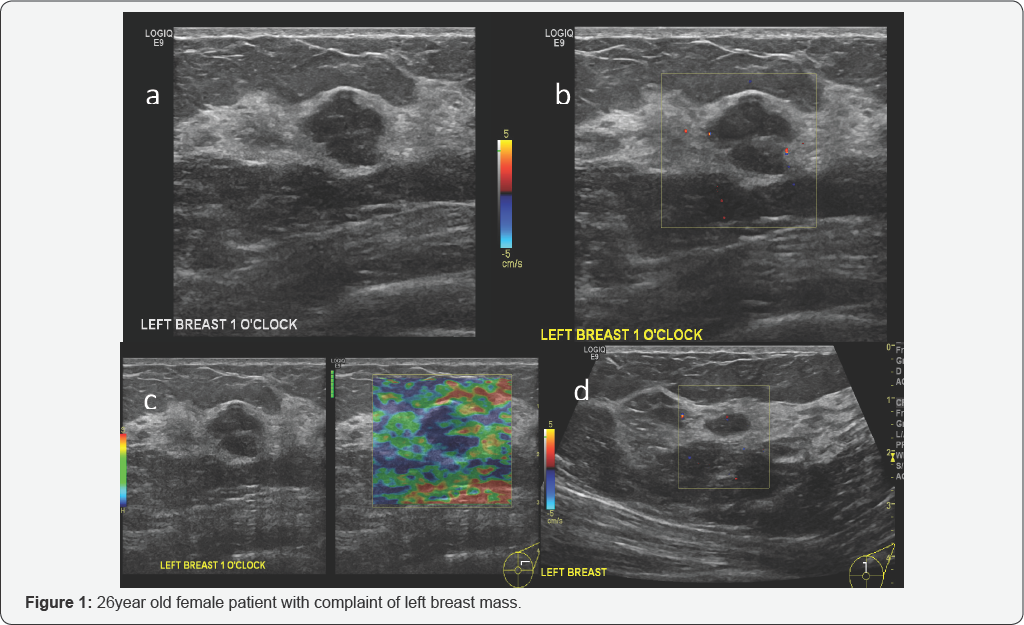
US: Hypoechoic mass at 1’o"clock position in left breast with lobulated outline (Figure 1a) measures approximately 2.5 x 2.0cm, showing no internal vascularity (Figure 1b), US elastography shows benign features as it shows more more- elastic areas and another small well defined hypoechoic nodule at 12 O’clock position with no color flow represents fibro adenoma (Figure 1).

Impression-Case 1

Lobulated hypo echoic nodule in left breast could represent fibro adenoma however needs tissue diagnosis for confirmation. BI-RADS 3-4a as no previous exam available. Another well- defined hypoechoic nodule in the left breast represents fibroadenoma.BI-RADS 2. Diagnosis of Left breast, core biopsy: Fibro epithelial lesion consistent with fibro adenoma.

Case 2-Ultrasound

Case 2

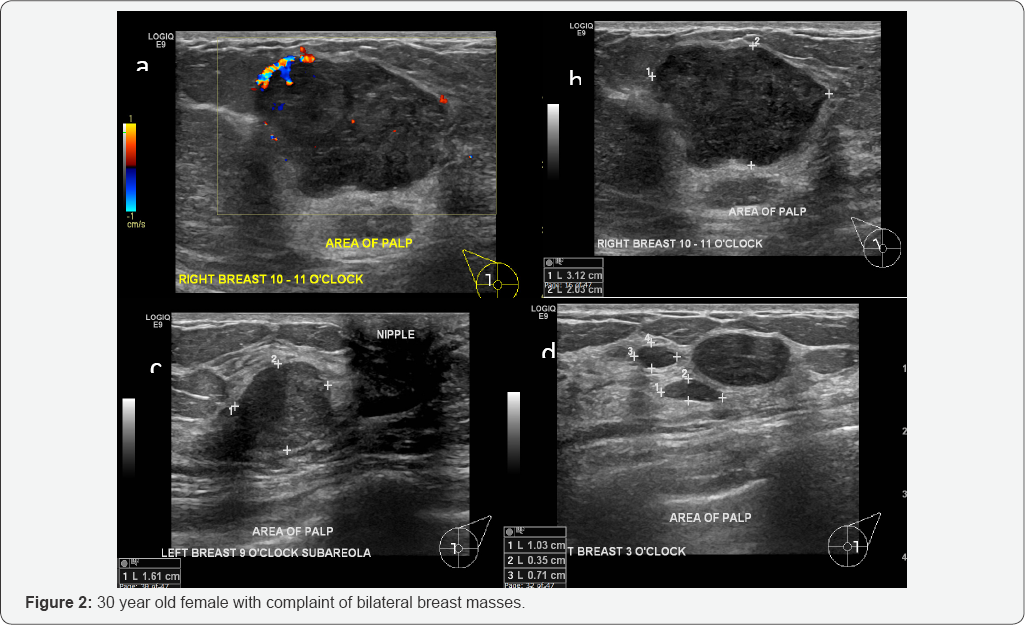
US: Right breast (Figures 2a & 2b) ultrasound reveals lobulated hypoechoic lesion at 10 to 11 o’clock position at the site of palpable mass measures approximately 31 x 20 mm (b) demonstrated some peripheral vascularity (a). Left breast ultrasound (Figures 1c & 1d) revealed hypo echoic lesion in sub areolar region at 9 o’clock position (c) at the site of palpable mass measures about 16 x 14 mm with no internal vascularity in Doppler exam (not shown). Three hypoechoic nodules at 3 o’clock position measures about 24 x 10 mm, 10 x 3 mm and 7 x 4 mm (d)with no internal vascularity in Doppler exam (not shown) (Figure 2).
Impression-Case 2

Above-described finding representing bilateral breast fibro adenomas. BI-RADS 3. For clinical correlation and short-term follow-up or tissue diagnosis from larger right breast mass.
    i. Patient preferred tissue diagnosis;
    ii. Diagnosis of Right breast, core biopsy;
    iii. Fibro epithelial lesion consistent with fibro adenoma.
Case 3

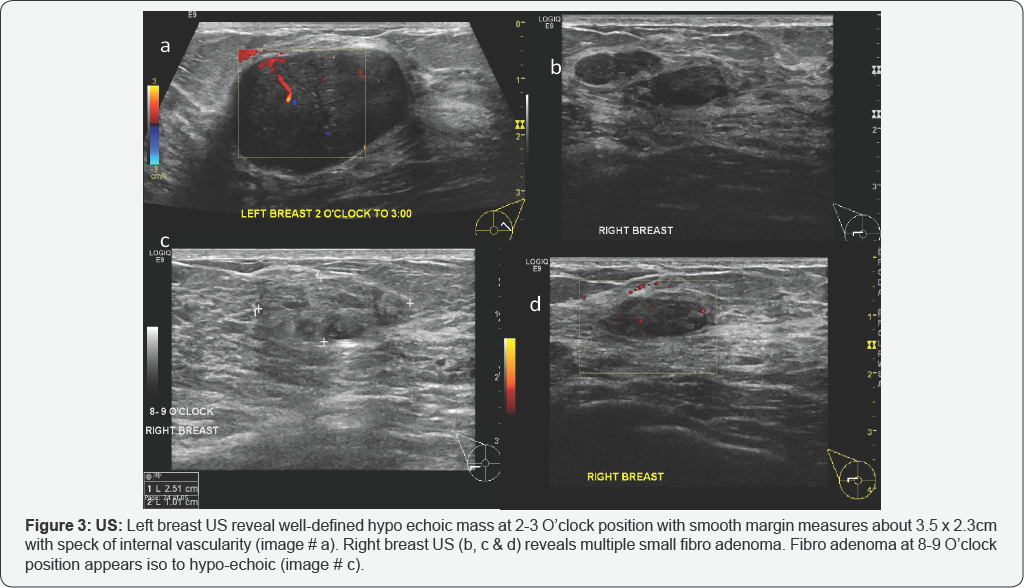
US-Left breast US reveal well-defined hypo echoic mass at 2-3 O’clock position with smooth margin measures about 3.5 x 2.3cm with speck of internal vascularity (Figure 1a). Right breast US (Figures 2b3c & 3d) reveals multiple small fibro adenoma. Fibro adenoma at 8-9 O’clock position appears iso to hypo-echoic (Figure 3).

Impression: Case 3

Above-described finding representing bilateral breast fibro adenomas. BI-RADS 3.
    i. Patient preferred tissue diagnosis;
    ii. Diagnosis of Right breast, core biopsy;
    iii. Fibro epithelial lesion consistent with fibro adenoma.

Introduction

Fibro adenomas are the most common solid breast masses excised in the adolescent population [1]. Classically, fibro adenomas are mobile non-tender breast lesions [1]. US scans show the typically benign features of benign solid lesions: a well-circumscribed hypo echoic mass that may be oval, round, or macro lobulated. Other features of benign solid masses at US include three or fewer circumscribed lobulations, well- circumscribed margins, and horizontal orientation with transverse diameter greater than antero-posterior diameter. The diameter commonly ranges from 2 to 3 cm or less, although some may grow considerably larger. The term “giant fibro adenoma” is reserved for fibro adenomas that are 10 cm or more in diameter [1].

Clinical Presentation

The usual clinical presentation is in a woman of reproductive age with a mobile palpable breast lump. Due to their hormonal sensitivity, the fibro adenoma commonly enlarges during pregnancy and involute at menopause. Hence, they rarely present after the age of 40 years. The lesions are well defined and well circumscribed clinically and the overlying skin is normal. The lesions are not fixed to the surrounding parenchyma and slip around under the palpating hand, hence the colloquial term a breast “mouse”.

Discussion

Fibro adenomas are benign fibro epithelial tumors that develop in the lobules at the ends of mammary gland ducts, which are the basic units of analysis at histopathologic assessment. Fibro adenomas are composed of epithelium and stroma, and they are the breast tumors most commonly found in adolescent girls and young women at clinical examination and histopathologic analysis. When palpable, fibro adenomas are smooth, mobile and firm or rubbery. In 15% of cases, multiple fibro adenomas are present. Fibro adenomas occasionally develop into very large masses, particularly in adolescent girls and young women; such masses are called juvenile giant fibro adenomas [2].
Radiologists must be familiar with a variety of benign breast conditions to confidently distinguish malignant disease from benign disease. Fibro adenomas are benign tumors composed of stromal and epithelial elements .These tumors are commonly seen in young women. Multiple or complex fibro adenomas may indicate a slightly increased risk for breast cancer; the relative risk of patients with such fibro adenomas is approximately twice that of patients of similar age without fibro adenomas.
The value of ultrasound in differencing cystic from a solid mass has been documented in numerous studies. Sonographic differentiation of benign from malignant solid breast tumors sometimes not possible with a good degree of accuracy, mainly because of their overlapping US features [3]. The fibro adenomas are usually hypo echoic and homogeneous in echo texture (72%). Some of the fibro adenomas may have irregular margins. Intratumoral calcifications and rarely necrosis can be seen. State-of-the-art high-frequency transducers, geometric analysis of tumors, and real-time ultrasound-guided fine-needle aspiration biopsy should help to distinguish between benign and malignant solid breast masses in indeterminate cases.

Details About Ultrasound Imaging Of The Breastxs

Ultrasound is safe and painless, and produces pictures of the inside of the body using sound waves. Ultrasound imaging, also called ultrasound scanning or sonography, involves the use of a small transducer (probe) and ultrasound gel placed directly on the skin. High-frequency sound waves are transmitted from the probe through the gel into the body. The transducer collects the sounds that bounce back and a computer then uses those sound waves to create an image. Ultrasound examinations do not use ionizing radiation (as used in x-rays), thus there is no radiation exposure to the patient. Because ultrasound images are captured in real-time, they can show the structure and movement of the body's internal organs, as well as blood flowing through blood vessels.
Ultrasound imaging is a noninvasive medical test that helps physicians diagnose and treat medical conditions as well as very helpful for follow-up. Doppler ultrasound, also called color Doppler ultrasonography, is a special ultrasound technique that allows the physician to see and evaluate blood flow within the mass as well as in organs. Ultrasound imaging of the breast produces a picture of the internal structures of the breast. During a breast ultrasound examination the sonographer or physician performing the test may use Doppler techniques to evaluate blood flow or lack of flow in any breast mass. In some cases this may provide additional information as to the cause of the mass.

Location of Fibro adenomas

Although they can be located anywhere in the breast, there may be a predilection for the upper outer quadrant.

Radiographic Features

Mammography

Fibro adenomas have a spectrum of features from the well circumscribed discrete oval mass hypo- or isodense to the breast glandular tissue, to a mass with macrolobulations or partially obscured margin. Involuting fibro adenomas in older, typically postmenopausal patients may contain calcification, often producing the classic, coarse popcorn calcification appearance. In some cases the whole lesion is calcified. Calcification may also present as crushed stone-like micro calcification which makes differentiation from malignancy difficult.

Breast Ultrasound

Typically seen as a well-circumscribed, round to ovoid, or macro lobulated mass with generally uniform hypo echogenicity. Intralesional sonographically detectable calcification may be seen in ~10% of cases [3] sometimes a thin echogenic rim (pseudo capsule) may be seen sonographically.

Breast MRI

T1: typically hypo intense or isointense compared with adjacent breast tissue
T2: can be hypo- or hyper intense
T1 C+ (Gd): can be variable but a majority will show slow initial contrast enhancement followed by a persistent delayed phase (type I enhancement curve); non-enhancing internal septations may be seen.

Diagnosis

These lesions are easily biopsied under ultrasound guidance. When a lesion has the typical features of a fibro adenoma on ultrasound and there are no clinical red flags they can be safely followed clinically. When lesions enlarge or have atypical imaging findings, ultrasound-guided core biopsy is a minimally invasive outpatient procedure that will give a diagnosis with virtually no complications [4].
Depending on where you work, there may be a maximum diameter above which a biopsy should be done if no previous imaging is available. There is significant local variation in this regard. The reason for intervention based on size is that a phylloides tumor may be indistinguishable from a fibro adenoma on ultrasound. A maximum diameter of 2.5 cm may be a useful benchmark for biopsy if you have no previous imaging. Interval enlargement is an indication for biopsy [5].

Pathology

A fibro adenoma is a type of adenomatous breast lesion. It contains epithelium and has minimal malignant potential. Multiple fibro adenomas occur in 10-15% of patients. Patients with multiple fibro adenomas tend to have a strong family history of these tumors.

Treatment and prognosis

They are benign lesions with minimal or no malignant potential. The risk of malignant transformation is extremely low and has been of reported to range around be 0.0125-0.3%.
Indications for biopsy include:
    i. Enlarging lesion
    ii. Atypical findings on ultrasound
    iii. A lesion above 2.5-3.0 cm where there are no previous studies for comparison
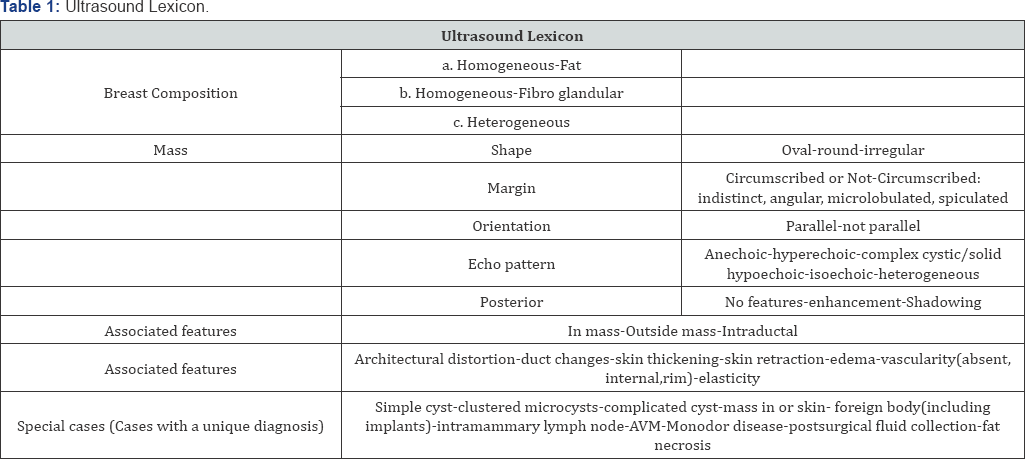
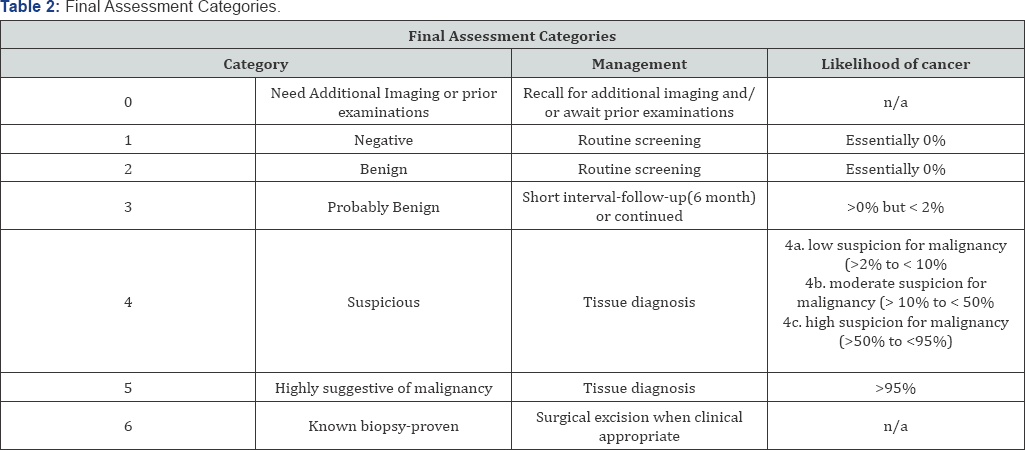
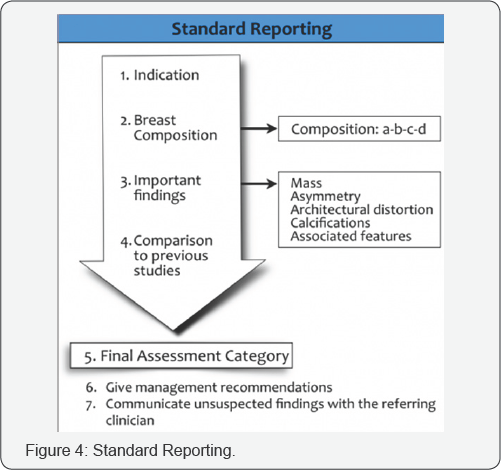
    iv. Patient peace of mind: some patients are simply not happy with a palpable mass in the breast without a histological diagnosis; this is a valid and reasonable indication for biopsy (Tables 1 & 2) (Figure 4).


Conclusion

In the adolescent population benign breast findings are overwhelmingly the most common cause of symptomatic breast abnormalities. A careful physical examination with clinical follow-up and US help for the evaluation of patient symptoms. Reassurance should be provided for both the patients and parents in cases of benign findings at both clinical examination and US. When US scans are negative, however, the level of clinical concern should guide management. Given the overwhelmingly benign causes, surgery should be the last resort and reserved for only lesions that enlarge or have highly suspect features.


To know more about JuniperPublishers

Friday, December 13, 2019

Introduction to Therapeutic Antibodies-Juniper Publishers

Journal of Tumor Medicine & Prevention

The family of antibody biologicals has been growing and encompasses antibody-drug conjugates, radiolabeled antibodies for imaging, fusion proteins containing fragments of antibody, bispecific antibodies, and monoclonal antibodies. The rate of approval for these antibodies have exploded in the last century and are now utilized for treating cancer, cardiovascular disease, inflammatory disease, organ transplantation, infection, pulmonary respiratory disease as well as for diagnostic purposes. The present review aims to give a brief overview of the developmental history of these therapeutic antibodies along with a brief discussion of their pharmacodynamic and pharmacokinetic properties. Also, the review highlights the emerging limitations and the future strategies to overcome these limitations of antibody-based biologics.
Keywords: Monoclonal antibodies; Pharmacodynamics; Pharmacokinetics; Chimeric antibodies; Humanized antibodies; Murine antibodies; Human antibodies
Abbreviations: CDR: Complementary Determining Region; CDC: Complement Dependent Cytotoxicity; ADCC: Antibody Dependent Cellular Cytotoxicity; EGFR: Epithelial Growth Factor Receptor

Introduction

Antibodies are immunoglobulins that are part of the humoral immune response and are secreted by the B-cells (plasma cells). Antibodies act by binding to either soluble antigens or ligands that are expressed on the surface of organisms or cells. In terms of structure, antibodies are Y-shaped glycoproteins made up of two heavy chain polypeptides and two light chain polypeptides that are held together by disulfide bridges. The light and the heavy chain are made up of constant regions and variable regions with light chain having one variable and one constant region and the heavy chain having one variable and three to four constant regions (part of which forms the Fc, crystallizable portion). The variable region of the light chain and the heavy chain together forms the antigen-binding site (Fab, antigen binding portion). At the end of each variable region is the hypervariable region (CDR, complementary determining region) and it is this region that allows for numerous conformations for infinite antibody-antigen binding probability.

Developmental history of therapeutic antibodies

The concept of therapeutic antibodies was first put forth by Paul Ehrlich who came up with the nomenclature “antikorper” (German for antibody) [1]. However, the first important step towards production of therapeutic antibodies only happened when Kohler and Milstein (received the Nobel prize for their discovery) developed a protocol to produce murine monoclonal antibodies (-omab, nomenclature) from hybridomas [2]. This paved the way for the food and drug administration’s (FDA) approval of the first murine monoclonal antibody for use in prevention of acute kidney transplant rejection [3]. The murine monoclonal antibody targeted CD3 receptors of the T cells and was called muromonab-CD3 (OKT-3) and was found to be significantly better than the conventional steroid treatments (Azathioprine and Prednisone). Unfortunately, this first-generation antibody had a major disadvantage arising from the presence of the murine immunogenic component that gave rise to the induction of human anti-mouse antibodies after administration [4]. Because of this immunity, patients rapidly cleared the murine antibody from their system resulting in a very low therapeutic window of this therapeutics.
To overcome this hurdle, the second generation of therapeutic antibodies, characterized by a combination of ~65% human component (constant region) and the rest murine component (variable region) was developed simultaneously by two research groups led by Morrison and Boulianne, respectively [5,6]. The first “chimeric” therapeutic antibody (-ximab, nomenclature) to receive FDA approval for use in peri-surgical prevention of thrombosis for coronary artery interventions was, Abciximab, which targeted the platelet glycoprotein IIb/IIIa receptor [7]. Unfortunately, administration of these chimeric antibodies still resulted in the induction of human anti-chimeric antibodies thereby reducing their potency and efficacy in patients. This shortcoming arising due to the immunogenicity of the murine component of antibodies led to the development of the next generation of “humanized” monoclonal antibodies (-zumab, nomenclature). This was first achieved by Jones and colleagues by replacing the murine hypervariable region of the antibody with genetically engineered human myeloma protein to produce a therapeutic antibody that had ~95% human components [8]. The first humanized antibody, Daclizumab, was initially first approved for use in preventing kidney transplant rejection and acted on CD25 but is now primarily used to treat relapsed multiple sclerosis. Even though, the increased humanization of the antibody is associated with less immunogenicity, patients treated with these family of antibodies have been shown to produce human anti-humanized antibodies [9].
Human antibody (-umab, nomenclature), the third generation of therapeutic antibody, was developed with the idea to completely ablate immunogenic response and thereby increase clearance time and the efficacy of the therapeutics. The requisite breakthrough was provided by Winter and colleagues who developed the protocol of mimicking the natural positive selection of antibodies in bacteriophages using a phage display technology [10]. The execution of this technique led to the development of the first fully human antibody against tumor necrosis factor called, Adalimumab and was approved for use in autoimmune and inflammatory conditions like rheumatoid arthritis and Crohn’s disease [11]. Finally, transgenic mice created by humanizing the murine immune system and then inoculating these mice with antigen, resulting in fully realized human antibody was created by Scott [12]. Panitumumab, was the first human antibody targeting Epidermal Growth Factor Receptor (EGFR) that received FDA approval for use in colorectal cancer using the transgenic mouse technology [13]. Surprisingly, even with the low possibility of immunogenicity, immunogenic response has been observed in patients treated with human antibodies, suggesting that engineered antibody will always demonstrate some spectrum of immune response that can never be eliminated [14].

Pharmacodynamics of therapeutic antibodies

The therapeutic activity of an antibody is dependent on the Fc and the Fab portion of its structure and its mechanism of action can be broadly classified into Fc-dependent activity and Fab-dependent activity. The Fab-dependent activity requires the antibody to bind to a soluble antigen and assist in the neutralization of the antigen. For example, Bevacizumab binds with very high affinity to various isoforms of Vascular Endothelial Growth Factor (VEGF) and inhibits its angiogenic activity by preventing VEGF from activating its receptors resulting in an anti-cancer effect [15]. In addition to soluble antigens, the Fab-dependent activity can also manifest itself by binding of the antibody to a membrane bound antigen. Such binding can result in two therapeutic scenarios:
(i) Binding of the antibody to the membrane-bound antigen can result in an inhibitory effect. For example, Cetuximab binds to the cell surface receptor EGFR with higher affinity than its natural ligand like epithelial growth factor or transforming growth factor-α resulting in an antagonistic effect that decreases EGFR signaling leading to death in cancer cells [16].
(ii) Binding of the antibody to the membrane-bound antigen can result in stimulatory effect. For example, Rituximab binds to CD20 receptor on B cells and induces apoptosis by an agonistic induction of cytoplasmic calcium ions leading to caspase 3-mediated apoptosis in leukemic cells [17].
The Fc-dependent activity depends either on the activation of the classical pathway of compliment resulting in Complement Dependent Cytotoxicity (CDC) or on the recruitment and activation of FcγR-expressing immune cells (NK or T cells) resulting in Antibody Dependent Cellular Cytotoxicity (ADCC) and in some cases antibody dependent cellular phagocytosis. Trastuzumab (anti-HER2), Obinutuzumab (anti-CD20) and Catumaxomab (anti- CD3) are all examples of therapeutic antibodies that utilize CDC and ADCC for their biological activity. Furthermore, there is quite a lot of overlap between the biological activities of antibodies as seen in Trastuzumab and Rituximab both of which can have Faband Fc- dependent activity [18].

Pharmacokinetics of therapeutic antibodies

Therapeutic antibodies are denatured or proteolytically cleaved in the gastrointestinal tract and hence generally administered via intravenous, intramuscular or subcutaneous route [19]. The typical pharmacokinetic profile after administration follows a biphasic response with a rapid distribution phase followed by a slower elimination phase. The distribution of antibodies, dictated by its large molecular size and poor lipophilicity, is limited to the vascular and intestitial spaces. Factors that influence distribution includes, diffusion, cellular internalization (pinocytosis, endocytosis, phagocytosis), binding affinity to its antigen and hydrophobicity [20]. Primary method of elimination after absorption of antibodies is through proteolytic degradation. Due to its large size, glomerular filtration is impossible preventing renal clearance of antibodies. Clearance of antibody can be antigen specific (also referred to as, target-mediated drug disposition) and depend on the expression level, location (soluble vs. membrane bound), distribution (organ specific vs. entire body) and whether the antigen expression is modulated (upregulated vs. downregulated). For example, Adalimumab that targets and binds to antigen like tumor necrosis factor-α that is expressed in very low levels, the pharmacokinetic profile is very linear as opposed to Omalizumab that targets high expressing IgE and shows a non linear pharmacokinetic clearance profile [11,21]. On the other hand, Rituximab (anti-CD20) demonstrates a time dependent pharmacokinetics because of the B-cell depletion with treatment causing decreased presence of CD20 resulting in reduced clearance on repeated dosing [22].
Non-specific antibody clearance can be due to protein degradation following cellular uptake or due to effector function of the antibody like CDC or ADCC [23]. Also, the structural and chemical properties of the antibody like charge, solubility, target specificity and glycosylation patterns can affect its clearance [24]. Finally, patient’s health status, demographic factors and medication history all play a role in influencing the pharmacokinetics of therapeutic antibodies.

Limitation of therapeutic antibodies

The major limiting factor in the widespread use of antibodies in the clinic is the production cost under Good Manufacturing Practices to manufacture therapeutic antibodies. An alternative cost-effective production system needs to be evaluated in order to make therapeutic antibodies affordable to every individual. Secondly, immunogenicity to therapeutic antibodies resulting in production of anti-therapeutic antibodies not only increases the clearance of the antibody and efficacy of the antibody, but also leads to severe immune reaction in humans. Thirdly, because of its large size, antibodies do not have a very good tissue distribution which is further exacerbated in solid tumors with minimal vasculature [25]. Also, some organs like the brain are not accessible for a large macromolecule like an antibody. Finally, therapeutic antibodies that rely on ADCC for its activity have to compete with the high levels of endogenous IgG for the FcγR of the immune cells. This necessitates injection of very high concentrations of antibodies to reach significant serum concentrations needed to compete with the patient’s IgG [26]. Overcoming these hurdles will facilitate the widespread use of therapeutics in the clinic.

Discussion and conclusion

The new horizons being explored in the use of therapeutic antibodies can be broadly classified into the following areas of interest:
(i) Targeted delivery to specific organs
(ii) Flexibility in the route of delivery
(iii) Specific delivery to the intracellular compartment of cells and
(iv) Newer forms of antibody delivery systems.
Not surprisingly, significant advances have been made in each of this enumerated fields. Asfostase alpha specifically targets the bone with the aid of a deca-aspartate peptide that is fused to C-terminus of the antibody and has been FDA approved for use in the treatment of hypophatasia [27]. Oral delivery of antibodies like PRX-106 for ulcerative colitis and anti-CD3E antibodies for treatment of non-alcoholic steatohepatitis are showing clinical activity and demonstrate that traditional delivery routes, like intravenous and subcutaneous, will no longer be a limiting factor in treating aliments using antibodies [28,29]. Use of cell penetrating peptides conjugated to biologically active antibodies have been successfully tested for increasing the antibody burden within the cytosol of the cells heralding the advent of therapeutic antibodies that target cytosolic antigen [30]. Finally, delivery of genetic material encoding the antibody presents an innovative addition to the antibody delivery system armament. One of the novel strategies involves intramuscular injection of adenoassociated viruses encoding the therapeutic antibody of interest. This technology has been tested in non-human primates and has demonstrated consistent high expression of the encoded antibody for several years following the injection [31]. In conclusion, novel strategies that bring together the biology of antibodies and technological advancements of bioengineering, will culminate in safe, efficient and clinically successful therapeutic antibodies.
 
To Know More About Open Access Journals Please click on: ttps://juniperpublishers.com/index.php

Is Juniper Publishers Legit in 2025? A Transparent Review for Researchers

  Is Juniper Publishers Legit in 2025? A Transparent Review for Researchers   In 2025, the academic publishing landscape continues to evol...