Showing posts with label Aging. Show all posts

Tuesday, January 23, 2024

Effects of Strength Training and The Pilates Method on Dynamic Balance, Physical Capacity and Quality of Life in Older People: A Triple-Blind Randomized Clinical Trial - Juniper Publishers

 Yoga and Physiotherapy - Juniper Publishers

Abstract

Objectives: The study aimed to compare the effect of different exercise modalities on dynamic balance, physical capacity, and quality of life. Methods: Fifteen older people aged over 60 years participated in this randomized clinical trial. Group 1 performed resistance training (RG) and Group 2 exercises based on the Pilates method (PG). The dynamic balance behavior was evaluated by Timed Up and Go (TUG) and the 6-minute walk test (6MWT) physical capacity. Quality of life was assessed using the questionnaire SF-36. Results: Regarding balance and physical capacity, we can observe an improvement in the results of TUG and 6MWT, after four weeks of intervention in the PG. No significant differences were found when comparing STG and PG. In terms of quality of life, the criteria of general health and vitality had a statistically significant improvement in the STG and PG. It is concluded that for the older people evaluated in 4 weeks of training, there was no statistically significant difference compared to the groups for the dynamic balance and physical capacity variables. Both strength exercises and Pilates method show significant improvement in criteria assessed in quality of life.

Keywords: Aging; Postural Balance; Physical Capacity; Quality of Life; Physical Training

Abbreviation: RG: Resistance Training, PG: Pilates method, TUG: Timed Up and Go, MWT: Minute Walk Test, UFCSPA: University of Health Sciences of Porto Alegre, SPSS: Statistical Package for Social Science

Background

Physical changes due to the aging process affect muscle strength, balance, and gait, leading to a decline in physical capacity in older people, increasing the chances of falls, morbidity, and mortality among this population [1]. Physical exercise is an intervention used by health professionals for muscle strengthening, physical resistance, and prevention of changes in body balance in the older population. With the practice of exercise, it is possible to obtain an improvement in the risk factors of chronic degenerative diseases, gait speed, muscle weakness, consequently improving the biopsychosocial domains and increasing the quality of life [2,3].

Resistance training has been one of the most common exercise programs applied to the older people, and it has been established that this type of training improves muscle strength, range of motion, levels of functional autonomy, body composition and mental health [4-6].

Among the physical activities recommended for this public, the Pilates method also stands out, which portrays a system of physical exercises created by Joseph Pilates more than a century ago and, even with its multiple ramifications, it is noted that the work with the method is based on the wide variety of movements combined with proper breathing [2,3,5,7,8]. This study is justified by the fact that the literature indicates resistance training and the Pilates method as excellent exercise options for the older people [3,7], however, is not known which of the two has a greater effect on balance, physical capacity, and quality of life in healthy older people, and there is still a lack of standardization in exercise protocols. Therefore, the objective of the present study was to analyze the effect of two different training programs (resistance training versus Pilates method) on the dynamic balance, physical capacity, and quality of life of healthy older people in the community.

Methods

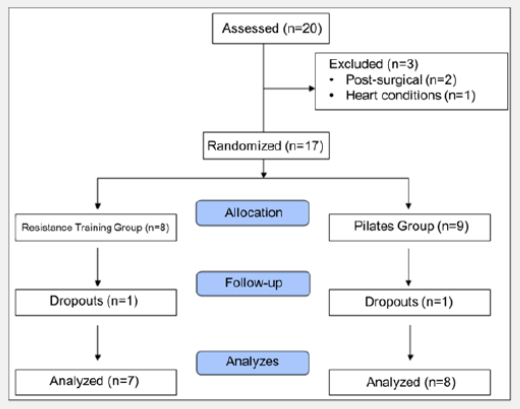
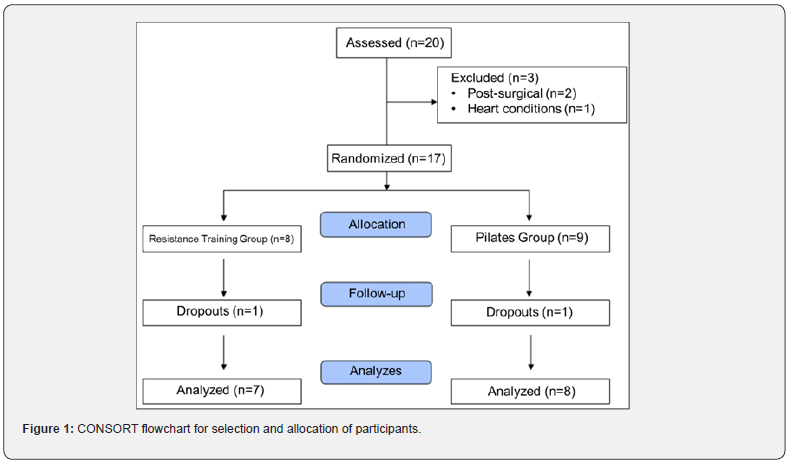
Blinded randomized controlled clinical trial. Approved by the Research Ethics Committee of the Federal University of Health Sciences of Porto Alegre (UFCSPA), under number 2.137.840/2017. Fifteen older people participated in the study, 7 in the Resistance Training group (RG) and 8 in the Mat Pilates group (PG). All volunteers who agreed to participate in the research signed the Informed Consent Form.

Subjects

Older people, residents in the city of Porto Alegre, who were contacted through different sources participated in this study: public invitation, carried out through posters; dissemination on social networks and local dissemination actions with pamphlets. Inclusion criteria were people aged 60 years or older, as established by Brazilian Law No. 8.842 [9], with available time for training. Those who had autonomy and independence, and control of chronic diseases and physical symptoms were considered healthy [10]. Older people who were in a regular physical training program in the last 12 weeks, cognitively impaired, people with a physical disability that prevented them from participating in the groups, in any type of postoperative period or at high risk for performing physical exercises, by cardiopulmonary, vascular, or metabolic disorder, were excluded.

Procedures for Data Collection and Evaluations

The evaluation of the participants was carried out by the same evaluator before and after the training. In the first evaluation, the Mini-Mental exam was performed [11] to assess the individual’s cognitive ability to participate in the study. Dynamic balance was assessed by Timed Up and Go (TUG) test. The test indicates balance and functional mobility, whose performance is related to gait, postural and direction changes during the act of walking, being evaluated through the time spent in carrying out the route [12]. The physical performance was assessed using the Six-Minute Walk Test (6MWT), which measures the maximum distance covered in a period of 6 minutes and is commonly used to assess submaximal cardiorespiratory capacity while performing activities that require commuting. [13]. All individuals were familiarized with the tests previously.

To assess quality of life, participants answered the Medical Outcomes Study 36 - Item Short-Form Health Survey (SF-36) [14] seated in a comfortable and air-conditioned environment.

Intervention Protocol

To ensure the quality of the intervention protocol, as well as the method used in this study, the teams responsible for the training protocols were trained by the responsible researcher to perform the exercises specifically in the RG or PG groups. The study was conducted in secrecy about the training method, focusing on protocol criteria and the safety of participants. The individuals were randomized into two groups, RG and PG, with a training frequency of 3 times a week, over 4 weeks, lasting 60 minutes each. The older people in the RG were first submitted to the estimated test of one repetition maximum (1RM estimated), following the recommendations of the ACSM [15], for each of the exercises of each training cycle. All loads were then adjusted to 70% to 80% of 1RM [15,16]. The protocol was composed of 12 global exercises. The individuals were instructed to perform three sets, from eight to twelve repetitions in each. If the participant reported that the load was light, the load was adjusted again.

In the PG, the protocol had 24 global exercises, all maintaining the principles of the Pilates method. The method is based on 6 principles: control, breathing, fluid movement, precision, concentration, and centering [17]. The exercises were performed with sets of ten repetitions [18]. All exercises were performed on the ground, without the use of equipment. Only accessories such as a Swiss ball, soft ball, stick, dumbbell (1 kg for all individuals) and elastic band were used. [19]. In all sessions, of both groups, the individual was submitted to the same training model, with the same exercises, and if the individual needed any adaptation for the exercise, this was done. In this study, in both training programs, exercises involving strengthening of upper and lower limbs, abdominal and trunk muscles were designed, each modality respecting the characteristics described above. There was a rest period between one exercise and another, not exceeding the time of 1 minute. If the participant reported exhaustion to perform the task, it was finished. No more than 4 individuals were allowed per training schedule, with 2 duly trained instructors to carry out the protocol.

Allocation Sequence Generation

The division between the RG and PG groups occurred after the initial evaluation under analysis of the inclusion and exclusion criteria, following the availability of volunteers’ participation. A table was presented to the older people with the training times, without identifying the modality at each time. According to his availability for training, he stayed in G1 or G2 and only learned the type of training when he participated in it, although the researchers responsible for the training were careful not to mention which method was being used. The health professional who carried out the initial assessment of the elderly was unaware of the schedules for each group, therefore, there was no influence or indication during the choice of the individuals. Both RG and PG offered morning and afternoon schedules, and alternated offering weekly schedules for the beginners. The person responsible for this logistics also kept the assessments confidential for the researchers who conducted the training sessions.

Allocation Masking and Implementation

The evaluators were not aware of the RG and PG training schedules. The researchers responsible for the training were blinded to the evaluation process and to the opposite group. The volunteers were instructed not to comment with the evaluators during the reassessment about the types of exercises they performed. The researcher responsible for analyzing the outcomes was not aware of the allocation of groups, receiving data from the evaluator as Group 1 and Group 2.

Blinding

Due to the masking and implementation of the allocation, the volunteers, the evaluator, the researchers responsible for the training and the researcher responsible for the analysis of the outcomes were blinded.

Statistical Analysis

For data analysis, the Shapiro-Wilk test was performed in order to verify the normality of continuous data. The descriptive analysis of parametric numeric data was expressed as mean and standard deviation, and when non-parametric as median, minimum, and maximum. Descriptions of qualitative variables were expressed in absolute and relative frequency. For inferential analysis, comparisons between RG and PG referring to baseline data were performed using the Student’s t test for independent samples when continuous, and the Chi-square test with Yates correction when categorical. To compare the non-parametric data of the SF-36, the Kruskal Wallis H test and the post hoc Mann Whitney U test were used. Comparisons between GF and GP in the TUG and 6MWT, for the 2 groups in the 2 moments, before and after, were carried out with the Anova Two-Way test with Sheffee’s Post-hoc. All analysis was performed using the Software Statistical Package for Social Science (SPSS, version 21), considering a significance level of 5% (p≤ 0.05).

Results

The present study was composed of 7 individuals in the RG and 8 in the PG. All showed cognitive ability assessed by Mini Mental to participate in the study. The allocation of participants is shown in Figure 1. The characterization of the elderly is presented in (Table 1). There were no differences between the groups in the evaluated variables, demonstrating a homogeneity of the sample, except for the number of female individuals in the GP. The results referring to the applied tests are presented in (Table 2). All the participants were able to complete the dynamic balance and physical capacity tests without interruptions. Regarding the quality of life of the participants, assessed by the SF-36 questionnaire, we can highlight an improvement in the domain of vitality (p=0.008) and general health status (p=0.001) even with statistical significance (Table 3).
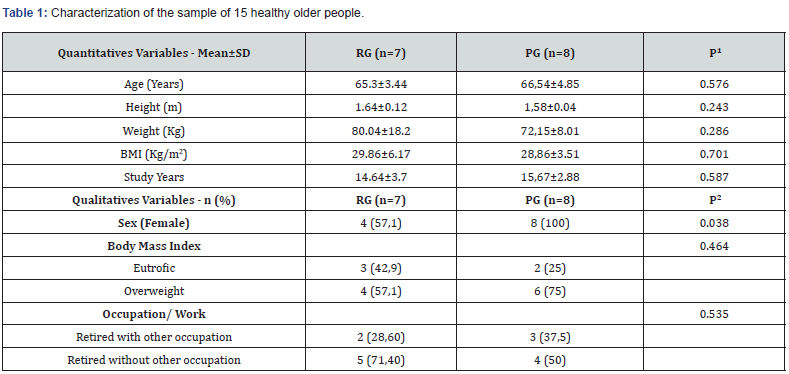
Where: SD= standard deviation; n= sample; %= relative sample; RG= resistance group; PG= Pilates group; BMI= body mass index; p¹= Student’s t test to independents sample; p²= Qui-Square test with Yates correction.
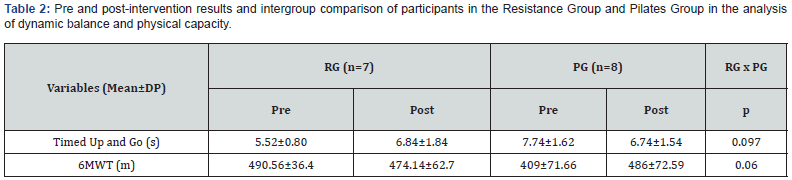
Where: n= sample; RG= resistance group; PG= Pilates group; SD= standard deviation; 6MWT= six-minute walk test; p= comparison by Anova Two-Way with Shaffee Post-hoc.
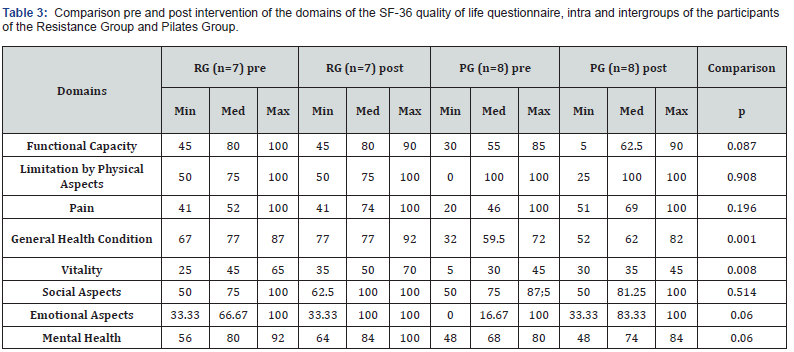
Where: n= sample; RG= resistance group; PG= Pilates group; Min= minimum; Max= Maximum; Med= Median; p= H of Kruskal Wallis with Mann Whitney’s U post hoc.

Discussion

In the present study, we did not observe a statistically significant improvement in relation to the performance in the TUG test, corroborating the findings of Vieira et al [19]. One of their hypotheses would be the intervention duration. In addition, we also believe in the hypothesis that they are healthy elderly people, who already had values considered good for their age group in the initial assessment, and another assessment instrument could provide greater specificity to the results. However, the TUG is the most used instrument to assess balance in the older people [17]. The RG did not show improvements in balance after the intervention period, still demonstrating a decline in its performance. The findings of Low et al [6] e Orr et al [20] claim that resistance training does not generate changes in variables on balance. In order to obtain results on balance in the older people, more dynamic and challenging exercises are recommended, with resistance training indicated as a complement to intervention on this outcome. Because, since balance is dependent on several systems for its maintenance, one should not work on resistance exercises alone [21].

We can observe the improvement in TUG results in relation to the effect on balance in elderly people in PG compared to RG, although not statistically significant. Exercises based on the Pilates method, in general, include dynamic muscle stretching and muscle strengthening using body weight as resistance. [22]. According to Chatzopoulos et al [23] dynamic stretching has a positive effect on balance, unlike static stretching. This being one of the hypotheses that would explain the change in the behavior of equilibrium in RG. Also, studies from Barker et al [24], Bullo et al [25] and Cancela et al [26] concluded that the Pilates method has strong evidence of improvement in static and dynamic balance in older people. Research demonstrate that the Pilates method activates and strengthens the central musculature of the “power house”, required during the execution of the exercises and this can contribute to an improvement in the posture and alignment of the trunk, changing the center of gravity, which directly reflects on the maintenance capacity of body balance [27,28]. Regarding physical capacity, we can observe a greater distance in the 6MWT after four weeks of intervention in the RG, although the comparison between RG and PG reached statistical significance (p=0.06). In exercises based on the Pilates method, planti and dorsiflexors and lower limb strength are worked on simultaneously throughout the exercises [29]. What may have contributed to a better performance in the 6MWT, suggesting that individuals have a more evident improvement in physical capacity with training based on the Pilates Method [18].

According to Santos et al [30], exercises that work on motor coordination are able to provide an increase in gait speed in the older people, also indicating functional independence [31]. Comparing the Pilates method to traditional resistance exercise, it presents a greater degree of difficulty in its execution, since it requires concentration, activation, and coordination of several muscle groups at the same time [22]. In both groups, the SF-36 domains on vitality and general health showed improvements, indicating the positive impact that physical exercise provides in the lives of the elderly. With age-related physical losses, the older people have a reduction in physical activity levels and become more sedentary, reduce their work and social activities, factors that may be associated with a decrease in quality of life [32]. In addition to the health benefits of regular physical activity, seniors find support from other seniors in these groups and end up resuming their social activities. Therefore, physical exercise brings significant changes to the quality of life of older people [32-34].

Existing studies regarding the effect of training on balance in older people have been described in systematic reviews and meta-analyses as having low methodological quality. Which demonstrates the importance of carrying out works encompassing this theme [35,36]. In this study, we evaluated healthy older people. In addition, the average age of the participants demonstrates that they are young older, which could justify the values presented in the TUG in the initial evaluation. According to Alcock et al [37] the postural control of older women suffers worsening with age, with significant annual reductions, with greater oscillation in the most challenging conditions. The number of individuals in this study was a limitation, data collection was terminated early due to the onset of the Covid-19 pandemic. During the study five participants did not stay over the four weeks. It is known that the older population has difficulty in following an activity, mainly due to family commitments, health problems, lack of social and family support [32]. New studies are suggested with larger samples, and with longer duration protocols, in order to identify from what moment, the gains on balance occur. Second Bird [38] to obtain improvements in balance attributed to neuromuscular adaptations, at least 5 weeks of training are required.

Conclusion

The findings of this research showed that in four weeks of training, there was no statistically significant difference compared to the groups for the dynamic balance and physical capacity variables. Both strength exercises and the Pilates method show significant improvement in criteria evaluated in quality of life, which is extremely relevant, showing that, regardless of the time of performance, these modalities bring benefits to healthy older people.

To Know more about Journal of Yoga and Physiotherapy
Click here: https://juniperpublishers.com/jyp/index.php

To Know more about our Juniper Publishers
Click here: https://juniperpublishers.com/index.php

Wednesday, January 10, 2024

Effects of Strength Training and The Pilates Method on Dynamic Balance, Physical Capacity and Quality of Life in Older People: A Triple-Blind Randomized Clinical Trial - Juniper Publishers

Yoga and Physiotherapy - Juniper Publishers

Abstract

Objectives: The study aimed to compare the effect of different exercise modalities on dynamic balance, physical capacity, and quality of life. Methods: Fifteen older people aged over 60 years participated in this randomized clinical trial. Group 1 performed resistance training (RG) and Group 2 exercises based on the Pilates method (PG). The dynamic balance behavior was evaluated by Timed Up and Go (TUG) and the 6-minute walk test (6MWT) physical capacity. Quality of life was assessed using the questionnaire SF-36. Results: Regarding balance and physical capacity, we can observe an improvement in the results of TUG and 6MWT, after four weeks of intervention in the PG. No significant differences were found when comparing STG and PG. In terms of quality of life, the criteria of general health and vitality had a statistically significant improvement in the STG and PG. It is concluded that for the older people evaluated in 4 weeks of training, there was no statistically significant difference compared to the groups for the dynamic balance and physical capacity variables. Both strength exercises and Pilates method show significant improvement in criteria assessed in quality of life.

Keywords: Aging; Postural Balance; Physical Capacity; Quality of Life; Physical Training

Abbreviation: RG: Resistance Training, PG: Pilates method, TUG: Timed Up and Go, MWT: Minute Walk Test, UFCSPA: University of Health Sciences of Porto Alegre, SPSS: Statistical Package for Social Science

Background

Physical changes due to the aging process affect muscle strength, balance, and gait, leading to a decline in physical capacity in older people, increasing the chances of falls, morbidity, and mortality among this population [1]. Physical exercise is an intervention used by health professionals for muscle strengthening, physical resistance, and prevention of changes in body balance in the older population. With the practice of exercise, it is possible to obtain an improvement in the risk factors of chronic degenerative diseases, gait speed, muscle weakness, consequently improving the biopsychosocial domains and increasing the quality of life [2,3].

Resistance training has been one of the most common exercise programs applied to the older people, and it has been established that this type of training improves muscle strength, range of motion, levels of functional autonomy, body composition and mental health [4-6].

Among the physical activities recommended for this public, the Pilates method also stands out, which portrays a system of physical exercises created by Joseph Pilates more than a century ago and, even with its multiple ramifications, it is noted that the work with the method is based on the wide variety of movements combined with proper breathing [2,3,5,7,8]. This study is justified by the fact that the literature indicates resistance training and the Pilates method as excellent exercise options for the older people [3,7], however, is not known which of the two has a greater effect on balance, physical capacity, and quality of life in healthy older people, and there is still a lack of standardization in exercise protocols. Therefore, the objective of the present study was to analyze the effect of two different training programs (resistance training versus Pilates method) on the dynamic balance, physical capacity, and quality of life of healthy older people in the community.

Methods

Blinded randomized controlled clinical trial. Approved by the Research Ethics Committee of the Federal University of Health Sciences of Porto Alegre (UFCSPA), under number 2.137.840/2017. Fifteen older people participated in the study, 7 in the Resistance Training group (RG) and 8 in the Mat Pilates group (PG). All volunteers who agreed to participate in the research signed the Informed Consent Form.

Subjects

Older people, residents in the city of Porto Alegre, who were contacted through different sources participated in this study: public invitation, carried out through posters; dissemination on social networks and local dissemination actions with pamphlets. Inclusion criteria were people aged 60 years or older, as established by Brazilian Law No. 8.842 [9], with available time for training. Those who had autonomy and independence, and control of chronic diseases and physical symptoms were considered healthy [10]. Older people who were in a regular physical training program in the last 12 weeks, cognitively impaired, people with a physical disability that prevented them from participating in the groups, in any type of postoperative period or at high risk for performing physical exercises, by cardiopulmonary, vascular, or metabolic disorder, were excluded.

Procedures for Data Collection and Evaluations

The evaluation of the participants was carried out by the same evaluator before and after the training. In the first evaluation, the Mini-Mental exam was performed [11] to assess the individual’s cognitive ability to participate in the study. Dynamic balance was assessed by Timed Up and Go (TUG) test. The test indicates balance and functional mobility, whose performance is related to gait, postural and direction changes during the act of walking, being evaluated through the time spent in carrying out the route [12]. The physical performance was assessed using the Six-Minute Walk Test (6MWT), which measures the maximum distance covered in a period of 6 minutes and is commonly used to assess submaximal cardiorespiratory capacity while performing activities that require commuting. [13]. All individuals were familiarized with the tests previously.

To assess quality of life, participants answered the Medical Outcomes Study 36 - Item Short-Form Health Survey (SF-36) [14] seated in a comfortable and air-conditioned environment.

Intervention Protocol

To ensure the quality of the intervention protocol, as well as the method used in this study, the teams responsible for the training protocols were trained by the responsible researcher to perform the exercises specifically in the RG or PG groups. The study was conducted in secrecy about the training method, focusing on protocol criteria and the safety of participants. The individuals were randomized into two groups, RG and PG, with a training frequency of 3 times a week, over 4 weeks, lasting 60 minutes each. The older people in the RG were first submitted to the estimated test of one repetition maximum (1RM estimated), following the recommendations of the ACSM [15], for each of the exercises of each training cycle. All loads were then adjusted to 70% to 80% of 1RM [15,16]. The protocol was composed of 12 global exercises. The individuals were instructed to perform three sets, from eight to twelve repetitions in each. If the participant reported that the load was light, the load was adjusted again.

In the PG, the protocol had 24 global exercises, all maintaining the principles of the Pilates method. The method is based on 6 principles: control, breathing, fluid movement, precision, concentration, and centering [17]. The exercises were performed with sets of ten repetitions [18]. All exercises were performed on the ground, without the use of equipment. Only accessories such as a Swiss ball, soft ball, stick, dumbbell (1 kg for all individuals) and elastic band were used. [19]. In all sessions, of both groups, the individual was submitted to the same training model, with the same exercises, and if the individual needed any adaptation for the exercise, this was done. In this study, in both training programs, exercises involving strengthening of upper and lower limbs, abdominal and trunk muscles were designed, each modality respecting the characteristics described above. There was a rest period between one exercise and another, not exceeding the time of 1 minute. If the participant reported exhaustion to perform the task, it was finished. No more than 4 individuals were allowed per training schedule, with 2 duly trained instructors to carry out the protocol.

Allocation Sequence Generation

The division between the RG and PG groups occurred after the initial evaluation under analysis of the inclusion and exclusion criteria, following the availability of volunteers’ participation. A table was presented to the older people with the training times, without identifying the modality at each time. According to his availability for training, he stayed in G1 or G2 and only learned the type of training when he participated in it, although the researchers responsible for the training were careful not to mention which method was being used. The health professional who carried out the initial assessment of the elderly was unaware of the schedules for each group, therefore, there was no influence or indication during the choice of the individuals. Both RG and PG offered morning and afternoon schedules, and alternated offering weekly schedules for the beginners. The person responsible for this logistics also kept the assessments confidential for the researchers who conducted the training sessions.

Allocation Masking and Implementation

The evaluators were not aware of the RG and PG training schedules. The researchers responsible for the training were blinded to the evaluation process and to the opposite group. The volunteers were instructed not to comment with the evaluators during the reassessment about the types of exercises they performed. The researcher responsible for analyzing the outcomes was not aware of the allocation of groups, receiving data from the evaluator as Group 1 and Group 2.

Blinding

Due to the masking and implementation of the allocation, the volunteers, the evaluator, the researchers responsible for the training and the researcher responsible for the analysis of the outcomes were blinded.

Statistical Analysis

For data analysis, the Shapiro-Wilk test was performed in order to verify the normality of continuous data. The descriptive analysis of parametric numeric data was expressed as mean and standard deviation, and when non-parametric as median, minimum, and maximum. Descriptions of qualitative variables were expressed in absolute and relative frequency. For inferential analysis, comparisons between RG and PG referring to baseline data were performed using the Student’s t test for independent samples when continuous, and the Chi-square test with Yates correction when categorical. To compare the non-parametric data of the SF-36, the Kruskal Wallis H test and the post hoc Mann Whitney U test were used. Comparisons between GF and GP in the TUG and 6MWT, for the 2 groups in the 2 moments, before and after, were carried out with the Anova Two-Way test with Sheffee’s Post-hoc. All analysis was performed using the Software Statistical Package for Social Science (SPSS, version 21), considering a significance level of 5% (p≤ 0.05).

Results

The present study was composed of 7 individuals in the RG and 8 in the PG. All showed cognitive ability assessed by Mini Mental to participate in the study. The allocation of participants is shown in Figure 1. The characterization of the elderly is presented in (Table 1). There were no differences between the groups in the evaluated variables, demonstrating a homogeneity of the sample, except for the number of female individuals in the GP. The results referring to the applied tests are presented in (Table 2). All the participants were able to complete the dynamic balance and physical capacity tests without interruptions. Regarding the quality of life of the participants, assessed by the SF-36 questionnaire, we can highlight an improvement in the domain of vitality (p=0.008) and general health status (p=0.001) even with statistical significance (Table 3).

Where: SD= standard deviation; n= sample; %= relative sample; RG= resistance group; PG= Pilates group; BMI= body mass index; p¹= Student’s t test to independents sample; p²= Qui-Square test with Yates correction.

Where: n= sample; RG= resistance group; PG= Pilates group; SD= standard deviation; 6MWT= six-minute walk test; p= comparison by Anova Two-Way with Shaffee Post-hoc.

Where: n= sample; RG= resistance group; PG= Pilates group; Min= minimum; Max= Maximum; Med= Median; p= H of Kruskal Wallis with Mann Whitney’s U post hoc.

Discussion

In the present study, we did not observe a statistically significant improvement in relation to the performance in the TUG test, corroborating the findings of Vieira et al [19]. One of their hypotheses would be the intervention duration. In addition, we also believe in the hypothesis that they are healthy elderly people, who already had values considered good for their age group in the initial assessment, and another assessment instrument could provide greater specificity to the results. However, the TUG is the most used instrument to assess balance in the older people [17]. The RG did not show improvements in balance after the intervention period, still demonstrating a decline in its performance. The findings of Low et al [6] e Orr et al [20] claim that resistance training does not generate changes in variables on balance. In order to obtain results on balance in the older people, more dynamic and challenging exercises are recommended, with resistance training indicated as a complement to intervention on this outcome. Because, since balance is dependent on several systems for its maintenance, one should not work on resistance exercises alone [21].

We can observe the improvement in TUG results in relation to the effect on balance in elderly people in PG compared to RG, although not statistically significant. Exercises based on the Pilates method, in general, include dynamic muscle stretching and muscle strengthening using body weight as resistance. [22]. According to Chatzopoulos et al [23] dynamic stretching has a positive effect on balance, unlike static stretching. This being one of the hypotheses that would explain the change in the behavior of equilibrium in RG. Also, studies from Barker et al [24], Bullo et al [25] and Cancela et al [26] concluded that the Pilates method has strong evidence of improvement in static and dynamic balance in older people. Research demonstrate that the Pilates method activates and strengthens the central musculature of the “power house”, required during the execution of the exercises and this can contribute to an improvement in the posture and alignment of the trunk, changing the center of gravity, which directly reflects on the maintenance capacity of body balance [27,28]. Regarding physical capacity, we can observe a greater distance in the 6MWT after four weeks of intervention in the RG, although the comparison between RG and PG reached statistical significance (p=0.06). In exercises based on the Pilates method, planti and dorsiflexors and lower limb strength are worked on simultaneously throughout the exercises [29]. What may have contributed to a better performance in the 6MWT, suggesting that individuals have a more evident improvement in physical capacity with training based on the Pilates Method [18].

According to Santos et al [30], exercises that work on motor coordination are able to provide an increase in gait speed in the older people, also indicating functional independence [31]. Comparing the Pilates method to traditional resistance exercise, it presents a greater degree of difficulty in its execution, since it requires concentration, activation, and coordination of several muscle groups at the same time [22]. In both groups, the SF-36 domains on vitality and general health showed improvements, indicating the positive impact that physical exercise provides in the lives of the elderly. With age-related physical losses, the older people have a reduction in physical activity levels and become more sedentary, reduce their work and social activities, factors that may be associated with a decrease in quality of life [32]. In addition to the health benefits of regular physical activity, seniors find support from other seniors in these groups and end up resuming their social activities. Therefore, physical exercise brings significant changes to the quality of life of older people [32-34].

Existing studies regarding the effect of training on balance in older people have been described in systematic reviews and meta-analyses as having low methodological quality. Which demonstrates the importance of carrying out works encompassing this theme [35,36]. In this study, we evaluated healthy older people. In addition, the average age of the participants demonstrates that they are young older, which could justify the values presented in the TUG in the initial evaluation. According to Alcock et al [37] the postural control of older women suffers worsening with age, with significant annual reductions, with greater oscillation in the most challenging conditions. The number of individuals in this study was a limitation, data collection was terminated early due to the onset of the Covid-19 pandemic. During the study five participants did not stay over the four weeks. It is known that the older population has difficulty in following an activity, mainly due to family commitments, health problems, lack of social and family support [32]. New studies are suggested with larger samples, and with longer duration protocols, in order to identify from what moment, the gains on balance occur. Second Bird [38] to obtain improvements in balance attributed to neuromuscular adaptations, at least 5 weeks of training are required.

Conclusion

The findings of this research showed that in four weeks of training, there was no statistically significant difference compared to the groups for the dynamic balance and physical capacity variables. Both strength exercises and the Pilates method show significant improvement in criteria evaluated in quality of life, which is extremely relevant, showing that, regardless of the time of performance, these modalities bring benefits to healthy older people./p> 

To Know more about Journal of Yoga and Physiotherapy
Click here: https://juniperpublishers.com/jyp/index.php

To Know more about our Juniper Publishers
Click here: https://juniperpublishers.com/index.php


Tuesday, November 14, 2023

A Book Review of Exporting Chinese Architecture: History, Issues and “One Belt One Road” - Juniper Publishers

 Civil Engineering Research - Juniper Publishers

Abstract

Power devices are used in various industrial applications, including energy transfer (grid, wind), industrial applications (rail, photovoltaic systems) and civil equipments (electric vehicles, battery charges, home appliance). Power switches reliability may be affected by their high switching frequency, causing strong thermal fluctuations. Therefore, an electro-thermal analysis is essential to improve their reliability and to ensure continuous operation. The device aging phenomenon is taken in consideration for lifetime estimation.

Keywords: Power device; Thermal stress; Junction temperature; Electro-thermal model; Lifetime; Aging

Introduction

The first two decades of the twentieth-first century have witnessed the growing scholarly attention paid to the history of transnational architectural production, which demonstrated the dynamic flow of people, ideas, goods, and technical know-how, especially from the Second World to the Third World during the Cold War [1-5]. Exporting Chinese Architecture is the first English monograph on the subject of China-aided architecture built in the rest of the world, providing international readers with a window through which to understand the contexts, practices, and consequences of China’s engagement with the globe through material constructions. The editors Charlie Xue and Guanghui Ding worked together with 20 other scholars to conduct a comprehensive and systematic review of China’s aid construction process from multiple perspectives. The collected 13 articles are organized into three parts, namely “Historical Narrative”, “Cross-Border Design and Construction” and “One Belt and Road”. According to the editors’ statistics, over the past 60 years, more than 1,500 buildings were subsidized by the Chinese government and built by Chinese professionals in more than 160 countries, involving an investment equivalent to more than 100 billion US dollars. Sixty years (1958-2018) of construction assistance and cooperation are all connected and underlined by “transformational modernism” put forward by the editors. This “transformational modernism” changed the face of many cities in developing countries, and also Chinese architecture itself.

Xue and Ding had already analyzed the role of design institutes in offering foreign aid under the chapter “Architectural Export from China’s Design Institutes “ in their earlier book A History of Design Institutes in China: from Mao to market. In the short review of the book, Kenneth Frampton expressed his interest in “how Chinese modern culture spreads to the developing countries through design institutes, especially in Africa and Southeast Asian countries”. As an expansion of the topic mentioned by Frampton, Exporting Chinese Architecture explains the background, motives, principles, and features of China’s aided constructions, and takes five questions as a guide to uncover the stories behind the production of foreign-aided buildings, including the international situation, diplomatic relationship, society, cultures, and economic situations. In addition, the local attitudes and evaluations towards China-aided buildings have also enriched the understanding of China’s aided constructions. Ultimately, the editors believe that building quality is eventually the pursuit of the goal of China’s exported architecture when designers and constructors face the tasks.

The first part is the interpretation of the historical context at the macro level. The evolution of architectural forms, materials, technologies, and aesthetics is a visible expression of the changing politics, economy, technology, foreign policy, and diplomatic relations in China. China’s architectural aid has experienced three periods Woods [6]: 1) Free aid (1956-1978): To meet the local needs for modern industrialization and political performance, China assisted to build industrial facilities and public buildings in Mongolia, North Korea, Vietnam, Laos, Cambodia, Indonesia, Guinea, Ghana, Sri Lanka, Pakistan, etc. 2) Reasonable aid (1979- 1995): Under the market-oriented policy, Chinese government carried out rationalization reforms on aided construction, pursuing effective, fast, and low-cost works. 3) Institutionalized aid (1996-2018). The style, technology, and standards of aided construction are the factors that Chinese architects focused on. In Chapter 4, Amoah uses “Architecture diplomacy” to discuss space and rights with the National Theatre of Ghana as an example. He believes that the political factors of China’s aided architecture are overwhelming and points out the contradictions of the implementation process. While Chinese architects introduced local elements to express Ghanaian cultural attributes, Amoah was concerned about the lack of opportunity by local architects to participate in architectural design and the damage to the rural landscape, and ecological environment, arguing that Chinese engagement gave rise to what he called a “deformational modernism”.

The second part is a detailed study of specific architectural types at the medium level. The local influence in combination with research and evaluation also be discussed. This part is a collection of four papers, the first three are special analyses of aided medical buildings (Tang, et al.), conference buildings Zhang et al. [7], and educational buildings [8]. The last chapter Zhang et al. [7] enlarges the view of the city and discusses the role of China’s aided construction in the urban development of Djibouti and Addis Ababa. Overall, “designed in China, adapted to overseas” is the basic principle of architectural aid. China’s foreign aid construction is generally based on the various development goals of the recipient countries and built to show China’s positive image and enhance its soft power. The aided medical and health projects are deeply supported by the local people, improving the level of medical infrastructure, and having a positive social impact; while the parliament buildings, (international) conference centers, and stadiums are conducive to shaping the image of the recipient country as a landmark [9]. Such projects are the basis for the recipient country to be qualified to host international conferences and events, which in turn attract foreign investment for urban development [10]. However, these aided political edifices have received mixed reviews internationally. In contrast, education aid projects are more likely to gain respect and acclaim due to their international feature, humanitarian nature, and public benefit. These aid programs have created only a fragmented picture of the modern city, with limited impact on urban life, however.

The third part, focusing on the “One Belt, One Road” initiative, is the consideration of cases on a micro level under the policy guidance. This section shows how Chinese professionals have in recent decade engaged with the international world through architectural design and construction. In addition to traditional state-owned design institutes, design institutes such as IPPR and CCDI have also captured a portion of the market share of aided construction [11]. A series of events in the 21st century point to an international opportunity for greater integration. The overseas design practice is changing from the “philanthropic project” that emphasizes assistance to the “compound output” that realizes win-win value, with a shift from “project export” to “investment export” (Ai). This is completely consistent with China’s current national strategy of “the One Belt and One Road” Initiative. Throughout the construction industry, promoting multilateral mechanisms with developing countries and actively developing cooperative partnerships is the trend of China’s overall policy in the future [7]. The history of aided construction proves China’s construction strength, technology, and international cooperation capabilities. As an unpredictable “blue ocean”—unexplored new market areas, the overseas business and special features of Chinese large design enterprises still deserve further study and exploration [12].

In general, hundreds of projects mentioned and more than forty projects analyzed in this book can be summed up in two basic issues: first is the discussion and analysis of the Chinese model of foreign aid. In the international context, the relationship between “China, the West, Soviet socialism, and locality” is complex and intertwined. There is a worship of authority, but also a certain sense of common humanity and humanism. The authors concretize the abstract relationship between them, among which political preferences, tropical modernism, standard issues, and economic rationality are the focus of discussion. Second is an in-depth inquiry into how influential factors, especially non-architectural ones, are reflected in architectural entities. The development of aided architecture is undoubtedly related to external factors such as politics, economy, society, and culture. But this transformation is a multi-level and non-simultaneous complex process. In addition, the changes and continuity of Asian-African relations are evident throughout the history of China’s architectural aid. Africa has more than 70% of aided projects and occupies an important position in China’s foreign aid construction [13]. Following Asia, and Latin America, Africa began its modernization, rapid urbanization, and social reform. After independence, many African countries are highly dependent on foreign aid. Although African countries have their history and glorious native civilization, the uniqueness is missing due to the constraint of economic, colonial control, and political turmoil. In such a situation, aid eager for instant benefit would worsen the state, causing recipient countries to alleviate poverty but lose their vitality and identity [14]. Therefore, a reasonable and moderate model as well as a healthy cooperative construction relationship have always been the goals pursued by Chinese construction professionals.

Although this book provides a systematic and comprehensive review of the history of construction aid and conducts in-depth research on architectural cases, it lacks an overview of building types at the middle level. Perhaps due to the limited length of the introduction, the editors did not fully describe “more than 1,500 buildings subsidized by the Chinese government and built by Chinese professionals in more than 160 countries, including railways, stations, factories, theaters, stadiums, schools, hospitals, and government buildings.”, and only three of these types were expanded. Other types of aid construction are also mentioned in the first and third parts of this book. The study of respective emergence, duration, quantity, and regional distribution of these types is likely to corroborate the shifts in bilateral international relations, political and economic policies, and development needs of recipient countries.

The practical significance of studying China’s aided architecture is not to create a new field, rather, it is to integrate the research on “Third-world” countries into existing Chinese architectural research and practice, with the implication of rethinking Chinese contemporary architecture within a broader world network, thus avoiding isolated thinking and simplified operations [8]. As part of international development assistance, China’s exported construction is a transnational practice shaped by geopolitics, power competition and cooperation, knowledge transfer, and the movement of people, capital, goods, and ideas [15]. Therefore, there is a need to look at Chinese aid issues from a global perspective and to combine common human standards of environmental values with the differentiated development paths adhered to by different regions. This stance of respect, civilization, fraternity, and sharing is rooted in the contemporary reflection of ancient Chinese wisdom.

Overall, Exporting Chinese Architecture is a fascinating and in-depth introduction to the process of China’s construction aid. It is suitable not only for students and faculties of architecture but also for other readers interested in political history, social history, cultural history, art history, diplomacy and international relations, cross-cultural studies, etc. The book’s informative historical materials, diverse protagonists, rich on-site surveys and photographs, and diverse perspectives provide a multifaceted record depicting the history of China’s aid construction, like a piece of the puzzle, complementing the historical and theoretical discussion on China’s modern and contemporary architecture. The authors strive to use interdisciplinary methods to achieve factual research, data statistics, text interpretation, formal analysis, and even cross- cultural comparison, adding new contexts and perspectives to stimulate the reader’s thinking. Regardless of race, people from different political systems and cultures share the desire for a better life. Promoting the building of a world of common prosperity is not only the goal pursued by great power diplomacy with Chinese characteristics but also the common mission of the international community. From this point of view, what will go out in the future is no longer a narrowly defined “Chinese design”, but a closer and more diversified relationship between “China and the world”.


To Know more about our Juniper Publishers

Wednesday, May 6, 2020

The Effects of Free Radicals on Aging Process - Juniper Publishers

Biomedical Engineering & Biosciences - Juniper Publishers

Abstract

Aging is a process that brings many changes in the body and free radicals are increasingly remarked responsible for most of these changes. A theory which is called "free radical theory of aging" assumes that accumulation of reactive oxygen species (ROS) caused aging. Additionally, aging is a multifactorial process and this process can not reduce to any one single situation. This review aims to summarize various studies about the role of free radicals on aging process.
Keywords: Free radicals; Aging; Oxidative stress.

Introduction

The aging is a very multifactorial and complex biological process. It can be defined as the morphological, functional and structural modifications realized between birth and death [1]. On top of genetic factors, external parameters, such as smoking, nutrition, environmental conditions, alcohol, can promote to its expected appearance. A detailed relevance in this perspective has been paid to the effects of free radicals, particularly to reactive oxygen species (ROS), which are causing “oxidative stress” [2].
There are so many theories about aging process but not a single theory is acceptable. Actually, it is unreliable that only a single theory can describe all the aging mechanisms. "The free radical theory of aging” gives hope among the all of these theories, today. This theory was first suggested by Harman in 1956 [3], and it blamed for the aging process and death of organisms. "The free radical theory of aging” is based on the free radical reactions and their prominent and ubiquitous presence in organisms. The theory supposes that free radical reactions cause production of the aging changes, diseases and the main aging process [4].

Free Radicals and Oxidative Stress

A free radical is a chemical species such as an atom, a molecule or an ion which contains an uneven number or unpaired electrons. There are many sources of free radicals in biological systems. There are some ways in that free radicals can be generated, but their most prevalent source is the mitochondria that uses 90% of the O2 in the human body [5]. Moreover, minor amounts of free radicals are produced by electron transport chain located in endoplasmic reticulum, nuclear and plasma membranes. Free radicals which found in biological systems were supposed to be included in aging and various pathological processes [6].
Reactive oxygen species (ROS) are most common free radicals. The ROS value control is provided not only by ROS generation, also by elimination. The production and elimination of ROS are closely related. Biological systems have complicated and multiplex antioxidant systems which minimize negative effects of ROS or eliminate them [7]. Even so, under certain conditionss there is a balance between these two processes but sometimes this balance can be disturbed. Unquestioning, increase in stable state ROS value, that results from imbalance between production and elimination of ROS, can affect many physiological processes such as aging, carcinogenesis DNA- damage and for initiation of many diseases [2].

Effects of Free Radicals

ROS can cause various damages to biologic macromolecules, such as nucleic acids, proteins and lipids. Especially, polyunsaturated fatty acids of membranes are the most sensitive macromolecules as oxidation targets for ROS. Membrane fatty acids are so sensitive due to lipid peroxidation (LPO) process, because once LPO is initiated, a harmful chain reaction begins [8]. Nucleic acids such as DNA and RNA are also very sensitive to ROS attack. Oxidation of these nucleic acids causes mutations in both mitochondrial and nuclear genomes [9]. Nearly, all amino acids in a protein or in an enzyme can be oxidized by ROS. And these oxidation can cause modifications which lead to losses of function [10].
Many different cellular macromolecules can be attacked by ROS but certainly damage to DNA is most considerable for aging, particularly in postmitotic cells for example neurons. Especially, mitochondrial DNA (mtDNA) is nearby to the position of ROS generation in mitochondria. Mutations such as deletions and point mutations in mtDNA, take part with aging processes in postmitotic organs and tissues like as brain [11] and attain high values in aged individuals, particularly in the control region that is answerable for mtDNA transcription and replication [12,13]. The altered mtDNA expands towards superiority while aging in these postmitotic cells.
Additionally to formation of ROS, the other property of long-lived animals interrelates oxidative stress with aging: the level of fatty acid unsaturation of biological cell membranes. Unsaturated fatty acids especially polyunsaturated fatty acids are the most sensitive macromolecules of cells against free radical damages, in connection with the existence of unstable electrons. These electrons attack double bonds of unsaturated fatty acids. Their susceptibility to LPO increases exponentially by the double bonds number of per molecule. For this reason, decreased value of fatty acid unsaturation will reduce oxidative stress in cells. Several previous studies have determined that the maximum longevity is actually negatively correlated with the level of fatty acid unsaturation of cells and tissues of mammalian [14,15].
In conformance with a considerable function for ROS in nervous system especially in brain aging [16], various studies point out ROS level and neurodegenerative diseases of neural cells. It is specified that ROS can cause death of astrocytes [17] and neurons [18] by both necrosis and apoptosis. Also, evidences containing ROS in main degenerative disorders is consistent with their function in brain and neuronal aging. There are lots of studies which are agreement with that oxidative stress plays a role in degeneration of dopaminergic cells in Parkinson's disease [19]. Many obtained results specify that oxidative stress is one of the first observed processes in Alzheimer's disease [20]. Considering the studies done up to this time, we can say that there is a strong relationship between free radical caused oxidative stress and aging.

To know more about Juniper Publishers

Wednesday, September 19, 2018

Aging and Resiliency (OAJGGM) - Juniper Publishers

Juniper Publisher-Open Access Open Access Journal of Gerontology & Geriatric Medicine 

Aging and Resiliency 

Authored by Donald A Jurivich DO 
Resiliency is the ability to bounce back from a physical or emotional problem. An emerging public health concept is that attenuation of the aging process with improved resiliency will extend healthy lifespan. By slowing the rate of aging a health dividend is expected whereby the human population will manifest fewer chronic conditions or delay the onset and duration of chronic disabilities that consume over 90 percent of health care costs. In this conceptual framework the European Union has set a public health goal of extending current average life expectancy of the population by a modest 2 years.
To Read More Full Text Click on: 
For More articles in Open Access Journal of Gerontology click on: https://juniperpublishers.com/oajggm/index.php

The Role of The Coach in Elite Equestrian Sport - Juniper Publishers

  Physical Fitness, Medicine & Treatment in Sports - Juniper Publishers Abstract British Equestrian (BE) aims to develop a holistic coac...