Chemists have traditionally relied on experiments to
gather data and analyze it in order to advance their understanding of
chemistry. However, since the 1960s, computer methods have been
developed to assist chemists in this process, leading to the emergence
of a new discipline known as chemo-informatics. This field has found
applications in various areas such as drug discovery, analytical
chemistry, and material science. One approach that has gained momentum
in recent years is the use of artificial intelligence (AI) in chemistry.
AI has been employed for tasks such as predicting molecular properties,
designing new molecules, and validating proposed retrosynthesis and
reaction conditions. Its use has led to significant progress in drug
discovery R&D by reducing costs and time-related problems. Despite
these advancements, the concept of AI in chemistry remains relatively
unexplored. The use of artificial intelligence (AI) in chemistry has
experienced significant growth in recent years. Both journal and patent
publications have seen a substantial increase, particularly since 2015.
Analytical chemistry and biochemistry have shown the greatest
integration of AI, with the highest growth rates. In summary, this
review provides a comprehensive overview of how AI has progressed in
various fields of chemistry and aims to provide insight into its future
directions for scholarly audiences.
Keywords: Artificial Intelligence; Chemistry; Synthesis; Chemical Compounds; Glaser’s Choice Theory; Game Theory
Abbreviations:
QSPR: Quantitative Structure Property; QSAR: Quantitative Structure
Activity Relationships; ANN: Artificial Neural Networks; DNN: CASD: Deep
Neural Networks; Computer-Assisted Synthesis Design; ML: Machine
Learning; DL: Deep Learning; MDP: Markov Decision Processes; POSG:
Partially Observable Stochastic Game
When I was an undergraduate student, I always had
problems with the synthesis of chemical compounds! I always wondered why
we should preserve the method of synthesizing different materials
somehow! This problem bothered me to the point that, at the time when
the new generation of smart phones was beginning to emerge, it led me to
the idea of finding a way to computerize the raw materials of chemical
compounds to combine with each other and get the desired product.
Actually, I was thinking of an algorithm! At that time, I still didn’t
know anything about programming and data science; also, machine learning
or artificial intelligence had not been so developed. My idea remained
sterile until I met artificial intelligence; this is the beginning of a
new era of chemistry!
Chemistry in Times of Artificial Intelligence
In 1956, John McCarthy coined the term “artificial
intelligence” to refer to the branch of computer science concerned with
machine learning processes that can perform tasks typically requiring
human intelligence. This involves replicating human intelligence in
machines, which has become a crucial aspect of the technology industry
due to its ability to collect and analyze data at low cost while
ensuring a safe working environment. Artificial intelligence has
numerous applications, including natural language processing, reasoning,
and strategic decision-making. It can also modify objects based on
specific requirements. Artificial intelligence is not limited to
engineering but also has many applications in the chemical field. It is
useful for designing molecules and predicting their properties such as
melting point, solubility, stability, HOMO/LUMO levels, and more.
Additionally, artificial intelligence aids
in drug discovery by determining molecular structures and their
effects on chemicals. This process is time-consuming due to its
multi-objective nature; however, artificial intelligence can expedite
it by utilizing previously available datasets. In summary, artificial
intelligence is a critical component of modern technology that
enables machines to replicate human intelligence and perform
complex tasks. Its applications extend beyond engineering into
fields such as chemistry where it aids in drug discovery and
molecular design.
This combination allows for the development of advanced
water treatment systems that are highly efficient and effective in
removing pollutants from water sources. By using nanotechnology,
it is possible to create materials with unique properties that
can selectively remove specific pollutants from water. Artificial
intelligence can be used to optimize the performance of these
materials and ensure that they are used in the most effective
way possible. Furthermore, this technology can also be used to
monitor water quality in real-time, allowing for early detection
of potential contamination events. This is particularly important
in areas where access to clean water is limited or where there
are concerns about the safety of drinking water. Overall, the
combination of artificial intelligence and nanotechnology has the
potential to revolutionize the way we treat and manage our water
resources. It offers a powerful tool for addressing some of the
most pressing environmental challenges facing our society today.
Chemistry has experienced a significant increase in data,
which coincided with the advent of powerful computer technology.
This allowed for the use of computers to perform mathematical
operations, such as those required for quantum mechanics, which
is the foundation of chemistry. This deductive learning approach
involves using a theory to produce data. However, it was also
discovered that computers can be used for logical operations
and software can be developed to process data and information,
leading to inductive learning. For instance, understanding the
biological activity of a compound requires knowledge of its
structure. By analyzing multiple sets of structures and their
corresponding biological activities, one can generalize and
gain knowledge about the relationship between structure and
biological activity. This field is known as chemoinformatics and
emerged from computer methods developed in the 1960s for
inductive learning in chemistry.
Initially, methods were developed to represent chemical
structures and reactions in computer systems. Subsequently,
chemometrics, a field that combined statistical and pattern
recognition techniques, was introduced for inductive learning.
These methods were applied to analyze data from analytical
chemistry. However, chemists also sought to address complex
questions such as:
1. Determining the necessary structure for a desired
property;
2. Synthesizing the required structure;
3. Predicting the outcome of a reaction.
To predict properties quantitatively, researchers established
quantitative structure property/activity relationships (QSPR and
QSAR). Early efforts were made to develop computer-assisted
synthesis design tools. Finally, automatic procedures for structure
elucidation were needed to answer the third question.
Artificial Intelligence
Early on, it was recognized that developing systems for
predicting properties, designing synthesis, and elucidating
structures in chemistry would require significant conceptual
work and advanced computer technology. Consequently, emerging
methods from computer science were applied to chemistry,
including those under the umbrella of artificial intelligence.
Publications such as “Applications of Artificial Intelligence for
Chemical Inference” emerged from the DENDRAL project at
Stanford University, which aimed to predict compound structures
from mass spectra. Despite collaboration between esteemed
chemists and computer scientists and extensive development
efforts, the DENDRAL project was eventually discontinued due
to various reasons, including the waning reputation of artificial
intelligence in the late 1970s.However, recent years have seen a
resurgence of artificial intelligence in general and its application
in chemistry in particular. This is due to several factors such as
the availability of large amounts of data, increased computing
power, and new methods for processing data. These methods are
often referred to as “machine learning,” although there is no clear
distinction between this term and artificial intelligence.
Databases
Initially, various computer-readable representations
of
chemical structures were explored for processing and building
databases of chemical structures and reactions. Linear notations
were preferred due to their conciseness but required a significant
set of rules for encoding. However, with the rapid development
of computer technology, storage space became more easily and
cheaply available, enabling the coding of chemical structures
in a manner that opened up many possibilities for structure
processing and manipulation. Eventually, the representation of
chemical structures by a connection table - lists of atoms and
bonds - became the norm. This allows for atomic resolution
representation of structure information and access to each
bond in a molecule. Despite this shift, one linear code - SMILES
notation - remains widely used due to its ease of conversion into
a connection table and suitability for sharing chemical structure
information online. A molecular structure can be viewed as a
mathematical graph. To store and retrieve chemical structures
appropriately, various graph theoretical problems had to be solved such
as unique and unambiguous numbering of atoms in a molecule, ring
perception, tautomer perception, etc. The use of
connection tables enabled the development of methods for full
structure, substructure, and similarity searching.
Prediction of Properties
This approach is known as quantitative structure-activity
relationship (QSAR) modeling. QSAR models have been
successfully used to predict a wide range of properties, including
toxicity, bioactivity, and physical properties such as solubility
and melting point. Another approach to predicting properties is
through the use of machine learning algorithms. These algorithms
can analyze large amounts of data and identify patterns that can
be used to make predictions. Machine learning has been applied
to a variety of chemical problems, including drug discovery and
materials design. Overall, the ability to predict chemical properties
is essential for drug discovery, materials science, and many other
fields. The development of methods for processing chemical
structures and building databases has enabled the creation of
powerful tools for predicting properties and accelerating scientific
discovery (Figure 1).
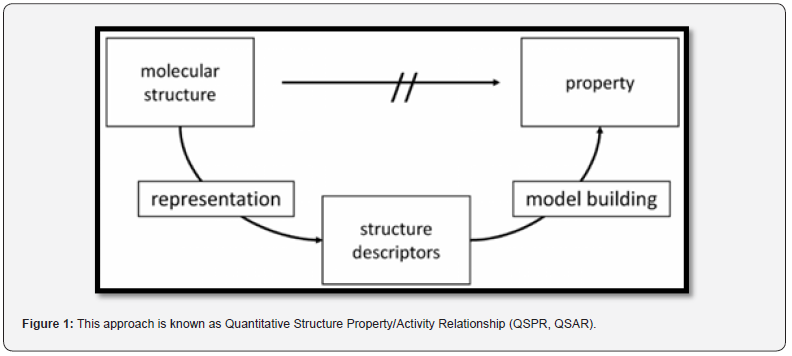
This approach is known as Quantitative Structure Property/
Activity Relationship (QSPR, QSAR). Many different methods for
the calculation of structure descriptors have been developed.
They represent molecules with increasing detail: 1D, 2D, 3D
descriptors, representations of molecular surface properties, and
even taking account of molecular flexibility. Also, quite a variety
of mathematical methods for modeling the relationship between
the molecular descriptors and the property of a compound are
available. These are the inductive learning methods and are
sometimes subsumed by names like data analysis methods,
machine learning, or data mining. They comprise methods like
a simple multi-linear regression analysis, a variety of pattern
recognition methods, random forests, support vector machines,
and artificial neural networks. Artificial neural networks (ANN)
try to model the information processing in the human brain and
offer much potential for studying chemical data.
For establishing a relationship between the molecular
descriptors and the property, values, so-called weights, have to
be attributed to the connections between the neurons. This is
most often achieved by the so-called backpropagation algorithm
by repeatedly presenting pairs of molecular descriptors and their
properties; these iterations quite often go into the ten-thousands
and more. An ANN has the advantage that the mathematical
relationship between the input units and the output need not be
specified or known; it is implicitly laid down in the weights and
can also comprise non-linear relationships. It was tempting to
envisage that with artificial neural networks the field of artificial
intelligence was awakening again. And in fact, in recent years
terms like deep learning or deep neural networks have appeared in
many fields including chemistry that provide a renaissance to the
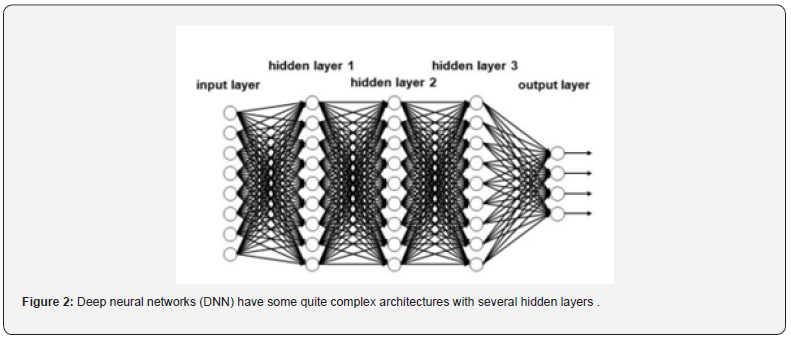
domain of artificial intelligence. A deep neural network (observe
that the network has been rotated by 90 degrees compared to the
one in Figure 2).
Deep neural networks (DNN) have some quite complex
architectures with several hidden layers .This has the consequence
that many weights for the connections have to be determined in
order to avoid overfitting. Novel approaches and algorithms had
to be developed to obtain networks that have true predictivity.
Deep neural networks need a large amount of data for training
in order to obtain truly predictive models. Most applications of
DNN have been made in drug design and in analyzing reaction
data (vide infra).
Reaction Prediction and Computer-Assisted Synthesis
Design (CASD)
These new systems use machine learning algorithms
and deep neural networks to predict reactions and suggest
synthesis pathways. The accuracy of these systems has improved
significantly, with some achieving success rates of over 90% in
predicting reactions and suggesting synthetic routes. Such systems
have the potential to revolutionize the field of organic synthesis by
enabling chemists to design new molecules and synthesize them
more efficiently. However, there are still challenges to overcome,
such as the need for more comprehensive reaction databases
and the development of more accurate machine learning models.
Nonetheless, the progress made in recent years suggests that
computer-assisted synthesis design will become an increasingly
important tool for organic chemists in the future.
The development of computer-assisted synthesis design
(CASD) systems has been hindered until recently due to limited
reaction databases and search procedures. However, with the
availability of large reaction databases and novel data processing
algorithms, CASD systems have been developed using machine
learning algorithms and deep neural networks to predict
reactions and suggest synthesis pathways. These systems have
achieved high success rates in predicting reactions and suggesting
synthetic routes, with the potential to revolutionize organic
synthesis. Nonetheless, challenges remain, such as the need for
more comprehensive reaction databases and more accurate
machine learning models. Methods for calculating values for
concepts like synthetic accessibility or current complexity have
also been developed to assist chemists in selecting molecules for
further investigation. The combination of large reaction databases
with novel data processing algorithms has matured CASD systems,
making them a valuable tool for organic chemists in planning
laboratory work.
Computer-assisted synthesis design (CASD) systems have
recently emerged as a valuable tool for organic chemists, facilitated
by the availability of large reaction databases and novel data
processing algorithms. Machine learning algorithms and deep
neural networks have been used to predict reactions and suggest
synthesis pathways, achieving high success rates. However,
challenges remain, such as the need for more comprehensive
reaction databases and more accurate machine learning models.
Methods for calculating values for concepts like synthetic
accessibility or current complexity have also been developed to
assist chemists in selecting molecules for further investigation.
The combination of large reaction databases with novel data
processing algorithms has matured CASD systems, making them a
promising tool for planning laboratory work. In addition, the use
of bioinformatics and chemoinformatics methods in combination
has led to interesting insights in the study of biochemical pathways,
including the identification of major pathways for periodontal
disease and the derivation of flavor-forming pathways in cheese
by lactic acid bacteria. Finally, novel artificial intelligence methods
such as deep learning architectures are being applied to metabolic
pathway prediction, offering exciting possibilities for pathway
redesign.
Cosmetics Products Discovery
In recent years, chemoinformatics and bioinformatics
methods that have established their value in drug discovery
such as molecular modeling, structure-based design, molecular
dynamics simulations and gene expression have also been utilized
in the development of new cosmetics products. Thus, novel skin
moisturizers and anti-aging compounds have been developed.
Legislation has been passed in the European Union with the
Cosmetics Directive that no chemicals are longer allowed to be
added to cosmetics products that have been tested on animals.
This has given a large push to the establishment of computer models for
the prediction of toxicity of chemicals to be potentially included in
cosmetics products.
Material Science
The prediction of the properties of materials is probably
the most active area of chemoinformatics. The properties
that are investigated range from properties of nanomaterials,
materials from regenerative medicine, solar cells, homogeneous
or heterogeneous catalysts, electrocatalysts, phase diagrams,
ceramics, or the properties of supercritical solvents. Reviews
have appeared. In most cases, the chemical structure of the
material investigated is not known and therefore other types of
descriptors have to be chosen to represent a material for a QSAR
study. Materials could be represented by physical properties such
as refractive index or melting point, spectra, the components
or the conditions for the production of the material, etc. Use of
chemoinformatics methods in material science are particularly
opportune as in most cases the properties of interest depend
on many parameters and cannot be directly calculated. A QSAR
model would allow the design of new materials with the desired
property.
Process Control
The problem of the detection of faults in chemical processes
and process control have benefited quite early on from the
application of artificial neural networks. An overall course on
the application of artificial intelligence in process control has
been developed by six European universities. Chemical processes
rapidly generate a host of data on flow of chemicals, concentration,
temperature, pressure, product distribution, etc. This data have to
be used to recognize potential faults in the process and rapidly
bring the process back to optimum. The relationships between
the various data produced by sensors and the amount of desired
product cannot be explicitly given, making it an ideal case for
the application of powerful data modeling techniques. Quite a
few excellent results have been obtained for such processes as
Petrochemical or pharmaceutical processes, water treatment,
agriculture, iron manufacture, exhaust gas denitration, distillation
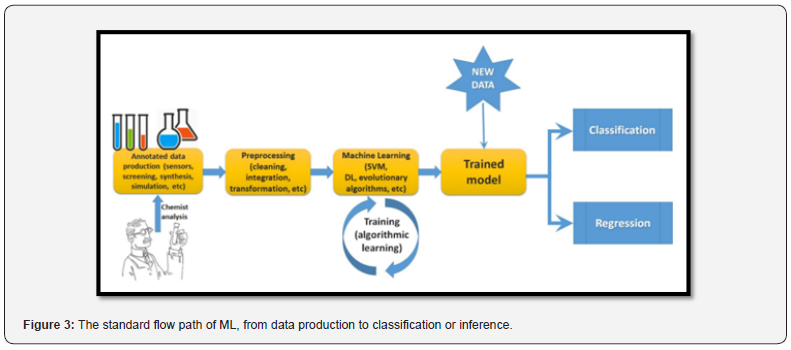
column operation, etc. (Figure 3).
Identification of Compounds with Genetic Algorithms
Bio-inspired computing involves the development of
procedures that mimic mechanisms observed in natural
environments. For example, genetic algorithms are inspired by
Charles Darwin’s concept of evolution and use the principle of
“survival of the fittest” to facilitate optimization. In this process,
active compounds interbreed and mutate to produce new
compounds with new properties. Compounds that show useful
properties are selected for further synthesis, while those that do
not have useful properties are ignored. After several generations,
new functional compounds appear with inherited and acquired
properties. This process requires accurate composition modeling,
appropriate mutation methods, and robust fitness assessments
that can be obtained computationally, reducing the need for
expensive experiments. In genetic algorithms, each compositional
or structural feature of a compound is considered a gene. Chemical
genes include factors such as individual components, polymer
block size, monomer compositions, and processing temperature.
Genome contains all the genes of a combination, and the resulting
properties are known as phenotypes. Genetic algorithms scan
the search space of gene domains to identify the most suitable
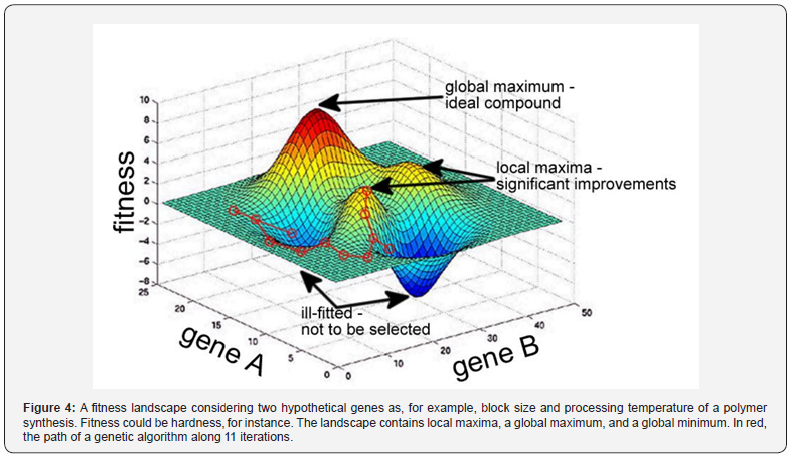
phenotypes based on a fitness function. The relationship between
genome and phenotype creates a fitness perspective, as shown in the
figure below for two hypothetical genes related to polymer synthesis
processes aimed at high hardening rates. The fitness
perspective is implicit in the problem model defined by gene
domains and fitness function.
The genetic algorithm moves along the landscape generating
new combinations while avoiding combinations that do not
improve fitness. This mechanism increases the probability of
achieving the desired properties. Bio-inspired computing involves
mimicking natural mechanisms to develop optimization methods.
Genetic algorithms, inspired by Charles Darwin’s concept of
evolution, use the principle of “survival of the fittest” to create new
combinations with new characteristics. Each trait is considered a
combination of a gene, and the genome includes all the genes of
a combination, resulting in a phenotype. Genetic algorithms scan
the search space of gene domains to identify the most suitable
phenotypes based on a fitness function. The relationship between
genome and phenotype creates a fitness landscape that is implicit
in the problem model defined by gene domains and fitness
functions. This mechanism increases the probability of achieving
the desired properties. The effectiveness of genetic algorithms has
been shown in various fields, including catalyst optimization and
material science (Figure 4).
Synthesis Prediction Using ML
The challenging task of synthesizing new compounds,
particularly in organic chemistry, has led to the search for
machine-based methods that can predict the molecules produced
from a given set of reactants and reagents. Corey and Wipke’s 1969
approach used templates produced by expert chemists to define
atom connectivity rearrangement under specific conditions.
However, limited template sets prevented their method from
encompassing a wide range of conditions. The use of templates or
rules to transfer knowledge from human experts to computers has
gained renewed interest due to the potential for automatic rule
generation using big datasets, as seen in medicine and materials
science. Machine learning methods, such as neural networks,
have been successful in predicting retrosynthesis outcomes using
large datasets. Deep learning appears to be the most promising
approach for exploring large search spaces. Recent experiments
using link prediction ML algorithms on a knowledge graph built
from millions of binary reactions have shown high accuracy in
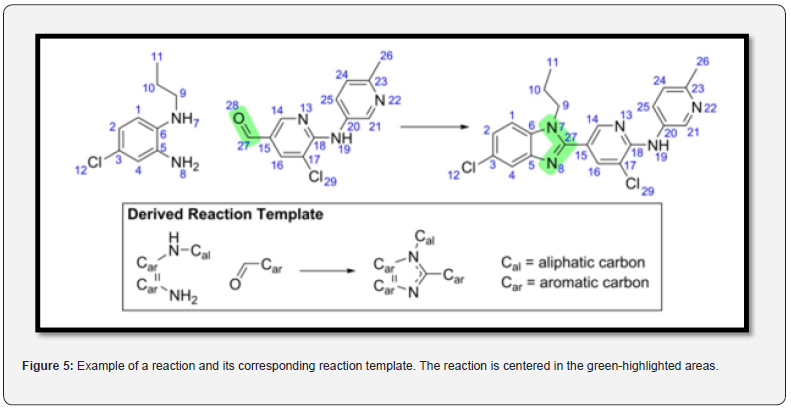
predicting products and detecting unlikely reactions (Figure 5).
The Corresponding Template Includes the Reaction
Center and Nearby Functional Groups
Reproduced from the search for machine-based methods
to
predict the molecules produced from a given set of reactants and
reagents in organic chemistry has led to the use of templates and
rules to transfer knowledge from human experts to computers.
However, limited template sets have prevented these methods from
encompassing a wide range of conditions. Recent experiments
using machine learning (ML) methods, such as neural networks
and deep learning (DL), have shown high accuracy in predicting products
and detecting unlikely reactions. DL appears to be the most promising
approach for exploring large search spaces
and has been used to predict outcomes of chemical reactions
by assimilating latent patterns for generalizing out of a pool of
examples. The SMILES chemical language has been employed
in DL models to represent molecular structures as graphs and
strings amenable to computational processing. DNNs have been
used to predict reactions with superior performance compared
to previous rule-based expert systems, achieving an accuracy of
97% on a validation set of 1 million reactions. Additionally, DNNs
have been used to map discrete molecules into a continuous
multidimensional space, where it is possible to predict properties
of existing vectors and predict new vectors with certain properties.
Optimization techniques can then be employed to search for the
best candidate molecules.
Learning from data has always been a cornerstone of chemical
research. In the last sixty years computer methods have been
introduced in chemistry to convert data into information and
then derive knowledge from this information. This has led to
the establishment of the field of chemoinformatics that has
undergone impressive developments over the last 60 years and
found applications in most areas of chemistry from drug design to
material science. Artificial intelligence techniques have recently
seen a rebirth in chemistry and will have to be optimized to also
allow us to understand the basic foundations of chemical data.
This review examines the growth and distribution of AI-related
chemistry publications over the past two decades using the CAS
Content Collection.
The volume of journal and patent publications has increased
significantly, particularly since 2015. Analytical chemistry and
biochemistry have integrated AI to the greatest extent and with
the highest growth rates. Interdisciplinary research trends were
also identified, along with emerging associations of AI with
certain chemistry research topics. Notable publications in various
chemistry disciplines were evaluated to highlight emerging use
cases. The occurrence of different classes of substances and their
roles in AI-related chemistry research were quantified, detailing the
popularity of AI adoption in life sciences and analytical chemistry.
AI can be applied to various tasks in chemistry, where complex
relationships are often present in data sets. AI implementations
have dramatically reduced design and experimental effort by
enabling laboratory automation, predicting bioactivities of new
drugs, optimizing reaction conditions, and suggesting synthetic
routes to complex target molecules. This review contextualizes
the current AI landscape in chemistry, providing an understanding
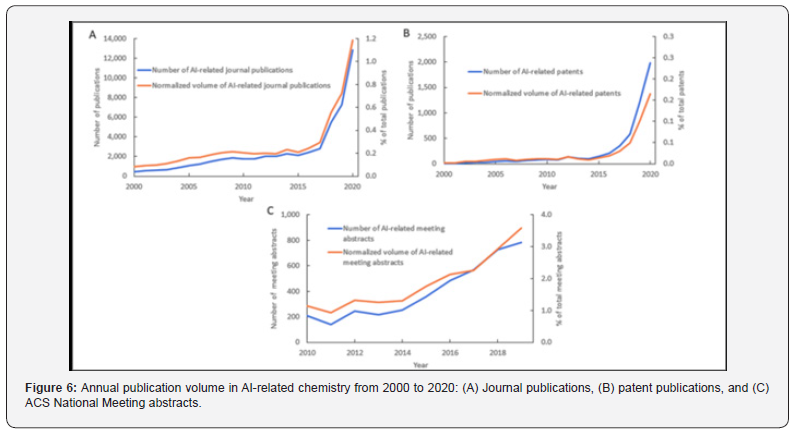
of its future directions (Figure 6).
This review analyzes the growth and distribution of
AIrelated
chemistry publications over the past two decades using
the CAS content collection. The volume of journal publications
and patents has increased significantly since 2015 in particular,
as analytical chemistry and biochemistry have integrated artificial
intelligence with the largest amount and the highest growth rate.
Interdisciplinary research trends were identified, along with
emerging connections of artificial intelligence to specific chemistry
research topics. Significant publications in various chemistry
disciplines were evaluated to highlight emerging applications. The
popularity of artificial intelligence adoption in life sciences and
analytical chemistry was determined by examining the occurrence
of different classes of materials and their role in artificial
intelligence-related chemistry research. Artificial intelligence has
reduced experimental design and effort by enabling laboratory
automation, predicting the bioactivities of new drugs, optimizing
reaction conditions, and suggesting synthetic routes to complex
target molecules. This review examines the current landscape
of artificial intelligence in chemistry and provides insight into
its future directions. The CAS content corpus was searched to
identify publications related to artificial intelligence from 2000
to 2020 based on various artificial intelligence terms in the title,
keywords, abstract text, and concepts selected by CAS experts.
Approximately 70,000 journal publications and 17,500 patents
from the CAS content collection were identified as related to
AI. The number of journal publications and patents increased
over time and showed similar fast-growing trends after 2015.
The proportion of research related to artificial intelligence is
increasing, indicating an absolute increase in research efforts for
artificial intelligence in chemistry.
This review analyzes the growth and distribution of AI-related
chemistry publications over the past two decades using the CAS
Content Collection. The volume of journal and patent publications
has significantly increased, especially since 2015, with analytical
chemistry and biochemistry integrating AI to the greatest extent
and with the highest growth rates. Interdisciplinary research
trends were identified, along with emerging associations of AI with
specific chemistry research topics. Notable publications in various
chemistry disciplines were evaluated to highlight emerging use
cases. The popularity of AI adoption in life sciences and analytical
chemistry was quantified by examining the occurrence of different
classes of substances and their roles in AI-related chemistry
research. AI has reduced design and experimental effort by
enabling laboratory automation, predicting bioactivities of new
drugs, optimizing reaction conditions, and suggesting synthetic
routes to complex target molecules. This review contextualizes the
current AI landscape in chemistry and provides an understanding
of its future directions. The CAS Content Collection was searched
to identify AI-related publications from 2000 to 2020 based on
various AI terms in their title, keywords, abstract text, and CAS
expert-curated concepts. Roughly 70,000 journal publications and
17,500 patents from the CAS Content Collection were identified as
related to AI. The numbers of both journal and patent publications
increased with time, showing similar rapidly growing trends
after 2015. The proportion of AI-related research is increasing,
suggesting an absolute increase in research effort toward AI in
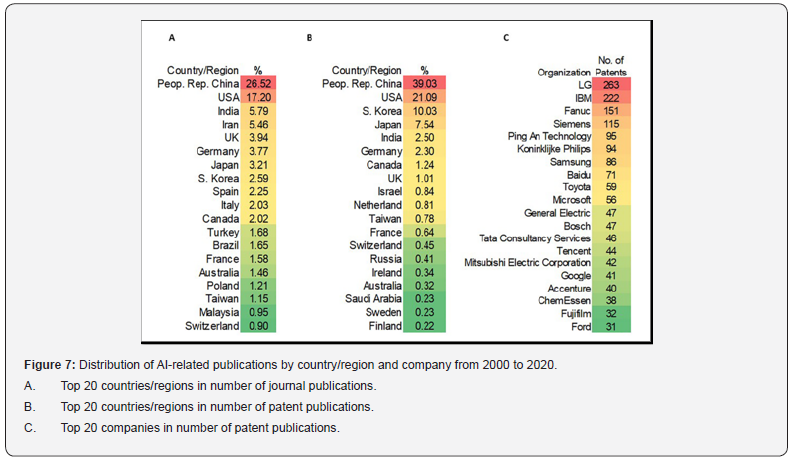
chemistry (Figure 7).
Here, the growth and distribution of AI-related
chemistry
publications over the past two decades is reviewed using the CAS
content collection. The volume of journal publications and patents
has increased significantly, especially since 2015, with analytical
chemistry and biochemistry incorporating AI the most and
with the highest growth rates. Interdisciplinary research trends
were identified, along with emerging connections of artificial
intelligence to specific chemistry research topics. Significant
publications in various chemistry disciplines were evaluated to
highlight emerging applications. The popularity of artificial
intelligence adoption in life sciences and analytical chemistry was
determined by examining the occurrence of different classes of
materials and their role in artificial intelligence-related chemistry
research. Artificial intelligence has reduced experimental design
and effort by enabling laboratory automation, predicting the
bioactivities of new drugs, optimizing reaction conditions, and
suggesting synthetic routes to complex target molecules. This
review examines the current landscape of artificial intelligence
in chemistry and provides insight into its future directions.
Then the countries/regions and organizations of origin of AIrelated
chemistry documents were extracted to determine their
distribution. China and the United States had the highest number
of publications for both journal articles and patents. Medical
diagnostics developers and technology companies make up a
large portion of commercial licensees for chemical AI research.
Publication trends in specific research areas were also analyzed,
and analytical chemistry had the highest normalized volume in
recent years. Energy technology and environmental chemistry
and industrial chemistry and chemical engineering are also
growing fields in terms of research related to artificial intelligence.
Biochemistry is heavily featured in AI-related patent publications,
likely due to its use in drug research and development.
This article examines the growth and distribution of AI-related
chemistry publications using the CAS Content Collection over the
past two decades. The volume of journal and patent publications
has significantly increased, particularly since 2015, with analytical
chemistry and biochemistry integrating AI to the greatest extent
and with the highest growth rates. Interdisciplinary research
trends were identified, along with emerging associations of AI with
specific chemistry research topics. Notable publications in various
chemistry disciplines were evaluated to highlight emerging use
cases. The popularity of AI adoption in life sciences and analytical
chemistry was quantified by examining the occurrence of different
classes of substances and their roles in AI-related chemistry
research. AI has reduced design and experimental effort by
enabling laboratory automation, predicting bioactivities of new
drugs, optimizing reaction conditions, and suggesting synthetic
routes to complex target molecules.
This review contextualizes the current AI landscape
in
chemistry and provides an understanding of its future directions.
The countries/regions and organizations of origin for AI-related
chemistry documents were then extracted to determine their
distributions. China and the United States contributed the largest
numbers of publications for both journal articles and patents.
Medical diagnostic developers and technology companies make
up a large portion of the commercial patent assignees for AI
chemical research. Trends of publications in specific research
areas were also analyzed, with Analytical Chemistry having the
highest normalized volume in recent years. Energy Technology and
Environmental Chemistry and Industrial Chemistry and Chemical
Engineering are also growing fields in terms of AIrelated
research. Biochemistry is highly represented in AI-related
patent publications, possibly due to its use in drug research and
development. Interdisciplinary relationships do appear in AIrelated
chemistry research, demonstrating how AI can be applied
in research areas where the relationships between available data
in separate domains are not obvious to researchers (Figure 8).
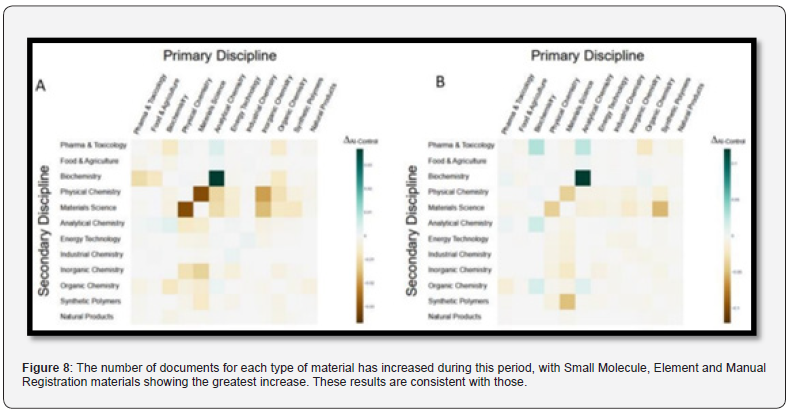
Difference in proportion of total AI-related publications and
control group (non-AI related) by interdisciplinary pair: (A)
journal publications and (B) patent publications. The distribution
of AI-related research in chemistry can be analyzed by examining
the number of papers related to different classes of materials.
Overcoming challenges in material representation and data
availability is critical to implementing artificial intelligence in
chemistry. Therefore, identifying the most common types of
materials studied in the literature can indicate areas where
researchers have successfully addressed these challenges.
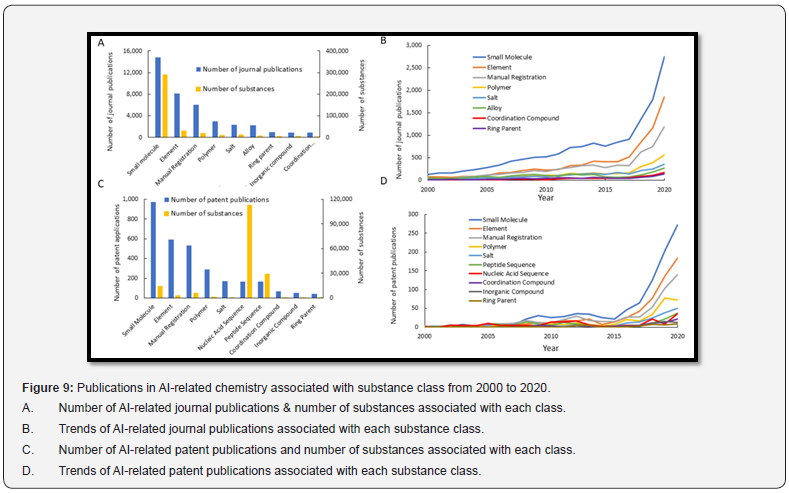
CAS classifies materials into several classes, and the figure
below shows the number of AI-related journal publications for
common material classes, including alloy, coordinated compound,
element, hand register, ring parent, small molecule, polymer,
salt, and inorganic compound. Gives. Publications containing
Small Molecule materials have the largest number, followed
by publications containing Element and Manual Registration
materials. This trend is probably due to the relative simplicity and
ease of modeling of these materials compared to Coordination
Compound and Polymer. The high number of documents containing
manual recording material corresponds to the high volume of
publications in biochemistry. The figure below also shows the
total number of materials in AI-related journal publications for
each material class. The process in substance counting is similar
to document counting, although skewed by the higher number of
small molecule substances in each document (Figure 9).
The popularity of AI applications in chemistry has grown
rapidly in recent years, with some fields further along in adoption
than others. The success of AI implementation is linked to the
availability and quality of data, as well as opportunities for gaining
insights and automating repetitive tasks. Analytical chemistry
and biochemistry have seen significant AI deployment due to the
availability of large training sets and data for macromolecules.
The popularity of AI applications in drug discovery is reflected in
the large number of publications involving small molecules. The
increased availability of software and hardware tools, research
area-specific data sets, and researcher expertise have contributed
to the growth of AI in chemistry. While AI has been successfully
adapted to many areas of chemical research, there are still areas
where its impact has yet to be felt. With continued improvements
in AI and interdisciplinary research, these areas may see increased
adoption in the future.
Glasser’s Choice Theory
Choice theory posits that the behaviors we choose are
central to our existence. Our behavior (choices) is driven by
five genetically driven needs in hierarchical order: survival,
love, power, freedom, and fun. The most basic human needs are
survival (physical component) and love (mental component).
Without physical (nurturing) and emotional (love), an infant will
not survive to attain power, freedom, and fun.
“No matter how well-nourished and intellectually stimulated
a child is, going without human touch can stunt his mental,
emotional, and even physical growth”.
Choice theory suggests the existence of a “quality world.” The
idea of a “quality world” in choice theory has been compared
to Jungian archetypes, but Glasser’s acknowledgement of this
connection is unclear. Some argue that Glasser’s “quality world”
and what Jung would call healthy archetypes share similarities.
Our “quality world” images are our role models of an individual’s
“perfect” world of parents, relations, possessions, beliefs, etc. How
each person’s “quality world” is somewhat unusual, even in the
same family of origin, is taken for granted.
Starting from birth and continuing throughout our lives, each
person places significant role models, significant possessions,
and significant systems of belief (religion, cultural values, icons,
etc.) into a mostly unconscious framework Glasser called our
“quality world”. The issue of negative role models and stereotypes
is not extensively discussed in choice theory. Glasser also
posits a “comparing place,” where we compare and contrast
our perceptions of people, places, and things immediately in
front of us against our ideal images (archetypes) of these in our
Quality World framework. Our subconscious pushes us towards
calibrating-as best we can-our real-world experience with our
quality world (archetypes). Behavior (“total behavior” in Glasser’s
terms) is made up of these four components: acting, thinking,
feeling, and physiology. Glasser suggests we have considerable
control or choice over the first two of these, yet little ability to
directly choose the latter two as they are more deeply sub- and
unconscious. These four components remain closely intertwined,
and the choices we make in our thinking and acting will greatly
affect our feelings and physiology.
Glasser frequently emphasizes that failed or strained
relationships with significant individuals can contribute to
personal unhappiness. Spouses, parents, children, friends, and
colleagues. The symptoms of unhappiness are widely variable
and are often seen as mental illnesses. Glasser believed that
“pleasure” and “happiness” are related but far from synonymous.
Sex, for example, is a “pleasure” but may well be divorced from
a “satisfactory relationship,” which is a precondition for lasting
“happiness” in life. Hence the intense focus on the improvement
of relationships in counseling with choice theory-the “new reality
therapy”. Individuals who are familiar with both reality therapy
and choice theory may have a preference for the latter, which
is considered a more modern approach. According to choice
theory, mental illness can be linked to personal unhappiness.
Glasser champions how we are able to learn and choose alternate
behaviors that result in greater personal satisfaction. Reality
therapy is a choice theory-based counseling process focused on
helping clients learn to make those self-optimizing choices [1].
The Ten Axioms of Choice
a. The only person whose behavior we can control is
ourselves.
b. All we can give another person is information.
c. All long-lasting psychological problems are relationship
problems.
d. The problem relationship is always part of our present
life.
e. What happened in the past has everything to do with
who we are today, but we can only satisfy our basic needs right
now and plan to continue satisfying them in the future.
f. We can only satisfy our needs by satisfying the pictures
in our quality world.
g. All we do is behave.
h. All behavior is total behavior and is made up of four
components: acting, thinking, feeling, and physiology.
i. All of our total behavior is chosen, but we only have
direct control over the acting and thinking components. We can
only control our feelings and physiology indirectly through how
we choose to act and think.
j. All total behavior is designated by verbs and named by
the part that is the most recognizable.
In Classroom Management
William Glasser’s choice theory begins: Behavior is not
separate from choice; we all choose how to behave at any time.
Second, we cannot control anyone’s behavior but our own. Glasser
emphasized the importance of classroom meetings as a means to
improve communication and solve classroom problems. Glasser
suggested that teachers should assist students in envisioning a
fulfilling school experience and planning the choices that would
enable them to achieve it. For example, Johnny Waits is an
18-year-old high school senior and plans on attending college to
become a computer programmer. Glasser suggests that Johnny
could be learning as much as he can about computers instead
of reading Plato. Glasser proposed a curriculum approach that
emphasizes practical, real-world topics chosen by students based
on their interests and inclinations. This approach is referred to as
the quality curriculum. The quality curriculum places particular
emphasis on topics that have practical career applications.
According to Glasser’s approach, teachers facilitate discussions
with students to identify topics they are interested in exploring
further when introducing new material. In line with Glasser’s
approach, students are expected to articulate the practical value
of the material they choose to explore[2].
Education
Glasser did not endorse Summerhill, and the quality schools
he oversaw typically had conventional curriculum topics. The
main innovation of these schools was a deeper, more humanistic
approach to the group process between teachers, students, and
learning.
Critiques
In a book review, [3] Christopher White writes that Glasser
believes everything in the DSM-IV-TR is a result of an individual’s
brain creatively expressing its unhappiness. White also notes
that Glasser criticizes the psychiatric profession and questions
the effectiveness of medications in treating mental illness. White
points out that the book does not provide a set of randomized
clinical trials demonstrating the success of Glasser’s teachings.
Quality of World
The Quality Realm is central to William Glasser’s views. A
person’s values and priorities are represented in the brain as
mental images in a space called the Superior Realm. Photographs
of significant people, locations, ideas, and convictions could be
filed away in their minds. According to Glasser, the pictures in a
human’s Supreme bring them joy and fulfill some fundamental
needs. Such images are personal and not subject to any societal
norm checking. The Quality Planet is our ideal utopia.
Working of Glasser’s Choice Theory
Clients’ emotions and physiological reactions to stress may
be improved via habitual and cognitive modification instruction.
The educational field is a perfect illustration of this. Disappointed
pupils who are unable to master particular ideas as well as acquire
particular talents may be instructed to rethink what they consider
a high-quality universe. Some changes can be implemented to
emphasize the company’s history of problematic habits and
encourage them to identify and address the underlying causes of
that habit to prevent a recurrence. An essay on Schema Therapy
states that both Theory and its subset, Reality Psychotherapy, do
not focus on the past. Customers are urged to live in the now. They
encourage people to consider alterations to their routine that
could bring about more satisfying outcomes.
Conclusion of session Glasser’s Choice Theory
Glasser’s original version of the Choice Theory posits that
at our most fundamental level, choices are made to satisfy a set
of requirements. It is hypothesized that people want to choose
the option they believe would be best for them, which does not
imply that bad judgments will not have negative results. It has
been shown, meanwhile, that Psychodynamic Approach may aid
individuals in developing more effective approaches to managing
issues. Choice Theory originates in traditional habits and has
contributed greatly too many academic disciplines.
Game Theory
Game theory is the study of mathematical models of
strategic
interactions among rational agents. [1]It has applications in
all fields of social science, as well as in logic, systems science
and computer science. The concepts of game theory are used
extensively in economics as well. [2] The traditional methods of
game theory addressed two-person zero-sum games, in which each
participant’s gains or losses are exactly balanced by the losses and
gains of other participants. In the 21st century, the advanced
game theories apply to a wider range of behavioral relations; it is
now an umbrella term for the science of logical decision making in
humans, animals, as well as computers.
Modern game theory began with the idea of mixed-strategy
equilibria in two-person zero-sum game and its proof by John
von Neumann. Von Neumann’s original proof used the Brouwer
fixed-point theorem on continuous mappings into compact
convex sets, which became a standard method in game theory
and mathematical economics. His paper was followed by the
1944 book Theory of Games and Economic Behavior, co-written
with Oskar Morgenstern, which considered cooperative games of
several players. [3] The second edition of this book provided an
axiomatic theory of expected utility, which allowed mathematical
statisticians and economists to treat decision-making under
uncertainty. Therefore, it is evident that game theory has evolved
over time with consistent efforts of mathematicians, economists
and other academicians. Game theory was developed extensively
in the 1950s by many scholars. It was explicitly applied to
evolution in the 1970s, although similar developments go back at
least as far as the 1930s. Game theory has been widely recognized
as an important tool in many fields. As of 2020, with the Nobel
Memorial Prize in Economic Sciences going to game theorists Paul
Milgrom and Robert B. Wilson, fifteen game theorists have won
the economics Nobel Prize. John Maynard Smith was awarded the
Crafoord Prize for his application of evolutionary game theory [4-
12].
Cooperative / Non-Cooperative
A game is cooperative if the players are able to form binding
commitments externally enforced (e.g. through contract law).
A game is non-cooperative if players cannot form alliances or if
all agreements need to be self-enforcing (e.g., through credible
threats). [13] Cooperative games are often analyzed through
the framework of cooperative game theory, which focuses on
predicting which coalitions will form, the joint actions that
groups take, and the resulting collective payoffs. It is opposed to
the traditional non-cooperative game theory which focuses on
predicting individual players’ actions and payoffs and analyzing
Nash equilibria.[14,15] The focus on individual payoff can result
in a phenomenon known as Tragedy of the Commons, where
resources are used to a collectively inefficient level. The lack of
formal negotiation leads to the deterioration of public goods
through over-use and under provision that stems from private
incentives. [16]Cooperative game theory provides a high-level
approach as it describes only the structure, strategies, and payoffs
of coalitions, whereas non-cooperative game theory also looks at
how bargaining procedures will affect the distribution of payoffs
within each coalition.
As non-cooperative game theory is more general, cooperative
games can be analyzed through the approach of non-cooperative
game theory (the converse does not hold) provided that sufficient
assumptions are made to encompass all the possible strategies
available to players due to the possibility of external enforcement
of cooperation. While using a single theory may be desirable, in
many instances insufficient information is available to accurately
model the formal procedures available during the strategic
bargaining process, or the resulting model would be too complex
to offer a practical tool in the real world. In such cases, cooperative
game theory provides a simplified approach that allows analysis
of the game at large without having to make any assumption about
bargaining powers.
Symmetric / Asymmetric
A symmetric game is a game where the payoffs for playing a
particular strategy depend only on the other strategies employed,
not on who is playing them. That is, if the identities of the players
can be changed without changing the payoff to the strategies,
then a game is symmetric. Many of the commonly studied 2×2
games are symmetric. The standard representations of chicken,
the prisoner’s dilemma, and the stag hunt are all symmetric
games. Some scholars would consider certain asymmetric
games as examples of these games as well. However, the most
common payoffs for each of these games are symmetric. The most
commonly studied asymmetric games are games where there
are not identical strategy sets for both players. For instance, the
ultimatum game and similarly the dictator game have different
strategies for each player. It is possible, however, for a game to
have identical strategies for both players yet be asymmetric. For
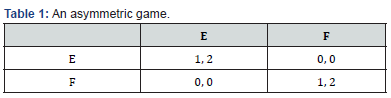
example, the game pictured in this section’s graphic is asymmetric
despite having identical strategy sets for both players (Table 1).
Zero-Sum / Non-Zero-Sum
Zero-sum games (more generally, constant-sum games)
are games in which choices by players can neither increase nor
decrease the available resources. In zero-sum games, the total
benefit goes to all players in a game, for every combination of
strategies, always adds to zero (more informally, a player benefits
only at the equal expense of others). [17] Poker exemplifies a
zero-sum game (ignoring the possibility of the house’s cut),
because one wins exactly the amount one’s opponents lose. Other
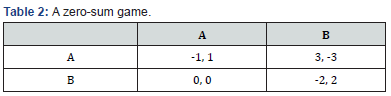
zero-sum games include matching pennies and most classical
board games include Go and chess (Table 2).Many games studied
by game theorists (including the famed prisoner’s dilemma) are
non-zero-sum games, because the outcome has net results greater
or less than zero. Informally, in non-zero-sum games, a gain by one
player does not necessarily correspond with a loss by another.
Constant-sum games correspond to activities like theft and
gambling, but not to the fundamental economic situation in which
there are potential gains from trade. It is possible to transform any
constant-sum game into a (possibly asymmetric) zero-sum game
by adding a dummy player (often called “the board”) whose losses
compensate the players’ net winnings.
Simultaneous / Sequential
Simultaneous games are games where both players move
simultaneously, or instead the later players are unaware of the
earlier players’ actions (making them effectively simultaneous).
Sequential games (or dynamic games) are games where players
do not make decisions simultaneously, and the player’s earlier
actions affect the outcome and decisions of other players. [18]
This need not be perfect information about every action of earlier
players; it might be very little knowledge. For instance, a player
may know that an earlier player did not perform one particular
action, while they do not know which of the other available actions
the first player actually performed. The difference between
simultaneous and sequential games is captured in the different
representations discussed above. Often, normal form is used to
represent simultaneous games, while extensive form is used to
represent sequential ones. The transformation of extensive to
normal form is one way, meaning that multiple extensive form
games correspond to the same normal form. Consequently,
notions of equilibrium for simultaneous games are insufficient for
reasoning about sequential games.
Perfect Information and Imperfect Information
A game of imperfect information. The dotted line represents
ignorance on the part of player 2, formally called an information
set. An important subset of sequential games consists of games
of perfect information. A game with perfect information means
that all players, at every move in the game, know the previous
history of the game and the moves previously made by all other
players. In reality, this can be applied to firms and consumers
having information about the price and quality of all the available
goods in a market. [19] An imperfect information game is played
when the players do not know all moves already made by the
opponent such as a simultaneous move game.[20] Most games
studied in game theory are imperfect-information games.[citation
needed] Examples of perfect-information games include tic-tactoe,
checkers, chess, and go [21-23]. Many card games are games
of imperfect information, such as poker and bridge.[24] Perfect
information is often confused with complete information, which
is a similar concept pertaining to the common knowledge of each
player’s sequence, strategies, and payoffs throughout gameplay.
[25] Complete information requires that every player know
the strategies and payoffs available to the other players but not
necessarily the actions taken, whereas perfect information is
knowledge of all aspects of the game and players.[26] Games of
incomplete information can be reduced, however, to games of
imperfect information by introducing “moves by nature”.[27].
Bayesian Game
One of the assumptions of the Nash equilibrium is that every
player has correct beliefs about the actions of the other players.
However, there are many situations in game theory where
participants do not fully understand the characteristics of their
opponents. Negotiators may be unaware of their opponent’s
valuation of the object of negotiation, companies may be unaware
of their opponent’s cost functions, combatants may be unaware
of their opponent’s strengths, and jurors may be unaware of
their colleague’s interpretation of the evidence at trial. In some
cases, participants may know the character of their opponent
well, but may not know how well their opponent knows his or
her own character. Bayesian game means a strategic game with
incomplete information. For a strategic game, decision makers are
players, and every player has a group of actions. A core part of the
imperfect information specification is the set of states. Every state
completely describes a collection of characteristics relevant to the
player such as their preferences and details about them. There
must be a state for every set of features that some players believe
may exist.
Example of a Bayesian game
For example, where Player 1 is unsure whether Player 2 would
rather date her or get away from her, while Player 2 understands
Player 1’s preferences as before. To be specific, supposing
that Player 1 believes that Player 2 wants to date her under a
probability of 1/2 and get away from her under a probability of
1/2 (this evaluation comes from Player 1’s experience probably:
she faces players who want to date her half of the time in such
a case and players who want to avoid her half of the time). Due
to the probability involved, the analysis of this situation requires
understanding the player’s preference for the draw, even though
people are only interested in pure strategic equilibrium.
Combinatorial Games
Games in which the difficulty of finding an optimal
strategy
stems from the multiplicity of possible moves are called
combinatorial games. Examples include chess and go. Games that
involve imperfect information may also have a strong combinatorial
character, for instance backgammon. There is no unified theory
addressing combinatorial elements in games. There are, however,
mathematical tools that can solve some particular problems and
answer some general questions. Games of perfect information
have been studied in combinatorial game theory, which has
developed novel representations, e.g., surreal numbers, as well as
combinatorial and algebraic (and sometimes non-constructive) proof
methods to solve games of certain types, including “loopy”
games that may result in infinitely long sequences of moves. These
methods address games with higher combinatorial complexity
than those usually considered in traditional (or “economic”) game
theory.[31,32] A typical game that has been solved this way is Hex.
A related field of study, drawing from computational complexity
theory, is game complexity, which is concerned with estimating the
computational difficulty of finding optimal strategies. Research in
artificial intelligence has addressed both perfect and imperfect
information games that have very complex combinatorial
structures (like chess, go, or backgammon) for which no provable
optimal strategies have been found. The practical solutions
involve computational heuristics, like alpha-beta pruning or use
of artificial neural networks trained by reinforcement learning,
which make games more tractable in computing practice.
Infinitely Long Games
Games, as studied by economists and real-world game players,
are generally finished in finitely many moves. Pure mathematicians
are not so constrained and set theorists in particular study games
that last for infinitely many moves, with the winner (or other
payoff) not known until after all those moves are completed. The
focus of attention is usually not so much on the best way to play
such a game, but whether one player has a winning strategy. (It
can be proven, using the axiom of choice, that there are games -
even with perfect information and where the only outcomes are
“win” or “lose” - for which neither player has a winning strategy.)
The existence of such strategies, for cleverly designed games, has
important consequences in descriptive set theory.
Discrete and Continuous Games
Much of game theory is concerned with finite, discrete games
that have a finite number of players, moves, events, outcomes, etc.
Many concepts can be extended, however. Continuous games allow
players to choose a strategy from a continuous strategy set. For
instance, Cournot competition is typically modeled with players’
strategies being any non-negative quantities, including fractional
quantities. Continuous games allow the possibility for players to
communicate with each other under certain rules, primarily the
enforcement of a communication protocol between the players.
By communicating, players have been noted to be willing to
provide a larger amount of goods in a public good game than they
ordinarily would in a discrete game, and as a result, the players
are able to manage resources more efficiently than they would in
discrete games, as they share resources, ideas and strategies with
one another. This incentivizes, and causes, continuous games to
have a higher median cooperation rate. [35].
Differential Games
Differential games such as the continuous pursuit and evasion
game are continuous games where the evolution of the players’
state variables is governed by differential equations. The problem
of finding an optimal strategy in a differential game is closely
related to the optimal control theory. In particular, there are two
types of strategies: the open-loop strategies are found using the
Pontryagin maximum principle while the closed-loop strategies
are found using Bellman’s Dynamic Programming method. A
particular case of differential games are the games with a random
time horizon.[36] In such games, the terminal time is a random
variable with a given probability distribution function. Therefore,
the players maximize the mathematical expectation of the cost
function. It was shown that the modified optimization problem
can be reformulated as a discounted differential game over an
infinite time interval.
Evolutionary Game Theory
Evolutionary game theory studies players who adjust their
strategies over time according to rules that are not necessarily
rational or farsighted.[37] In general, the evolution of strategies
over time according to such rules is modeled as a Markov chain
with a state variable such as the current strategy profile or how
the game has been played in the recent past. Such rules may
feature imitation, optimization, or survival of the fittest. In biology,
such models can represent evolution, in which offspring adopt
their parents’ strategies and parents who play more successful
strategies (i.e., corresponding to higher payoffs) have a greater
number of offspring. In the social sciences, such models typically
represent strategic adjustment by players who play a game many
times within their lifetime and, consciously or unconsciously,
occasionally adjust their strategies. [38].
Stochastic Outcomes (And Relation to other Fields)
Individual decision problems with stochastic outcomes are
sometimes considered “one-player games”. They may be modeled
using similar tools within the related disciplines of decision
theory, operations research, and areas of artificial intelligence,
particularly AI planning (with uncertainty) and multi-agent
system. Although these fields may have different motivators,
the mathematics involved are substantially the same, e.g., using
Markov decision processes (MDP).[39] Stochastic outcomes can
also be modeled in terms of game theory by adding a randomly
acting player who makes “chance moves” (“moves by nature”).
[40] This player is not typically considered a third player in what
is otherwise a two-player game, but merely serves to provide a
roll of the dice where required by the game.
For some problems, different approaches to modeling
stochastic outcomes may lead to different solutions. For example,
the difference in approach between MDPs and the minimax
solution is that the latter considers the worst-case over a set of
adversarial moves, rather than reasoning in expectation about
these moves given a fixed probability distribution. The minimax
approach may be advantageous where stochastic models of
uncertainty are not available but may also be overestimating
extremely unlikely (but costly) events, dramatically swaying the
strategy in such scenarios if it is assumed that an adversary can force
such an event to happen. General models that include
all elements of stochastic outcomes, adversaries, and partial
or noisy observability (of moves by other players) have also
been studied. The “gold standard” is considered to be partially
observable in stochastic game (POSG), but few realistic problems
are computationally feasible in POSG representation.
Metagames
These are games the play of which is the development
of the rules for another game, the target or subject game.
Metagames seek to maximize the utility value of the rule set
developed. The theory of metagames is related to mechanism
design theory. The term metagame analysis is also used to refer
to a practical approach developed by Nigel Howard, whereby
a situation is framed as a strategic game in which stakeholders
try to realize their objectives by means of the options available
to them. Subsequent developments have led to the formulation of
confrontation analysis.
Pooling Games
These are games prevailing over all forms of society. Pooling
games are repeated plays with changing payoff table in general
over an experienced path, and their equilibrium strategies usually
take a form of evolutionary social convention and economic
convention. Pooling game theory emerges to formally recognize the
interaction between optimal choice in one play and the emergence
of forthcoming payoff table update path, identify the invariance
existence and robustness, and predict variance over time. The
theory is based upon topological transformation classification of
payoff table update over time to predict variance and invariance
and is also within the jurisdiction of the computational law of
reachable optimality for ordered system.
Mean Field Game Theory
Mean field game theory is the study of strategic decision
making in very large populations of small interacting agents. This
class of problems was considered in the economics literature by
Boyan Jovanovic and Robert W. Rosenthal, in the engineering
literature by Peter E. Caines, and by mathematicians Pierre-Louis
Lions and Jean-Michel Lasry.
Representation of Games
The games studied in game theory are well-defined
mathematical objects. To be fully defined, a game must specify
the following elements: the players of the game, the information
and actions available to each player at each decision point, and
the payoffs for each outcome. (Eric Rasmusen refers to these four
“essential elements” by the acronym “PAPI”.) A game theorist
typically uses these elements, along with a solution concept of
their choosing, to deduce a set of equilibrium strategies for each
player such that, when these strategies are employed, no player
can profit by unilaterally deviating from their strategy. These
equilibrium strategies determine an equilibrium to the game-a
stable state in which either one outcome occurs or a set of
outcomes occur with known probability.
In games, players typically have a ‘Dominant Strategy’, where
they are incentivised to choose the best possible strategy that
gives them the maximum payoff and stick to it even when the
other player/s change their strategies or choose a different option.
However, depending on the possible payoffs, one of the players may
not possess a ‘Dominant Strategy, while the other player might. A
player not having a dominant strategy is not a confirmation that
another player won’t have a dominant strategy of their own, which
puts the first player at an immediate disadvantage. However, there
is the chance of both player’s possessing Dominant Strategies,
when their chosen strategies and their payoffs are dominant, and
the combined payoffs form an equilibrium. When this occurs, it
creates a Dominant Strategy Equilibrium. This can be because of
a Social Dilemma, where a game possesses an equilibrium created
by two or multiple players who all have dominant strategies, and
the game’s solution is different to what the cooperative solution to
the game would have been.
There is also the chance of a player having more than one
dominant strategy. This occurs when reacting to multiple
strategies from a second player, and the first player’s separate
responses having different strategies to each other. This means
that there is no chance of a Nash Equilibrium occurring within the
game. Most cooperative games are presented in the characteristic
function form, while the extensive and the normal forms are used
to define noncooperative games.
Extensive Form
The extensive form can be used to formalize games with
a time sequencing of moves. Extensive form games can be
visualized using game trees (as pictured here). Here each vertex
(or node) represents a point of choice for a player. The player is
specified by a number listed by the vertex. The lines out of the
vertex represent a possible action for that player. The payoffs are
specified at the bottom of the tree. The extensive form can be
viewed as a multi-player generalization of a decision tree.[50-60]
To solve any extensive form game, backward induction must be
used. It involves working backward up the game tree to determine
what a rational player would do at the last vertex of the tree, what
the player with the previous move would do given that the player
with the last move is rational, and so on until the first vertex of the
tree is reached. The game pictured consists of two players.
The way this particular game is structured (i.e.,
with sequential
decision making and perfect information), Player 1 “moves” first
by choosing either F or U (fair or unfair). Next in the sequence,
Player 2, who has now observed Player 1’s move, can choose to
play either A or R. Once Player 2 has made their choice, the game
is considered finished and each player gets their respective payoff,
represented in the image as two numbers, where the first number
represents Player 1’s payoff, and the second number represents Player
2’s payoff. Suppose that Player 1 chooses U and then Player
2 chooses A: Player 1 then gets a payoff of “eight” (which in realworld
terms can be interpreted in many ways, the simplest of
which is in terms of money but could mean things such as eight
days of vacation or eight countries conquered or even eight more
opportunities to play the same game against other players) and
Player 2 gets a payoff of “two”. The extensive form can also capture
simultaneous-move games and games with imperfect information.
To represent it, either a dotted line connects different vertices to
represent them as being part of the same information set (i.e., the
players do not know at which point they are), or a closed line is
drawn around them [60-70].
Normal Form
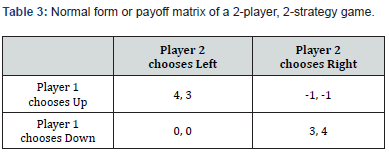
The normal (or strategic form) game is usually represented
by a matrix which shows the players, strategies, and payoffs (see
the example to the right). More generally it can be represented by
any function that associates a payoff for each player with every
possible combination of actions. In the accompanying example
there are two players; one chooses the row and the other chooses
the column. Each player has two strategies, which are specified by
the number of rows and the number of columns. The payoffs are
provided in the interior. The first number is the payoff received by
the row player (Player 1 in our example); the second is the payoff
for the column player (Player 2 in our example). Suppose that
Player 1 plays up and that Player 2 plays Left. Then Player 1 gets a
payoff of 4, and Player 2 gets 3 [70-90] (Table 3).
When a game is presented in normal form, it is presumed that
each player acts simultaneously or, at least, without knowing the
actions of the other. If players have some information about the
choices of other players, the game is usually presented in extensive
form. Every extensive-form game has an equivalent normal-form
game, however, the transformation to normal form may result in
an exponential blowup in the size of the representation, making it
computationally impractical.
Chemical game theory is an alternative model of game theory
that represents and solves problems in strategic interactions or
contested human decision making. Differences with traditional
game theory concepts include the use of metaphorical molecules
called “knowlecules”, which represent choices and decisions
among players in the game. Using knowlecules, entropic choices
and the effects of preexisting biases are taken into consideration.
A game in chemical game theory is then represented in the form
of a process flow diagram consisting of unit operations. The
unit operations represent the decision-making processes of the
players and have similarities to the garbage can model of political
science. A game of N players, N being any integer greater than 1,
is represented by N reactors in parallel. The concentrations that
enter a reactor correspond to the bias that a player enters the
game with. The reactions occurring in the reactors are comparable
to the decision-making process of each player. The concentrations
of the final products represent the likelihood of each outcome
given the preexisting biases and pains for the situation [91-100].
Now that finally enough has been explained about the
theory of games, I want to state the fact in simple words that it is
actually possible to produce chemical compounds using artificial
intelligence and good strategies such as game theory and selection
theory. Easier and faster. The main thing that should be noted is
that with this method, reaching the final answer, especially in the
production of pharmaceutical products, is much simpler, more
accurate, and faster.
To Know more about Recent Advances in Petrochemical Science
Click here: https://juniperpublishers.com/rapsci/index.php
To Know more about our Juniper Publishers
Click here: https://juniperpublishers.com/index.php




