Juniper publishers have been established with the aim of spreading quality scientific information to the research community throughout the universe. We, as Open Access publishers, strive to offer the best in class online science publications. Open Access process eliminates the barriers associated with the older publication models, thus matching up with the rapidity of the twenty-first century. Our main areas of interest lie in the fields of science, engineering and other related areas.
In surveys that rely on self-reported behaviors, under-reporting and over-reporting is common and often extreme. This includes surveys of energy intake, body weight, use of drugs and alcohol, sexual behaviors, and political surveys. In one national study that compared respondents’ answers with actual measurements, nearly 40% of high school students over-reported their heights by 3 inches or more. The major cause of misreporting is social desirability biased responding, which refers to respondents who consciously misreport to make themselves look better. Having respondents answer questions anonymously is only minimally effective in reducing misreporting. Reliable survey tools for assessing social desirability have been available for decades, yet researchers who rely on self-reported behaviors continue to ignore the issue. In recent years, fewer than 5% of survey studies published in sexuality, ethics, and accounting journals had controlled for social desirability biased responding. Public policy can only be as effective as the truthfulness of the data on which it is based. Researchers conducting survey research are urged to include a measure of social desirability bias in their experimental design.
Keywords: Survey Research; Self-reported Behaviors; Misreporting; Social Desirability; Test Validity; Political surveys
The Centers for Disease Control and Prevention (CDC) biennially conducts a survey of U.S. high school students’ risky behaviors titled the Youth Risk Behavior Surveillance (YRBS) [1]. These include self-reported use of alcohol, drugs and tobacco, as well as dietary and sexual behaviors. However, in a study of the validity of their own results, CDC researchers took actual measurements after the survey and found that high school students, on average, over-reported their heights by 2.7 inches, with 39.5% over-reporting by at least 3 inches [2]. Many students under-reported their body weight. The net effect was that for 12.7% of students, body mass index was under-reported by at least 5 kg//m2.
Numerous other studies using the gold standard (actual measurements vs. self-reports) have also found that many people, not just high school students, under-report their energy intake and body weight, often by 30% or more, and over-report their height [3-13]. In one study, up to 14% of people under- reported their energy intake to such an extent they were called “extreme under-reporters” [14]. The under-reporting of energy intake and body weight is so common and often extreme that one group of researchers concluded that self-reports of energy intake are “fundamentally and fatally flawed” [4, p. 911]. Another researcher called these self-reported data “implausible” [15]. The misreporting is only minimally due to bad memory [4]. For example, many adults with obesity also under-report on inventories of high-calorie foods in their homes [16]. Instead, there is “robust evidence of social desirability bias” [6, p. 198].
Social desirability biased responding refers to “the need of [individuals] to obtain approval by responding in a culturally appropriate manner” [17, p. 353]. The higher one’s level of social desirability, the more likely he or she is to over-report desirable behaviors and under-report undesirable behaviors on surveys of personal behaviors. Concerns about social desirability biased responding were first expressed over 90 years ago [18]. The component of social desirability biased responding that is of greatest concern to researchers is called impression management which refers to respondents who consciously under- or overreport to make themselves look better [19]. The degree of misreporting depends on the sensitivity of the issue, mode of data collection and interviewer’s characteristics (e.g., face-to-face interview versus anonymous testing), and wording of questions [20-21].
Several studies have observed statistically significant correlations between degree of under-reporting of energy intake and level of social desirability [22-27]. Under-reporting smoking, use of alcohol and illicit drugs, and adolescent reckless driving is common and are also significantly correlated with social desirability [28-33].
Studies have found that social desirability response bias also affects self-reports about HIV serostatus and risky sexual behaviors (e.g., receptive anal intercourse) [34-36]. Men overreport their use of condoms [37-39] and erect penis size [40] and under-report their engagement in extramarital affairs [41] and these, too, are associated with high social desirability scores [36, 40-41].
An early sexuality study found that respondents’ answers changed when they were told that questions were going to be repeated while taking a polygraph test [42]. In another study, over half of adolescents denied having ever had a sexually transmitted infection, yet hospital records indicated that they had been treated [43]. There is ample evidence of under- or over-reporting for many other sexual behaviors [44]. In health research, qualitative studies are “very susceptible” to social desirability biased responding [45]. Deliberate misreporting is also common in the behavioral sciences (unrelated to health). For example, in the field of political science, self-reported voter turnout in national elections has far exceeded actual turnout for decades [46-48]. Educated people who express an interest in politics are the most likely to over-report. The over-reporting of voter turnout is attributed to socially desirable responding [49]. In the 2016 presidential election, people who were more likely to comply with social science norms were less likely to show support for Trump in preelection polls, yet many obviously voted for him [50].
On ballot measures regarding same-sex marriage, opposition on election day is 5% to 7% greater than is found in preelection polls [51].
Social desirability bias also affects expressed racial attitudes in political surveys [52] and attitudes about restrictive immigration [53]. Social desirability biased responding is found in many cultures. For example, in low-income African countries, men are more likely to oppose women’s political rights when they are interviewed by a man [54]. In another African study, people gave different answers depending on whether the interviewer was from the same ethnic group [55]. Among non-pregnant Indian women, self-reported use of smokeless tobacco was found to be 20.6% lower when interviews were done while their husband was present [56].
In summary, conscious misreporting for self-reported behaviors is common and frequently extreme. In a review of anthropology studies, respondent misreporting was called “a well-kept open secret” [57, p. 504].
Researchers who conduct surveys have long assumed that if respondents are allowed to answer questions anonymously, they will answer honestly. However, studies have shown that answering questions anonymously only minimally reduces social desirability biased responding [58]. The CDC’s YRBS has respondents answer questions anonymously yet recall that 39.5% of high-school students over-reported their height by at least 3 inches [2]. How likely is it that these same individuals were truthful when answering sensitive questions about their use of drugs and alcohol, and their experiences with risky sexual behaviors? Today, un-proctored computer-assisted self-administered techniques have replaced the standard paper-and-pencil survey, but a metaanalysis of these studies found that they are no better at reducing social desirability biased responding [59].
There are some excellent scales to measure social desirability bias. The most widely used is the Marlowe-Crowne scale, a 33- item scale that can be used in all fields of research [17]. For brevity, a 13-item short form is available [60]. There is also a 20-item scale developed specifically to measure impression management, the Balanced Inventory of Desirable Responding [61], but recent research shows that the Marlowe-Crowne Scale may still be superior [62]. It is not the intent of this paper to assess which technique is better, but instead to acknowledge that several techniques are available to researchers to assess social desirability bias.
Regardless of which measurement tool is used, logistic regression can be used to adjust raw scores [63]. In brief, the researcher measures “socially desirable response tendency [e.g., using the Marlowe-Crowne Scale] alongside a measure of interest and then adjusts raw scores on that measure by an amount commensurate with the degree of socially desirable responding” [34, p. 97].
The CDC says that “educators, parents, local decision makers…...use YRBSS data to…...develop local and state policy” [64, p. 1]. However, policy can only be as effective as the truthfulness of the data on which it is based. While the CDC makes a great effort to obtain a nationally representative sample, it gives only passing mention to its previous findings of extreme under- and over-reporting (“the extent….cannot be determined,” p. 11). The CDC’s research group knows their respondents’ answers are often untruthful but continues to present them as fact
The YRBS is just one example of large nationally representative surveys that ask sensitive questions but include no measure of social desirability bias. Others include the National Health andNutrition Examination Survey, National Survey of Family Growth, and National Survey of Sexual Health and Behavior.
Tests for social desirability bias are equally applicable to smaller studies using convenience samples, but these authors have also generally ignored the possibility of respondents underand/ or over-reporting. In a recent study, it was found that fewer than 5% of survey studies in accounting-and-ethics research had controlled for social desirability biased responding [65]. Surveys used by sexuality researchers almost always include personal and sensitive items for which answers cannot be authenticated by the gold standard. An examination by this author of survey studies (excluding interviews) published in The Journal of Sex Research for the three-year period 2022 through 2024 revealed that only 3.6% of studies employed a measure of social desirability responding or authentication of self-reported behaviors. Similarly, an examination of papers published in the same three-year period in American Journal of Sexuality Education and Sex Education, journals that publish studies of the effects of teaching sexuality education on behaviors, attitudes and opinions, revealed that none of 46 papers using surveys included a measure of social desirability responding.
After decades of warnings about social desirability biased responding on surveys [17-18, 20-21, 44, 57] and the development of several methods to assess such bias [17, 60-61], there appears to be little concern by researchers using surveys about the truthfulness of their respondents’ answers. Left to themselves, researchers continue to present self-reported behaviors as factual data. If change is to occur, editors of journals must begin to urge that researchers using surveys of self-reported behaviors include a measurement of social desirability biased responding in their experimental design.
Taiwan’s abundant geothermal resources and extensive hot springs have cemented its reputation as a top destination for enthusiasts. Since 1999, the Taiwan Tourism Bureau has fervently promoted the nation’s hot spring assets, aiming to cultivate immersive travel experiences. This study employed a comprehensive approach, integrating Focus Group Interviews, the Delphi method, and the Analytical Hierarchy Process (AHP) to explore expert perspectives on the driving forces behind hot spring district development in Taiwan. Research, from Focus Group Interviews in Tainan to Delphi method outcomes, enabled a structured evaluation of key factors across various hot spring districts nationwide. The AHP results revealed the relative weights and rankings of dimensions, highlighting “Environmental Attributes” as the most critical. Six key factors essential for promoting hot spring districts emerged: “Excellent Quality of Hot Spring Water,” “Beautiful Landscape,” “Good Sanitary Environment,” “Rich Eco-resources,” “Well-planned Hot Spring Wellness Services,” and “Relaxing Natural Environment.” By integrating research findings from Focus Group Interviews, the Delphi method, and the AHP, this study effectively aligned development efforts with sustainable objectives, aiding evidence-based policy formulation. The findings underscored the importance of prioritizing key factors and implementing sustainable practices, contributing to Taiwan’s tourism landscape enrichment.
Keywords: Analytical Hierarchy Process; Delphi Method; Focus Group Interviews; Hot Spring Districts; Wellness Tourism
Abbreviations: LOHAS: Lifestyle of Health and Sustainability; AHP: Analytic Hierarchy Process; OIR: Overall Inconsistency Ratio; CI: Consistency Index; DW: Dimensions Weight; R: Rankings
Health, encompassing physical, psychological, and social well-being, is recognized across contemporary domains [1,2]. In the Asia Pacific Region, health tourism is gaining popularity [3], driven by historical, cultural, and therapeutic appeal, especially evident in hot springs [1]. Post-COVID-19, hot springs have become increasingly sought after by tourists seeking personal wellness and harmony with nature [4]. While locals cherish hot springs for relaxation and reconnecting with nature, visitors often stay briefly due to work commitments, indicating a gap in recognizing their therapeutic benefits amidst busy schedules.
Nestled at the convergence of the Eurasian and Philippine Sea plates, Taiwan boasts abundant geothermal resources and extensive hot springs [5-7]. Despite the allure of Taiwan’s hot spring districts, a recent study explored the experiences of Taiwanese high-tech and banking professionals, highlighting issues of occupational stress [8]. These individuals struggle to prioritize stress relief or plan leisurely trips due to demanding work schedules, often visiting hot spring districts for fleeting respites rather than dedicated wellness retreats. Recognizing the health impacts of work-related stress, implementing Lifestyle of Health and Sustainability (LOHAS) programs in Taiwan’s hot spring locales, including hiking and hydrotherapy, can positively impact meridian energy levels, offering rejuvenation [9]. Alternatively, for those unable to engage in health tourism, recent proposals advocate for footbath models to manage occupational stress at home [10,11]. Nonetheless, while these alternatives contribute to health maintenance and stress alleviation, they cannot fully replicate the comprehensive benefits of immersive hot spring experiences [2].
Recognizing this trend, the Taiwan Tourism Bureau has actively promoted in-depth hot spring travel since 1999, aiming to integrate hot spring tourism with health treatment activities. Additionally, in 2003, Taiwan implemented the Hot Springs Act, igniting rapid growth in hot spring districts, making them a pivotal investment sector in Taiwanese tourism. However, most of Taiwan’s hot springs originate from high mountain districts [12], presenting challenges for their transformation into hot spring districts. As of April 2024, Taiwan’s official statistics reveal the presence of 25 approved hot spring districts, encompassing 434 legally designated hot spring operators across various types of accommodations, including resorts, hotels, and villas [13]. Notably, Tainan city stands out with 2 hot spring districts and a total of 36 hot spring operators. This has prompted academic research to focus on this subject, but unfortunately, most of these studies merely symbolize tourists’ willingness to revisit without engaging policymakers, overlooking the intrinsic value of hot springs.
Lin suggests that Taiwan’s hot springs are evolving into distinct travel destinations, emphasizing the necessity of shaping uniqueness [14]. However, branding tourist destinations typically involves a wide array of stakeholders, including local residents, tourists, and industry operators [15]. Zenker & Petersen argue that local residents often develop strong attachments to places [16], and the visibility of places can enhance tourists’ attachment [17]. Achieving a delicately balanced social consensus that accommodates the commercial interests of local tourism operators while preserving the community’s sense of place is a challenge [18-20], especially when considering the sustainable development vision of the hot spring districts brand. Lee emphasizes three indicators influencing the attractiveness of hot spring destinations: core attractions, infrastructure, and safety standards [21,22].
Lee & King stress that resources, strategies, and environmental goals directly impact the competitiveness of Taiwan’s hot spring districts. They emphasize prioritizing safety measures, especially in hot spring bathing environments. Despite this, indicators for hot spring destination branding and policy concerns have been largely neglected. Challenges persist in Taiwan’s hot spring districts, especially as tourist numbers increase and industry standardization becomes more apparent. Ensuring sustainable utilization of hot spring resources and fostering distinct regional branding pose significant policy challenges for Taiwan [22].
In summary, the research emphasizes Taiwan’s focus on health and quality of life [14,23], highlighting the need for the government and tourism industry to identify key factors in developing Taiwan’s hot spring districts into wellness destinations. Using the Analytic Hierarchy Process (AHP) to gather expert insights on hot spring district development can offer valuable post-COVID-19 insights into wellness tourism.
In essence, the primary aim of employing Focus Group Interviews in this study is threefold: to probe themes with insufficient information, elicit stakeholders’ perspectives on the development of the hot spring districts, and mitigate potential biases arising from researchers’ experiential judgment and strategic considerations, thereby ensuring alignment with key policy strategy aspects. After reviewing related literature [3-5,21,22,24-27] and conducting several discussions among researchers, four issues and 39 criteria were proposed. Among these, three issues—Environmental Attribute, Supporting Facilities, and Health Facilities_were deemed relevant to the development of wellness tourism by Dunn and were thus incorporated into this study [28]. The fourth issue, Marketing and Promotion, was added due to the significant role of marketing activities in raising awareness among target customers.
The Focus Group Interview method engages 6 to 12 participants simultaneously in open and interactive discussions, allowing for a comprehensive exploration of research topics within a condensed timeframe. Renowned for its capacity to yield authentic and in-depth insights, this method is particularly well-suited for exploratory research [29-31]. At the heart of these discussions are the fundamental issues identified in the literature review as pivotal to the development of hot spring districts. These discussions take place in the Tainan government meeting room, moderated by representatives from Tainan’s tourism department.
Participants in these discussions represent key stakeholders in Tainan’s hot spring district policy, including government officials, scholars, members of local associations, and operators of hot spring resorts. Their selection follows a purposive sampling method aimed at ensuring diverse perspectives. Through faceto- face interactions, participants engage deeply with the topics, fostering commitment to decision-making on strategy factors and minimizing biases.
Throughout the sessions, meticulous real-time documentation captures the essence of the discussions, providing a solid foundation for subsequent analysis. Experts then scrutinize the feedback received, refining the identified indicators. Finally, the moderator synthesizes the consensus reached in the focus group discussions into 25 decision-making indicators.
Delphi Method Delphi expert questionnaire Survey
The consensus conclusions drawn from Focus Group Interviews provide the framework for structuring the Delphi expert questionnaire [23,32]. This process unfolds through distinct review rounds:
First Round: Experts assess the results of 25 decision-making indicators identified in the Focus Group Interviews, offering feedback on each item. They have the option to “retain,” “delete,” “merge,” “modify,” “add supplementary,” or “classify into policy directions.”
Second Round: Experts further refine and validate the strategy factors, integrating them into appropriate key factors.
The primary objective of employing the Delphi method in this study is to provide key factors for the Analytic Hierarchy Process (AHP). Recognizing the importance of streamlining the AHP implementation process, it is crucial to limit the number of hierarchical factors to ensure experts’ willingness and efficiency in completing the questionnaire.
Delphi Method Expert Selection
For the Delphi expert selection, following the guidelines proposed by Murry and Hammons (2005), the researcher establishes criteria for expert selection using purposive sampling, as detailed in Table 1. Experts are invited from across Taiwan, provided they have current involvement in hot spring affairs. This includes individuals such as hot spring academic researchers, hot spring industry managers, and hot spring policy managers, each boasting a minimum of 6 years of experience in hot spring research or management. A total of 12 experts are invited to participate in the Delphi method.
Analytic Hierarchy Process AHP Expert Questionnaire Survey
The AHP model is utilized to evaluate the weights of the key factors in this study [33,34]. Based on the consensus conclusions reached through the second round of the Delphi method, the researcher formulated dimensions to identify suitable key factors for the AHP expert questionnaire. The AHP assessment scale comprises five levels of importance, ranging from “equally important” (1) to “extremely important” (9), with intermediate values for nuanced evaluation. Experts assessed the relative importance of dimensions and key factors accordingly. The process involves the following steps: i. Selection of evaluation dimensions and key factors for constructing the AHP expert questionnaire. ii. Construction of the hierarchical structure of the evaluation model. iii. Establishment of pairwise comparison matrices for all dimensions and key factors. iv. Conducting consistency testing and calculating the weights of all dimensions and key factors using Expert Choice 5.0 software. v. Determination of the final aggregation appropriateness ratings and prioritization of all dimensions and key factors.
AHP Expert Selection
The criteria for AHP expert selection align with those of the Delphi method. The initial list comprises experts from the Delphi method, supplemented by additional experts based on predefined criteria. This comparative approach aims to assess variances between experts who participated in the Delphi method and those who did not during the AHP survey. A total of 18 experts participate, in the AHP, including 7 academic professors, 2 government tourism department chiefs, and 7 hot spring resort managers.
Data Collection and Processing Delphi Method Data Analysis
Upon collecting valid questionnaires from the second round of the Delphi method, the researcher proceeded with coding and data input. Statistical analysis was conducted using SPSS 18.0 and Excel 2013 software, calculating various key factors to gauge consensus and divergence among expert opinions.
Analytic Hierarchy Process Data Analysis
Expert Choice 11.5 software facilitated the analysis, being designed upon the theoretical framework of the AHP [35]. The tool, developed by one of the founders of the AHP theory, Saaty, aimed to streamline calculations and reduce redundancy. It utilized the inconsistency ratio (I.R.) as a measure of agreement, with an overall inconsistency ratio (O.I.R.) ≤ 0.1 deemed acceptable [21,34].
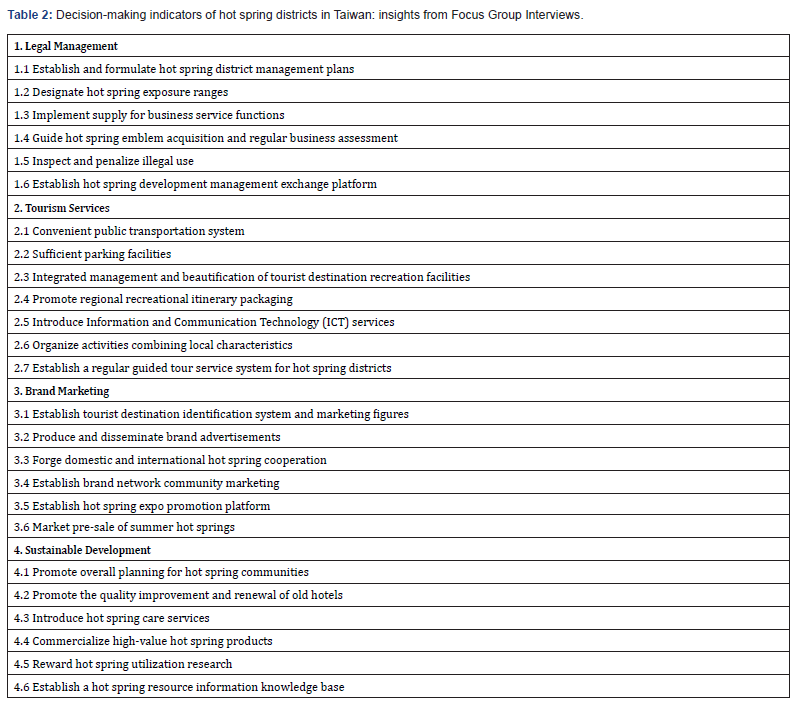
After direct oversight by the chief of Tainan’s tourism department, Focus Group Interviews were conducted, guided by researchers who supported four issues and 39 criteria. These discussions involved 8 participants from various sectors within the hot spring industry, ensuring a comprehensive range of opinions. Subsequently, the researcher reorganized and summarized the decision-making indicators related to hot spring districts. The results, presented in Table 2, were distilled from the Focus Group Interviews. Finally, the moderator synthesized the consensus drawn from the Focus Group Interviews into 25 decision-making indicators, which were further categorized into four dimensions: Legal Management (6 indicators), Tourism Services (7 indicators), Brand Marketing (6 indicators), and Sustainable Development (6 indicators).
Delphi Questionnaire Survey
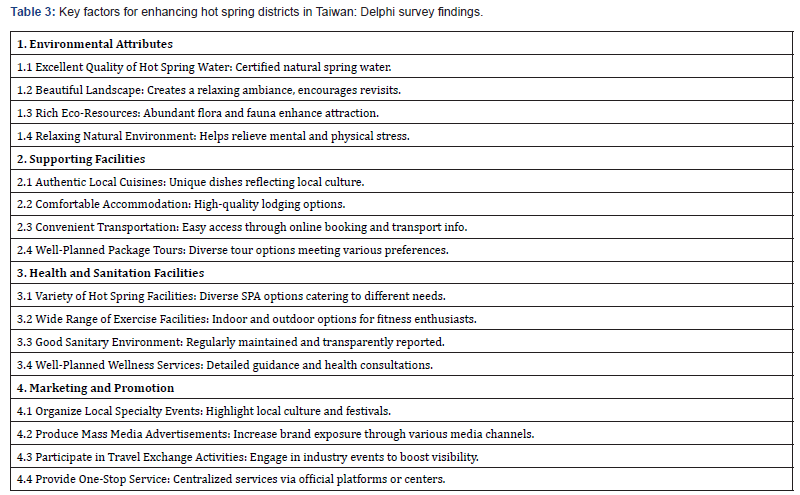
The results from the Focus Group Interviews, comprising four dimensions and 25 indicators, guided the structuring of the Delphi questionnaire. Twelve experts participated in the Delphi process, refining decision-making indicators based on valid responses in the second round and integrating them into key factors across the four dimensions. The questionnaire was then adjusted, condensing the initial 25 indicators from the Focus Group Interviews into 16 key factors distributed among the dimensions: Environmental Attributes, Supporting Facilities, Health and Sanitation Facilities, and Marketing and Promotion, with each dimension comprising four key factors. These results, essential for AHP, are summarized in Table 3.
Comparison between the results in Table 2 and Table 3 highlights a significant evolution. Initially, the Focus Group Interview results delineated four dimensions: Legal Management (6 indicators), Tourism Services (7 indicators), Brand Marketing (6 indicators), and Sustainable Development (6 indicators). However, Delphi experts refined these dimensions, also adjusting their terminology to better suit the context of hot spring districts in Taiwan. For instance, “Sustainable Development” was redefined as “Environmental Attributes” unanimously by Delphi experts. “Tourism Services” and “Brand Marketing” were amalgamated into “Supporting Facilities” and “Marketing and Promotion,” respectively. “Legal Management” was omitted as all legal considerations were deemed integral across all dimensions.
Additionally, Delphi experts introduced a new dimension called “Health and Sanitation Facilities,” which involved reclassifying the 25 decision-making indicators from the Focus Group Interviews. Consequently, 16 key factors were refined and incorporated into the revised dimensions by Delphi experts. This adjustment process, under the guidance of Delphi experts, sought to pinpoint crucial and pertinent key factors for the advancement of hot springs in Taiwan. While Focus Group Interviews enable thorough discussions among stakeholders, the Delphi questionnaire offered a structured platform for experts to evaluate the relevance of each key factor, providing a broader perspective that encompasses hot spring districts nationwide.
In the pursuit of evidence-based policymaking, challenges such as competing stakeholder demands, difficulty in official problem recognition, and ineffective government actions are encountered [36,37]. Rip suggests that an open-closed approach can resolve this dilemma [38]. This study utilized outcomes from Focus Group Interviews followed by a Delphi questionnaire survey to effectively gather stakeholder opinions. Cairney and Head argue that evidence-based practice offers effective solutions by enabling policy managers to critically evaluate evidence’s validity, generalizability, and applicability, alongside identifying the best available evidence [39,40]. Through the Delphi questionnaire survey, issues were oriented towards sustainable development objectives and better aligned with policy decisions, marking a crucial step in exploring “evidence-based policy formulation.”
AHP Expert Questionnaire Survey
Following the questionnaire design phase, a group of 18 experts actively engaged in the hot spring industry was invited to participate in the survey. This cohort comprised 9 managers from travel agent companies and hot spring resorts, 2 government officials, and 7 academic scholars, each with over a decade of experience in the hot spring field. Upon the return of the questionnaires, meticulous scrutiny ensued to ensure the consistency index (C.I.) of each matrix within every layer was less than or equal to 0.1 [21]. Subsequently, 8 questionnaires with any C.I. value exceeding 0.1 were removed to mitigate potential errors, resulting in a response rate of 55.56%. Following the consistency testing, the remaining 10 questionnaires underwent analysis to determine the relative weights of evaluation criteria at each level, thereby facilitating the assessment of the importance of each dimension and criterion.
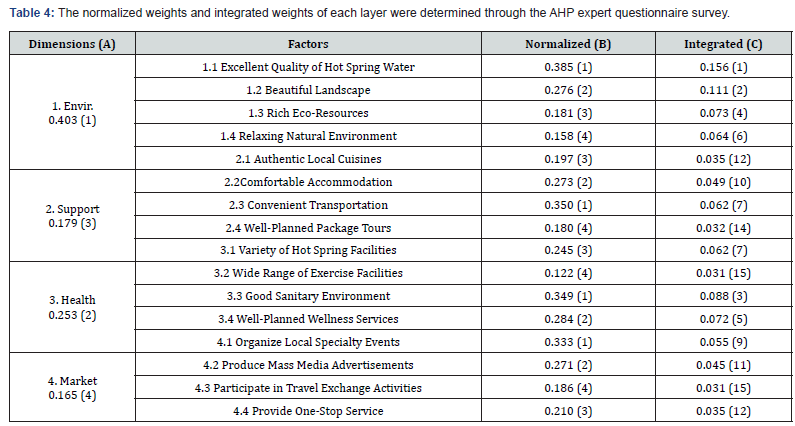
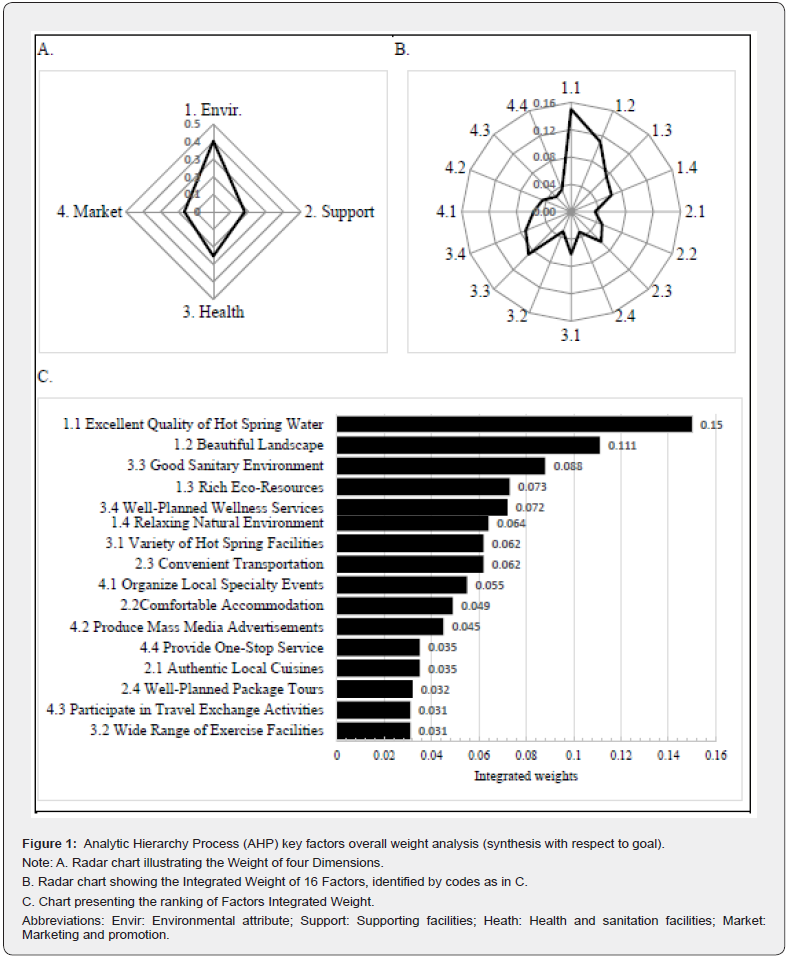
The AHP provides a systematic framework for evaluating complex decision-making scenarios, offering valuable insights into the relative importance of various factors influencing the development of hot spring districts in Taiwan. The AHP results, delineated in Table 4 and Figure 1, unveil the relative weights (Dimensions Weight, DW) and rankings (R) at the dimension analysis level: “Environmental Attribute (DW=0.403, R1),” “Health and Sanitation Facilities (DW=0.253, R2),” “Supporting Facilities (DW=0.179, R3),” and “Marketing and Promotion (DW=0.165, R4).” These rankings underscore the pivotal role of environmental attributes and health and sanitation facilities in shaping visitors’ experiences at hot spring districts, emphasizing their significance in meeting the fundamental needs of relaxation and rejuvenation sought by visitors.
Note: Numbers in parentheses are ranks. (A) = Dimensions Weight; (B) = Normalized Weight; (C) = Integrated Weight = (A)*(B). Abbreviations: Envir: Environmental attribute; Support: Supporting facilities; Heath: Health and sanitation facilities ; Market: Marketing and promotion.
Referring to industry standards [26], the researcher pinpointed 6 key factors essential for boosting hot spring districts in Taiwan: “Excellent Quality of Hot Spring Water (IW=0.15, R1),” “Beautiful Landscape (IW=0.111, R2),” “Good Sanitary Environment (IW=0.088, R3),” “Rich Eco-resources (IW=0.073, R4),” “Well-planned Hot Spring Wellness Service (IW=0.072, R5),” and “Relaxing Natural Environment (IW=0.064, R6).” Notably, industry experts stressed the significance of nature-related aspects in attracting customers. Conversely, factors like “Wide Range of Exercise Facilities (IW=0.0031, R16),” “Participation in Travel Exchange Activities (IW=0.031, R15),” and “Well-planned Package Tours (IW=0.032, R14)” received lower rankings, indicating their perceived lesser importance in driving visitor satisfaction and destination attractiveness.
These results align with recent research emphasizing the importance of sustainability-related attributes in post-COVID-19 hot spring tourism, with recommendations focusing on enhancing destination sustainability to maintain market competitiveness [4]. Similarly, the growing trend of health tourism, driven by increasing emphasis on quality of life and demographic shifts towards an aging population, has positioned hot spring resorts as sought-after destinations for holistic wellness experiences. For example, studies examining health tourism products for domestic tourists in Korea have provided valuable insights for industry practitioners seeking to capitalize on this burgeoning market segment [41].
Among these key factors, the outstanding quality of natural hot spring water emerges as the most critical criterion for the success of hot spring districts. The act of immersing oneself in hot spring water to relieve physical fatigue and rejuvenate constitutes the primary motivation for visitors. Various types of spring water, including sulfide-rich, carbonate-rich, and highmineral spring water, each boasting unique therapeutic effects, can cater to diverse consumer segments with different needs. Therefore, by highlighting the excellent quality and distinctive healing properties of their hot spring water, resort operators can distinguish and elevate the image of their resorts.
Moreover, key factors such as beautiful landscapes, rich ecoresources, good sanitary conditions, and a serene environment complement the relaxation experience, further underscoring the significance of nature- related amenities. Therefore, it is imperative for resort operators to prioritize sourcing high-quality hot spring water and maintaining picturesque natural surroundings, ensuring sustainable management of the hot spring source and water quality to create a natural sanctuary for customers.
This study utilized a combination of Focus Group Interviews, the Delphi method, and Analytic Hierarchy Process (AHP) to explore the perspectives of hot spring experts on the key factors shaping hot spring districts in Taiwan. The findings underscored the significance of six key factors-specifically, “Excellent Quality of Hot Spring Water,” “Beautiful Landscape,” “Good Sanitary Environment,” “Rich Eco- resources,” “Well-planned Hot Spring Wellness Service,” and “Relaxing Natural Environment”-all intricately tied to the natural surroundings. It emphasizes the pivotal role of a pristine and serene natural environment, alongside robust sanitary conditions, in the success of hot spring districts. The integration of research insights from Focus Group Interviews, the Delphi method, and AHP facilitated the alignment of development initiatives with sustainable goals, aiding evidence-based policy formulation. Moreover, insights from experts participating in the Delphi and AHP processes revealed that hot spring resorts with high-quality hot spring water and scenic surroundings gain a competitive edge in meeting customers’ fundamental needs for mental and physical relaxation. Considering these findings, we advocate for resort operators to preserve their natural surroundings while enhancing wellness services to ensure sustainable development. These results not only enhance the appeal of hot spring districts but also reinforce the long- term viability of hot spring resorts in Taiwan.
Generally, osteoarthritis (OA) is considered to be a common degenerative joint disorder characterized by destruction of the articular cartilage, subchondral bone alterations and low-grade joint synovitis. Aging population and obesity are increasingly being associated with a concomitant increase in the incidence of OA and disability worldwide causing significant burden on the individual and society. The understanding of OA has evolved over years from a degenerative (wear and tear) non-inflammatory disease to a disease of joints that results from many predisposing factors including: aging, genetics, excessive exercise, obesity, genetic predisposition, inflammatory autoimmune disorders, poor nutrition, injury, metabolic disorders such diabetes mellitus, homocysteinaemia, joint trauma, hormonal imbalance, altered biomechanics, obesity and infection. All these factors contribute to an imbalance between catabolism and anabolism of joint cartilage leading to eventual joint damage and structural joint failure. This review focuses on the pathophysiological basis of OA highlighting the potential of specific targeted treatments.
Keywords: Osteoarthritis; Pathophysiology; OA treatment; Cytokines; Inflammation; Targeted therapy
Osteoarthritis (OA) is one of the most common non-inflammatory rheumatic and musculoskeletal disease {RMD}associated with progressive cartilage destruction which leads to structural and functional joint failure. Aging and other concomitant diseases such as diabetes mellitus are associated with significant increased risk of developing OA. The understanding of OA has evolved over years from that of a degenerative (wear and tear) non-inflammatory disorder to a disease of joints that results from many predisposing factors that include inter alia: aging, genetic predisposition, excessive exercise, obesity, genetic predisposition, hormonal imbalance, inflammatory autoimmune disorders, poor nutrition, injury, metabolic disorders such diabetes mellitus, homocysteinaemia, joint trauma, altered biomechanics, obesity and infection [1-3].
Despite OA being the most common joint disease, there is still is no definitive or preventive treatment other than symptomatic treatment. As the aging population increases globally, OA poses a significant financial and social burden. This highlights the need to develop disease modifying osteoarthritic drugs (DMOADs) [2]. A full understanding of the pathophysiologic and inflammatory pathways that initiate the onset and progression of OA will facilitate the development of targeted therapies [2,3]. Early diagnosis as well as understanding the risk factors and development of biomarkers of OA will aid early therapeutic intervention. The pathophysiologic mechanisms involved in OA are complex and multiple, and lead to the development of a state of chronic inflammation resulting in propagation and progression toward the phenotype of clinical OA [3]. Current studies have shown that inflammatory cytokines produced also by chondrocytes, induce chondrocytes to release metalloproteinases that degrade cartilage [4]. This review will focus on the pathophysiological basis of OA highlighting the potential of targeted treatments and need to continue to design such strategies.
Chondrocytes produce articular cartilage. Cartilage is comprised of extracellular collagen matrix and various proteoglycans. Cartilage is metabolically active and is constantly renewed throughout life [1-5]. The elasticity and compressibility of cartilage is due to the proteoglycan Aggrecan. Aggrecan is a central core protein comprising of numerous glycosaminoglycan chains of chondroitin sulphate and keratan sulphate moiety which are attached to hyaluronic acid [5]. The collagen functional and metabolic network is disrupted with ageing leading to fissuring and increased levels of advanced glycation end products (AGE). AGE binds specific advanced glycation end products (RAGE) receptors found on the surface of chondrocytes. This binding perturbates the catabolic activity in chondrocytes [6]. AGEs can also induce oxidative stress in cells triggering the secretion of many pro-inflammatory cytokines and chemokines.
A variety of cellular factors involved in the pathogenesis of OA are inter alia: mononuclear cells, chondrocytes, osteoblasts and osteocytes, and synovial lining cells [1-19]. A variety of soluble mediators such as: proinflammatory cytokines {tumour necrosis factor α (TNFα), interleukin 1β (IL-1 β), interleukin 6 (IL-6)}, transforming growth factor β (TGF β), metalloproteinases (MMPs), lipid mediators [Prostaglandin E2 (PGE2)], nitric oxide (NO), insulin-like growth factor1 (IGF-1), adipokines (leptin, adiponectin, resistin) and neuropeptides [neuropeptide Y, vasoactive intestinal peptide (VIP), substance P, and calcitonin gene related peptide (CGRP)] are also involved in the disease pathophysiology [2,7,8]. Neuropeptides induce pain in OA via afferent sensory nerve nociceptors which signal to the brain the via the spinal and spinothalamic tracts [9]. Nociceptors are found on several structures of the osteoarthritic joint such as the synovium, periosteum, subchondral bone and ligaments [7,8].
Chondrocytes express estrogen receptors which can mediate the production of growth factors [7]. The synthesis of these growth factors is decreased in menopausal women due to a reduction in estrogens [7]. One of the risk factors for OA in weight-bearing joints and also for non-weight-bearing joints such as hands is obesity. Adiposity contributes to a proinflammatory milieu since adipose tissue secretes many inflammatory mediators such as adipokines and leptin [10,13]. Leptin is also found in osteophytes and cartilage from patients with OA and its levels in synovial fluid correlate with body mass index (BMI). Leptin is pro-inflammatory and stimulates the synthesis of IGF-1 and TGFβ, and proteoglycans by chondrocytes [11,12]. Leptin enhances the capacity of pro-inflammatory cytokines to induce NO synthesis [12,24]. Visfatin is one of the adipokines which has been shown to enhance cartilage degradation [13]. Adiponectin levels are low in obese patients and are also negatively associated with hand OA progression [14].
Pro-inflammatory cytokines can activate chondrocytes, synovial cells and osteoblasts. OA Chondrocytes from OA patients can secrete a number of metalloproteinase enzymes such as MMP-1 (collagenase 1), MMP-3, MMP-9, MMP-13 (collagenase 3), aggrecanase, ADAMTS-4 and ADAMTS-5, that all degrade cartillage. Specific endogenous metalloproteinase tissue inhibitors (TIMPs) {TIMP1, TIMP2, TIMP3 and TIMP4} are also produced and inhibit MMPs activity. is determined by The MMPs and TIMPs balance ratio, determines the rate of cartilage matrix degradation in joints. Collagenase 1 and 3, and MMP-13 (collagenase 3) can cleave type II collagen [5]. Cartilage degradation can also be induced by Stromelysin-1 (MMP-3), Stromelysin-2 (MMP-10), Stromelysin-3 (MMP-11) [15]. Matrisylin (MMP-7) also plays a role in the degradation of proteoglycans [16]. IL-1β differential regulates MMPs and TIMP syntheses suggesting that the low the grade IL-1β production in joints may promote cartilage degradation by relative upregulation of MMPs versus TIMP, thereby creating an unfavorable balance between the level of the degrading enzymes and their inhibitors [17].
Abnormal mechanical forces and oxidative stress can stimulate chondrocytes, synovial cells and subchondral osteoblasts to produce proinflammatory cytokines {IL-1β, TNF-α} [18]. These cytokines can initiate a variety of catabolic and degradative processes in cartilage mediated by metalloproteinases that degrade cartilage extra-cellular matrix (ECM) [2,19]. The expression of ADAMTS-4 and ADAMTS-5 and enhanced production PGE2 can be induced by IL-1β and TNF-α via enhanced of the gene expression and/or activities of COX-2, microsomal PGE synthetase-1 (mPGES-1), and soluble phospholipase A2 (sPLA2). IL-1β and TNF-α can also stimulate nitric oxide synthetase (iNOS or NOS2) to upregulate NO production and stimulate other production of other proinflammatory cytokines such as IL-6, LIF (leucocyte inhibiting factor), IL-17 and IL-18, chemokines and IL-8. Serum levels of IL-6 and IL-8 are significantly higher OA patients when compared to healthy subjects. The genes associated with the differentiated chondrocyte phenotype, including aggrecan (AGAN) and type II collagen (COL2A1) are suppressed by IL-1β and TNF-α [5]. The inhibition of IL- 1β involves upregulation of: IL-1 Receptor antagonist (IL-1Ra), soluble form of IL-1R, and anti-inflammatory cytokines [2,20]. On the other hand, the anti-inflammatory cytokines IL1Ra, IL-4, IL-10, IL-13 and interferon gamma (IFNϒ) are also present in the OA joint. They inhibit the secretion of some MMPs and may differentially increase the synthesis of TIMPs [21]. Defective production of these anti-inflammatory factors could contribute to OA pathogenesis.
IL-1β and TNF-α, and lipopolysaccharides {produced by bacterial infections}, can upregulate iNOS gene expression and induces NO production. In chondrocytes. NO is involved in the degradation of cartilage by down-regulating the synthesis of IL-1Ra, aggrecan and collagen, enhancing MMPs activity. NO may contribute to chondrocyte apoptotic cell death by downregulating cell survival signals from the ECM [22,23]. In experimental animal models of OA, inhibitors of NO synthesis retard the development of histological changes and clinical features of experimental OA [24]. The eicosanoid pathway is also involved in chondrocyte activation [25,26]. Pro-inflammatory cytokines induce Prostaglandin E2 (PGE2), via the PLA2 pathway, cyclo-oxygenase 2 (COX2) and mPGES1. The activity of synovial cells, macrophages, chondrocytes is modulated by PGE2, which also induces bone resorption [27]. PGE2 induces several MMPs and can potentiate the action of other inflammatory mediators.
A loss of chondrocyte maturational arrest which pushes chondrocytes towards a more differentiated, hypertrophic-like state, has been observed in cartilage from OA patients. This chondrocyte hypertrophy increases the expression of type X collagen, upregulation of matrix metalloproteinases-13 and induces the synthesis of type II collagen and aggrecan, (MMP-13), synthesis of shorter proteoglycans and initiation of pathological calcification [27]. Chondrocytes can also interestingly, acquire a de-differentiated phenotype associated with increased types I and III collagen synthesis whilst type II collagen synthesis is inhibited [27]. Chondrocytes also acquire an activated phenotype corresponding to a pro-degradative state producing several proteinases induced prostaglandins), free radicals (NO, H2O2) and cytokines. These mediators perpetuate chondrocyte activation creating a vicious loop for cartilage degradation. NO induces NF-κB signaling that enhances pro-inflammatory cytokine production in the joint. NO also induces apoptotic chondrocyte cell death which further could decreases the synthesis of ECM components [21].
Cartilage breakdown products also enhance synovial inflammation which enhances catabolic and pro-inflammatory processes leading to excessive production of metalloproteinases that also break cartilage matrix establishing a positive feedback loop. The synovial tissue from OA joints is infiltrated with macrophages and T cells associated with enhanced inflammatory cytokine expression in both early and late OA. Another important feature of OA pathophysiology is also the presence of sclerosis, osteophytes, bone cysts and bone marrow lesions (BMLs) and subchondral bone remodeling [28]. BMLs can occur at the onset of the disease and are now considered to be a precursor for OA development as well [29,30]. Osteoarthritis subchondral osteoblasts can stimulate overproduction of IL-6, IL-8, C-terminal type I procollagen propeptide, alkaline phosphate, osteocalcin, TGF β1, IGF-1, urokinase, and osteopontin [28-31]. These osteoblasts in the affected joints, fail to respond to the bioactivity of parathyroid hormone, which might explain the dysregulated bone remodeling and osteophyte development [28].
Stimulation of trans-membrane G protein–coupled receptors by a variety of stimuli such as cytokines, hormones, neurotransmitters inter alia, initiates intracellular signaling by recruitment of by recruiting of the G protein-coupled receptor kinase 2 (GRK2). Perturbations of the GRK2 molecular pathway may also be involved in OA pathophysiology. GRK2 is involved in myocardial cell hypertrophy. Its expression has also been found to be increase in the chondrocytes from mouse models of OA and injured human cartilage and may also be involved in chondrocyte hypertrophy [31]. It has been observed that gene deletion of GRK2 in mice decreased experimental OA development [32]. This suggests a potential important role of GRK2 in OA pathophysiology. Finally, subchondral bone is involved in the pathogenesis of OA. Firstly, mechanical stress induce osteoblasts to produce the degradative MMP-1, MMP-13, PGE2 and IL-6. Secondly, enhanced expression of IGF-1 and TGF β in subchondral bone initiates new bone formation and development of osteophytes and subchondral sclerosis.
In conclusion, OA) is now considered to be a slow progressive inflammatory disease characterized by low grade inflammation, degradation of articular cartilage and joint function failure and pain. The balance between catabolic and anabolic mediators and their regulators is dysregulated. In addition, cartilage, the pathophysiologic processes also involve the entire joint, with active participation by subchondral bone, ligaments, capsule, synovial membrane and periarticular muscles. The understanding of the molecular and cellular pathophysiology of the disease is opening up novel therapeutic options using existing treatment modalities and potential to design and develop new ones.
The classical mode for the management of OA has been control of symptoms with a variety of symptom modifying OA drugs (SMOAD). The understanding of the pathophysiology of OA has given hope to the potential of disease modifying OA drugs (DMOAD) that are expected to modify the underlying OA pathophysiology, thereby inhibiting structural damage to prevent and/or reduce the development of mechanical joint failure and associated disability, and provide symptomatic relief of pain as well as mitigate the need for surgery. A number of targets have been identified for target therapy approaches:
Targeting Inflammatory sites
a. IL-1 inhibition
i. Anakinra
ii. Canakinumab
iii. Gevokizumab
iv. Lutikizumab
Targeting Bone Marrow Lesions
a. Bisphosphonates
b. Strontiun ranelate
c. Teripatide
d. Vid D3
e. Calcitonin
Targeting Cartilage Metabolic pathway
a. Growth factors
b. Wnt signaling pathway
c. Cathepsin-K
d. MMP/ADAMTS
e. AMPK pathway
Pain Mechanisms
a. NGF
b. Intra-articular corticosteroid injections
A number of trials have been helping with existing drugs with mixed results and outcomes [33-44]. A number of challenges are there. The existing drugs have an unfavorable safety profile given the nature of OA. There is therefore an unmet medical need for DMOADs which would be expected to bring significant clinical effects to OA management in the future. However, since catabolic and proinflammatory mediators (intracellular signaling, cytokines, GRP2, nitric oxide, neuropeptides prostaglandins) are involved in perturbating balance between cartilage matrix production, degradation and repair as well as OA synovitis, there is a potential for targeted therapeutic management.