Acheulean culture has been identified as one of the
oldest industrial sites (for archaeological studies) with large
quantities of Acheulean cultural tools like handaxes, cleavers, picks,
side scrapers etc. A cross-cultural dating had earlier revealed that a
similar culture may have existed in Ugwuelle, Southeastern Nigeria. The
archaeological research was conducted by F.N. Anozie and his team in
1977. This has further raised some critical thoughts on the true
position of this Ugwuelle site as having existed as an Acheulean site.
For instance, there are currently divided opinions amongst scholars as
to whether Ugwuelle artifacts are truly Acheulean or pre-forms of
Achulean bifaces. Some authors like Philip Allsworth-Jones see the site
as an axe factory with possible Holocene date. This paper advocates a
systematic and detailed revisit of archaeological finds of this
particular site in Nigeria to sought ways of aligning it with other
known Acheulean sites in the world. This study was carried out using
archaeological reconnaissance and a review of related literatures to
make its positions. The implication of this paper is to further make
clarifications on the true position of the Ugwuelle archaeological site
in Nigeria.
Keywords: Acheulean; Stone tools; Ugwuele; Sites; Archaeology; Reconnaissance; Excavation
Archaeological discoveries overtime have aided in
tracing the origin and generational root of man from inception [1]. This
is one of the reasons why the discipline of archaeology had commanded
much respect and regard from some other disciplines. The archaeological
study of earliest human settlement in the world is made possible through
the understanding of various archaeological remains especially that
from different regions of Africa. The archaeological record has been
identified as a cultural period when the Homos (habilis and erectus)
lived and made useful implements for a sustainable living. Braq &
Trump [2] noted that; In Europe the term Acheulian is used for the later
(i.e. post –ABBEVILLIAN) stages of the lower PALAEOLITHIC HANDAXE
tradition. The conventional borderline between Abbevillian and Acheulian
is marked by a technological innovation in the working of stone
implements, the use of a flaking tool of soft material (wood, bone,
antler) in place of a hammer stone... the type site is in France at
Saint Acheul, Amiens, where the implements were found in deposits of the
early part of the RISS glaciations. Study of evidences and other
archaeological excavations are still revealing the spread of
archaeological remains to some other continents of the world as
Acheulean and other similar cultures of Abbrevillian, Chellean, etc
which were said to have existed during the lower Paleolithic have been
noticed to have existed in Africa and Europe.
For instance the Chellean term was said to have been used to represent
archaeological cultures during the lower Palaeolithic Hand axe tradition
in Europe. Also the Chellean was said to have evolved to what is
referred to today as the Acheulean hence the term Chelleo-Acheulean was
formerly used for the succession of hand axe industries in Africa but
has been replaced today by what is popularly known as Acheulean culture
[2]. This later degenerated from the Acheulean to some other cultures,
as man was rapidly developing both in thoughts and innovations through
the exploration of various resources in the environment. There was
equally increase in human population and tool traditions [3-5]. However,
observations, excavations, inferences and other lab analysis are still
in progress towards perfecting the true knowledge of existence of the
early man in some parts of the world through cultural resemblances and
linkages of notable archaeological cultures. As noted earlier, the
understanding of activities of the early man in place is a function of
availability and analysis of tools made and used like wood, stone, clay,
metal, fossil remains and other available evidences.
Previous archaeological research in Africa had
revealed that man originated from Africa throughout the whole world and
his traces from the early Australopithecines to the Homo species.
Evidence on this occur not only on the remains of man himself,
but also on the tools he produced and used. These early human
developments in Africa occurred in stages and were marked
by different cultures. Thus, we have the Oldowan culture noted
with tools like the choppers, spheroids and polyhedrals. Then
the Achulean culture marked with tools like handaxes, cleavers,
side scrapers and flakes. In some cases, picks are found in the
assemblage. There is also the Sangoan culture marked by the
picks. This claim on the origin from and spread out of Africa moved
Alagoa & Derefaka [6] to write “Man began to move out of Africa,
the first evidence of appearance of Homo sapiens about 200,000
years ago occurred again in Africa. Africa can, therefore, be said
to be not only the cradle of mankind, but also the re- engineering
homeland for humans”. The Acheulean culture marked by the
above-mentioned tools which are the hall mark of this work has
been found in many parts of Africa. Generally, it is associated with
the genus Homo erectus (the erect moving hominid). Amongst
the areas/sites where the Acheulean had been found in Africa
are; West Africa - in Mali, Mauritania, Senegal and Nigeria. Within
Nigeria, we have Jos Plateau in the sites of Mai Idon Toro, Pingell,
Iying and the Nok valley. Allsworth-Jones [7] refers to Jos plateau
area as the best for Acheulean in tropical West Africa. Ugwuele is
another likely destination of Acheulean as was informed by Anozie
[8]. Anozie [9] described his perception on the discovery of the
site in 1977, in the following lines “We are not aware of any other
site in the world with such an enormous amount of stone axes and
other tools. An explanation is possible. Since suitable stone flaking
materials were not available in the area, it is understandable if the
Acheulean camped at the site for a very long time in order to use
the dolerite in the manufacture of tools which were very essential
to them. It is also likely that tools made at Ugwuele were used at
places far away from the site”.
The Ugwuele Archaeological Site (1977).
The Nigerian site of Ugwuele-Uturu has attracted widespread
interest since its discovery in part because of F. N. Anozie’s original
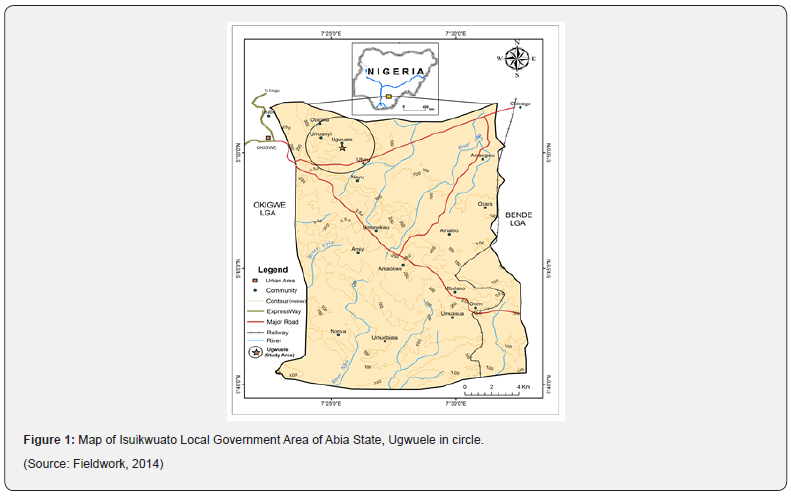
description of it as Acheulean [10]. This site is about 7kms North
of Hope – Ville Rehabilitation centre which is found immediately
one enters Uturu Okigwe which is about 10kms east of Okigwe
on the Okigwe Afikpo road [11]. It has 50 53’N, 70 26’E as its
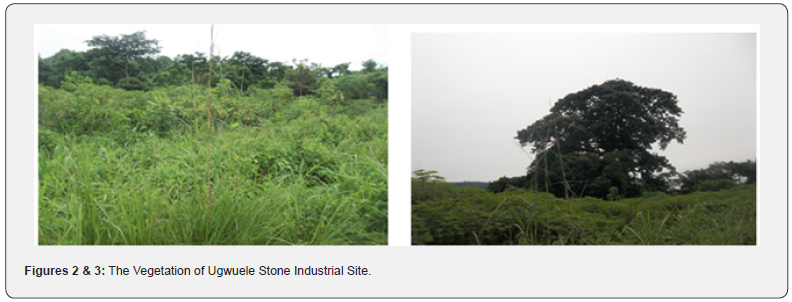
coordinates (Figure 1). While the vegetation of the site is savanna,
“…dominant grasses are Pennisteum purpuram and Andapogon
sp., with a sprinkling of others such as Imperata cylindrical. The
few trees present include oil palm and Phyllanthus descoideus”
[12]. Also, the vegetation of the area is also made up of shrubs
and stunted trees like Acioa batari and Velvet tamarind (Figures
2 & 3). Allsworth-Jones [10] is of the opinion that the event that
really exposed the site to the attraction of academic interests and
subsequent researches was the activities of the quarrying company
in the area. It has been described as the largest Stone Age factory
in the world. Materials found here occur in stratigraphically
sealed context and made from dolerite, an intrusive, fine-grained
igneous rock [11,14]. The site was originally discovered in October
1977 and first investigated by a team of archaeologists from the
University of Nigeria Nsukka [10].
The inconclusive nature of the Ugwuele archaeological
investigation raised conflicting opinions amongst the actors who
worked on the site. For instance, Allsworth-Jones has vehemently
disagreed with Anozie who the Principal Investigator on the true
nature of the lithic materials was discovered from the Test Pits
conducted in the site. For instance, Allsworth-Jones was of the
opinion that “the artifacts presented (by Anozie) ... as a ‘Point’,
but the lower surface is worked and it appears to have been
abandoned before completion. Of course, if the process described
above is regarded as no more than roughouts, then the rather
fancy morphological names given to them are illusory” [10].
Also, in his (Allsworth-Jones) current publication, he informed
that Anozie could not date his samples hence he inquired from
the dating company who denied any record of such sample from
Anozie as was claimed. But Anozie [8] never claimed to have dated
the samples as was claimed. He maintained that he wanted to
date those samples but had a challenge which made the process
inconclusive. This all-important archaeological site has been
denied of extensive and detailed excavation to ascertain the true
nature of the site and as well silence the long-existed arguments
that have emanated from the site since its first preliminary
investigation in 1977. Hence while Anozie was projecting the site
as an Acheulean site, Allsworth-Jones insisted that the site could
have been an axe factory site and that the only Acheulean site to
have existed in Nigeria is within the vicinity of Jos Plateau where
him (Allsworth-Jones) and Anozie were part of the archaeological
investigators in the site. Also, Allsworth-Jones agreed with Marliac
[14] who maintained that sites can equally be found at various
localities within the vicinity apart from their original sources. To
this regard Allsworth-Jones [10] expressed that “one could expect
that the same might be true for Ugwuele-Uturu”.
J. D. Clark had a
different view of the site from that of Anozie when the result of the
preliminary investigation was presented by Anozie, Andah and
Derefaka during the 9th Pan-African Congress in Jos in December,
1983. This he made known in his report in ‘Nyame Akuma’ 1983
[10]. Clark views the site just like Allsworth-Jones, as an axe
factory site that are found in some parts of Africa like Cameroon.
He declined from giving a clear nod to the postulation that the site
is an Acheulean. Infact both Clark [14] and Allsworth-Jones [10] in
their publications reported that the conference paper presented
on the Ugwuelle studies during the 1983 Pan-African Congress at
Jos by Anozie and other prominent actors in the investigation, was
not published as a full paper in the conference proceedings except
the short abstract. But they (Clark and Allsworth-Jones) failed to
inform the cause of this accidental exclusion of the paper from the
preceding conference proceedings.
The question now is, was it
excluded for lack of merit? Baseless argument. Author’s decision?.
Regional and/or continental bias?, Or academic sentiments and
politics? This has opened up the need for the arguments and
demands of this paper. Much have been said on the archaeological
evidence at Ugwuele in Uturu area of Abia State, Nigeria, with
respect to the evidence of existence of early industrial sites in the
area owing to the discovery of early stone tools in large quantity
at a particular area of the community that are not habited by
the extant society but used occasionally as farm site by the
community. Anozie F. N. led the first archaeological investigation
of the site and concluded that the site was Acheulean. This view
did not go well with that of Allsworth-Jones who profusely
criticized this view from Anozie and maintained that the site
could have been an ax factory site with a possible Holocene date
[8, 10 & 11]. In this site, many stone tools similar to that of the
Acheulian culture have been identified i.e. handaxes , cleavers and
Picks revealing the possibility of the existence of a culture similar
to the other Acheulean cultures known in the world Anozie,
Chikwendu & Umeji [11]. The true nature of the site is still a vague
as extensive investigation is still a mirage. “The only published
but still avowedly preliminary description of the site has been
given by the Late F. N Anozie who directed the UNN excavation
at Ugwuele over an eight-week period during November 1977 to
March 1978” [10]. However, the nature and location of these stone
tools coupled with issues on human use and natural factors have
formed major questions for cultural thoughts on the site and its
position in archeological evidence and analysts of the early human
settlement in Africa. These amongst other issues this paper tends
to address.
In this study, ground reconnaissance enabled for the corpus
collection of lithic samples from the site. This is coupled with
detailed field observation and critical content analysis of
previous contending literatures on the subject matter. During the
ground reconnaissance, most of the broken lithic artifacts were
randomly collected and sorted typographically. Furthermore,
the entire site area and environs were walked round and many
cultural and natural features like shrines, groves, caves and rock
shelters which give clue to early human settlement in the area
were observed. Site Catchment Analysis (SCA) of Ugwuelle site
was conducted 5-6 kilometres radius or one hour work, to study
the various landscapes as earlier mentioned. Among these were
Ugwuogwu iron smelting site, Nnemchukwu cave, Okpuchukwu
cave, Ogu-agor cave and rock shelter, the grove of Nwogba stream
made up of a vegetation cover that consist of majorly of mat plants
(pandamus pandam) which are also features possible early human
settlement in the study area. Descriptive and evaluative methods
of data analysis were employed for data analysis.
The Genesis of the Site Discovery
It all began in 1977 when a student in the Department of
Geography, University of Nigeria, Nsukka, visited a quarry site
in his home town of Ugwuele in the present Isuikwuato Local
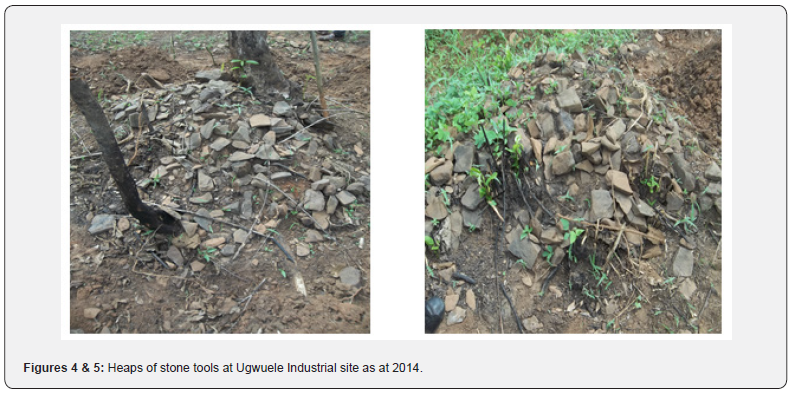
Government of Abia State, Nigeria. He saw many stone flakes in
large quantity scattered over a large area of land (Figures 4 &
5). He thought of the academic relevance of the discovery, and
decided to report it to Professor G.E.K Ofomata of the Department
of Geography, University of Nigeria, Nsukka. Professor Ofomata
immediately understood the archaeological implications of those
stone flakes and took a wise decision of taking some of them to the
Archaeological Laboratory of the University of Nigeria, Nsukka for
professional analysis and interpretation. The site was later visited
by professional archaeologists from the Department of History
and Archaeology, University of Nigeria, Nsukka, in October, 1977
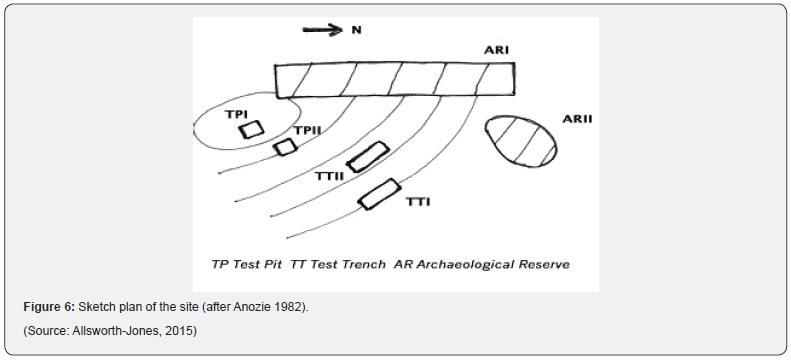
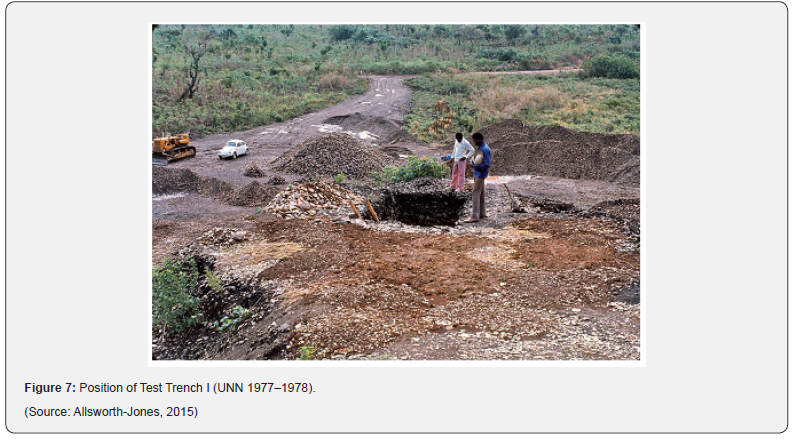
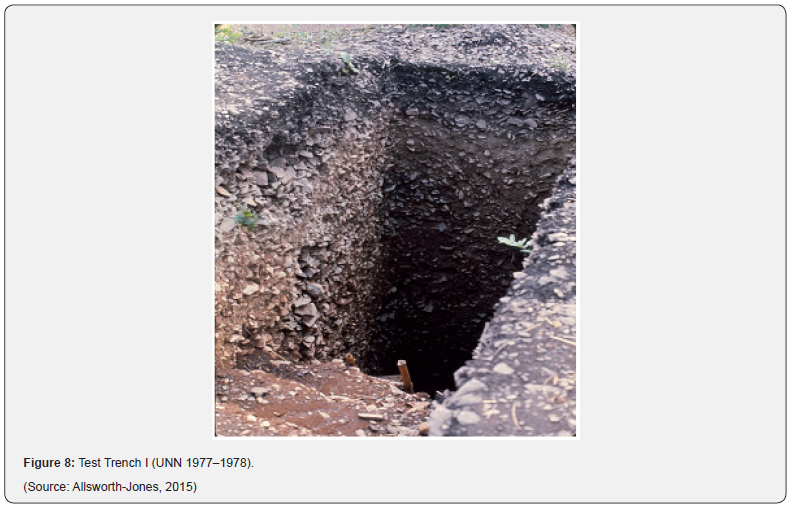
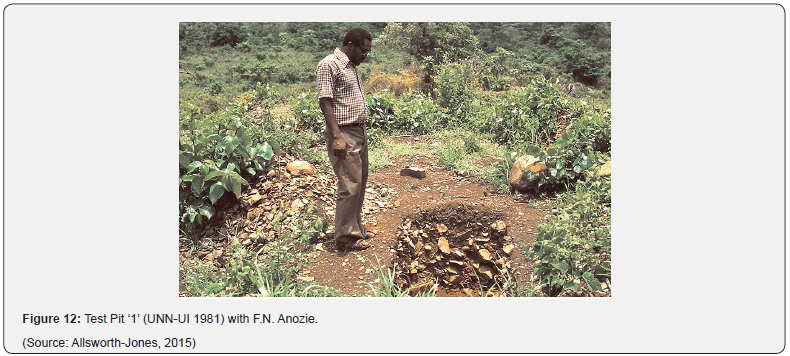
for a rescue excavation. It was recorded that during this excavation,
two test pits of 2m by 2m each coupled with two trenches of 6m
by 2m each were excavated. Apart from the Initial archaeological
investigation of the site in 1977 led by F. N. Anozie of the blessed
memory, another archaeological investigation was carried out in
1981 by a team from the University of Nigeria Nsukka, University
of Ibadan and the Nigerian National Museum which is currently
referred to as the National Commission for Museums and
Monuments (NCMM) [8-10, 16-18].
At the end so many stone
tools which included handaxes, cleavers, stone knives, picks, were
discovered in industrial quantity. The discovered stone tools were
made of dolerite [19]. Details of findings from these series of
minor archaeological investigations of the site can be found in the
publications of prominent actors in that exploration (i.e. Anozie
et al. 1978; Anozie 1982; 1983; 1985; 1993; Andah & Derefaka
1983; Allsworth-Jones 1987; 2015; etc). It is not the intension of
this paper to revisit the details of finds from those archaeological
investigations on the site which have already been stated in many
previous studies like the ones mentioned above, but this paper
is more interested in the controversies that were generated as a
result of these finds and the escape route towards establishing
the true nature of the site devoid of any form of sentiments and
prejudices.
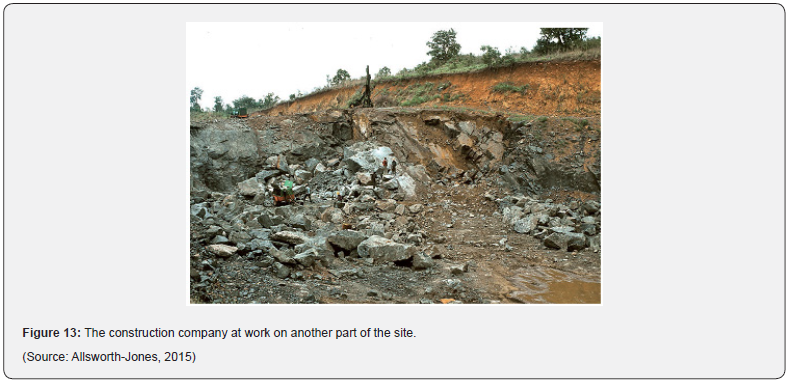
As at the time of the most recent ground reconnaissance on
the site, (between 19th – 23rd May 2014), the quarrying company
was still going on with its quarrying activities in the site. Though
they reserved some part of the site for future archaeological
studies as they promised when the site was discovered in 1977,
the site is faced with serious threat of destruction as tones of the
materials were being quarried on daily basis and carried away for
road construction and other uses. Anozie [9] informed that the
site is not dated yet but can be undisputedly put at between 1.6
million and 95,000 years BP. He concluded that from the studies
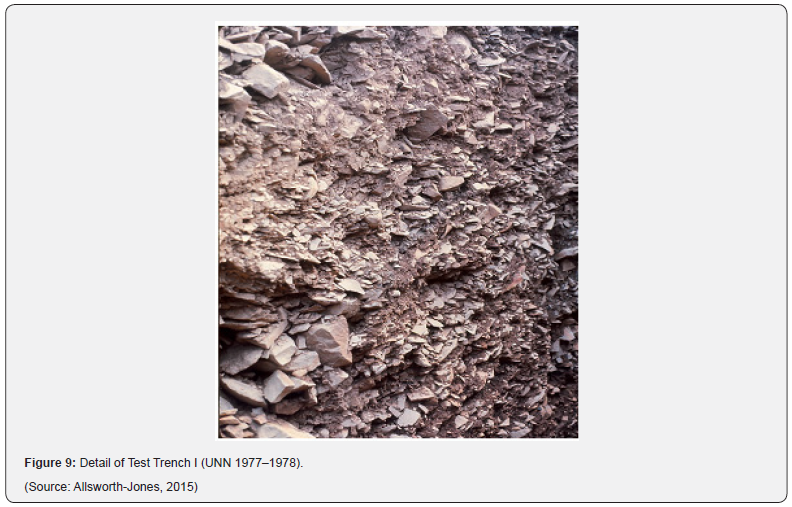
of Clark [20], the Ugwuele site (Figures 6-13) could belong to the
later phase of Acheulean which has been dated to about 500,000
years BP. Anozie [9] went ahead to assert that “We are trying to
obtain a more definite date using Carbon-14 and Potassium argon
techniques of dating as suitable dating materials were found at
the site during the excavation, although we have some problems
with these two techniques. We have also invited a geologist and
a palynologist to see if the site could be dated by other means”.
This was in contrast to the accusations from Allsworth-Jones who
reported that Anozie claimed to have taken the samples to a lab
for dating.

Further Archaeological Questions
Evidences from the site at Ugwuelle in Uturu Area of Abia
State and the arguments surrounding it motivated this research.
This paper tends to reflect on Ugwuelle industrial site and its
position further on the archeological map of Nigeria. Some cultural
thoughts are necessary at this juncture towards preserving and
promoting the archaeological understanding of the Ugwuelle
industrial site. First reflationary point is on the nature of tools
discovered at this site. It is quite understandable that stone
tools discovered at the Ugwuelle industrial site are much like the
famous Acheulean tools of the Middle Stone Age, a subsequent
stone tool culture to the earliest Oldowan culture.
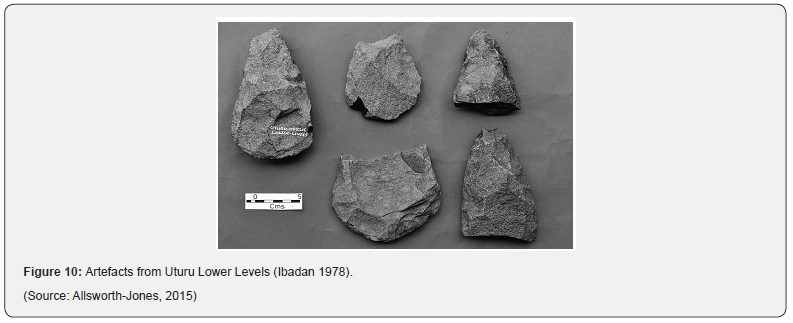
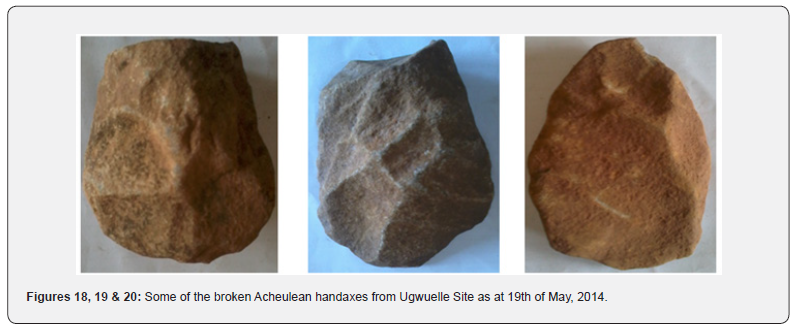
These stone
tools as can be seen in Figures 9-11 include hand axes, cleavers
and picks of different sizes; most of which are in broken forms.
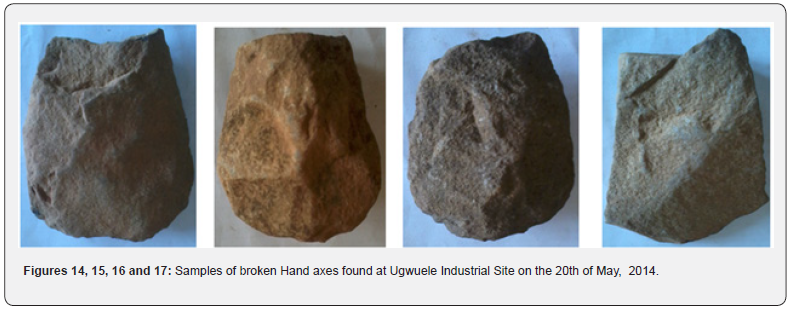
Unfortunately, much of these tools are in fragments as a complete
hand axe or cleaver like that of Mai Idontoro or Pingel in the Jos
Plateau Acheulean cultures has not been found (Figures 14-17).
This is evidenced from the reconnaissance conducted by the
present researchers. This raises up a lot of questions like, (i) is
Ugwuele truly Achulean? (ii) If Achulean, are the materials of
primary or secondary workshop/redeposition? (iii) Were they
preforms for Late Stone tools (ground/polished stone) axes as
posited by Clark [15] and Allsworth-Jones [10] or not? From our
experience through the archaeological reconnaissance conducted
in the area, Ugwuele site is likely an Acheulean site as it contains
all the lithic tools with which Acheulean sites are known all
over the world [12, 21-25]. Surprisingly, 37 years after the first
preliminary study (1977) was conducted on the site, lithic tools
were still discovered through a focused ground reconnaissance
as was conducted by the present authors in May, 2014. Finds of
this recent reconnaissance were in harmony with those from the
earlier preliminary investigations of the site as was published in
the works of Anozie et al (1978), Anozie (1982), (1983), (1985),
(1993), (2002), Andah and Derefaka (1983), Clark (1983), and
Allsworth-Jones (1987 and 2015). It is an industrial site taking
into consideration the abundance of raw materials in the form of
dolerite stones and stone chips found within the vicinity.
From our
ground reconnaissance, we were of the opinion that the broken
handaxes and the cleavers and the lack of complete ones could be
that the makers selected the finished tools with which they hunt
and dismember the animals killed and discarded the unfinished
or broken ones only to re-visit the site when they run out or of
tools. In addition, it is of primary workshop as there are no areas
within the vicinity that such lithic raw material which breaks
at a sharp edge could be found. Thus, natural environmental
factors have a role to buttress this point. Down the slope of the
hill is a stream which may have served as source of water to the
workers/hunters. As for our last question, the Ugwuele site is not
a direct preform or Late Stone Age in Africa. Though there is the
appearance of Sangoan tools like picks, they occurred in small
numbers when compared with the handaxes and the cleavers. No
evidence of Late Stone Age tools (either of the lower or the upper)
like the polished stone axes and the microliths of any form have
so far been found in Ugwuele tool assemblage. It is our contention
here that a further research outside the vicinity of Ugwuele in
particular and Okigwe area in general may reveal where the
finished products from Ugwuele were taken to. Furthermore, it
is also our contention here that the tools were produced through
chipping and flaking techniques and not the levallois technique
as claimed by Anozie (1982).
The technique of debiting carried
out in the site can further add weight to this claim. Our reason
for this lie on the fact that the raw material (dolerite stone and to
some extent quartz materials used) are so hard to be worked on
using bone as anvil and a hammer stone. Another call for thought
is on the human remains. Hand axe culture is synonymous with
Acheulean, Abbevillian and Chellean cultures (Balout, 1981).
Evidence of human remains was recorded at these places in
association with these stone tools. This was an indication of
the manufacturers and/or users of these stone tools. Thorough
studies at these sites made relevant inferences and premises in
the existence and nature of humans at such sites. Such was not
the case at Ugwuele owing to incomprehensive research.
Stone
tools discovered have not been associated with any human remain
apart from the use of the cross-cultural dating and inferences
by detailed and purposeful archeologists. This raises another
reflationary point on the position of the Ugwuele industrial site
in the world Archaeological Map. Moreover, another reflationary
point is on the issue of systematic and comprehensive excavation.
Anozie (2002) asserted that the Ugwuele Industrial site was
discovered in July 1977 and had first archaeological visit in
October 1977, for a rescue excavation. Also during this rescue
excavation it was noted that only two test pits of 2m by 2m was
dug coupled with two trenches that were dug on 6m by 2m each.
These excavations revealed multiple stone tools in industrial
quantity which include handaxes, cleavers, picks and stone knives
(Anozie, Chikwendu & Umeji, 1981; Anozie, 2002). These rescue
excavations shouldn’t have been sufficient for such a magnificent
and historical archaeological site. In some other similar sites in
some other parts of the world, a much comprehensive excavation
had been conducted with many other ones in progress so as to
maintain detailed and more accurate archaeological inferences.
However, there are also issues on substantive dating for
this site. According to (Braq & Trump 1975, p.71) “time factor
is obviously of paramount importance in archaeology and many
methods of recording is employed”. This is amongst the supporting
factors of archaeological discoveries and inferences. The dating of
a site aids in preserving the archaeological relevance of the site
in a world of faster development and subsequent destructions of
heritage resources. Although the Ugwuele site has not been dated,
Clark (1974) had already noted before the discovery of the site,
that similar culture in the other parts of Africa are put between
1.6 million and 95,000years BP (in Anozie 2002). Anozie who was
amongst the first excavators of the Ugwuele site in 1977, when
discussing on the age of the site noted as thus; “At present, the
Ugwuele site has not been precisely dated but the culture is well
known in Africa and its time range is undisputedly put at between
1.6million and 95,000 years BP; so the age of Ugwuele is within
this range... judging from the tools, it seems that the site belongs to
a phase which in other parts of Africa (Clark 1974) has been dated
to about 500,000 years BP. We are trying to obtain a more definite
date using the Carbon-14 and the potassium argon techniques of
dating as sustainable dating materials were found at the site during
the excavation, although we have some problems with these two
techniques.
We have also invited a geologist and a palynologist
to see if the site could be dated by other means (Anozie 2002,
p.18). Datable materials were also recovered by Anozie in his text
trench II at the depth of 1.2 metres in form of extensive hearth
and charcoal which according to him (Anozie 1982) were sent to
Groningen for C14 dating(but inexplicably so far without result).
Also excavations and dating at Iwo Eleru revealed that the site is
about 11,000BC and likely earlier at Ugwuele (Shaw & Daniels
1984). None of these have shown a substantive date for the
Ugwuele industrial site. This factor has brought much segregation
for this historic site in the world archaeological sequence and
discuss.
The nature of the site demands that proper dating will
give more understanding and appreciation of historical and
archaeological relevance of the site. Presently, most of the dates
applied are from sites that are contiguous with Ugwuele. Finally,
archaeological reflections are sacrosanct on the issue of surface
collection in the site. During the recent ground reconnaissance
on this industrial site at Ugwuele on the 19th to 23rd of May 2014,
much of the stone tools (mostly in broken forms) (Figures 14 - 20)
were still lying on the surface of the soil. Some of these stone tools
were picked up and taken to the Archaeological museum of the
Department of Archaeology and Tourism, University of Nigeria,
Nsukka for further studies. The survival of these artifacts till date
may be attributed to the fact that the site is not yet inhabited by
people and the reserved areas have not been quarried. Presently,
the community is using the area as farm site.
Allsworth-Jones [10] concluded his own view about the
Ugwuelle site and its future in the following lines; I submit
that the technological/typological profile of Ugwuelle and its
stratigraphic context insofar as we know it fits far better with a
Holocene workshop ‘model’ than it does with the kind of structure
that we would expect in the Acheulean as detailed above. That the
picture presents itself on the basis of the incomplete data we have
at our disposal. What is needed now is a re-examination of all the
evidence, coupled with an appraisal and possibly a fresh attempt
to date the extant deposits at the site itself. Then we will be on a
much surer footing [10] It is worthy to note that this study is a
wakeup call to all relevant stakeholders in the field of archaeology.
A detailed excavation is needed in the site which would help
unravel some of the questions surrounding this site. It would also
help in making a comprehensive study and inferences on the site
like some other archaeological sites of similar cultures from other
parts of the world. Series of test pits opened in the site by Anozie
and his team during the initial discovery of the site, did not help in
ascertaining the true nature of the site hence the current debate
on its archaeological status.
We propose in line with Okafor (1989)
that an extensive and systematic excavation of six different pits of
10 x 15m in the site (which is currently under threat by the activities
of SETRACO Querying Company) and a further reconnaissance
survey of the site area. The depth of the six trenches should not
just stop at the sterile layer but go beyond possible hiatus until no
hiatus is further observed. Also, further Site Catchment Analysis
(SCA) should equally be conducted on the landscape of the Uturu
area of Abia State, Nigeria, to support findings from the excavation.
This work should be executed by a conglomeration of seasoned
archaeologists with members from Nigeria and some other
parts of the world. Interestingly, some seasoned archaeologists
from Nigeria, England and South Africa have already indicated
interest in being part of this team. Departments of Archaeology
in University of Nigeria and University of Ibadan in Nigeria should
be fully involved since they are part of the history of the site. They
are also expected to provide some of the equipment and human
resources for the study. More importantly, a study of this kind,
would need external funding for efficiency and unbiased report.
This should be followed by series of systematic analysis, dating,
interpretation and notable publications, which are expected
to give answers to the critical questions raised in this paper.
This is expected to dowse further debates on the archaeological
relevance of the site since its discovery in 1977. Moreover,
before the study, formal consultations and approvals should be
sought after from the National Commissions for Museums and
Monuments in Nigeria, coupled with the Commission’s support
towards the success of the study. Orientation programmes should
be organized for the members of the host community on the
proposed plan; how it will benefit them and their expected role.
This will not only help in promoting and preserving Ugwuele
Industrial site as a rich cultural heritage center in Nigeria and
Africa in a wider scale [26-28] but also boost the tourism potential
of Ugwuele community and Abia State In general. This would have
settled various contentions on the site which made Okafor [12] to
conclude his study on the site in the following lines. How can the
cultural association be determined since enough geological data
concerning the site are available, we should concentrate on the
archaeology. What is needed is a full trench excavation, at least 10
by 15m in size, in the decomposed bedrock area in order to expose
the stratigraphic sequence.
The area of the site that appears to
be most promising is the undisturbed southern part of Reserve
I, so the trench should be placed here. During the excavation,
care should be taken to collect any available organic remains
which could yield information on chronology, environment and
ecological setting. The establishment of an adequate date for the
site will settle all the arguments [12]. Finally, it is our contention
here that from this research and evidences that turned up that
Ugwuele archaeological site may be an industrial site and may
have belonged to the Acheulean site as evidenced from the tools
found in the area. The issue of accurate chronology of Ugwuele
as we suggested awaits further archaeological researches through
detailed archaeological excavations. It is earnestly recommended
that this call for a total revisit to this site should be harkened to,
through adequate collaborative efforts from relevant experts. As
noted earlier, a research of this kind can only be funded by the
National Commission for Museums and Monuments in Nigeria
and other relevant funding agencies like UNESCO, with interest
in culture and heritage preservation. The result of this research
would answer most of the puzzling archaeological questions
raised in this paper and also determine the value and position of
the Ugwuele site in the world archaeological map.