Monday, January 11, 2021

Experiment: Make Binding Forces Visible- Molecular Binding Forces, Recycling/Reuse, Life Cycle Engineering (LCE) - Juniper Publishers

 Academic Journal of Polymer Science  Juniper Publisher  

Abstract

A very simple experiment shows students the difference between primary and secondary molecular binding forces. Use an empty plastic cup for milk, yoghurt or coffee and destroy it by pressing the cup together. You will watch cracks only longitudinal the cup. Try to break the cup horizontally you will fail. What you observe are the secondary binding forces between the molecules oriented along the length of the cup versus the primary binding forces perpendicular to the long side of cup.

Keywords: Molecular Binding Forces; Recycling/Reuse; Life Cycle Engineering (LCE)

Introduction

What should be found/investigated ?

[answer: Are the primary molecular binding forces (within the molecular chain acting binding forces, i.e. between primarily connected atoms) actually significantly stronger than the secondary binding forces (between molecules acting forces)? How can a yoghurt cup be reused in a cup of the same application without violating high hygiene regulations in Germany? What role has Life Cycle Engineering for product developers play in the industry? For answers: Students should examine a yoghurt or milk cup.] [1,2].

Why/what could this be important for?

[answer: The shelf life of packaging helps to mechanically preserve food and make it durable for longer. If the digestion breaks easily, e.g. when falling down, damage to the goods and dirt occur. With this experiment, the students understand how the processing of plastics influences the product properties, how to basics of chemistry i.e. binding forces can be easily (and surprisingly) make visible and tangible and how to intelligently understand recycled material in food packaging (for hygienic reasons almost impossible!).]

Why is the experiment essential for the participants?

[answer: We all use plastic packaging and throw them away carelessly after use. Mostly we are still annoyed about the voluminous amounts of garbage. And we are surprised how much brain lard and unexpected highly interesting effects, however, are often stuck in such “worthless” products.]

First Experiment

What is being done?

[answer:

a. Each student brings a large (0.5 l) empty cleaned yoghurt or milk plastic cup

b. Each student brings a small (0.25 or 0.3 or 0.5l) empty cleaned PET bottle

c. The cup and the bottle are squeezed at the top of the edge (cup) or at its whole body (bottle). ]

What happens?

[answer: The cup breaks into the ground in longitudinal cracks; further crushing leads to longitudinal strips via cracks. The PET bottle does not break!]

Why does the cup break this way? Why does such a strip not break transversely to the longitudinal direction? Not, if you bend over 20x or more often vigorously back and forth?

[solution: the cup was deep drawn below the plastic melting temperature or injection molded above the melting temperature; the macromolecules are as a result shear forces oriented in the longitudinal direction. When breaking, the majority of the approx. factor 20 - 35 weaker secondary binding forces act between the polymer molecules; while the binding forces in the chain (between the stronger C-C-bindings) are stressed at right angle they guarantee a high strength. ] [3-8].

Second Experiment

If the students now repeat the same experiment on a piece cut from the PET bottle and load the plastic strip by 90° in each direction, what happens then?

[solution: this PET piece from the bottle has equally high strength in both directions. It does not break in any direction of loading!]

Why?

[solution: biaxially oriented films during production result in stretched macromolecule chains in both directions (offset by 90°); this is followed by high primary bonds and correspondingly high strength biaxially. ]

Further Watching

What is noticeable when the students take a close look at the fracture surfaces of the longitudinal cracks in the yoghurt or milk cups?

[solution: They detect a three-layering of the approximately 0.4 mm thick foil wall of the cup. Outside and inside white, in between gray.] (Figure 1).

What is the explanation for this?

[solution: the outer layers are made of original material, inside is recycled material, so old (unhygienic) plastic of earlier cups, hidden. This is produced by the so-called co-extrusion [9].]

What are the hygienic regulations in Germany/ Europe?

A short summary will be found in [10]. Plastic packaging producers are well advised to certificate their packaging standards after British Retail Consortium (BRC) of the Institute of Packaging. This is a surrounding standard for quality, hygiene and product safety. Alternatively, the German/European DIN EN 15593 standards is comparable to BRC. In April 2020, the Fraunhofer IVV published an investigation about disruptive smelling in recycling plastic as LD PE and PET [11] which shows still a lot of open questions.

Conclusion

What should the students learn from this experiment?

[answer: They are intended to provide an insight into the complexity of today’s mass-produced plastic goods. They will also learn about the chemical and mechanical fundamentals of plastics and get an initial idea of engineering. A qualitative discussion about holistic thinking in terms of Life Cycle Engineering (technical, economical, environmental, social) creates awareness of systemic thinking.]

Is there a social aspect to the question?

[answer: Plastics, their advantages and disadvantages as well as their recycling are an up-to-date theme. In this way, plastics affect a number of important aspects, such as resource consumption, consumer behavior, closed loop economy, Life Cycle Engineering, processing and handling materials, environmental protection.]

Are special competences promoted with the experiment ?

[answer: Theory (basics of chemistry) comprehend by hand ; technical understanding; ability of observing; logical engineering thinking; problem-solving behavior; systemic mindset;]

Is the experiment interdisciplinary?

[answer: Yes: chemistry, technology, materials science, business administration (qualitative), product(food) protection/ hygiene.]

Is this an actual research topic? If so, why?

[answer: Yes. Safe packaging is an important issue in resource protection and hygiene. Circular economy is technically, economically, environmentally and socially significant.]

Is it a theme of author´s own sponsoring organization?

[answer: Yes.]

Infobox

Student laboratory

a. Open Youth Workshop Karlsruhe e. V. (Offene Jugendwerkstatt Karlsruhe e.V.)

b. Fraunhofer ICT, TheoPrax

Contactpersons

Peter Eyerer, Fraunhofer ICT, Pfinztal, Germany

Dörthe Krause, TheoPrax Foundation, Pfinztal, Germany

Age and type of school of the target group

From grade 8 of all school types and also for teachers.

Fields

Chemistry, natural sciences, technique, physics

Time needed

Approx. 45 minutes

Tags

a. Primary and secondary binding forces

b. Production of packaging products out of plastic

c. Recycling , reuse

d. Closed loop economy

e. Life Cycle Engineering

f. Systemic thinking

Methods

Didactically leaded research-oriented experiment

For the solutions of the question/problems there is enough information material (in writing, visual (videos), haptic).


To Know more about  Academic Journal of Polymer Science

Click here: 
https://juniperpublishers.com/ajop/index.php


To Know more about our Juniper Publishers

Click here: https://juniperpublishers.com/index.php    


Friday, January 8, 2021

Adult Flat Foot and its Associated Factors: A Survey among Road Traffic Officials - Juniper Publishers

 Arthritis & Bone Research - Juniper Publishers


Abstract

Introduction: Adult flat foot poses a challenge to health professionals and could lead to major life impediments. There is scant literature on this disorder in local communities and none has considered road traffic officials.

Objective: This study sought to determine the prevalence of flat foot among Nigerian road traffic officials and discover its association with their personal characteristics.

Methods:A cross-sectional design was used to recruit 103 adults (81 males and 22 females) who were between the ages of 21 and 50 years. The plantar arch index was used to diagnose flat foot via the exploration of foot prints. Data were analysed using descriptive and inferential statistics.

Results:The prevalence of flat foot was 11.6%, which mostly had a unilateral pattern among the participants. A significant association was observed between sex and flat foot prevalence (p = 0.038), revealing a higher ratio of affected females to males. There was not a similar finding on analysis with the participants’ age (p = 0.594). Furthermore, a significant association existed between increased BMI and flatfoot prevalence (p = 0.001).

Conclusion: This study among road traffic officials disclosed a prevalence rate that is comparable to other adult populations. Overweight/obese and female officials exhibited a greater risk of this disorder, so should be given special attention. Proactive efforts towards its screening, prevention and monitoring are recommended.

Keywords: Flat foot; Road traffic officials; Prevalence; Plantar arch index

Introduction

The foot is a complex structure which plays an important role in the lower limb’s processes of providing support, balance and propulsion [1]. Consistent measurements can be used to ascertain foot types based on their arches, as these describe the foot’s plantar surface contact area [2], and ultimately aid in the detection of flat foot [3].

Flat foot or pes planus, which denotes the complete or near-complete contact of the sole with the floor due to fallen foot arches, could be flexible or rigid [4]. The former is regarded as a paediatric developmental incidence that may persist into adulthood, typically with no symptoms [5] but provides a higher risk of musculoskeletal injury [6]. Rigid flat foot however, is often a complex disorder in adults which could arise from acquired causes comprising of traumatic, degenerative and neuromuscular conditions [7]. Literature reveals that adult pes planus poses a common challenge to healthcare professionals [8] and it could result in major life impediments via severe pain and disability [7].

The prevalence of adult flat foot has been investigated by different authors [9-13] who obtained diverse results. Notable discrepancies exist on its association with BMI, age and/or sex, as revealed by other authors [14-16]. These differences extend to Nigeria as some researchers have also reported contrasting prevalence of flat foot in adults [17-20], however there is a consensus amongst them on a higher prevalence among Nigerian women. Generally, a dearth of literature is still evident on this disorder as it has not been explored as much as paediatric flat foot. Furthermore, paramilitary or road traffic organizations have not been considered in the available studies.

There seems to be no literature on pes planus or anthropometric data on the feet of Nigerian road traffic officials, despite some information on work-related impediments on similar indigenous personnel [21]. In order to monitor flat foot and manage its occurrence as well as associated impairments on this population, it is important to collate and explore relevant data. Hence, this study was executed to determine the prevalence of flat foot among Nigerian road traffic officials and discover its association with their personal characteristics.

Materials and Methods

Research Design

A cross-sectional descriptive design was utilised for this study. Participants were recruited through purposive sampling technique in the Federal Road Safety Corps (FRSC) Enugu sector command in Enugu State, Nigeria. Officials were identified from the staff register, educated and invited for an assessment procedure in order to ascertain their eligibility to participate in the study. Inquiries about any previous foot surgery and pain or wobbly sensation whilst standing, walking or moving the foot, was part of the procedure. It also involved a physical assessment for foot deformities, amputations, open wounds and dislocations/ fractures. A list of eligible officials was drawn up after this procedure, including those who did not report or display factors that would militate against their involvement.

Participants

A total of 103 adults, aged between 21 and 50 years, comprising of 81 males and 22 females who were officials of the FRSC Enugu sector command participated in the study. Ethical approval was obtained from the hospital health research/ethics committee and permission got from the Commander, FRSC Enugu sector command before commencing the study. The officials were fully educated about the study objectives and procedure for data collection, highlighting the need for volunteers. Informed consent was duly obtained from those who were willing to participate. Officials with either unilateral flat foot, bilateral flat foot or normal feet were included in the study whilst those with other foot deformities, had previous surgeries and other orthopaedic/ neurological conditions were excluded. The participants assembled in groups during their respective free periods and had their details as well as measurements taken. All the data were meticulously recorded and kept confidential.

Measurements

Standing upright and barefooted, the height of the participants was obtained using a stadiometer (in cm) whilst their weight was measured with a weighing scale (in kg). The feet of these officials were then sanitised for the following diagnostic procedure:

In the sitting position, the plantar arch Index (PI) was obtained via a specific routine based on previous literature [3,22-25]. Each official had to dip one foot on a pad adequately dampened with ink, stand up and firmly print the foot on a sheet of paper attached to a platform whilst flexing the ipsilateral knee slightly (upto 30°). This procedure was repeated to obtain the print of the contralateral foot and then, these footprints were used to calculate the PI for both feet via a validated method [26]. First, a line was drawn tangent to the medial forefoot edge and the heel region, its midpoint determined and a perpendicular line intersecting the footprint drawn from it. This was also performed for the heel tangency point. Next, two perpendicular distances X and Y were measured (X; representing the breadth spanning the medial to lateral edges of the midfoot and Y; representing the breadth spanning the medial to lateral edges of the rearfoot). Lastly, the value of X was divided by the value of Y to derive the PI. A normal PI is one encompassed within 2 standard deviations (SD) of the population mean [23]. PI values equal or above the total of 2SD with the mean were taken as indicative of flat foot.

Data Analysis

SPSS Software version 23 for Windows (IBM, Chicago, IL, USA) was used to analyse the data obtained in this study. Prevalence of flat foot, its pattern and the participants’ characteristics were presented descriptively in tabular form by using percentage frequencies. Association between flat foot prevalence and personal characteristics was examined using the Chi-square test. The level of significance was set at p<0.05 for these tests.

Results

Participants’ characteristics, prevalence and pattern of flat foot

A total of 103 road traffic officials of the FRSC Enugu sector command participated in this study. Table 1 shows the participants’ demographic profile which consists of 81 (78.6%) males and 22 (21.4%) females; mostly within 31 – 40 years (58.2%) and falling in the normal weight category (56.3%). It further displays that the prevalence of flat foot in this population was 11.6%. Table 2 reveals that flat foot mostly had a unilateral pattern (83.3%) with an equal occurrence in each foot (50%).

Novel Techniques in Arthritis & Bone Research

Association between Personal Characteristics and Prevalence of Flat Foot

The association between the participants’ characteristics and the prevalence of flat foot is presented in Table 3. A significant association was observed between sex and the prevalence of flat foot (p = 0.038). Notably, 25% of the females had flat foot while it was present in only 8.4% of the males. There was not a significant association between the participants’ age and the prevalence of flat foot (p = 0.594). Furthermore, a significant association existed between BMI status and the prevalence of flat foot (p = 0.001). This prevalence was highest (100%) in obese participants and much lower (6.9%) in those with normal weight while underweight officials did not have flat foot.

Novel Techniques in Arthritis & Bone Research

Discussion

Prevalence and Pattern of Flat Foot

The prevalence of flat foot in this study was revealed to be 11.6%, with a high unilateral occurrence observed among the participants. A similar finding of 11.25% reported by Bhoir et al. [11] concurs with the above result. However, these authors only reported that flat foot existed bilaterally. Dissimilar prevalence rates of 5.2% among 500 participants [10] and 13.6% within 250 students [9] have been observed in Asian adults, but it should be noted they used different methods to detect flat foot. Another Asian research which used the same method as this study [13] reported a higher prevalence rate of 39.7%, however its diagnosis was based on a given normal range and not in line with the 2SD criterion. Indigenous research discloses distinct results, with the closest prevalence of 13.4% and 13.9% reported by Eluwa et al. [19] and Ukoha et al. [17] respectively. Both researchers reported a higher presentation of bilateral flat foot among 18 to 30-yearold students.

Other local authors have also obtained contrasting results to this study’s finding by stating prevalence rates of 22.2% in a 2008 study [18] and 25.3% in a later research [20] on different adult populations, with the previous authors observing a greater bilateral flat foot occurrence. The latter research involved adults within a similar age range as this present study’s participants while every afore mentioned study comprised adults younger than 30 years. This fact about age, as well as the use of various diagnostic methods, might account for the discrepancy in flat foot prevalence revealed by the present finding. Nonetheless, the observed prevalence does not connote any deviation among road traffic officials.

Association with sex

This study revealed that flat foot was three times more prevalent in females than males; as sex displayed a significant association. It is consistent with previous reports of a higher prevalence of flat foot among Nigerian women [17-20], though they had a lesser ratio of affected females to males and did not consider an association. The higher ratio of 3:1 in this study could be as a result of a smaller sample with a variance in the number of each sex and not due to any circumstance pertaining to these road traffic officials. Other authors have not found a significant association between sex and flat foot prevalence [11,12] among Indian and Spanish residents respectively. Further contrasting this study’s finding, some researchers discovered a significant association of flat foot with male gender [14] while others who assessed 284 students reported a higher prevalence among males [13]. Nigerian authors have revealed the presence of sexual dimorphism in adult foot anthropometry [27-29] which might account for the higher flat foot prevalence among females, as this sex could possess a contributory feature. They observed that males had longer and broader feet which concurs with a US study that also revealed that females had shorter but higher arches, indicating the need for more foot support [30]. A study in England further revealed the existence of osteological differences between the feet of each gender, stating the potential susceptibility of the female foot to hallux valgus deformity [31]. It would be interesting to determine if there is indeed a link between sexual dimorphism and flat foot among Nigerian women, then specifically explore such finding in road traffic officials.

Association with BMI

Findings demonstrated that flat foot was more prevalent in the higher BMI statuses, especially among the obese participants. Similar reports which also depict a significant association between BMI and flat foot have been given by several authors in different countries [12,14-16]. These studies provided consistent observations of most flat-footed individuals having greater BMI. Conversely, other authors have revealed that there was not a significant correlation between the values indicative of flat foot and BMI among young adults [9,11]. One of these studies incorporated the navicular drop test while the other considered the arch index alongside other measures to diagnose flat foot

Some postulations of an increase in body weight and BMI influencing the foot arch [1,15] offer an explanation of this present finding. Other researchers have further stated that superfluous fat deposition causes pressure over foot arches [32] and that obesity affects the foot via excessive mechanical loading during walking [33]. These raise a query about a possible collapse and flattening of the foot arch. It is therefore pertinent to properly examine this study’s finding on indigenous adults to attain an accurate understanding. Nonetheless, there was not an extraordinary prevalence of flat foot, especially among the normal or underweight road traffic officials, which would have denoted an adverse manifestation in this population.

Clinical Implications

This study’s findings draw attention to the need for careful road traffic personnel screening, as well as keeping accurate records, to detect flat foot and identify relevant data associated with its prevalence in adults. Overweight/obese and female officials displayed a higher risk of this disorder; hence they should be given special attention. Constant monitoring to limit strain at occupational tasks and ensuring proper fit of work boots are recommended, as these might help prevent and manage flat foot among this population. Appropriate nutritional, exercise and enlightenment programmes are relevant for holistic management. This study’s authors also suggest that proper foot evaluation and consideration be given to obese women, as a primary step towards tackling indigenous adult flat foot prevalence.

Limitations

There is a need for a longitudinal study which would comprise more officials and consider the possible influence of work-related factors; as this preliminary research could not incorporate these aspects. Causal inferences cannot be made from this crosssectional study’s findings.

Conclusion

This study provided data on flat foot among road traffic officials, revealing a prevalence rate of 11.6%. Overweight/obese and female officials exhibited a higher risk of this disorder, so should be given attention. Regular and proactive efforts towards screening, prevention as well as monitoring of flat foot in this population are recommended.

Click here: https://juniperpublishers.com/index.php   

Tuesday, January 5, 2021

Human Papillomavirus and Cervical Cancer - A Review - Juniper Publishers

 Tumor Medicine & Prevention - Juniper Publishers   


Abstract

Cervical cancer used to be the leading cause of cancer death for women. Human Papillomavirus (HPV) infection is responsible for more than 90% cervical cancer. About 6.6% of women in Indian population are estimated to harbor cervical HPV infection. HPV 16 and 18 are accounting most prevalent type in cervical adenocarcinomas. In HPV life cycle, high-level amplification of the viral genome move outer layers of the epithelium are released to re-initiate infection, persistent infection leads to precancerous lesion. The numbers of cervical cancer cases and deaths have decreased significantly over the period with efficient diagnostic technique like Pap smear test. Development of sensitive technique for early detection of HPV infection and vaccination further reduce the incidence of cervical cancer.

Keywords: Cervical cancer; Human Papillomavirus infection; Pap smear test

Abbrevations: HPV: Human Papillomavirus; LCR: Long Control Region; SCC: Squamous Cell Carcinoma; LSIL: Low Grade Squamous Intraepithelial Lesion; HSIL: High Grade Intraepithelial Lesion; TLR: Toll Like Receptors; NK: Natural Killer

Introduction

Globally cervical cancer is the fourth most common cancer in women. Cervical cancer occurs due to neoplastic transformation of cells in the cervix i.e. lower part of the uterus. The worldwide incidence of cervical cancer, 5,10,000 new cases diagnosed every year and approximately 2,88,000 deaths [1]. In India, 1,32,000 new cases diagnosed and 74,000 death every year. The incidence is more common in women above the age of 30 years. Cervical cancer is almost always caused by Human Papilloma Virus (HPV) infection [2]. HPV infection is responsible for more than 90% cervical cancer causes and the other less important factors include smoking, weak immune system, birth control pills, and unsafe sex (contraceptives) [3]. 90% of cervical cancer cases are squamous cell carcinomas and 10% are adenocarcinoma. About 6.6% of women in Indian population are estimated to harbor cervical HPV infection.

Human Papilloma Virus (HPV)

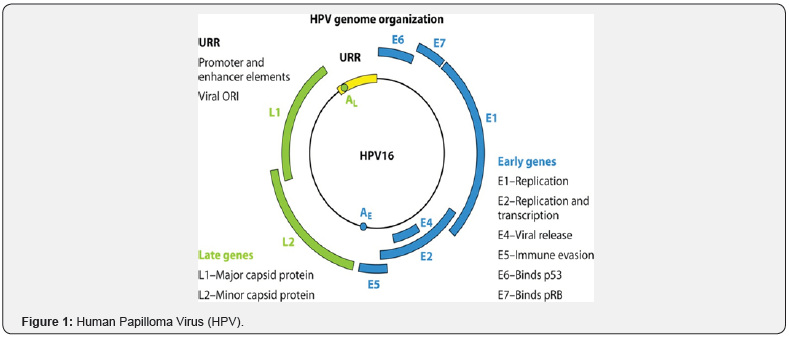
HPV are small (50 nm) double-stranded DNA viruses composed of a genome of 8kilobase pair, enclosed inside a nonenveloped capsid protein. The genome consists of three sets: (a) early genes (E1, E2, E4, E5, E6, E7) which regulate the vegetative and productive phase of viral life cycle: (b) late genes (L1, L2) which encode the capsid protein and (c) a non-coding regulatory region called Long Control Region (LCR) control the regulation of viral replication and transcription [4] (Figure 1).

Types

Approximately 200 different HPV types have been characterized, and the two most frequent high-risk HPV genotypes, HPV- 16 and HPV-18, according for 70% of cases. HPV6 and HPV11 are common causes of genital warts and precancerous lesions [5]. The HPVs can be broadly grouped into cutaneous types and mucosal types based on tissue tropism. The cutaneous types are found in the general population and cause common warts with individuals are immunosuppressed. The mucosal HPVs are further classified into high-risk and low-risk types, based on their respective degree of association with cervical cancer. The most common lowrisk types are HPV 6 and 11, detected most often in benign genital warts. HPV 16, 18, 31, and 45 are predominant types found in cervical Squamous Cell Carcinoma (SCC), accounting for more than 90% of cases, with HPV 16 alone accounting for about half the cases worldwide [6]. HPV 18 is the most prevalent type in cervical adenocarcinomas (55%), followed by HPV 16 (32%) and HPV 45 (10%). Epidemiological evidence suggests that infection with HPV is the greatest risk factor [7]. Its, role in the progression of the precursor lesions to cervical cancer is well established [8].

Mechanism of HPV infection

HPV infection normally does not integrate its DNA to host DNA. In high-risk HPV, DNA is often integrated into the human genome in cervical squamous cell carcinoma. It has been proposed that integration can be an early event associated with Low Grade Squamous Intraepithelial Lesion (LSIL) to High Grade Intraepithelial Lesion (HSIL) progression [9]. HPV can infect cells through damaged tissue. In the immune response, keratinocytes play an important role which can express Toll Like Receptors (TLR), participate in the innate immune response and recognize both endogenous and exogenous. In this process, TLRs are activated and can synthesize and release a variety of cytokines involved in immune regulation like IL-1, IL-6, IL-8, IL-10, TNF-α and IFN-β to activate Natural Killer (NK) cells [10]. The NK-activating receptors affect the cytolytic functionality. It elicits a proinflammatory expression profile which promotes innate immunity. The initial inflammatory response leads to infiltration of immune cells such as neutrophils, macrophages and lymphocytes.

HPVs are exclusively epitheliotropic, and their replication is intimately linked to the differentiation process of the host cells. Normal squamous epithelial cells grow as stratified epithelium, with those in the basal layers dividing as stem cells of transient amplifying cells. After division, one of the daughter cells migrates upward and begins to undergo terminal differentiation while the other remains in the basal layer as a slow-cycling, self-renewing population. Productive papillomavirus infection begins when infectious daughter cells of the basal layer, probably through micro-wounds. The viral genome is maintained in these cells as a stable episome at low copy number, and that generate productive wart. The early HPV genes E1 and E2 support viral DNA replication and its segregation such that the infected cells can be maintained in the lesion for a long period. As infected daughter cells migrate towards the epithelial surface, viral late gene products are produced to initiate the vegetative phase of the HPV life cycle, resulting in the high-level amplification of the viral genome. In the outer layers of the epithelium, viral DNA is packaged into capsids and progeny virions are released to re-initiate infection, persistent infection rather than clearance of the virus linked to the development of precancerous lesion followed for invasion and metastasis [11].

Diagnosis

The important methods to diagnose HPV infection are

• Pap smear test-It is a screening test first describe by Papanicolaou and Traut. Apart from premalignant and malignant changes, viral infections like HPV infection and Herpes can also be detected. Positive test requires further confirmatory tests like colposcopy, cervical biopsy, and DNA tests like PCR.

• Colposcopy and acetic acid test- Colposcopy is the examination of the cervix, vagina, and in some instances the vulva after the application of acetic acid solution.

• Biopsy- Colposcopy allows tissue sampling (biopsy) that is targeted to the abnormal areas.

• DNA test (PCR, Southern Blot Hybridization, In Situ Hybridization) - Initial methods of HPV detection used were direct probe hybridization such as dot blot and Southern blot.

Prevention

The two novel and highly efficacious prevention methods are prophylactic HPV vaccination to control the early peak of infections and sensitive HPV-based screening to detect and treat the secondary peak of precancerous [12,13].

Conclusion

This review has described the mechanism of HPV mediated carcinogenesis in human cells. A future challenge to this end is defining the research agenda for deciding on the optimal technology and intensity of screening to make cervical cancer a very rare disease while minimizing the possible harms.


To Know more about Tumor Medicine & Prevention   

Click here: 
https://juniperpublishers.com/jtmp/index.php


To Know more about our Juniper Publishers

Click here: https://juniperpublishers.com/index.php   

Wednesday, December 16, 2020

Introduction to Tape Authentication- A Study of Acoustic Characters - Juniper Publishers

 Trends in Technical & Scientific Research - Juniper Publishers


Introduction

Two terms often confused within are speaker verification and speaker recognition. The basic difference between the two lies in identity of the speaker. In other words, speaker verification could also be explained as the search which 1:1 match of the speaker and the other as 1: N search for the same. A sound spectrogram is also considered as a “photograph of an individual’s voice”. Taking the noise encountered during recorded speech recognition into consideration, probable location of the individual during the time of speech could be known.

Auditory analysis in general could be explained as the examination of various constituents of the voice which is received by an ear. The various governing factors for the same includes, sound quality, the order in which an individual breathes, amplitude, the style of speaking, the irregularities in speech, psychological conditions, etc., including all the acoustic characteristics of the individual.

Auditory Analysis

Each of ours voice is unique and the features that makes it unique are known as the voice prints. Voice prints are significant importance, specifically talking about forensic phonetics. The movement of the air particles occurs at a specific frequency and amplitude with respect to an individual [1].

The auditory analysis is the procedure of examination of the various parts and constituents of an individual’s voice that are received by ear. The characteristics if major concern, include the identification of an individual’s pitch, breathing order, his acoustics, tone, intonation and the state of mind of the individual while speaking. The auditory analysis of an individual’s voice is considered as one of the most important components under consideration, by the experts comparing and identifying the voice samples given. The various characteristics that are taken into consideration includes:

a) Melody

b) Irregularities in speech

c) Timbre of voice

d) Jargon used

e) Intensity

f) Emotional status

g) Rate of breathing while speaking

h) Pronunciation errors

i) Speed while speaking

As per various research conducted, it is suggested that the success rate of speaker recognition using auditory analysis is 85-99%. It is said so because the speaker rarely deviates from his individual characteristics while speaking. The characteristics , discussed above are some of the few, characters that are used for the analysis, the way you speak , the stress you give on a particular word, the accent you use are all that is included in the acoustic character used in differentiation you from rest of the population.

Speaking Style

The features of the character basically involve the features one has while speaking, the way in which the sentence spoken generally begins, the accent that is used while speech. The speaking style includes the property, of either being a fast speaker, or a slow speaker, or whether the speaker is a spontaneous one or not.

Speaking Speed

It is also not that the same person speaks in the same speed every time, condition is mostly emotion driven. The speaking speed of an individual is also said as the way in which he speaks a particular word, the time he takes, when he comes across each syllable and the pause, he gives between them. It is considered as one of the important factors while verification of sound as per auditory analysis.

Sound Intensity

Intensity is basically the voice tone of an individual. Intensity in voice is dependent upon the situation of an individual or the environment in which that specific sentence has been spoken. Intensity in one’s speech is the identification of recording that is made, giving an evidence of the situation in which, that individual was present.

Voice Timbre

Voice timbre, in simple words could be said as the quality of the tone while speaking. There is a slight difference between pitch and timbre, which is, that, timbre is a combination of overtone frequencies, whereas pitch usually involves a single frequency. Voice timbre is considered as the most important acoustic character, which when heard in a well stored record, can make the work of the investigator easier.

Irregularities in Speech

The stammer in one’s speech or in other words, the obstruction in an individual’s speech. Apraxia, dysarthria, DASE etc., could be considered while investigations and are the characteristic while searching an individual’s speech, accused of in a particular crime.

Sound Spectrometric Analysis

It would not be wrong to say that spectrographic analysis of sound is similar to as taking a picture of voice, based on the parameters of examining it visually. Various software are used for the creation and analysis of spectrograph, includes, Pratt, wave surfer, TF32. TF32 is most significantly used for analyzing the spectrograph, due to its simplicity and user friendliness, while working. Various parameters taken into consideration, includes:

a) Formant shape and its position

b) Pitch period

c) Noise speech ratio

d) Length of word and sentence length

e) Amplitude of formant

The parameters discussed above play a major role, during the analysis of the questioned voice sample, in order to find its authenticity. To improve test results, use of FTIR is considered a better alternative as compared to praat and other techniques used for analysis [2-4].

Praat is considered the second most used software, due to advantage it provides its users of noting down speech files and the way in which it simplifies the analyzing and labelling of the sound sample given or run down while finding out the audio report. There are many factors, considered, while writing down or telling about a specific sound spectrograph and analyzing it’s result, which is to recognize the specific voice sample.

Formant frequency

The formant frequency is taken into consideration, while reading up onto the result of the spectrograph thus encountered. The formant frequency in simpler words, is considered as the highest energy of the components of the sound in the fundamental frequency, or it could also be explained as the regions in the spectrogram having an amplitude that is high. The formant values depend on the age, sex of the individual. Formant shapes are characteristic of the movement of tongue, along with the use of the type of the alphabet that is spoken. The formant frequency is of significant importance when forensic phonetics is considered. Lower predictive coding is another matter of concern while predicting the formant frequency of the given sound sample. It is of concern that at least two LPC coefficients are to be calculated in order to find the formant frequency. Another plus point while using the spectrogram is the change in formant frequency, if any kind of disorder is present in the auditory system of the speaker.

Formant bandwidth and amplitude

The formant bandwidth, which is usually having a frequency range of -3Db, it is used for speech and speaker and the recognition of the speech. The bandwidth of the voice spectrogram is considered of significant importance, as it enables us to determine whether the voice in spectrogram is clear or not. It is explained as, having an inverse proportionality relation with the bandwidth, i.e., lower the bandwidth, higher is the clarity of the speech of the individual being tested in the spectrogram. A person’s speech habit influences the bandwidth, which is an important aspect of speech and voice recognition. The other aspect to be taken care of while working with the formant amplitude, is the formant frequency, which has a direct impact on the formant bandwidth. The distance between the formants is also another characteristic factor, while talking about the characteristic features of sound identification in an individual, which is the distance between two formants , i.e., as the distance between the formants decrease , their effect would be enhanced.

Spectrogram, when observed carefully has linear lines present on it, which is the pitch period. The height of the pitch is an indication of the pitch of the individual. The basic frequency is 120Hz for men and 230Hz, that of women. Frequency of an individual is considered to be inversely proportional to the pitch period interval. Various emotions including excitement, anger is seen to change the pitch of an individual. there are various other uses of pitch including, the determination of the sex of the speaker, when unknown.

Harmony ratio

The other important that is to be taken care of, while speaking of the spectrogram analysis of sound, including the noise-sound recognition and the word and sentence length. The NHR is of significant importance because is needed to make a sound evidence admissible in the court of law, because of the level required for the noise ratio taken in record. The spectrogram can also be used to determine, the speed of the speaker ,with would further , enable the investigator to shortlist from the list of suspects , to find out the actual culprit by sentence gap and the other acoustic habits of the speaker by looking at the spectrograph.

It should be noted that, the speaking speed is highly individualized, and enables in shortlisting from the group of suspects. Jitter is another aspect that enables the admissibility of an evidence in the court of law.

Frequency distortion

Jitter is basically the stress value and the degree of naturalness in an individual’s voice. In other words, it could be said as the distortion in frequency. The peak amplitude average is also another factor of importance in identification of speaker, so as to shortlist from the list of the probable speakers ,it enables us to know about the air taken by the lung during the speech of an individual , as it can be an indication of a specification impairment disease so as to enable us in shortlisting [5-7].

Development of Speaker Recognition by Visual Comparison of Spectrogram

a) As till now, we are well aware about the various characteristics taken into consideration, while examination of sound spectrogram. In simple words, a sound spectrogram, is variation as per the spectra of the sound in the speech of the individual.

b) The next method is Kersta method, which is used to determine the SRS, which is “voiceprint” identification method. It was identified in the year 1962, which said that speech spectrogram, is as permanent as that of the fingerprints, as unique as them.

c) The next study was contrary to the previous one, which said that the languages spoken also had a severe impact on the SRS made.

d) The Tosi study leads to the attempted validation of the Kersta approach. the approach said that the experts to be used in order for identification so as to reduce the errors during experiment.

e) After the national academy of sciences report, the SRS was made admissible in the court of law , in the year 1976, as per the FBI request, but it was further added that the evidence is only admissible when tested upon by a qualified expert.

Other Recognition Techniques

The other ways of recognition done by experts could be explained as the ones, done by either of two methods, that includes:

a) Aural perceptual approach: it is basically the use of detailed auditory analysis, that involves the parameters, such as the ones explained above. The various observations based on the linguistics of an individual are included in this approach. the approach also involves the use of IPA, during transcription of the analysis done on the basis of the characters taken into consideration.

b) Phonetic-acoustic approach: it is approach that basically involves, the use of relative amplitude, trajectory and the bandwidth based on the frequencies of the sound waves involved while speaking of an individual. The approach involves the use of various techniques involving visualization and the algorithms involving signal processing of specific signals as per the auditory analysis of the given specimen. The pitch, energy distribution as per the spectra, jitter is taken into consideration while examination of the sound analysis.

Interpretation of Results

a) First of all, the individuality of the speaker or the voice sample is verified. To reach up to a single, a lot of approach could be found out, either reduction process is used or grouping them into smaller and most probable groups is done. Finally, the aim of the expert to find of an individual either to lead the storyline or the accused of the event.

b) It should be kept in mind, that while observing the suspected population, the evidence when talking about voice evidence can only be identified as belonging to an individual.

It should be kept in mind that a particular recording can have multiple noise. In order to find out the actual sound required, “signal dependent filtration” is the one needed. The various filtering techniques used, includes adaptive filtering and the next technique required is of spectral subtraction (Figure 1).


Click here: https://juniperpublishers.com/index.php   


Monday, December 14, 2020

Covid-19 Era Post Viral Vagal Neuropathy Presenting as Persistent Shortness of Breath with Normal Pulmonary Imaging - Juniper Publishers

 Pulmonary & Respiratory Sciences - Juniper Publishers 

Opinion

All that is shortness of breath is not pulmonary. We have identified a cohort of 18 outpatients in a general otolaryngology practice in New York City who presented with persistent shortness of breath (SOB) despite normal pulmonary imaging. All patients had cough, fever and SOB between March 15 - May 15, 2020 during the height of the COVID-19 pandemic in New York City, with the SOB persisting for 4 - 12 weeks at the time of their presentation. 3/12 were positive for COVID-19 IgG antibodies, one of whom also tested positive with a nasal swab polymerase chain reaction (PCR) assay. Due to limited access, only 12 patients were able to obtain an antibody test and only 7 were able to get the PCR test. Of the 4 patients who had spirometry as part of their pulmonary investigation, the flow volume loop showed flattening of the inspiratory curve in all 4.

History revealed that the SOB was generally not waking these patients up at night nor was it affecting their exercise tolerance. Indeed, they often reported feeling breathing difficulties after their activity. Talking, shouting, singing, and odors typically brought on the SOB.

On physical exam of the larynx with awake video transnasal flexible laryngoscopy, all patients demonstrated that their vocal folds were not moving in normal synch with their breathing, that is, they were closing more than 50% of their glottic airway during quiet respiration when they should be opening. This abnormal vocal fold adduction could also be elicited by having the patient say the 5-word sentence “we see three green trees” and observing the vocal folds slowly closing afterwards for as long as 9 seconds. We believe that the persistent vocal fold adduction gave the patients their SOB. The flattening of the inspiratory curve on spirometry corroborated the laryngeal exam findings. This is different than laryngospasm where the vocal folds suddenly slam shut for prolonged periods of time and gives a different symptom profile.

This vocal fold dysfunction, or paradoxical vocal fold movement disorder [1], is a vagal neuropathy, often occurring after a viral illness. One of the reasons it has traditionally been difficult to make the diagnosis of post viral vagal neuropathy is that most people are unable to recall that they had a viral illness, especially if the inciting event happened years ago. In the time of coronavirus, patients seem to be paying much more attention to when they began to feel ill.

Our cohort was treated successfully with a combination of physical therapy - respiratory retraining - and diet modification techniques. The handful of foods and beverages less than pH4 (Table 1) tend to aggravate the breathing issues so we recommended that they be avoided.

We feel that in a time of understandably great emphasis on serial CT scans of the chest to evaluate patients with persistent shortness of breath, offering this other, emerging diagnostic possibility to account for such symptoms may be helpful to the clinician. In patients with persistent SOB, with or without cough, where the pulmonary imaging is unremarkable whether or not they tested positive for, or have antibodies to, Covid-19, but certainly with positive testing, one should consider both a spirometry and an otolaryngology evaluation. This symptom complex may be due to a virus-related cranial neuropathy which can be readily identified with office laryngoscopic evaluation and then treated, with restoration of premorbid functionality.


Friday, December 11, 2020

Acquired Chiari Malformation and Cervical Syringomyelia with Posterior Fossa Mass Accidentally Discovered After Child Delivery - Juniper Publishers

 Theranostics of Brain, Spine & Neural Disorders - Juniper Publishers  


Abstract

23 female patients complained of severe occipital headaches and dissociative sensory loss in form of lost hot sensation in left hand after giving birth to her child. MRI showed post fossa mass, tonsillar herniation and cervical syringomyelia. Patient underwent suboccipital decompression and mass excision. Histopathology indicated the mass is pilocytic astrocytoma. Later patient symptoms improved dramatically, and MRI showed resolution of syringomyleia 6 months after surgery.

Keywords: Acquired chiari malformation; Syringomyelia; Neck pain; Lumbar puncture

Introduction

Acquired Chiari malformation with secondary syringomyelia is a rare occurring condition due to posterior fossa space occupying lesions that causes tonsillar herniation and subsequent syrinx formation [1]. Synringomyleia occurrence is still unclear till now starting from Dr. James Gardner theory of water hammer effect [2]. Till the Oldfield theory of piston effect [3].

Case Report

Female patient aged 23 years was doing well until she had given birth to her child, she underwent spinal anesthesia delivery was cesarean section. After delivery, she started to feel annoyed by occipital pain that increased in intensity and aggravated by straining and coughing (Figures 1-5). She then started to have dissociative sensory loss manifested mainly by lost hot sensation in her right hand. Symptoms progressed dramatically in period of 4 months. She had Cranio-cervical MRI showed Posterior fossa space occupying lesion associated with tonsillar herniation and cervical syringomyelia that mostly aggravated by lumbar puncture during spinal anesthesia. Patient underwent mass excision and suboccipital craniectomy and the space occupying lesion was Pilocytic astrocytoma. With post-operative improvement in her symptoms with remarkable recovery at 6 months follow up. MRI at 6 months’ follow-up showed complete resolution of the syringomyelia (Figures 6-10).

Conclusion

Acquired Chairi malformation requires surgical management of the pathology causing the condition along with suboccipital craniectomy to relieve pressure and recovery of the syringomyleia.

Click here: https://juniperpublishers.com/index.php   

Creating Art by 3D Pen - Juniper Publishers

  Fashion Technology & Textile Engineering - Juniper Publishers Abstract 3D printing technology is a new rapid prototyping technology, b...