Juniper publishers have been established with the aim of spreading quality scientific information to the research community throughout the universe. We, as Open Access publishers, strive to offer the best in class online science publications. Open Access process eliminates the barriers associated with the older publication models, thus matching up with the rapidity of the twenty-first century. Our main areas of interest lie in the fields of science, engineering and other related areas.
Conventional therapies for the disease cancer involves 3 modalities viz. chemotherapy radiation and surgery. The complete 100 percentage cancer cure could not be accomplished due to individual variable potentials and resistance to endure the side effects. Hence oncological experts still strive hand to achieve by novel drugs derived from various sources such as plant, animals, and synthetic products. Towards this, the cytotoxic components of the snake venom to eradicate the complete malignant cells in the primary sites as well as in the secondary metastatic sites/organs. The snake venoms being a conglomeration of various mixtures of different proteins, enzymes, metals, and toxic enzymes that act as either hemotoxic or neurotoxic, and their properties seem to be a promising agent to kill the cells through their differential functions, such as seizing tumour growth, inhibition of biochemical pathways that promote carcinogenesis, inhibition of certain signals for specific enzymes and protein factors that cause the synthesis of onco-proteins, prevention of epigenetic expression of cancer genes, and promotion of apoptotic genes. Still, we must go a long way in tackling the above disease. Unravelling the cytotoxic potentials of snake venom organic compounds would prove to be a superior than the synthetic drugs in the war against cancer.
Considering the theme Minimize Harms and Maximize Benefits for cancer cure [1] the exploitation of snake venom may seem untenable and / or as an abuse in view of the poisonous composition of snake venom with several enzymes, non-enzymes toxic peptides low molecular weight and high molecular weight proteins and also their impact on blood parameters and neural network of the envenomed patients or individuals. Among the various bio-active substances in the venom, matrix maltallo Proteinases (SVMMP ase), L- amino acid oxidases (LAAO) and a phospholipase A2S (PLA2) are malicious. The peptides and proteins account for 95% of snake venom dry weight while the rest 5% comprises the lipids, carbohydrates and biogenic amines.
The metallo proteinases (SVMP) and serine proteases are most abundant in the venom. Thromobo cytopenia and hypofibrinogenemia are the deleterious outcome of hemostatic disturbances by the snake venom’s. SVMPs, SVSP, PLA2, C-type lectins, L-AAO, Hyaluronidase are the toxic proteins which can induce inflammation, oxidative cum nitrative stress, thrombo cytopenia coagulopathies and bleedings etc. in human Cancer constitutes a multiple etiological disease caused by several environmental factors, with genetic malfunctions of normal cellular metabolism due to the cumulative addition of mutations to the extent of more than one lakh [2]. The life style factors represent the second most important cause of carcinogenesis especially in the economically developed countries like USA and Europe. According to the International Agency for Research on cancer it represents a malicious disease affecting more than 10 million individuals annually. WHOs futuristic estimation revealed that by 2030, cancer will cause 13.1 million deaths per annum [3]. The delineation of the disease characteristics which are the hallmarks to diagnose cancer has been made by several investigators in oncology. The chemotherapy, Radiation therapy and surgery are the three modalities of cancer treatment in existence as of now. The advancements made in these conventional strategies have made great strides in gaining control over the disease clinically.
The salient features regarding the success of orthodoxic/ conventional therapies include the following The diagnosis of early stages of cancer (stage 1 & 2).
i. The cure rate in overall cancers has increased markedly in the recent decades beyond 2000
ii. Treatment has become more individualized.
iii. The genomics has identified the high-risk groups and the familial cancers (hereditary)
iv. The immuno therapeutic approach and adjuvant therapies combined with the regular chemotherapy have been developed as alternative approaches to revamp the suppressed immune cells in vivo of the disease afflicted individuals.
Despite the advancements in the treatment strategies in conventional therapies the challenging feats for clinicians and oncologists regarding cancer disease entities are the following
1. The emergence of side effects consequent to all the three modes of treatments.
2. The problem of malignant cells indifference and resistance to drugs
3. Declining immunity in cancer patients
4. Drug related deaths.
5. Incompatibility of the results obtained in tissue culture in vitro in clinical practice and limitations in-vivo.
6. Arousal of malignant cells after remission period with more resistance to drugs
7. The mechanisms to switch off the functions of oncogenes or cancer genes that turn on the carcinogenesis process has not been identified.
In cancer therapy, despite extensive research on chemotherapy, development of new drugs without side effects as seen in conventional strategies, are warranted. Toward this snake venom promises to have a great potential as an anti- cancer agent and recent research investigations have elucidated that the peptides and enzyme components can cause deleterious effect to the cancer cell membrane and/ or interfere with the transport of substance which are cancer growth factors and interfere signal transduction processes in cancer cells which cause their proliferation and metastasis. Pharmaceutical domain views that the snake venom could open the doors for the new era of medicine in the treatment of cancer.
To form an oncological basis for the use of snake venom in cancer therapy, some preliminary observations in our school Ramalingam et al. [1] were made regarding the presence of venom in the different tissues of the victim (mice) subjected to envenomation (animal model) [4]. The result of the present investigation reveals the short duration of bringing mortality to mice by the Cobra (Naja naja) venom i.e., within 1 to 12 hrs. maximum in a median lethal dose of 13 μg/ kg weight. The venom was detected in all organs, irrespective of its specificity as a neurotoxin. The venom was detected for up to 3 hours in the tissues. The above findings construe that the naja venom showed a homogeneous diffusion in different organs. The venom poisoning effect extends up to three hours only. Since all the vital organs are absorbing the venom, the death due to envenomation may be attributed to the multi organs lethal toxicity and failure of multi organ’s function.
The pathological results imply that the poisoning would have brought damage to the brain and its neural network. In blood the hemolytic effect could have taken place and in the heart, the cardiac muscle may have been impaired. Likewise, the spleen poisoning may have brought the immuno depression and death of the immune cells in the animal. The results infer the high cytotoxicity of the venom in mice which may constitute the basis for the drug designing and bio similar drugs development, like the derivation of some anticancer compounds from the plants like vincristine, vinblastin, vinorbine, epipodophyllotoxin and taxols etc.
The result also revealed the uniform diffusion potential of the venom in different organs. As metastasis constitutes a critical process of spread of malignant cells in different organs like brain, Liver, Peritonea, Ovary, Uterine-cervix, bones, the drugs, or the components of venom with equal potential of diffusion constant may help to destroy the invasive metastatic cells and their establishment of secondary cancer cell populations, in the distant organ. This could be secondary breakthrough accomplishment in targeted therapy as drug in combination with bio active metabolites of plants can destroy the malignant cells in systemic circulation before seeding to distant organs as well as in the organs where the cells have been seeded.
The subtle mind-blowing query that remains is in the exploitation of snake venom, the deadliest poison towards cancer treatment. In this context, several research investigations recommended the usage of individual components and/or enzymes towards that end. For instance, studies have revealed that cobra snake venom’s cardiotoxin 3 (CTX 3) revealed its potential to decrease the expression activity of MMP ase-9 and the inactivation of MAPK and P131c/ AKT signaling pathways and NF-KB activity in the metastatic breast cancer cells.
Botrhops pauloensis, Botrhops. diporus and Botrhops. pirajai venoms which consist of the parts of pharmacologically active biomolecules, have been analysed against the cell lines HCT-8 (colon), HL-60 (leukaemia), MDAMB-435 (breast), and SF-295 (nervous system) and results showed high therapeutic potential effects such as anti-angiogenesis, inhibition of protein synthesis, necrosis, and apoptosis [5,6].
Similarly, the Russell viper Daboia russelii siamensis venom has an active compound enzyme, the phospholipase A2 superfamily, which consists of five distinct enzymes among 15 groups of crude protein venom has shown anti-cancer effects on human urinary bladder carcinoma (T24), human lung bronchus carcinoma (ChaGo-K-1), human fibrosarcoma (HT-1080), human skin melanoma (SK-MEL-28), and murine skin melanoma (B16F10). One of the compounds in phospholipase A2 (Drs-PLA2) inhibits tumor colonization through the prevention of nodule formation, migration, and metastasis Khunsap et al. [7].
Juhl et al. [8] have revealed that the cardiotoxin of the cobra venom inhibited the nucleic acid synthesis and decreased the cell proliferation in breast cancer tissue. Cytotoxic effects of cobra venom components were also reported against human lung adenocarcinoma A549, and promyelocytic leukemia HL60 and Ehrlich as cites tumors cells. (de Vieira Santos et.al. [9]; Feofanov et.al. [10]. Bazaa et.al. [11] have reported that snake venom’s PLA2 inhibited angiogenesis through an increase in the microtubule dynamics and disorganization of the focal adhesions. Bharathirajan et al. [12] also have revealed that CaCl2 added cobra venom showed significant loss of SP2/O myeloma cells. The cancer cells death was attributed to the probable disruption of the cancer cell membrane and the consequent influx of Ca2+ into the cytoplasm to cause cell death. Mora et al. [13] have opined that the cancer cellular proliferation response depends on a regulated Ca2+ influx through the plasma membrane. Wide spectrum of cancer types cytotoxically affected by the individual components of snake venom becomes evident and proves to be a prudent approach for the cancer therapy [7,19]. It is also opined by Jorge et al. (2011) that molecular model for synthesizing synthetic drugs mimicking the action of snake venom components would be of immense value in cancer treatment [14-19].
The above findings are evidence to the concepts in the cancer target therapy that the snake venom components need further advances for the isolation and purification of specific targeting ligands alongside specific plant bioactive molecules would be promising to yield results which will pave way to designing of a novel synthetic anti-cancer chemotherapeutic drug which would be effective to bring cytotoxic death to cancer cells without showing the side effects to the patients.
Meniere’s disease (MD) is a chronic inner ear disorder characterized by episodic vertigo, fluctuating sensorineural hearing loss, tinnitus, and aural fullness, significantly impacting patients’ quality of life. The etiology of MD is complex and multifactorial, involving genetic, environmental, vascular, and immunological factors. Among the various hypotheses proposed to explain MD’s pathogenesis, the autoimmune hypothesis suggests that an aberrant immune response targets inner ear antigens, leading to the characteristic symptoms of MD. This review article aims to comprehensively analyze the autoimmune hypothesis in MD, focusing on evidence, mechanisms, and future perspectives. The evidence supporting the autoimmune hypothesis includes clinical observations of higher prevalence rates of autoimmune conditions among MD patients, epidemiological links to autoimmune disorders, and laboratory findings of specific autoantibodies and elevated inflammatory cytokines. Proposed immunological mechanisms involve autoantibodies targeting inner ear antigens, molecular mimicry, and immune complex deposition, leading to inflammation and tissue damage in the inner ear. Experimental models and in vitro studies have replicated these autoimmune responses, further validating the hypothesis. Despite compelling evidence, some studies present conflicting results, highlighting the need for further research. Future directions include refining experimental models, exploring specific immunological pathways, and conducting comprehensive clinical studies. Understanding the autoimmune mechanisms in MD could lead to novel therapeutic strategies focusing on immunomodulation, potentially improving outcomes for patients with this debilitating condition.
Meniere’s disease (MD) is a chronic disorder of the inner ear characterized by episodic vertigo, fluctuating sensorineural hearing loss, tinnitus, and aural fullness. The disease’s impact on patients’ quality of life is profound, often leading to severe physical and psychological distress. MD’s pathophysiology is primarily associated with endolymphatic hydrops, a condition marked by the distension of the endolymphatic compartments of the inner ear. However, the precise etiological mechanisms remain elusive due to the multifactorial nature of the disease. Genetic predispositions, environmental triggers, vascular abnormalities, and immunological responses have all been implicated in MD’s complex etiology. This multifactorial complexity necessitates a nuanced exploration of various hypotheses to understand MD’s underlying mechanisms fully [1-3].
The autoimmune hypothesis suggests that Meniere’s disease may result from an aberrant immune response wherein the body’s immune system mistakenly targets the inner ear. This hypothesis has garnered significant attention due to growing evidence of autoimmune activity in MD patients, such as elevated levels of specific autoantibodies and abnormal immune cell function. Moreover, the association of MD with other autoimmune diseases, including rheumatoid arthritis and systemic lupus erythematosus, underscores a potential shared autoimmune mechanism. The relevance of this hypothesis lies in its potential to unveil novel therapeutic avenues, mainly through immunomodulatory treatments. By examining the current evidence, elucidating the underlying immunological mechanisms, and discussing future research directions, this review aims to provide a comprehensive understanding of the autoimmune aspects of MD, offering new perspectives on managing this debilitating condition [1-5].
Meniere’s disease, a perplexing disorder characterized by recurrent vertigo, fluctuating hearing loss, and tinnitus, has long posed a challenge in terms of its etiology and management. Recent investigations have increasingly pointed towards an autoimmune component underlying the pathogenesis of Meniere’s disease. This hypothesis is substantiated by clinical, epidemiological, and laboratory evidence, which collectively illuminate a potential association between Meniere’s disease and autoimmune disorders [6]. Clinical Evidence: Numerous clinical studies have unveiled a higher prevalence of autoimmune conditions among individuals diagnosed with Meniere’s disease compared to the general population. This observation suggests a possible shared immunological vulnerability or predisposition.
Furthermore, clinical manifestations reminiscent of autoimmune pathology, such as inner ear inflammation and immune cell infiltration, have been identified in Meniere’s disease patients through histopathological analyses, bolstering the autoimmune hypothesis. Epidemiological Insights: Epidemiological investigations have contributed valuable insights into the relationship between Meniere’s disease and autoimmune disorders. Associations with conditions such as rheumatoid arthritis, systemic lupus erythematosus, and thyroid disorders have been consistently observed, providing compelling evidence for a potential autoimmune link. These findings underscore the importance of considering systemic immune dysfunction in evaluating and managing Meniere’s disease. Laboratory Findings: Further studies have supported the autoimmune hypothesis by uncovering immunological aberrations in Meniere’s disease patients. Elevated levels of autoantibodies and inflammatory cytokines have been detected in serum and cerebrospinal fluid samples, indicative of an activated immune response [6,7].
Additionally, the presence of immune complexes and evidence of inner ear inflammation in histological analyses underscore the potential involvement of autoimmune mechanisms in Meniere’s disease pathophysiology. Critical Analysis: While the evidence supporting the autoimmune hypothesis in Meniere’s disease is compelling, critical analysis is imperative to ascertain the strength and consistency of available data. Some studies have reported conflicting results or methodological limitations, warranting cautious interpretation. Future research endeavors should address these discrepancies and elucidate the specific immunological mechanisms driving Meniere’s disease, thereby paving the way for targeted therapeutic interventions [6-9]. The autoimmune hypothesis represents a promising framework for understanding the complex etiology of Meniere’s disease. Clinical, epidemiological, and laboratory evidence collectively support a potential role for autoimmune mechanisms in disease pathogenesis. However, ongoing research efforts are essential to elucidate the precise nature of this association further and translate these findings into improved diagnostic and therapeutic strategies for individuals affected by Meniere’s disease.
The exploration of potential immunological mechanisms involved in the pathogenesis of Meniere’s disease has unveiled several significant insights. One particularly noteworthy hypothesis involves the presence of autoantibodies that target inner ear antigens. Studies have identified elevated levels of antibodies against heat shock proteins (HSP70) and inner ear-specific proteins in the serum of MD patients. These autoantibodies may initiate an inflammatory response, leading to the disruption of the normal homeostasis within the inner ear. Additionally, cytokine profiling in MD patients has shown an upregulation of pro-inflammatory cytokines such as interleukin-1 beta (IL-1β) and tumor necrosis factor-alpha (TNF-α), which can contribute to inner ear inflammation and endolymphatic hydrops [10-12]. Autoimmune responses may trigger damage to the inner ear through several mechanisms. One proposed mechanism involves molecular mimicry, where viral or bacterial antigens share structural similarities with inner ear antigens, leading to a cross-reactive immune response. This phenomenon has been observed in other autoimmune diseases and could similarly play a role in MD. Moreover, the presence of immune complexes and complement activation within the endolymphatic sac has been documented, suggesting that the deposition of these immune components could lead to tissue damage and inflammation. Increased vascular permeability and cellular infiltration could exacerbate endolymphatic hydrops and damage sensory cells within the cochlea and vestibular apparatus [11-14].
The characteristic symptoms of Meniere’s disease, including vertigo, hearing loss, tinnitus, and aural fullness, can be directly linked to these autoimmune mechanisms. The inflammation and immune-mediated damage within the cochlea can impair auditory function, leading to fluctuating hearing loss and tinnitus. Similarly, inflammation within the vestibular apparatus can disrupt normal vestibular function, resulting in the episodic vertigo characteristic of MD. By understanding these immunopathological mechanisms, researchers and clinicians can better target therapies to modulate the immune response, potentially improving outcomes for patients with Meniere’s disease [10-15].
Recent research has delved into identifying immunological biomarkers linked to Meniere’s disease and autoimmune disorders, shedding light on their potential etiological connections. A study by Baschal, et al. [16] published in Otology & Neurotology, explored the role of immune-related genes in Meniere’s disease. They discovered significant associations between specific genetic variants and the susceptibility to Meniere’s disease and its pathogenesis, such as anti-heat shock protein 70 (HSP70), 68 KD protein, anti-alpha-actinin antibodies, and human leukocyte antigen (HLA) alleles, indicating a potential genetic predisposition [16]. Another study by Lopez-Escamez, et al. [17] in JAMA Otolaryngology-Head & Neck Surgery investigated the prevalence of autoimmune comorbidities in patients with Meniere’s disease. Their findings revealed a higher prevalence of autoimmune disorders, such as rheumatoid arthritis and systemic lupus erythematosus, among individuals with Meniere’s disease compared to the general population, implicating autoimmune mechanisms in its development [17].
In a comprehensive review of an animal model, a casecontrolled experimental hypothesis was conducted by Requena, et al. [18] and it was deduced that hearing loss could be inherited. These authors confirmed that the muscular dystrophies in humans and mouse models showed the same result in dystrophindeficiency Meniere’s disease [18]. These recent studies underscore the growing recognition of the immunological component in Meniere’s disease pathophysiology, paving the way for a future of targeted therapeutic strategies. Understanding the immunological biomarkers associated with Meniere’s disease and autoimmune disorders factors the interpretation of their complex interactions and may lead to the development of innovative treatments. Evaluating the clinical utility of immunological biomarkers in diagnosing and managing Meniere’s disease offers promising insights into their potential role in clinical practice.
A study by Zhang, et al. [19] published in Frontiers in Immunology investigated the diagnostic value of serum inflammatory cytokines in Meniere’s disease, showing elevated levels of specific cytokines, such as interleukin-6 (IL-6) and tumor necrosis factor-alpha (TNF-α), was associated with the severity of symptoms and disease progression, suggesting their potential utility as diagnostic markers [19]. Also, a review by Patel, et al. [20] and Zou et al. [21] in Current Allergy and Asthma Reports examined using immunomodulatory therapies to manage Meniere’s disease. They discussed emerging treatments targeting immune dysregulation in the body and inner ear, such as corticosteroids and biologic agents -anti-cancers, which have shown promise in alleviating symptoms and reducing disease activity in some patients [20,21]. These studies demonstrate the potential of immunological biomarkers and immunomodulatory therapies in Meniere’s disease management [20,21]. Incorporating these markers into clinical practice may offer more accurate diagnoses and personalized treatment approaches, significantly improving patient outcomes.
Different animal models have been used to understand Meniere’s disease (MD), and guinea pigs were the first species used for this purpose [22]. Such studies have given valuable information on the pathophysiology of MD. Genetically modified mice, referred to as PhexHyp (Hyp) and PhexGy (Gy), have been associated with the development of endolymphatic hydrops (ELH), among other ear abnormalities. Such genes are responsible for phosphate homeostasis, inducing osteomalacia and rickets, which also cause sensorineural hearing loss, thickening of the petrous temporal bone, narrowing of the internal auditory canal, and ELH; such abnormalities have also been described in human studies [22,23].
A study performed in Drosophila (a genus of flies) showed an association between the α-Dystrobrevin gene (DTNA) and the proprioception and function of the Johnston’s organ (JO, the equivalent of the inner ear in the flies) [24]. α-Dystrobrevin deficit was associated with hearing loss, impaired climbing ability, and homeostatic imbalances in the JO. These results are essential and potentially extrapolatable because DTNA genes have been found in mammals, including humans [25]. Another murine study, this time on guinea pigs, unveiled the presence of immunoglobulin deposits in the endolymphatic sac, providing support for the autoimmune component of MD [26,27]. This damage could potentially be the initial step in the cascade leading to the development of ELH and MD. Similar findings were observed in human studies, where samples were taken from the endolymphatic sac, further emphasizing the potential role of autoimmunity in Meniere’s disease [28,29].
There has been a growing amount of research regarding the autoimmunity and immunological involvement in the pathogenesis of Meniere’s Disease. The structures of inner ear tissue can act as autoantigens and be targeted by the immune system, causing tissue damage [30]. The following criteria must be present for the disease to be considered autoimmune: direct evidence for an antibody or T-cell involvement, indirect evidence from experimental animal studies, clinical clues, and genetic clustering with other autoimmune diseases [31,32]. Kangasniemi et al. [33] analyzed a group of studies to derive evidence of autoimmunity in Meniere’s disease. The studies reviewed have been small and lacked evidence that could reveal autoimmune involvement based on the abovementioned criteria. It was poorly understood whether the antibodies can cause tissue damage in the inner ear. No autoantibodies specific to Meniere’s disease and its subgroups were identified. According to the literature, no significant evidence of autoimmunity in Meniere’s Disease has been identified. The field needs further research and investigation [33].
Other studies showed supporting evidence of the autoimmune mechanism of Meniere’s Disease. Although the mechanism is poorly understood, one-third of Meniere’s disease cases seem to have an autoimmune origin [34,35]. However, the antibodies to ubiquitous antigens commonly found in systemic autoimmune disease are not present in Meniere’s disease. Moreover, the signs and symptoms of autoimmune disorders are absent in these patients. No significant associations have been identified with connective tissue disorders. Many studies discuss the evidence that the immune response in Meniere’s disease is based on inner ear antigens. It remains debatable whether the antibodies to these antigens play a role in the pathogenesis of Meniere’s disease or whether they result from inflammation and tissue damage [36]. Despite the possibility of an autoimmune mechanism in Meniere’s disease, evidence remains controversial. Significant differences among studies may be explained by historical approaches in the understanding of the disease, as well as advancing intervention methods and clinical expertise. Ménière disease has multiple reported causes, and recent studies suggest associations with autoinflammatory processes and vestibular migraine. Future studies on biomarkers and imaging are warranted to improve understanding [37].
The endolymphatic sac contains lymphocytes and immunoglobulins and resorbs endolymphatic fluid and, therefore, is the site of immune reaction in the inner ear [38]. There have been a series of hypotheses about the autoimmune nature of Meniere’s disease (MD). The autoimmune pathophysiology of MD was first stipulated in 1958 by Lehnhardt about abrupt bilateral hearing loss, which he attributed to the production of anti-cochlear antibodies in the inner ear [38-40]. There have also been reports of serum antibodies targeting internal ear antigens, circulating immune-complexes, and a documented favorable response to steroid therapy in MD patients [38-40]. Also, individuals diagnosed with MD exhibit specific characteristics associated with immune disorders, including a positive family history of MD, a hereditary preference, and a purported association with human leukocyte antigen loci (Cw7, A1, B8). Autoimmune MD accounts for about 6% and 16% of unilateral and bilateral hearing loss in MD patients [38,40].
The treatment approach to Meniere’s disease is individualized depending on the patient’s presenting symptoms, such as migraine, vertigo, hearing loss, autoimmune arthritis, and allergy [41,42]. Many treatments have been proposed for the management of MD, such as low sodium diet, low caffeine intake, high fluid intake, diuretics - especially thiazide diuretics, betahistine - a weak histamine H1 agonist and potent histamine H3 antagonist, migraine medications, oral and intratympanic injection of steroids such as dexamethasone, gene therapy, and endolymphatic sac surgery [4,5]. Other treatments include intratympanic gentamicin injection (this is not a favorable treatment because of its toxic effect on the labyrinth, leading to altered function of the vestibular and cochlear membrane), vestibular neurectomy, labyrinthectomy, and external pressure device (Menniett) [41,42].
As the pathophysiology of MD is still unclear, so is its treatment approach. However, since the discovery of the viral pathophysiology of MD, the use of antiviral to manage the balance issues associated with MD has led to the elimination of various past surgical procedures previously used in the management of MD. Likewise, identifying the autoimmune component of the pathophysiology of MD may open doors to research on the role of immunotherapy and immunosuppressive biologics in MD treatment. Immunosuppressive biologics such as tumor necrosis factor-alpha (TNF-α) antagonist (etanercept) may be a new direction in MD management in the future, which, if promptly given with steroids, may reverse the inner ear damage [38].
Future research on Meniere’s disease could explore the subtlety of autoimmunity in the disorder’s pathogenesis. Studies exploring the molecular mechanisms underlying autoimmunity in Meniere’s, such as the involvement of specific autoantibodies or immune cell dysfunction, could provide crucial insights [21]. Additionally, investigations into the potential genetic predispositions to autoimmune processes in Meniere’s patients could shed light on personalized treatment approaches [16]. A study by Lopez-Escamez, et al. [17] in JAMA Otolaryngology-Head & Neck Surgery suggests further exploration of autoimmune mechanisms in Meniere’s disease, paving the way for targeted therapeutic interventions [17]. To bridge the knowledge gaps in Meniere’s disease, it is imperative that future clinical and experimental studies adopt comprehensive designs that encompass several key areas. Firstly, prospective longitudinal studies are crucial to unravel the disease’s natural course and identify disease progression predictors. These studies can incorporate advanced imaging techniques to assess inner ear morphology and function over time, as the study in Frontiers in Neurology proposed [19].
Secondly, randomized controlled trials are essential to evaluate the efficacy of emerging treatments targeting specific pathophysiological mechanisms. For example, trials investigating the effectiveness of immunomodulatory therapies in reducing disease activity could provide valuable insights into the role of autoimmunity in Meniere’s disease progression [18]. Current Allergy and Asthma Reports discuss the potential of immunomodulation in Meniere’s disease management. Their retrospective review studies confirmed the positive result of 68 KD protein in populations with progressive sensorineural hearing loss [SNHL] [19]. Moreover, the triumph of future research endeavors on Meniere’s disease is contingent upon the synergy of collaborative multi-clinical studies. These studies play a pivotal role in amassing cohorts of patients, facilitating robust subgroup data collection, analyses, and validation of findings across diverse populations. By embracing these recommendations, we can collectively propel our understanding of Meniere’s disease and foster more effective management strategies.
Meniere’s disease (MD) remains a challenging disorder due to its complex and multifactorial nature. While its primary pathology is linked to endolymphatic hydrops, the exact etiological mechanisms involving genetic, environmental, vascular, and immunological factors remain elusive. The autoimmune hypothesis posits that an aberrant immune response against inner ear antigens could significantly affect MD’s pathogenesis. Evidence supporting this hypothesis includes the presence of specific autoantibodies, elevated inflammatory cytokines, and a higher prevalence of autoimmune comorbidities in MD patients. This hypothesis enhances our understanding of MD and opens potential therapeutic avenues focusing on immunomodulation.
Experimental models and in vitro studies have significantly advanced our knowledge of the immunopathological mechanisms underlying MD. Animal models, particularly rodents, have shown that immune responses targeting inner ear antigens can replicate the disease’s symptoms and pathology. In vitro studies further corroborate these findings, demonstrating the detrimental effects of autoantibodies and cytokines on inner ear cells. Despite the promising evidence, discrepancies and methodological limitations in existing studies highlight the need for further research. Future studies should aim to refine these models, explore specific immunological pathways, and validate findings across diverse patient cohorts. Through continued research, we can better elucidate the autoimmune mechanisms in MD and develop targeted, effective treatments to improve patient outcomes.
This research paper is designed to gain knowledge about the ART (Assisted Reproductive Technology) technique i.e IVF. Most of the population has a high prevalence of infertility but due to lack of awareness they fail to seek medical treatment, thus the main objective of this research is to help people understand IVF and clear their concepts. Worldwide 10% of all couple’s face infertility which is causing stress and further lead to depression and social isolation as it is the natural human desire to have offspring. Infertility is caused by many reasons explaining why fertility treatments are necessary. Infertility is defined as being unable to get pregnant even when no contraceptive measures taken. From a literature point of view, infertility is defined as a complex health issue that is not only due to blocked fallopian tubes, ovaries, or any other issue but can be also due to certain lifestyles i.e., stress, an age that leads towards the assisted reproductive technology. Science has played a major role in the development of assisted reproductive technology; ART is a reproductive technology that is curing both male and female infertility. Almost 40 years ago world’s first IVF baby was born, more than over 8 million babies are born through infertility treatment IVF as it is an infertility procedure in which egg and sperm are fertilized outside the body. This research is based on qualitative analysis and content analysis and library research method is used. According to an estimated report, 400 million individuals would be the result of IVF and other fertility treatments. IVF provides hope to millions of infertile couples with the pleasure of parenthood. Further advancements and development are on the way for IVF to make it more effective and improve its success rate.
It is an established fact that women are the much-deprived part of society and this attitude is reflected throughout our society. Similarly, it is seen that women are considered less important than men in all societies globally and the most ignored sectors are education, employment, health, etc. Among all the social aspects in which women face inequality, health is the major concern for women, which should be seriously addressed [1-5].
In 1994 Cairo organized the 4th International Conference on Population and Development which demanded universal access to reproductive health, but it was neglected by the Millennium Development Goals. Women are usually neglected in the health sector; due to this inequity, they face a great challenge in basic health facilities. Reproduction is an essential human desire, when a couple fails to conceive naturally it causes a great deal of psychological pressure by the society and culture towards infertile couple which is usually devasting and highly affects their well- being, as infertility and its treatment have a stressful effect on the couple. Medical techniques have changed dramatically during the last few decades, yet the transformation with the help of humans will be restricted. Arthur C. Clarke, the visionary and science fiction writer, famously said that any remarkable advancement in technology is unlike magic [6-10].
Whenever technology will get a boost and there will always be solutions to the desired problems. Medical techniques for infertility have brought a drastic change in the life of an infertile couple. In vitro fertilization or IVF is a globally accepted procedure helping infertile couples to have their own children. In the field of science, the arrival of In Vitro fertilization procedure was a milestone for the infertile couple as the infertility rate in the world is high. IVF is a miracle procedure for many couples dreaming to conceive a healthy child of their own and fulfilling their dream of becoming parents hence, IVF brings reality to a dream of parenthood that was not possible as it enhances the chances of conceiving [11-15].
According to WHO globally about 48 million couples and 186 million individuals face infertility, a reproductive collapse to attain pregnancy after regular unprotected sexual intercourse. Many couples face infertility with no symptoms unless they start trying to conceive, since infertility is not a disease and can be treated in today’s era of science. Several conditions can cause infertility in both men and women, the signs and symptoms of each can vary. Couples may face trouble in conceiving, but the medical industry has been forever making advances in this field. About 60 million people around the developing world face infertility. In 2004 about 186 million women in developing countries were facing primary and secondary infertility, WHO-DHS Comparative Report reveals. The situation in Pakistan is not different as primary infertility is 3.9%, while secondary infertility is 18.0% [16-20].
Assisted reproductive technology (ART) is a fertility treatment that can bring hope to couples with difficulties or an inability to conceive children. Techniques of ART increase the chance of successful pregnancy by the manipulation of eggs, sperm, or embryos. It is a technique for infertile couples who have already tried other infertility treatments but failed to conceive. Different risks associated with ART procedure include multifetal gestations, prematurity, low birth weight, small for gestational age, perinatal mortality, caesarean delivery, placenta previa, abruptio placentae, preeclampsia, and other birth defects [21-25].
The infertility rate is increasing in the world, but the arrival of In Vitro fertilization treatment was a breakthrough in the field of science and assisted reproductive technology as it turns out to be a miracle for struggling couples making their dream of parenthood into reality with the record of safe and successful deliveries. Factors may be affecting the effectiveness of IVF i.e specifically the age of the female partner’s medical history to consider. Couples conceived pregnancy through IVF faced anxiety and depression more than normal pregnancy conceived parents while after an unsuccessful IVF sadness, depression, and anger [26-30].
Cost of IVF
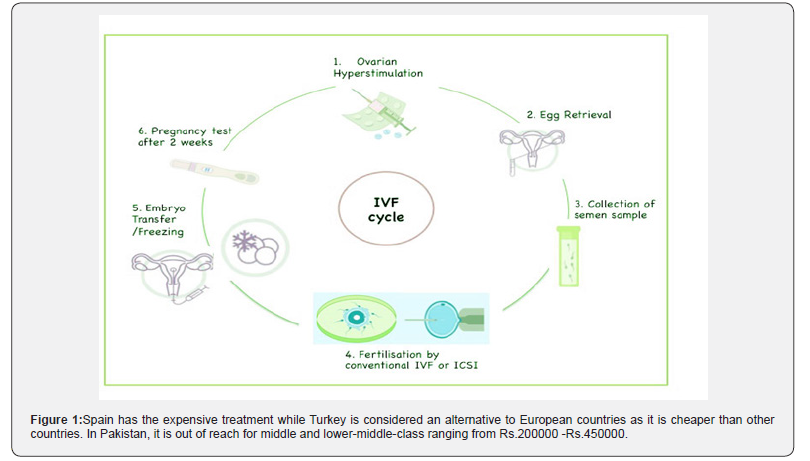
The charges for the basic cycle of Vitro fertilization (IVF) cycle is more than $12,000 but it varies from $15,000 - $10,000 which doesn’t include the cost of medications. Talking about the cost of IVF around the world varies as Greece has as low as 3000- 3500 EUR while the Czech Republic has 30 clinics managed by the Czech Society for Assisted Reproduction. Spain has the expensive treatment while Turkey is considered an alternative to European countries as it is cheaper than other countries. In Pakistan, it is out of reach for middle and lower-middle-class ranging from Rs.200000 -Rs.450000 (Figure 1).
Islamic Perspective
In Islam it is permissible to get infertility treatment with all assisted reproductive technologies, but the source of sperm, ovum and uterus must be from a legally married couple. Surrogacy is not permissible in Islam in fact frozen sperm is not allowed to use after the death of a husband. Quran and Hadiths have emphasized on the institution of marriage and family. Allah says in Quran in surah 16: 72; “And Allah has given you wives of your own kind, and has given you, from your wives, sons and grandsons, and has made provisions of good things for you. Is it then in vanity that they believe and in the grace of Allah that they disbelieve?”
Islam acknowledges that infertility is a significant hardship. The Quran gives the example of two prophets, Abraham and Zacharia, who were barren and described how they longed to have children of their own, even as they grew old and almost despaired of having children. Zacharia pray to his Lord, saying;
“0 my Lord! Grant unto me from You a progeny that is pure, for You are He that hears the Prayers.” The method they used to achieve their goal was to ask God repeatedly and sincerely with humility and faith. Eventually, God answered their prayers. “And the angels gave Abraham glad tidings of a son endowed with knowledge!”
Dr. Zaryab Setna a renowned gynaecologist in Pakistan states that what they practice in their clinic is according to Islam, no third person is involved, and eggs and sperms used for fertilization are from married couples [31,32].
Feminist Perspective
According to feminist researchers’ women are the primary source of IVF treatment as women receive more severe medical treatments which are riskier and prolonged as compared to their partners. According to Franklin, couples seek IVF treatment not only due to biological dysfunction but also to repair a missing societal role i.e parenthood [33].
Simone Bateman defines infertility as a pressure of society on couples to have their own family. It is estimated that the prevalence of infertility varies in the world about 1.5% of the female have primary fertility issues. According to feminist social pressures plays a crucial role in women’s life to fulfil their reproductive desires as these treatments are often psychologically and physically exhausting but they continue painful treatment to have their own child due to societal pressure. IVF is a source of hope to overcome the pain of infertility, as it is physically, emotionally, and financially draining for the couple.
Pakistani Perspective
In Pakistan, the first IVF centre was established in the mid of 1980s since then number of centres has been increased. In Pakistani society having a child is regarded as the only aim of being a woman, they are considered incomplete without a child. Infertility treatments are common in the world, but in Pakistani society, it is taboo to have any fertility treatment. IVF is still not considered a halal treatment in society as people don’t have knowledge about this treatment their concepts are not clear which makes it difficult for the couples seeking fertility treatment. Most of the couples who take IVF treatment do not want to disclose it to society as they are aware of the thoughts of society and they know society will judge them.
According to The Fertility clinic by Setna Dr. Zaryab Setna quoted that the success of IVF varies according to age and other factors i.e there are 41-42 % chances for age less than 35 years, 35% chances for women between 35-37 years, whereas 23-26% between age 38-40 years. According to a report on hospitals in Karachi i.e., the lack of knowledge about infertility explains the societal pressure on infertile couples.
The Agha Khan University report reveals that most of the time the couples face a lack of support from their families and a negative attitude from society led them to think even about suicide. The research concluded that infertility does not only socially isolate them, but the couples also face marital conflict as society pressurizes the newlywed to have immediate pregnancy as it is a common practice in a joint family system. According to another research, a woman is blamed for infertility in Pakistani society despite male infertility rates being higher. The research further stated that IVF is valid in Pakistan but is still not accepted as the permanent solution to fertility by society [34].
Worldwide it is estimated that more than 8 million babies are born through in vitro fertilization (IVF), after the birth of the world’s first IVF baby 40 years ago. The discovery for the treatment of infertility by Robert G. Edwards is considered as the “greatest benefit to mankind”. The discovery of IVF has brought a drastic change in the field of reproductive medicine. About 2-3% of newborns are born through this technology in many countries. Robert G. Edwards was awarded Noble Prize for development in IVF, as the technique has been a source of joy for millions of infertile couples by giving them chance to conceive their own child.
In 2015 Ernst & Young’s report titled Expanding IVF treatment in India stated that nearly 10-15% of married couples are affected by infertility in India. The report further mentions that by the year 2020, couples aged between 30-40 years, are likely to be more affected by infertility.
Many couples seek help through fertility treatments to cope the infertility issues. In 70’s when initially IVF started the success rate was 5-10%, but with the passage of time and advancement of science and technology the success rate has increased now and the success rate per IVF cycle is 60-80%., though success is still not guaranteed, it is a ray of hope for those who have not conceived in years. According to Dr. Shweta Goswami, there is no guarantee of successful IVF for any infertile couple, because the success rate varies from patient to patient, it would be 10% for others or it would be 60%, but still, there is hope for them.
A 34-year-old female cancer patient gave birth to a baby by using a fertility procedure involving the collection, maturing, and freezing of eggs 5 years ago. It was a successful pregnancy by immature eggs that were later frozen and then matured. About 1-3% million births worldwide are the result of IVF in the U.S and Europe. The increased demand for IVF technology has led to research and development of the technology. According to a report (2010), an estimated 48.5 million couples were infertile i.e., 6 million increases since 1990. In 2002 according to Rustein and Shah, more than 186 million married women from developed countries (excluding China) were infertile. According to Dr. Zafar IVF is a treatment for infertility where other assisted reproductive technology fails to cure infertility. It is a hormone controlling ovulation process followed by removing eggs and sperm and then initiating the fertilization process in a fluid medium, later then the fertilized egg is transferred to the mother’s uterus for fetal fullterm development.
Keeping in mind the research topic, the qualitative approach has been used as a research methodology. A method of content analysis was employed as it is a widely used qualitative research technique. The main purpose of this research was to have librarybased research including books and different articles and research from various libraries in Karachi and the main library and seminar libraries of the University of Karachi.
According to World Health Organization (WHO), infertility is stated as a disease of the reproductive system, that fails to achieve pregnancy after regular sexual intercourse. Infertility is a world problem that is growing continuously. According to Lewine, his analysis on extensive meta-regression draws attention to a significant decrease in sperm counts of fertile men from Europe, North America, Australia, and New Zealand.
Infertility knowledge is limited by lots of misconceptions and myths by society. A global survey was conducted, which revealed that many women have no knowledge about fertility treatment, most of the time regardless of seeking fertility treatment couples chose alternative medicines. Infertility treatment is usually a long and exhausting process for a couple and does not always have a happy ending for the couple but is still a ray of hope for the couple. Infertility in Pakistan is approximately 22% with 4% primary and secondary infertility is almost around 18%. Infertility should not be considered only a medical problem as it is also a social issue. Society must accept infertility treatments as a solution so that it can help couples to seek fertility treatment timely.
Medical science has made a remarkable success in the field of ART: IVF which has helped infertile couples to cope with fertility issues and help them to conceive their own child with the treatment. Furthermore, the modification of treatments will probably occur with ongoing use and practice. A typical IVF cycle lasts several weeks and involves many rounds of medication and minor surgical procedures in order to stimulate ovulation, pick up and fertilize gametes, and transfer embryos. Multiple pregnancies are the known complications of IVF as a result of the transfer of multiple embryos. Every couple wants to have a child of their own, ART is not common as people have no clear knowledge about IVF and its cultural and religious perspective is also not clear to the majority which makes it difficult for infertile couples to discuss and have awareness to help themselves with infertility. IVF is still out of reach for many couples as it is a very expensive treatment. Thus, like any other discovery or technology, IVF is a set of challenges and difficulties, but its result and success rate compensate for the challenges as it gives the pleasure of parenthood to millions of people.