Trends in Technical & Scientific Research - Juniper Publishers

Interdisciplinary and multidisciplinary sciences over
the last few decades have become the major booster of science
development. The most important discoveries occur just at the
intersection of sciences and in collaboration of several fields. There
appeared such intermediate fields as mathematical physics, physical
chemistry, biophysics, biochemistry, geophysics, etc. In Astronomy,
Astrophysics has long been the main field, and in present
Archaeoastronomy, Astrochemistry, Astrobiology, Astroinformatics (which
is tightly related to Virtual Observatories) are developing. On the
other hand, in recent years many science areas surfeit of research on
Earth, more and more use data coming from the Space and are being
developed just due to them. It is possible that soon, various science
areas create Space departments or simply develop their research in close
collaboration with astronomers. Interesting discoveries have been made
in studies of astronomical topics in various areas of culture; such
topics are widely used in folklore, other genres of literature,
painting, and architecture. Astronomy has also a leading role in
Scientific Tourism, Scientific Journalism and in general, dissemination
of popular science or public outreach.
Keywords: Interdisciplinary sciences; Multidisciplinary sciences; Transdisciplinary sciences, Astronomy; Astronomy in culture
By studying the features of the current stage of development of astronomy, we have distinguished the current tendencies:
i.
Broader usage of modern astronomical instruments and research methods
(telescopes, various modes of spectroscopy (IFU, MOS, etc.), active and
adaptive optics, digital receivers, software).
ii.
Multiwavelength studies (γ-rays, X-rays, UV, optical, IR, sub-mm, mm,
and radio; using space telescopes, etc.) and Multimessenger studies,
including the development of neutrino, cosmic rays, and gravitational
wave astronomy.
iii.
Results based on large-scale astronomical data processing (Astrostatistics, Virtual Observatories, computer modeling, etc.).
iv.
Large international astronomical projects and large collaborations
(OPTICON, SDSS, ESA Gaia, PanSTARRS, SKA, ESO ELT, LSST, etc.).
v.
The expansion of connection of Astronomy to other science fields (Astro
Particle Physics, Astrochemistry, Astrobiology, close connection with
Optics, Mechanics, Spectroscopy, Atomic and Nuclear Physics,
Informatics, mathematical modeling, and with other spheres of culture).
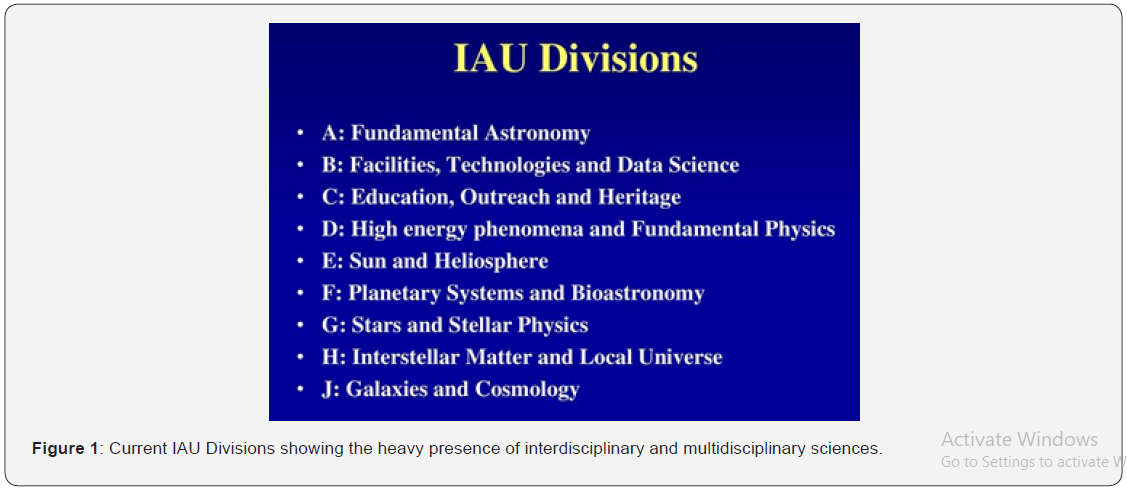
In this article we will discuss the last point in more details. If we
consider the recently revised divisions of the International
Astronomical Union (IAU), we can see that only 4 out of 9 divisions are
dedicated to purely astronomical fields and 4 are devoted to
interdisciplinary and multidisciplinary sciences, or at least their
elements are present (Figure 1): Division B - Equipment, Technology and
Data Sciences (related to Optics, Modern Technologies, Astroinformatics,
and Virtual Observatories); Division C - Education, Public Relations
and Heritage (related to Archaeoastronomy, Astronomy in Culture,
Astronomical Education and Public Outreach); Division D - High Energy
and Fundamental Physics (related to Nuclear and High Energy Physics);
and Division F - Planetary Systems and Biology (related to
Astrobiology).
Such tendencies in astronomy are also evident by a number
of interdisciplinary and multidisciplinary IAU commissions and
working groups, UNESCO’s “Astronomy and World Heritage”
Program, the International Virtual Observatory Alliance (IVOA),
regularly held “Astronomical Data Analysis Software and Systems”
(ADASS) Conferences, Committee of Space Research (COSPAR),
International Council on Monuments and Sites (ICOMOS), the
European Society for Astronomy in Culture (SEAC), International
Science Council (ISC, formerly ICSU), World Data System (WDS),
Information Theories & Applications (ITHEA) organization, the
International Planetary Data Alliance (IPDA) and others. All these
organizations were mainly established in the 2000
Astronomy can really be considered as a leading link between
interdisciplinary and multidisciplinary sciences. The point is
that Astronomy, Astrophysics, Astrochemistry, Astrobiology,
Archaeoastronomy, Theoretical Astrophysics (the use of
Mathematics in Astrophysics), Astrostatistics, Astroinformatics
(closely related to Virtual Observatories) have been developed for
a long time. On the other hand, in the recent years, many fields
of sciences being satisfied with research on the Earth, more and
more use the data obtained from the Universe and are developed
due to them. It is quite possible that soon different sciences will
create Space divisions or simply will develop their research in
close collaboration with astronomers. Interesting discoveries
have been made in the study of astronomical topics in various
fields of culture. Such topics have been widely used in folklore,
other genres of literature, painting and architecture. Astronomy
also plays a leading role in scientific tourism, scientific journalism,
the dissemination of science in general, or the popularization
of science (public outreach), which strengthens the connection
between science and society.
At the International Year of Astronomy, declared by UNESCO
(IYA-2009), the International Astronomical Union developed
a ten-year strategic plan for the development of astronomy,
according to which the emphasis is especially on the development
of close relations between astronomy and other fields of sciences,
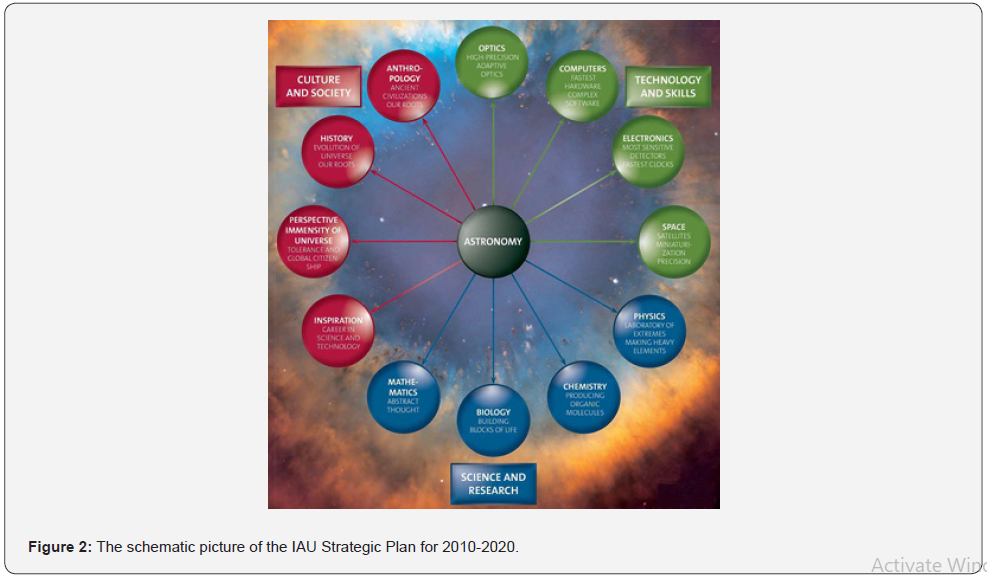
technology and culture. The IAU has declared its Strategic Plan in
2009, according to which Astronomy will play a key role among
all sciences and research, technologies and skills, and cultures
and societies. Figure 2 gives the schematic picture of this plan. In
frame of this, world Office of Astronomy for Development (OAD)
and 11 Regional Offices of Astronomy for Development (ROADs;
one in Armenia) have been founded [1]. Below we give examples
of relation between astronomy and a number of other sciences,
which prove the important role of astronomy in the development
of interdisciplinary and multidisciplinary sciences.
Philosophical categories such as matter, space and time are
directly related to the formation and development of forms of
energy and matter in the Universe. By studying the origin and
development of the Universe in astronomy, we significantly
enrich our philosophical understanding. In Philosophy, a subject
of centuries-long debates and ideological struggles has also been
the discussions on Geocentrism and Heliocentrism and related
to them is the religious notion of Anthropocentrism, which has
been rejected by astronomical facts. However, the Problem of
Extraterrestrial Civilizations (SETI/CETI) has not yet been finally
resolved, although we are closer than ever to discovering other
civilizations.
Though the modern astronomy (particularly the Byurakan
Astrophysical Observatory) is mainly engaged in astrophysical
research, but when we look at the sections of astronomy, we
are convinced that there are many other branches: Astrometry,
Chronology (Calendar and Chronology), Celestial Mechanics,
Galactic Astronomy, Planetary Science, Cosmology and Cosmogony,
Observational and Theoretical Astronomy, Computational
Astronomy, non-optical, neutrino and gravitational wave
Astronomy, etc. However, the connection between astronomy and
physics plays an important role, which is expressed especially in
the fields of Astrophysics, Solar Physics and Astroparticle Physics.
On the other hand, almost all the branches of physics – mechanics,
optics, electromagnetism, atomic and nuclear physics, the theory
of relativity – are used in astronomy and are directly related to
the study of the Universe.
Moreover, at present they are mainly
enriched and developed based on astronomical data, as the
Universe is a huge laboratory, where there are all the conditions
for Physics “experiments”. It is especially worth mentioning the
development of atomic and nuclear physics due to the information
received from the Space, the testing of the theory of relativity by
means of cosmic phenomena. On the other hand, the development
of optics is directly related to astronomy since 1609, from the first
telescope made by Galileo to the largest modern optical devices,
telescopes with 10m and larger in diameter mirrors. It is more
interesting to consider all modern physics on a cosmological scale:
quantum field theory, theories of unification of forces, formation of
elementary particles, nuclear reactions and synthesis of chemical
elements, black holes, etc. All these phenomena and theories can
be “tested” and understood only within the framework of the
“Warm Universe” theory, which is widely used in Cosmology.
Many of the chemical elements were first discovered
in Space
and then discovered or synthesized on Earth. The second most
common element is Helium, originally in 1868, during the Solar
eclipse, was discovered in the spectrum of the Sun by the French
astronomer Jules Janssen and the English astronomer Norman
Locker. It was named after the Sun (Greek “Helios” – Sun). It was
detected only in 1882 on the Earth and obtained a final approval in
1903 at Earth conditions. Chemists and astronomers believe that
other chemical elements can be found in the Universe, as well as
the chemical composition of the Universe we know is still being
revised, which is why Astrochemistry is currently in full swing. A
comparative study of the chemical composition of the Universe
and its individual systems and cosmic bodies sheds light on the
chemical evolution of the Universe. In the above-mentioned “Hot
Universe” cosmological theory, the problem of chemical elements,
from the simplest to the most complex, the problem of synthesis
and changes in their composition plays an important role. Since
1937, numerous molecules have been found in the coldest places in Space,
mainly in interstellar environments, for a total of 189,
including 43 two-atom ones, 41 three-atom ones, 26 four-atom
ones, 19 five-atom, 15 six-atom, 9 seven-atom, 11 eight-atom,
10 nine-atom, and containing ten or more atoms – 15 types of
molecules, which also enrich the modern chemistry.
Many organic compounds and other molecules necessary
for life have been discovered in Space: water, oxygen, carbon,
methane, carbon monoxide ice granules, carbon dioxide,
formaldehyde, crystalline silicates, di- and tri- acetylene (C4H2
և C6H2), complex organic molecules (Polycyclic Aromatic
Hydrocarbons, PAH), which are considered the “building bricks”
of life, etc. The connection between Astronomy and Biology
is very wide: it includes Space Biology (one of the founders of
which is considered to be Norayr Sisakyan) – a science that
studies unusual, unique factors in the Universe: weightlessness,
Earth’s gravity, radiation, ecology of closed systems, the basics of
astronauts training and selection, metabolism of organisms, and
many other questions, the Problem of Extraterrestrial Civilizations
(the study of the possible biological forms of aliens; SETI – Search
for Extraterrestrial Intelligence and CETI – Communication with
Extraterrestrial Intelligence), the Theory of Cosmic Panspermia
(the theory of the possible propagation of life from one planet
to another through comets), Astrobiology (which at large unifies
all listed areas), Alternative Biology (consideration and study of
other than Carbon-Oxygen forms of life), Astrology (in positive
sense; influence of cosmic bodies on biological beings living on
Earth), influence of astronomical phenomena in paleontology
(destruction of dinosaurs by meteorite impact, freezing of the
Earth’s surface due to disruption of Solar activity cycles, etc.). A
detailed review on the Problem of Extraterrestrial Civilizations
and Extrasolar Planets is given in Mickaelian [2].
The reason for the slow development of Geology is the
limitation of the Earth, but in recent years the study of the Moon,
other planets of the Solar System and their satellites has led to
a significant enrichment of Geology. The fields of Lunar Science
and Planetology (Planetary Science) have appeared, including
individual fields of Martian Science, Venus Science and Mercury
Science, which are especially developed. In contrast to the
relatively flat terrain of the Earth, the mountains of Mars reach
a height of 25km, active formations have been found on the
planets and their satellites, in their outer layers there are many
interesting “geological” formations, the study of which enriches
our knowledge. The field of Comparative Planetology has been
created.
Theoretical astronomy (celestial mechanics, astrodynamics)
and theoretical astrophysics (the inner structure of the stars, the
theory of radiative transfer, etc.) are based entirely on the study of
the cosmic bodies and phenomena by mathematical methods. The
most complex equations in mathematics are used in astrophysics.
The study of the large-scale structure of the Universe is based on
Theoretical Cosmology, which is also the mathematical apparatus
of the General Theory of Relativity. Inverse Problems, Integral
Equations, Mathematical Modeling, Astrostatistics the Theory
of Errors are widely used and developed in astronomy. Due to
the huge amount of data accumulated, the role of statistics in
astronomy is so great that conferences on “Statistical Problems in
Modern Astronomy” and other similar topics are regularly held.
One of the most widely used applications of the Computer
Science is Astronomy, which is associated with a vast amount of
information in it. At present, this branch is called Astroinformatics,
which includes mathematical modeling, Astrostatistics, work with
large repositories and databases, Computational Astronomy,
Virtual Observatories, etc. Numerous astronomical software
and systems have been developed, in particular the All-Sky
Virtual Observatory (ASVO). The development of astronomy
is particularly facilitated using modern methods in astronomy
education, including in the form of computer games, public
professional astronomical programs. Regular conferences are
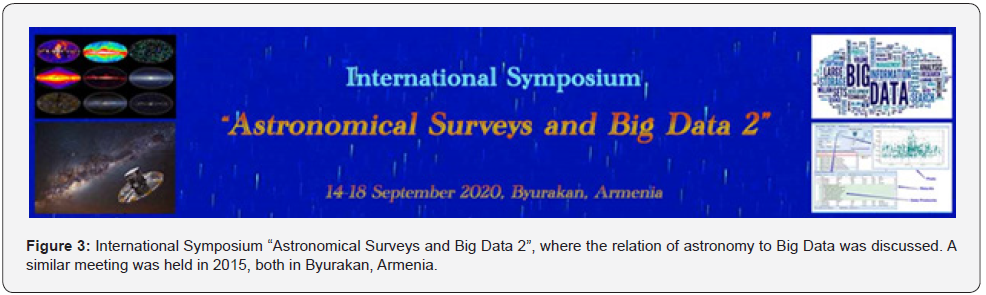
held on “Astroinformatics”, “Big Data in Astronomy”, “Astronomical
Data Analysis Software and Systems”. We give in Figure 3 a
schematic view of Big Data in Astronomy. Detailed reviews on Big
data in Astronomy and Computational Astrophysics are given in
Mickaelian [3] and Mickaelian & Astsatryan [4].
The role of celestial mechanics in Space flights and
Astronautics is invaluable. The study of the motions of celestial
bodies led first to the development of the most classical branch of
physics, mechanics, and later to the possibility of controlling the
motions of artificial bodies in the near Space, including the launch
of many terrestrial artificial satellites, as well as the Astronautics.
Moreover, the advantages of astronomy as a super-accurate
science are revealed here: the movements of both celestial bodies
and artificial satellites and other spacecrafts are calculated with an
accuracy of seconds and centimeters. On the other hand, as in the
Middle Ages, sailors, and now astronauts use the positions of the
stars for navigation. This field is called Astronavigation. With the
development of astronautics, reciprocally astronomy progressed
rapidly, as most of the electromagnetic waves emitted by space
bodies due to the influence of the atmosphere do not reach the
Earth’s surface. Extra atmospheric or space observatories gave
rise to IR, UV, and X-ray astronomy, which greatly expanded our
understanding of the Universe. Moreover, even in the optical
range, Space Astronomy made significant progress (the example
of Hubble Space Telescope is the most characteristic), as both
the sensitivity and spatial resolution of the observations were
significantly improved.
In astronomy, the so-called Astroclimate plays an important
role in choosing the location of observatories. It is the same climate
that is familiar to all meteorologists, but also considering the
statistical number of cloudless nights during the year, the degree
of atmospheric turbulence, the quality of astronomical images, and
a number of other factors that affect astronomical observations.
On the other hand, the field of Space Climate is currently
developing, which includes the influence of space phenomena and
conditions on the Earth and its atmosphere, which is particularly
due to the activity of the Sun and the Earth’s magnetosphere.
Some manifestations of solar activity, such as solar flares and
protuberances, dramatically alter the Earth’s magnetic field,
causing geomagnetic storms that have a serious impact on power
plants and all types of communications. Life-threatening ozone
holes can also be caused by such influences. Cosmic particles also
play an important role, including that from the point of view of
the safety of spacecrafts and other space devices. Finally, global
warming is also closely linked to Solar activity.
Ancient astronomy or archaeoastronomy (not to be confused
with the history of astronomy) studies the manifestations of
astronomical knowledge by ancient civilizations, the discovery
of historical events through records of astronomical phenomena.
These include the ancient observatories, calendars, astronomical
rock art, naming of constellations, historical records of astronomical
events, Medieval sky maps and astronomical instruments, other
items of ancient astronomy and manifestations of the astronomical
heritage. There are international organizations related to
Archaeoastronomy (IAU commissions and working groups,
UNESCO “Astronomy and World Heritage”, International Society for
Archaeoastronomy and Astronomy in Culture (ISAAC), SEAC, etc.),
international meetings are held on this subject and international
journals are published also related to Archaeoastronomy (Journal
for the History of Astronomy, Mediterranean Archaeology and
Archaeometry, Archaeoastronomy, Culture and Cosmos, Journal of
Astronomical History and Heritage).
Almost in all spheres of culture, such as mythology and
religion, folklore, poetry, fine art, architecture, linguistics,
symbolism, etc., the influence of celestial phenomena and
astronomical understanding have penetrated to one degree or
another. Very important is the factor of inspiration by the starry
sky, which is a source of many creations, eventually leading to the
many manifestations of the celestial bodies and phenomena in art
and other spheres of culture. Again, calendars play a significant
role in culture and all they are based on astronomical knowledge.
Religions and Mythology are tightly related to astronomical
knowledge as well. Other manifestations of astronomy in culture
are Ethnoastronomy; astronomy in Folklore and Poetry; astronomy
in Arts; astronomy in Fashion, Astrolinguistics, Astroheraldry, and
Astrosymbolism; Astronomical Observatories as Astronomical
Heritage; Astro Tourism and Astronomical Outreach. Figure
4 shows the logo of the meeting “Cultural Astronomy” held in
2016 in Armenia. The two last fields (Archaeostronomy and
Astronomy in Culture, AAC) are very closely related and very
often they collaborate having joint organizations, holding joint
meetings and publishing joint journals. The IAU Working Group
Archaeostronomy and Astronomy in Culture (WGAAC) unifies
these disciplines as well.
Astronomical observatories are among the most
attractive
places for scientific tourism, many observatories in the world
have thousands of visitors, which contributes to their recognition,
scientific rating, and material benefits. Scientific tourism can be
a serious addition to historical and cultural tourism, particularly
in Armenia. We have developed a webpage on Astro Tourism for
the South West and Central Asia region (http://astrotourism.aras.
am/), which can be extended to other regions as well. In scientific
journalism, according to world statistics, 50-90% of the topics
in different countries are related to the Universe in one way or
another: Astronomy, Space Flight, aliens, Archaeostronomy,
Astrology, etc. That is why astronomy has a responsible role in the
development of scientific journalism. The role of astronomy in the
popularization of science is more obvious, as it is by far the most
attractive science. The IAU also attaches great importance to this,
having recently established the Commission #55 “Communication
of Astronomy with the Public”. A journal with the same name is
published. IAU runs a large-scale astronomy education program,
which includes not only school and university astronomy, but
also a policy of providing astronomical knowledge to the general
population in all age groups.
In recent years, the Byurakan Astrophysical Observatory
and the Armenian Astronomical Society, has taken serious
steps to strengthen the connection between astronomy and
other sciences and culture. The first steps were the historicalastronomical
works of Benik Tumanian, Haik Badalian, Elma
Parsamian, Paris Herouni, Grigor Brutean and Karen Tokhatyan
(history of Armenian astronomy, calendar, ancient observatories,
rock art or petroglyphs). Grigor Gurzadian and Hrant Tovmasian
made significant contribution in the field of Space Astronomy. In
2002-2007, Areg Mickaelian digitized the Markarian (the First
Byurakan) Survey (FBS, digitized version: DFBS), based on which
the Armenian Virtual Observatory [5] was created, the joint result
by astronomers and computer specialists. Among the works
of Ararat Yeghikian can be distinguished the studies related to
Astrochemistry and Astrobiology.
However, a significant step forward was the International
Year of Astronomy (IYA-2009) declared by UNESCO, when several
international programs were launched to strengthen the cultural
connection between astronomy and other sciences. IYA-2009
activities in Armenia were quite wide and multifaceted. ArAS
2009 annual conference on “Astronomy and Society” was held,
where the issues of archaeoastronomy, astrobiology, astronomical
education, amateur astronomy, astronomy and society were
discussed. An archaeoastronomical seminar and conference were
organized in 2011 և 2012. Three major events in 2014 [6], 2016
[7] and 2017 [8] were devoted to the Astronomical Heritage
and related topics. A detailed review on Armenian activities on
AAC is given in Mickaelian & Farmanyan [9]. In 2010, the group
of scientific journalists from Armenia was established by ArAS.
The issues of scientific tourism have been discussed since 2009.
With such developments, astronomy can really become a leader
in the connection between interdisciplinary and multidisciplinary
sciences and science and culture.
The importance of astronomy is reinforced with its practical
usage by society. First, it is significant for the formation of
person’s worldview, especially for the young people. Calendars
and Chronology based on astronomical knowledge or the use of
astronomical information, Time service, Orientation և Location/
positioning, Earth և space navigation, optical devices, photography,
Celestial Mechanics, Astronautics, further development of Physics
and almost all other sciences based on information from Space have
played an important role for the development of human society,
development of Information Technologies (digital technology,
computing methods and the Internet) and many other fields.
Computed tomography (CT) and Magnetic Resonance Imaging
(MRI) are the excellent examples of the astronomy achievements
advancement in other areas.
A vivid example of the practical significance of astronomy
is the use of nuclear energy, which became possible based on
astronomical research conducted in the 1930s. In trying to explain
the sources of Solar energy, trying to apply all the known forms of
energy at the time, scientists were at a dead end, as thousands,
millions of times more energy was required than mechanical,
thermal, or chemical energy. Finally, Hans Bethe discovered nuclear
reactions that release enormous amounts of energy, describing
with great precision the processes going on in the Sun’s nucleus,
the synthesis of 1 nucleus of helium from 4 nuclei of hydrogen.
This theory was further developed by Robert Oppenheimer and
others, and was later used to build atomic bombs, nuclear power
plants, nuclear submarines, and other equipment. Currently, most
of Armenia’s electricity comes from the Armenian Nuclear Power
Plant.
The development of astronomy has been closely related to the
development of technology. It was displayed at the measurements
and calculations, angle calculating tools, optical devices,
photography, photometry, spectroscopy, spectrophotometry,
polarimetry, interferometry, adaptive optics, computers, IT sector,
digital technology, processing systems, Internet development,
e-Science and other fields. All the mentioned fields have both
developed astronomy and they themselves have been developed
due to the requirements set by astronomy. It is especially evident,
the role of astronomy in the creation and development of optical
devices, and now it is in the field of IT, because the large flow
of information coming from space makes special demands and
implies new approaches, in particular, computer clusters grid
systems are mainly used by professionals of nuclear physics and
astronomers. It can be said that astronomy has been and remains
at the front of technology development and perhaps only the
military industry with its demands and its role in the development
of technology can be compared with astronomy.
The role of astronomy in the development of physical sciences,
as well as other natural sciences is becoming more and more
important due to the use of the vast amount of information coming
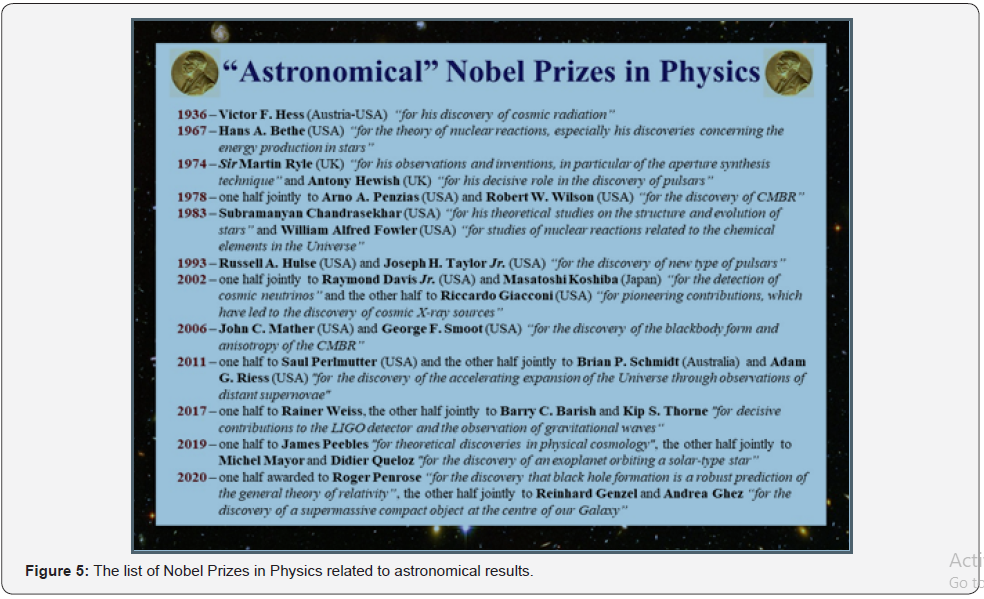
from the Universe. We would like to mention that the Nobel Prizes
are obvious indicator of the increase of the role of Astronomy
during the recent years. Several the astronomers or physicists
working on astronomical problems have received Nobel Prizes in
Physics, which has started in 1901. During the first 100 years, only
6 such teams have been awarded Nobel Prizes. And during 2001-
2020, only 20 years, 6 more “astronomical” teams have also been
awarded Nobel Prizes in Physics, including the last two, in 2019
and 2020. We give in Figure 5 the list of “astronomical” Nobel
Prizes in Physics.
We have described and analyzed the relation of Astronomy to
other (mainly natural) sciences, and we have shown the leading
role of Astronomy in the creation of many new inter- and multidisciplinary
areas. One can regard several developments of both
individual fields of natural sciences, which is already gradually
happening and the development of science in general:
a) Establishment and further development of
interdisciplinary sciences between individual science disciplines
and Astronomy (like Astrophysics, Astrochemistry, Astrobiology,
Planetology, etc.)
b) The development of multidisciplinary and
transdisciplinary sciences based on involvement of many science
disciplines, including Space-based knowledge.
c) Development of Space sciences related to individual
science disciplines, such as Communications, Mapping,
Meteorology, Remote Sensing, Space Astronomy, Space Biology
and Medicine, etc. At present, in fact all explorations, when
possible, move to Space and benefit from its possibilities.
d) Further development of Big Data science and computer
technologies based on new data coming from the Space and being
used for various science fields. Development of e-Science like the
creation of Virtual Observatories (VOs) in Astronomy
e) Integration of the scientific data and all information to
combined and homogeneous databases, like CODATA and WDS
(World Data System) created by the International Science Council
(ISC).
To Know more about Trends in Technical & Scientific Research
Click here: https://juniperpublishers.com/index.php